
.avif)
5 Online CE Courses for Nurses

A renewal deadline is approaching, and a nurse is comparing three very different options: a state-required law course, an employer-requested safety topic, and a flexible elective that could strengthen patient care. The course title alone won't identify the right choice. The decision depends on accreditation, state-board mapping, delivery format, pricing transparency, and proof of completion.
Online CE courses for nurses became a practical option well before remote learning became routine. A 2016 nursing alumni study found that 83.9% of respondents had taken continuing education online, while 75.9% preferred online delivery over face-to-face formats.
1. Florida Impairment in the Workplace for Nurses
A nurse who notices a colleague arriving disoriented, making unusual medication errors, or showing a sudden decline in reliability needs more than general awareness. The Impairment in the Workplace for Nurses course from Premiere Education addresses recognition, treatment pathways, and Florida's legal reporting requirements in a topic that connects directly to patient safety.
This is a strong candidate when Florida renewal planning includes a required impairment-related topic, or when a clinical manager wants staff to understand how to respond without turning suspicion into accusation. The practical value lies in separating observable behavior from diagnosis. A nurse may document specific changes in practice, follow workplace procedures, and escalate through the correct channel rather than confront a colleague impulsively or ignore a risk.

Why the topic fits clinical decisions
Impairment can involve mental or behavioral health concerns, substance use, fatigue, or another condition that affects safe practice. The course's mental-and-behavioral-health and infection-control-and-safety categories make it more relevant to risk management than a broad professional development elective.
A practical scenario illustrates the difference. If a nurse repeatedly leaves documentation incomplete and appears unable to follow a medication verification process, the useful learning outcome isn't just identifying “impairment.” It's knowing what observations belong in a report, what support or treatment pathway may apply, and which legal duties govern reporting in Florida.
Practical rule: A course about impairment should help a nurse act safely and lawfully, not encourage informal investigation.
What to verify before enrolling
The product page is a first-party listing, which simplifies confirmation of the course title, delivery details, and completion process. Learners should still verify the number of contact hours, applicable accreditation statement, Florida acceptance, assessment requirements, and certificate fields before purchase. Florida nurses can also compare the course against Florida nursing CE requirements before adding it to a renewal plan.
The trade-off is focus. This course may be highly useful for a Florida nurse who needs the topic or works in a setting with safety concerns, but it won't replace specialty education in areas such as wound care, cardiac nursing, or dementia care. It works best as a compliance and workplace-response course, especially when the learner needs documentation tied to a Florida-specific obligation.
2. Florida Rule and Law for Nurses
Florida Rule and Law for Nurses addresses the legal and ethical framework that shapes nursing practice. It may suit a Florida nurse who needs education on jurisprudence, professional boundaries, scope of practice, or regulatory responsibilities rather than a clinical specialty.
Review the Premiere Education course page for the current course title, provider information, contact hours, delivery format, and completion requirements. For a more detailed check, review the Florida Rule and Law for Nurses course details on Premiere Education to verify current contact hours and Florida board mapping before enrolling. A course description that mentions “ethics” or “jurisprudence” does not, by itself, confirm that the course meets a specific state requirement.
A better fit for mandate-driven renewal
Texas illustrates why state mapping matters. Texas permits a nurse to meet continuing competency through 20 contact hours in the current area of practice, or through achieving, maintaining, or renewing an approved national nursing certification. The state also requires two contact hours in nursing jurisprudence and ethics before the end of every third licensure renewal cycle (Texas Board of Nursing guidance).
Those Texas requirements do not establish Florida's rules. They do show why nurses should match each course to the correct board, license, and renewal period. This check matters particularly for nurses working across states, applying for endorsement, or maintaining more than one credential.
A certificate proves completion. It does not automatically prove that the course satisfies every license requirement.
The practical trade-off
The course's ethics focus connects regulatory content to decisions made during a shift. A charge nurse deciding whether a task can be delegated, a nurse documenting a patient refusal, or an RN responding to a confidentiality concern all need to understand the applicable duty, documentation, and escalation path.
The limitation is that law courses can feel abstract without workplace examples. Before enrolling, confirm Florida board mapping, the accreditation statement, assessment or completion steps, and the certificate fields. The record should identify the provider, nurse, course title, contact hours, award date, and accreditation information. Louisiana board guidance identifies these certificate elements and emphasizes retaining proof of completion (Louisiana State Board of Nursing continuing education FAQs). Applying the same documentation practice helps Florida learners maintain a clear renewal file.
For a nurse seeking Florida-specific compliance education, this course is more targeted than a general ethics elective. Its online format may also fit shift work, provided the learner can complete any required assessment and save the certificate. Nurses pursuing clinical skill development should pair it with practice-focused education rather than use it as a substitute.
3. California Responsible Beverage Service Training
A California nurse who also advises a wellness business or supports events with alcohol may face responsibilities outside ordinary patient care. Responsible Beverage Service Training addresses that workplace need, but it should not be selected as general nursing CE without checking the intended credential and approval route.
The California Responsible Beverage Service Training course from Premiere Education covers laws, risks, and responsibilities linked to alcohol service. Learners practice recognizing warning signs and making responsible-service decisions. Those skills may apply in hospitality, event, residential, or healthcare-adjacent settings where alcohol access can create safety concerns.

When a nurse should consider it
The course fits a specific role rather than a routine license-renewal plan. A nurse practitioner who operates or advises a wellness business, a healthcare worker involved with an event venue, or an organization combining healthcare and hospitality training may need responsible-beverage education for workplace duties.
Consider a nurse serving as a health and safety lead at a California event venue. The role may involve identifying over-service, understanding when service should be refused, and documenting an incident. Those decisions differ from assessing alcohol withdrawal in a patient, so the learner should identify the actual employer or credential requirement before enrolling.
The course category, alcohol-service-and-delivery, makes its intended use clear. That distinction helps prevent a workplace certification from being mistaken for nursing contact hours.
Verify the credential before counting it
First determine whether the goal is a California responsible beverage service credential, nursing contact hours, or both. The Premiere Education article about RBS training provides context about RBS training. The learner must still confirm the current authority, employer requirement, completion record, and any renewal implications.
ANCC certification renewal requires specialty-aligned contact hours. Verify whether a non-nursing credential can count toward the specific certification before enrolling. The course should not be counted toward nursing renewal unless the relevant board, credentialing body, or employer confirms that it qualifies.
Its value is therefore situational. It can support a California professional whose duties involve alcohol service, especially when the online format suits shift work and the learner can save proof of completion. It does not replace nursing-specific CE just because it is flexible or easy to complete.
4. Fundamentals of Alzheimer's Disease for Healthcare Providers
A nurse caring for an older adult with memory loss needs more than a label for the condition. Fundamentals of Alzheimer's Disease for Healthcare Providers provides a broad foundation in risk factors, diagnosis, treatment, and evidence-based approaches to patient support.
The Premiere Education course is best viewed as an elective or specialty-aligned learning choice unless a particular employer, board, or credential requires Alzheimer's education. It can fit nurses in long-term care, home health, geriatrics, neurology, primary care, emergency nursing, and behavioral health.

Where the learning can change care
A practical example starts with a patient who becomes distressed during bathing and cannot explain why. A nurse with stronger dementia education may consider communication style, environmental triggers, pain, fear, or an unmet need before treating the behavior as simple noncompliance. That shift can affect assessment, family communication, safety planning, and the patient's dignity.
The course also makes sense for nurses who want a specialty-aligned pathway for certification renewal. A cardiology-certified nurse, for example, should prioritize education directly related to the certification role when using CE for ANCC renewal. A dementia course may support broader professional development, but it shouldn't be assumed to satisfy specialty-linked requirements without checking the credential rules.
Format matters for retention
Online delivery works well for shift-based nurses when the course allows pausing, resuming, and reviewing difficult material. Course management matters as much as subject matter. In a cross-sectional study of 125 nursing students, overall satisfaction with online learning was 41.8%, while 36.8% were satisfied or strongly satisfied with online classes. Course management and coordination were the strongest predictors of satisfaction (cross-sectional nursing education study).
That finding supports a practical selection test. A nurse finishing a night shift should be able to locate the next lesson, see progress, return to a case, and retrieve the certificate without friction. A visually attractive module with confusing navigation may produce less usable learning than a simpler course with reliable pacing and tracking.
The main trade-off is breadth. This course can strengthen foundational dementia care, but a nurse seeking advanced behavioral management, medication-specific learning, or a tightly defined state mandate may need a more specialized option. Before enrollment, the learner should confirm contact hours, accreditation, board acceptance, assessment requirements, and how the certificate will be stored.
5. Human Trafficking for Healthcare Providers An Analysis of Cases
Human trafficking education has a direct connection to clinical observation because healthcare encounters may expose injuries, fear, inconsistent histories, restricted communication, or controlling companions. Human Trafficking for Healthcare Providers An Analysis of Cases uses recognition, referral, and compassionate care as the practical center of the learning experience.
The Premiere Education course is categorized as popular, with tags for violence-and-abuse prevention and infection-control-and-safety. Those categories make it relevant to nurses who work in emergency departments, urgent care, obstetrics, pediatrics, behavioral health, community health, and other settings where vulnerable patients may present without a clear explanation of their circumstances.

Case analysis is more useful than recognition alone
Recognition is only the first step. A nurse may notice that a patient avoids eye contact, cannot speak privately, or appears coached by another person. The next decisions involve creating a safe opportunity to assess the patient, avoiding language that increases danger, following institutional policy, documenting objectively, and connecting the patient with appropriate resources.
A case-based course is valuable because those decisions rarely arrive as a clean checklist. The nurse must weigh privacy, immediate safety, mandatory reporting duties, cultural sensitivity, and the risk of escalating a situation before the patient has support. The course should be evaluated on whether it gives learners a defensible response process rather than a collection of warning signs.
The strongest trafficking education changes how a nurse conducts the next private conversation, not just what the nurse can name on a slide.
Compliance value versus clinical value
Some employers or state systems may require human trafficking training, while other nurses will take it as an elective. The learner should identify which category applies before counting the course toward renewal. A state-specific mandate may require a defined provider, subject, format, or reporting process, and a broad healthcare course may not satisfy all of those conditions.
Recordkeeping deserves equal attention. The certificate should identify the learner, provider, course, award date, contact hours, and accreditation statement. If the provider reports to an agency such as CE Broker, the learner should verify that the report succeeded. CE Broker guidance explains that automatic reporting depends on matching license information in the learner account and CE Broker, and that differences in the name, license prefix, or number format can prevent correct reporting (CE Broker automatic reporting guidance).
This course is a strong elective for patient-safety practice and may support a workplace mandate. It shouldn't be purchased on topic relevance alone. The decisive checks are state acceptance, accreditation, reporting, certificate access, and whether the case format fits the learner's clinical setting.
5-Course Comparison: Online CE for Nurses
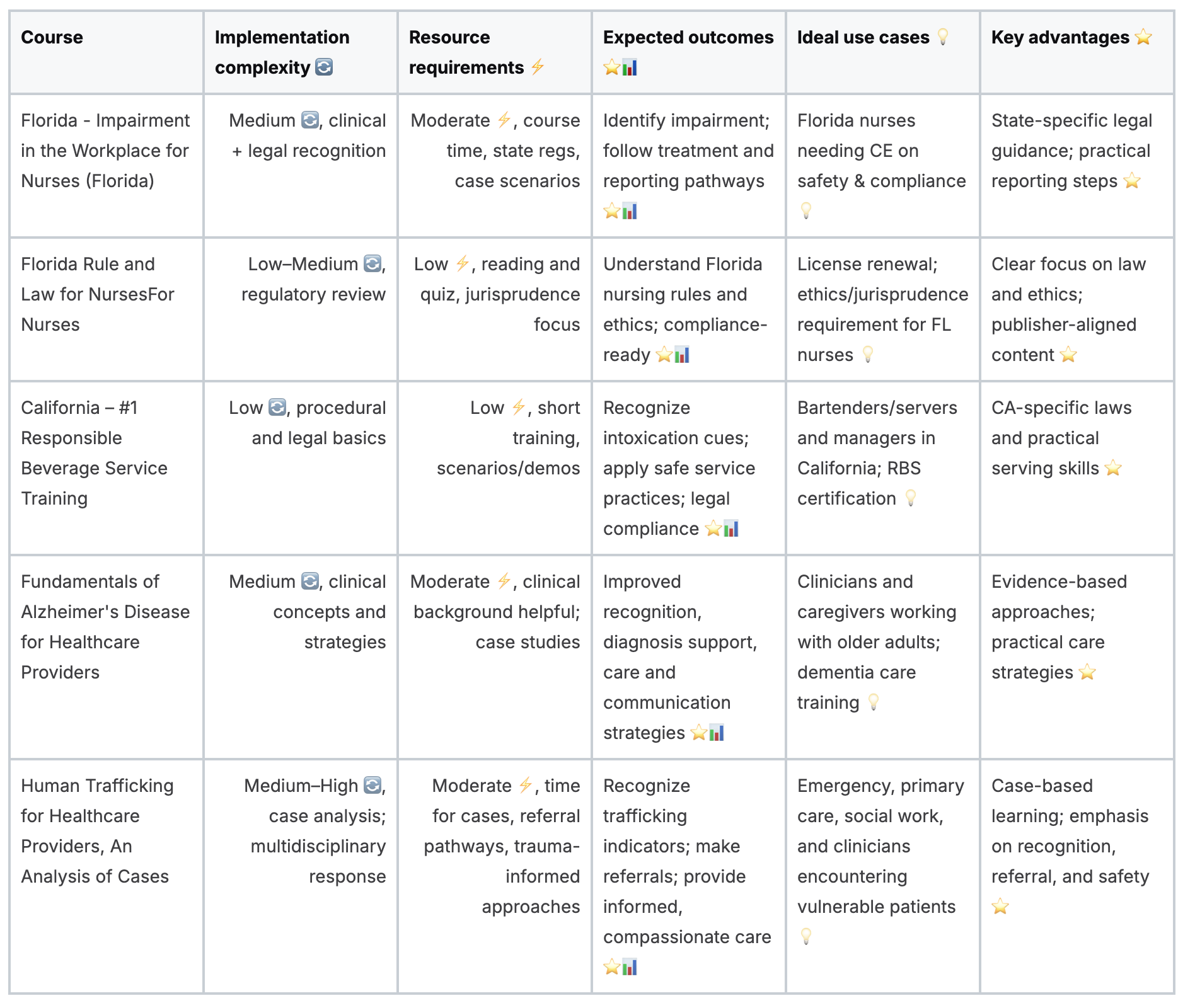
Verify Before You Add CE to Your Record
The best online CE courses for nurses solve a defined problem. A Florida nurse may need a rule-and-law course for a state obligation, an impairment course for workplace safety, or an Alzheimer's course to build practice-specific knowledge. A California professional working in an alcohol-service environment may need responsible beverage training, while a nurse in emergency or community care may choose human trafficking education for stronger recognition and referral skills.
Before enrollment, the learner should verify five details:
- Match the license and renewal period: Confirm the state, license type, specialty, renewal date, and exact subject requirement with the applicable board.
- Confirm acceptance: Check whether the course carries ANCC approval or another accreditation accepted by the relevant board or credentialing body. ANCC's renewal rules require specialty alignment, so a course must fit the certification role when it is being used for that purpose (ANCC renewal requirements).
- Separate mandatory and elective learning: A course can be clinically useful without satisfying a mandate. Treat state-specific law, ethics, impairment, and trafficking requirements as distinct from general professional development.
- Review format and total pricing: Check whether the course is self-paced, whether progress can be paused and resumed, whether an assessment is required, and whether individual access, membership, or organizational purchasing offers the clearest value. Premiere Education provides individual courses, membership plans, and group tools for assigning and tracking staff education.
- Save the record: Download the certificate, retain the completion details, and confirm any agency-reporting status. If reporting depends on CE Broker, verify that the learner's name and license information match exactly.
A nurse completing occasional electives may prefer individual access and direct certificate storage. A practice manager assigning recurring education to a team may need centralized enrollment, progress dashboards, completion monitoring, and exportable records. The right purchasing model depends on whether the priority is one renewal deadline or an ongoing education program.
Requirements and course details can change. Learners should confirm current board guidance, accreditation, reporting rules, contact hours, and pricing with both the regulator and provider before purchase.
Premiere Education offers state-specific nursing CE, specialty-focused healthcare courses, memberships, certifications, and documentation tools for individuals and organizations. Nurses comparing online CE courses for nurses can review the catalog, confirm course mappings, and choose flexible learning or group tracking through Premiere Education.
Latest Posts





25% off Sitewide→
Use Code: PCECYBERSALE2025→