

Racial Disparities in Healthcare Statistics

Black Americans faced an age-adjusted death rate about 23% higher than the national rate in provisional 2023 figures from the Centers for Disease Control and Prevention. That comparison changes how a clinician or school administrator should read a reassuring national headline. An improving average doesn't establish that every community is receiving equitable care.
Reading racial disparities in healthcare statistics means separating several questions: who is included, whether people can reach care, and what happens after they arrive. A useful review starts with the population rate, then follows the decisions that staff can examine and change.
Current U.S. Numbers at a Glance
The CDC's provisional mortality figures describe all-cause mortality, which captures deaths from any cause rather than from one condition. The rates reflect the combined effects of chronic illness, infection, injury, healthcare access, care quality, and social conditions.
Age adjustment helps compare populations with different age distributions. It leaves other differences, such as income, neighborhood conditions, treatment, and exposure to discrimination, in view. The resulting rate supports population comparisons; it does not forecast an individual patient's outcome.
U.S. mortality and maternal death rates by race
The all-cause figures below come from the CDC provisional mortality report identified above. Maternal figures come from the CDC National Center for Health Statistics maternal mortality report, which reported 649 maternal deaths and an overall rate of 17.9 per 100,000 live births in 2024.

The CDC provisional mortality report recorded a 6.0% decline in the national age-adjusted death rate from 2022 to 2023. Black residents nevertheless continued to have the highest rate among the major groups measured. A national rate can improve while a subgroup's rate remains higher.
The CDC maternal report defines a maternal death as one occurring during pregnancy or within 42 days after pregnancy ends, from a cause related to or aggravated by pregnancy or its management. Accidental and incidental causes are excluded. This definition helps staff decide which cases belong in a maternal mortality review.
What an overall average can conceal
A hospital quality committee reviewing an overall maternal outcome measure may find that it meets the committee's benchmark. To see whether that result holds across groups, members can examine the same measure by race and ethnicity alongside the underlying case counts.
Practical reading: An acceptable overall result can coexist with an unacceptable subgroup result.
National figures identify a reason to investigate, but they do not establish why patients at a particular hospital experienced complications. Staff need local records, reliable demographic information, and a review of the care delivered to identify which process needs attention.
How to Read a Disparity Statistic
Race functions as a social category for identifying inequity. It does not explain disease biologically. The AHRQ race and ethnicity data toolkit explains that racial, ethnic, and language disparities can persist after adjustment for education, income, insurance, access, and health status.

Different summaries answer different questions
A prevalence ratio compares how common an existing condition or outcome is between groups. A risk or rate ratio makes a relative comparison for the measure being studied. A risk difference shows the absolute difference in outcome probability; a rate difference subtracts rates expressed in the same units.
These summaries are like different views of the same chart. Relative measures show how groups compare proportionally, while absolute measures show the size of the gap in the stated units. An adjusted estimate shows what difference remains after specified characteristics are accounted for statistically. Adjustment cannot account for influences that were not measured, and a relative comparison alone does not show the absolute burden.
Measurement choices shape who appears in the comparison. Some datasets separate non-Hispanic racial groups and Hispanic ethnicity; others include Hispanic people within racial categories. Small samples can lead analysts to combine or omit multiracial, Native Hawaiian and Pacific Islander, or American Indian and Alaska Native populations.
A clinic that combined multiracial patients into an “other” category later separated them and found a screening gap. The newly visible difference does not, by itself, show that care recently deteriorated. It may reflect a change in how the clinic measured and grouped patients.
A checklist before leadership receives the chart
- Self-identification: Confirm how patients supplied race and ethnicity information.
- Sample size: Show the denominator and uncertainty, while protecting confidentiality.
- Language and missingness: Record preferred language and identify incomplete demographic fields.
- Disaggregation: Explain which populations were combined, omitted, or reported separately.
- Traceability: Record the data year, group definitions, and source table or file beside each figure.
Useful reference documents include CDC National Center for Health Statistics provisional mortality files, CDC maternal mortality reports, and AHRQ's National Healthcare Quality and Disparities Report. A quality lead should preserve each measure's exact definition so that group labels do not change unnoticed.
The accompanying video offers another format for staff discussion.
Access Gaps Versus Gaps After Arrival
An access gap occurs before a patient receives the needed service. A care-delivery gap concerns what happens during assessment, treatment, follow-up, or escalation. Combining them into a single explanation makes it harder to select an effective response.
According to KFF's overview of race, inequality, and health, nonelderly American Indian and Alaska Native, Hispanic, Black, and Native Hawaiian and Pacific Islander people were more likely than White people to be uninsured in 2022. KFF also describes greater difficulty obtaining a usual provider and more cost-related skipped care among adults in these populations.
The spending trap
Consider patients referred for the same specialist evaluation. A patient who can't afford the appointment may generate little spending because the evaluation never happens. Another patient may eventually require an admission after delayed treatment, generating substantial spending.
Neither spending total establishes care quality. Lower spending can reflect unmet need; higher spending can reflect a preventable crisis. Equal visit counts also say little about whether patients received appropriate testing, understandable instructions, or completed follow-up.
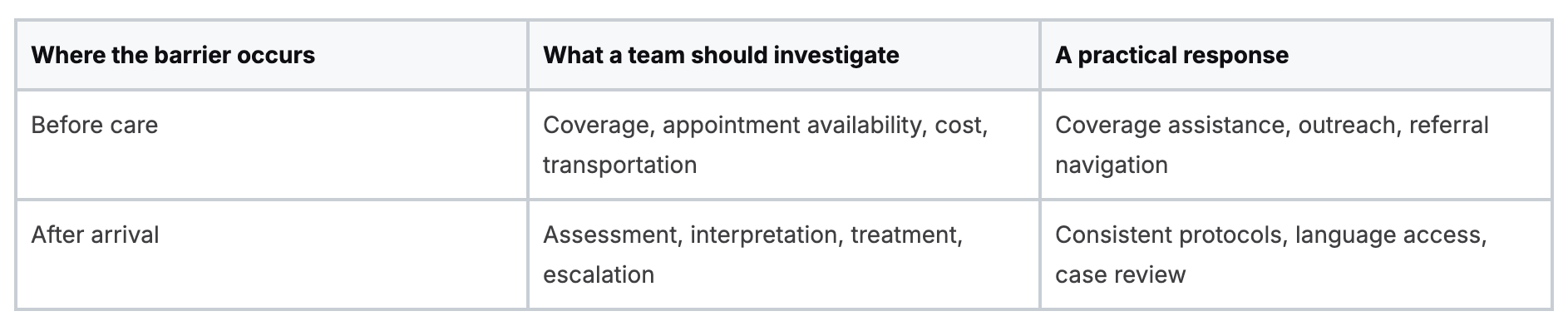
National racial categories also contain different local experiences. A rural clinic, an urban health center, immigrant families, U.S.-born patients, and distinct Asian communities shouldn't automatically receive the same intervention.
A compliance lead can pair local access mapping with professional learning on closing gaps in social determinants of health. The operational question remains specific: does the patient need help reaching the service, or does the organization need to change what happens once the patient arrives? A cultural-competency lecture alone can't resolve both problems.
Where Care Quality Falls Short
Black patients received worse care than White patients on 85 of 190 measures in AHRQ's comparative healthcare quality and disparities reporting, compared with better care on 19 measures and no statistically meaningful difference on 86. The same AHRQ reporting found worse care on 73 of 190 measures for Hispanic patients and 47 of 110 measures for American Indian and Alaska Native patients.
These measures span effectiveness, access, timeliness, patient safety, and preventive care. The comparison describes how measures are distributed across groups, not how many individual patients received poor care. A national rate is a starting point: the pattern can look different by subgroup, measure, or clinic.

From a screening target to a process review
A primary-care network can meet its overall cancer-screening target while one clinic lags. When its quality lead separates completion rates by race, ethnicity, preferred language, and clinic location, a subgroup may show fewer completed screenings despite similar documented eligibility.
That gap gives the team a place to investigate. Review each step: Was screening offered? Was an order placed? Did scheduling reach the patient? Were results and follow-up completed? This traces where the process faltered without assuming the patient was noncompliant.
Useful dashboard fields include:
- Population definition: Race and ethnicity categories, eligibility criteria, and clinical condition.
- Interpretation safeguards: Sample size, missing information, and uncertainty.
- Operational context: Payer, geography, clinic, and language needs.
Together, these fields can show whether a pattern spans the network or is concentrated in one workflow. A favorable network average may mask a clinic that needs support.
Match the mechanism to a control
The National Academies has identified provider bias or prejudice, greater clinical uncertainty in encounters with minority patients, and stereotypes about behavior or health as mechanisms of unequal care. Teams can address these mechanisms through specific controls.
Standardized clinical protocols can prompt the same evidence-based assessment for comparable presentations. If a clinician departs from the pathway, the record should include an individualized clinical reason.
Structured risk assessment and language access help staff gather relevant information before resolving uncertainty. A qualified interpreter supports clear communication. A nod or short answer alone may not show that a patient understood.
Bias-aware communication practice can help staff examine how they respond to pain reports, questions, or hesitation. In a case exercise, learners can separate the patient's documented statements from assumptions about motivation.
A disparity audit needs an owner, a corrective action, and a scheduled review. A chart without a response is only documentation.
Keep measures with no statistically meaningful difference under observation. The result does not establish that outcomes are equal, and an inadequate sample can make a difference difficult to detect. Review both the result and whether the sample supports the comparison.
Why the Gaps Have Lasted
The Institute of Medicine's 2003 report, Unequal Treatment: Confronting Racial and Ethnic Disparities in Health Care, concluded that minority patients were less likely than White patients to receive the same quality of care even with comparable insurance, income, or ability to pay. The National Academies' 2024 assessment found little progress in closing racial and ethnic gaps, with inequities remaining in life expectancy, maternal and infant mortality, and chronic disease.
The practical significance is that coverage and socioeconomic conditions didn't fully explain unequal treatment. Differences remained after relevant patient and healthcare-system factors were considered.

A building problem, not a passing storm
A leak documented during an earlier inspection and still present during a later inspection calls for examining the building's design and maintenance. Treating each wet ceiling as an unrelated event won't repair the source.
Healthcare employers can make the same mistake when they review adverse events individually but never compare the processes patients experienced. A cardiology service might have consistent insurance coverage across reviewed cases while still needing to investigate differences in referral decisions, diagnostic follow-through, or communication.
Training should therefore connect to identifiable work:
- Implicit bias: Help staff recognize automatic associations before those associations influence assessment.
- Culturally responsive communication: Practice eliciting a patient's concerns without assuming preferences from group membership.
- Equitable clinical decisions: Require comparable evidence and documented reasons for treatment choices.
- Routine measurement: Assign responsibility for reviewing demographic differences in processes and outcomes.
Learning must reach the decision
A discussion of implicit versus explicit bias in healthcare can help staff distinguish an automatic association from a consciously held belief. The distinction matters because different behaviors may require different educational, supervisory, or organizational responses.
An employer shouldn't treat attendance at training as proof that a workflow changed. A useful follow-up asks whether clinicians now document the same assessment criteria, use available interpretation services, and respond consistently to escalation triggers.
Persistence justifies sustained measurement and training. It doesn't justify treating an individual patient's outcome as predetermined, or substituting a population pattern for the patient's examination, history, preferences, and clinical evidence.
Practical Examples in Clinics and Schools
A postpartum follow-up plan can make a maternity review more useful than a national comparison alone. A charge nurse can check when follow-up was recommended, whether the patient could attend, and what the team did if a complication arose before that visit.
A maternity review that changes a decision
The review team builds a timeline from the record: the patient's first report, assessment findings, reassessment, clinician notification, and treatment. It checks whether discharge instructions explained warning signs in the patient's preferred language and whether the follow-up plan was feasible.
The team distinguishes deaths meeting the maternal definition from other pregnancy-associated deaths and keeps mortality separate from nonfatal complications. Combining different outcomes can obscure what a local measure captures.
Case-review standard: Ask what staff knew, what they did, and whether the same clinical evidence would have prompted the same response for another patient.
If reviewers identify delayed escalation, the corrective action should name the trigger, responsible role, backup contact, and documentation requirement. Specific steps give the next nurse a clear response to follow during a busy shift.
Decisions in Arizona and Mississippi schools
An Arizona educator connecting a student to counseling might interpret a missed appointment as family disinterest. A direct conversation could identify an interpreter need, transportation difficulty, disability accommodation, or concern about confidentiality.
Document the actual barrier and arrange referral based on it, rather than on assumptions tied to race. The Arizona educator resource page provides profession-specific learning options and related education topics.
A Mississippi school administrator can examine whether attendance interventions, disciplinary responses, or health referrals differ across racial groups. During a case review, staff should record the observable concern, supports offered, referral criteria, and reason for the decision.
The Mississippi school staff and administration resource page offers professional-development resources. Staff should check applicable state and professional requirements before describing any course as mandatory.
In schools, demographic review should protect student privacy and limit access to identifiable information. Reviewing the decision process helps staff identify where referral criteria or supports may need attention, while keeping each student's circumstances at the center.
Turn the Numbers into Equitable Action
A useful improvement project starts with a measure the organization already collects and a process staff can change. The team should define what the measure counts, who is included, which demographic categories are recorded, and how missing information is handled.
A focused implementation sequence
- Select and define the measure. The quality lead documents eligibility, the outcome, demographic categories, the denominator, and missing information on the reporting worksheet.
- Locate the failure. Trace whether the gap arises in reaching care, receiving appropriate care, or completing follow-up. School teams can use the same method to review counseling or health referrals.
- Train the decision-makers. Staff rehearse the conversation, assessment, or escalation identified in the review. Supervisors then check whether practice changes.
For that training step, Premiere Education offers Racial Disparities in Healthcare: From Awareness to Equitable Action. The course takes roughly one hour.
Connect learning to an observable behavior
A nurse's learning plan can pair the course with case-based practice in recognizing assumptions, eliciting concerns, and escalating symptoms. The article on how nurses are reducing healthcare disparities can help frame discussion of nursing responsibilities.
Training becomes actionable when a supervisor can observe the intended behavior. For example, during a symptom assessment, a nurse can invite the patient to describe concerns, check understanding, and follow the same escalation criteria used for other patients.
Group data helps identify a system problem. The person in the room still deserves individual attention.
Premiere Education provides online continuing education for healthcare professionals, educators, and school staff, with tools for assigning training and documenting completion. Teams can review relevant Premiere Education learning options, choose a course related to a local care or referral issue, and schedule a follow-up review of staff practice.
Latest Posts





25% off Sitewide→
Use Code: PCECYBERSALE2025→