

High Reliability Principles for Healthcare and Schools

The last mandated training module is done. The completion report is green across every name on the roster. Then someone mentions a near miss from two weeks ago, the one nobody logged because the shift ran short, and it lands that the green report says nothing about whether the unit or the building is safe.
That gap between what gets documented and what happens on a real shift is where high reliability principles earn their keep. They're a set of operating habits that let teams in high-hazard work catch small problems before those problems combine into harm, and they matter as much to a school office manager tracking mandated reporter training as to a charge nurse running a medication pass.
The awkward part is that teams routinely mistake training completion for reliability. Courses get finished, boxes get checked, certificates get filed, and the underlying work stays exactly as fragile as it was before.
What High Reliability Principles Are and Where They Began
On a U.S. Navy flight deck, aircraft may take off or land every 48 to 60 seconds while crews coordinate under rapidly changing conditions, a pace the AHRQ PSNet primer on high reliability uses as its operational benchmark. Nothing about that deck is calm. What keeps it from becoming a catastrophe is a set of shared habits practised by everyone from the deck handler waving a jet forward to the officer deciding whether to suspend launches.

Those habits have names. High reliability organizing rests on five principles: preoccupation with failure, reluctance to simplify, sensitivity to operations, commitment to resilience, and deference to expertise.
Why researchers went looking for the organizations that didn't fail
High-reliability organization research emerged in the 1980s, when investigators set out to find complex, high-hazard operations that had avoided catastrophic failure over long periods. The foundational studies examined three U.S. cases: Federal Aviation Administration air-traffic control, U.S. Navy aircraft carriers, and Pacific Gas and Electric's Diablo Canyon nuclear power plant.
The researchers were pushing back on a fatalistic assumption: that accidents are unavoidable in tightly coupled, technologically complex systems. What they found instead were organizational practices that produced reliable performance under uncertainty, production pressure and changing conditions. Detect weak signals early. Resist the tidy explanation. Keep a live picture of the work. Recover fast when something breaks. Let the person with the most relevant knowledge make the call, whatever their rank.
From the flight deck to the school office
The model has since shaped safety management in healthcare, aviation, nuclear power, military operations and other high-consequence industries, and the reasons travel cleanly into schools and district offices. A hospital unit and a school building share the same skeleton: a small team, a fast-moving day, high-stakes decisions made under time pressure, and a long chain of handoffs where information falls out.
A useful test: if a new manager asked your team to prove it was reliable, what would you show them besides a completion report?
Reliability is something a team builds on purpose. It shows up in what people bother to report, who gets called when something looks wrong, and how quickly a small fix lands.
The Five Principles at a Glance
High-reliability organizing is built around five principles. The table connects each one to observable routines, so teams can assess their actions rather than rely on good intentions.

The two principles teams misread most
Preoccupation with failure is often mistaken for pessimism. The discipline is treating a clean stretch as a reason to keep looking. A unit with no reported events may have strong detection, or staff may lack a reporting channel they trust. The report count alone cannot distinguish between those explanations; teams need to ask what people are seeing.
Deference to expertise is a decision rule, not a morale exercise. The person closest to the work may notice a problem first, but that insight helps only if the team gives them a clear way to raise it and supports a pause when needed. A nurse questioning a medication step or an aide flagging a supervision gap should not have to rely on personal courage alone.
Reluctance to simplify changes how teams review incidents. Rather than settle on one root cause or blame one person, examine how workload, information flow and competing goals shaped the decision.
Quick self-check: Which principle receives the least attention in your team's routine reviews? Find the meeting, log or question where it should appear. If there is no regular place to examine it, the principle may exist on paper without being measured in practice.
Training completion can show that staff finished a course. It cannot, by itself, show that they recognize a risk, report it or have the time and support to act. Pair completion records with evidence from daily work before judging whether reliability is improving.
Applying the Principles in Hospitals and Schools
Start on a medication unit where three nurses report small label confusions in one month. The easy response is three separate reminders to three careful people. The reliable response treats the three reports as a set: the manager reviews them together, finds a shared label-printing issue, and the fix lands inside the week. The AHRQ PSNet guidance on high reliability in practice describes the machinery behind that move, near-miss reporting, trend surveillance, safety huddles at the start of each shift and structured review of weak signals, all aimed at correcting a process weakness before it reaches a patient.
Now move to a district office. Across three buildings, staff documentation for mandated reporting keeps arriving late or incomplete. Reviewed one at a time, that's three forgetful employees. Reviewed as a pattern, it traces to a form buried two clicks deep in a portal, and the district moves the link to the front page.
The signal to watch: a cluster of small reports in one workflow usually points at a process, not at a handful of careless people.
What a compliance program should actually track
A reliable program watches more than completions. It tracks overdue assignments, repeated assessment failures, certificate discrepancies, reporting exceptions and changes in regulatory requirements. Each of those signals can trigger one of three responses: targeted retraining, workflow redesign, or escalation to a subject-matter expert.
The evidence here is encouraging but thinner than conference slides suggest. Reviews report that high-reliability adoption is associated with improved healthcare outcomes, including fewer errors, while the overall quality of that evidence remains low and stronger controlled studies are still needed. That's why the evaluation measures matter: completion timeliness, assessment performance, incident trends and audit findings tell you more than a participation rate ever will.
Measuring Whether Your Team Is Getting More Reliable
On a hospital unit, a rise in near-miss reports could mean staff are seeing more hazards, or that they feel safer reporting them. On a school campus, training records can show who completed a course, but not whether staff follow the procedure under pressure. Reliable measurement pairs these signals with evidence of what happens next.

The trap that matters most
A BMJ Open Quality study on measuring high reliability notes that quantitative measurement of high-reliability principles has lagged behind the theory. It examines psychological-safety indicators such as trust in colleagues, trust in leaders, extra-role motivation, and local learning behaviours. That work points to a practical challenge: a score from individual surveys may miss whether the team shares a safe, consistent experience.
Report volume needs context. Read it alongside incident severity, escalation data, and staff feedback about whether speaking up feels safe. Otherwise, a team may mistake better reporting for worsening safety, or low reporting for proof that hazards are rare.
Practical rule: Choose three indicators, record a baseline this month, and review them with the team quarterly. Retire any measure that never changes a decision.
Training completion deserves its own caution. It records participation, not whether practice changed. Pair completion data with a measure of what staff do in the relevant workflow, and use feedback questions that assess learning rather than general satisfaction. For example, post event survey questions for conferences can help shape feedback prompts. Healthcare teams can also use practical tips for preventing medical errors at work to examine error patterns and system-based prevention.
Barriers to Adoption and How to Work Around Them
On a busy hospital unit, a huddle can disappear when patient care demands rise. At a school, reporting may slow when staff are covering absences or handling urgent student needs. The main obstacle is the organization's inability to create time, staffing, guidance and feedback loops for frontline participation. An AHRQ 2025 rapid review of high-reliability implementation identifies competing priorities, high costs, staffing challenges, limited resources and insufficient internal expertise as recurring barriers. It concludes that adoption requires sustained senior-leader attention and long-term resources.

Low reporting can mean overload, not safety
A 2025 healthcare implementation study describes reduced event reporting during periods of intense clinical demand, when personnel were occupied with patient care. Fewer reports may reflect reporting fatigue or reduced capacity, not safer performance. The same concern applies in schools and other settings where staff are stretched thin.
A quiet month during a staffing crisis is a warning, not a win. Adapt reporting channels during surges, shorten forms, and name a backup reviewer so reports do not sit in an unattended inbox. Keep a fixed huddle time where possible, and make clear who can cover it when the usual facilitator is unavailable.
Workload also shapes whether guidance can be followed. If procedures assume staff can absorb extra tasks indefinitely, reliability rests on individual heroics rather than a workable system. Senior leaders need to match expectations with staff time, guidance and resources, especially when workloads spike.
How to Build the Principles into Your Team in 90 Days
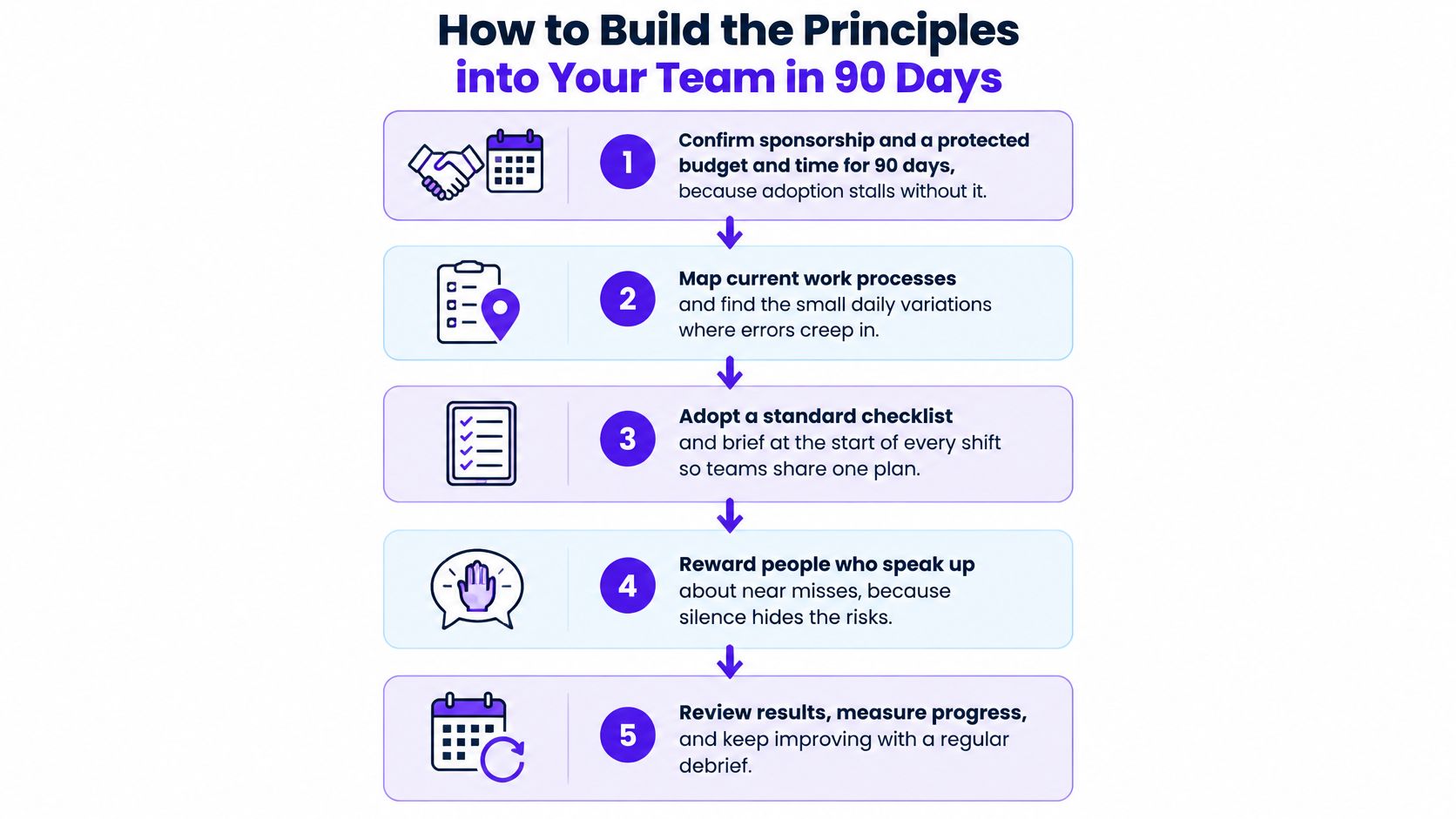
A quarter is enough time to change one routine and prove it moved, which is a better outcome than a year-long culture programme that leaves no trace.
- Secure sponsorship and a protected budget and time for the full 90 days. Adoption stalls when the effort depends on whoever has spare hours this week. The slip to avoid is a verbal endorsement with no calendar space behind it.
- Count last quarter's reports and map the current channels. You need a baseline before you change anything, or you'll spend three months arguing about whether progress happened. Skipping this step is the most common reason teams can't prove improvement later.
- Pick one high-consequence workflow, not the whole organization. Medication administration, visitor check-in or mandated reporting are all good candidates because each has a clear failure mode and a named owner. Choosing five workflows at once spreads a small team so thin that none of them gets reviewed.
- Start a 10-minute weekly near-miss review and require at least two contributing causes per event. The two-cause rule is what forces the team past the single tidy explanation. The slip is letting the review become a blame session, after which attendance collapses.
- Give frontline staff stop-and-ask authority and name the expert they can call. Write the name down, add a backup, and tell people what happens when they use it. Authority without a reachable expert turns into a dead end.
- Run a psychological-safety pulse survey at week 4 and again at week 12. Two points let you compare team experience rather than guess at it, and the questions should ask about the shared team, not just private mood. Keep it to a handful of items so people finish it.
- Review the scorecard each quarter and retire any indicator that changes no decision. A dashboard nobody acts on trains people to ignore dashboards. For teams wiring training into this work, these healthcare compliance training delivery tips cover the practical side of getting courses finished without the delivery becoming the whole project.
What a working routine looks like after 90 days
Reports go up, not down, because people believe something will happen to them. Reviews end in a fix with a date attached rather than a note in a file. Staff can name who decides when a situation turns ambiguous, and that person knows the role is theirs. The huddle still happens in a bad week, which is the only week it was ever really tested. Teams that also want to strengthen the handoffs between disciplines can look at how to achieve interprofessional collaboration in healthcare, since most reliability failures live in the seams between roles rather than inside any one of them.
Pick One Principle to Practice This Month
Choose one principle and one workflow for four weeks. A narrow trial gives the team time to see whether a change affects the work before adding more.
On a hospital unit, medication administration can be a practical workflow to examine. On a school campus, try mandated reporting or visitor check-in, where several staff members may share responsibility and information may sit in a portal.
Start a near-miss log with three fields: what happened, what signal appeared first, and who reviewed it. Use the same scorecard described earlier, so the first entry establishes a baseline rather than creating a separate tracking project. Training completion can show that people finished a course, but it cannot by itself show that a workflow is safer. Healthcare teams can explore Medical and Medication Error Prevention, a course covering medical and medication error prevention.
Schedule a 30-minute review four weeks from today. Read the log, look for recurring signals, and decide whether to adjust the workflow or add another principle.
Premiere Education offers accredited continuing education courses for healthcare teams and school staff, along with tools for assigning courses, tracking progress, and documenting completion. Completion records can be shared. Its catalog includes state-mandated training and clinical courses, including Medical and Medication Error Prevention. Visit Premiere Education to find courses relevant to your team's work.
Latest Posts




25% off Sitewide→
Use Code: PCECYBERSALE2025→