

CEUs for Counselors: State Requirements and Renewal Rules

388,200 counselors worked in the United States in 2022, and the Bureau of Labor Statistics analysis of mental health employment projects 18% growth for the combined occupation of substance abuse, behavioral disorder, and mental health counselors from 2022 to 2032, six times the 3% average projected across all occupations, with about 42,000 job openings a year. Renewal runs at workforce scale, every cycle, in every state.
The hours are the simple part. The difficulty sits in the documentation and the category rules. A counselor can log 30 clinically strong hours and still come up short at renewal, because a general course got recorded against an ethics mandate, or because the provider behind it sits off the board's approved list.
Hold every purchase to one question: will this board, for this license, count these hours in this category? The table below gives the totals. The checks that follow determine whether a course clears them.
CEU Hours by State at a Glance

Read a row in a fixed order. Total hours first, because that sets how many courses a counselor needs to buy. Cycle length second, because it converts the total into a monthly pace. Mandated subsets third. Approved-provider rule last, since it disqualifies a course no matter how good the content is. A 40-hour total is not cleared by 40 well-chosen hours. It is cleared by 40 hours that each land in the right category from a provider the board accepts.
The per-year math is where the states separate. Minnesota's 40 hours across a two-year period averages 20 hours a year; New York's 36 hours across three years averages 12 hours a year. A counselor holding both licenses isn't carrying one pace, they're carrying two.
A Minnesota LPC with 25 of 40 hours logged at month 12 has 15 hours to place. Across the 12 months remaining, a two-hour course roughly every other month closes the gap with room to spare. The same counselor at month 20 with 25 hours logged needs a different plan entirely: three courses inside four months, booked before the schedule fills.
Ohio's administrative rule sets 30 approved clock hours for licensed professional counselors and licensed professional clinical counselors. The cycle length is set by the board; read it from the renewal notice. Pacing against an assumed annual cycle is how counselors end up with surplus hours in one period and a scramble in the next.
For a state outside this table, the total lives in that state's statute or board rule, usually expressed as clock hours per renewal period. Some boards publish a per-year figure instead, and that is where the arithmetic goes wrong. Two counselors can finish the same cycle holding the same total and get different outcomes, because the board counts categories and providers, not effort.
Why Counselor CEU Rules Vary So Much
Nothing coordinates counselor CE nationally. Each board writes its own hour totals, its own topic mandates, and its own approval process for providers, which is why the same webinar is four countable ethics hours in one state and zero countable hours in another.
Driving rules make the same point. Every state tests a similar skill set, and a license from one state doesn't carry another state's test with it. CE works the same way. The clinical content is portable; the paperwork is local, and the local paperwork is what the board reads at renewal.
The board's current rule controls. A national association's guidance, a colleague's experience in another state, and last cycle's renewal letter are all starting points, not answers.
One conflict shows up immediately. Federal labor guidance describes counselors in private practice as completing continuing education annually, while state boards commonly run two-year or three-year cycles. That annual phrasing describes the profession's regulatory foundation, not a specific license, so the cycle published by the board wins.
Degree standards sit in a different system. The Council for Accreditation of Counseling and Related Educational Programs implemented its 2024 Standards on July 1, 2024, and its 2025 vital-statistics survey collected program data from 456 institutions and 956 counseling programs, per the CACREP 2024 Standards. Accreditation governs the preparation that leads to a license. It doesn't decide what counts after one, and it never overrides a board's hour count.
The rest is procedure. Confirm the rule, map the mandated topics, check the activity type, account for other states, sort out any educator certificate, and keep records that survive an audit.
Confirm Your Rules and Pace Your Hours Before Enrolling
Six steps, done in a single sitting, settle most renewal questions before money changes hands. The order matters. A course fee is easy to spend and the hours are hard to un-spend.
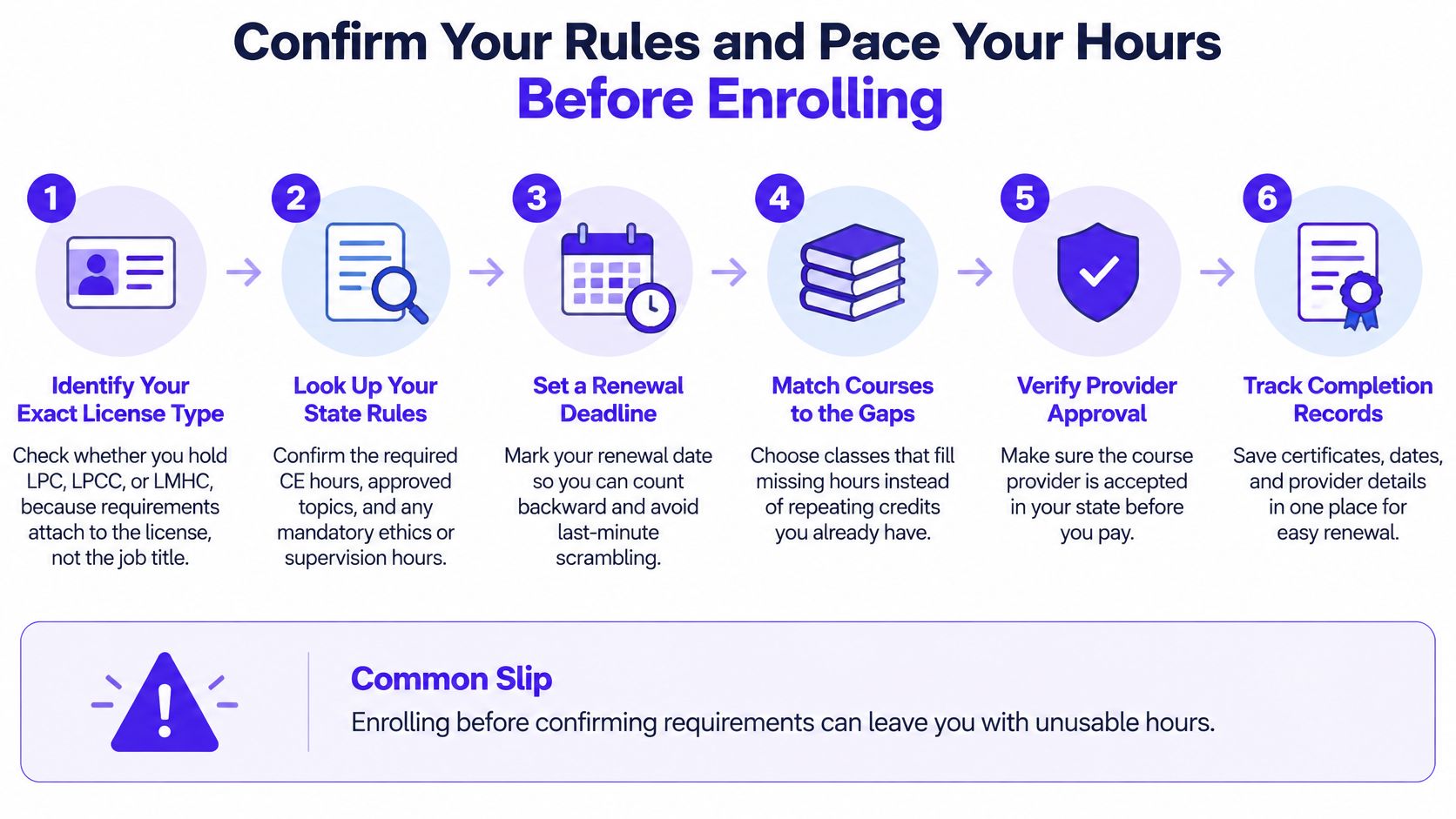
- Identify the exact license type. Requirements attach to the credential printed on the license: LPC, LPCC, LMHC. A school counselor, a clinical director, and a crisis clinician can share a building and answer to three different rule sets. Searching by job title lands on the wrong board's page and produces hours for a credential the counselor doesn't hold. School counselors who also carry an educator certificate pick up a second rulebook, and content for that setting runs toward school law and student supports rather than clinical treatment, the territory covered by Understanding and Implementing Section 504 Plans Ensuring Equity and Access for All Students.
- Find the renewal end date and cycle on the board's own page. The cycle is what turns a total into a pace. Boards commonly run two-year or three-year cycles, and the end date comes from the board's page or the renewal notice. An assumed calendar year can put a counselor's completed hours in the wrong window entirely.
- Subtract what's done and divide by the months remaining. A counselor six months from renewal with 12 hours outstanding needs two hours a month; the same shortfall discovered three months out needs four. Run the arithmetic early in the cycle, when the answer can still shape the shopping list. In renewal week it only describes the problem.
- Write out the mandated subsets before shopping. Some states carve required topics out of the total. Minnesota reserves part of its renewal hours for serving clients from diverse socioeconomic and cultural backgrounds, and Ohio sets ethics hours aside, with added supervision hours for counselors holding the endorsement. A bundle that fills the total while leaving a mandated category empty still fails at audit.
- Confirm the provider is approved by that specific board. New York accepts only formal CE delivered by a Department-approved provider, so a well-reviewed course from an unapproved source counts for nothing there. An "accepted nationwide" badge on a sales page is marketing until the board's approved-provider list confirms it.
- Filter the catalog by state and license, then run the five-field test. State, license, provider, category, hours. If a field is blank, the course stays out of the cart. Print the board's written answer and file it with the course record, so a later dispute has a paper trail instead of a memory.
Practical rule: five fields or no purchase. State, license, provider, category, hours.
A second opinion is worth having before checkout. State CE rules for counselors, a practitioner-written guide from Be Your Best Self & Thrive Counseling, PLLC, walks through how therapists sort the same question from the clinical side, which helps when the board's language is thin.
Counselors sharing a clinic with psychologists run into the same mechanics from a different rulebook, and this overview of CE credits for psychologists shows where the two sets of requirements split. Premiere Education's CE specialists will confirm which listing fits a given license by chat, email, or phone when the mapping isn't obvious.
Mandated Topics That Only Some States Require
Total hours and category hours are separate ledgers. A counselor can clear the first and fail the second, and the miss usually surfaces at renewal rather than at checkout.

Minnesota is the clearest documentation case: the completion record has to show both counseling-related CE and the subject, so a certificate with hours but no matching topic still leaves the category open. The reverse also fails. A well-chosen course outside the approved total does not create a line item that was never earned.
Ohio shows the same trap from the ethics side. An LPCC can reach the overall total through diagnosis and treatment coursework and still enter renewal week with the ethics column empty. The total is met; the mandate is not.
New York is the caution against assuming symmetry. The LMHC requirement summarized here is built around a Department-approved total, with no separate topic carve-out listed, so the task is to confirm whether a category rule exists before building a plan around one.
New York does layer separate mandates onto educators. The Dignity for All Students Act training is mandatory for New York educators, which is a different compliance track from LMHC renewal.
The New York – DASA Dignity for All Students Act Training covers that educator mandate alongside practical tools for addressing discrimination, harassment, and bullying. When a board does name an ethics subset, treat it as its own column; this guide to social work ethics CEUs shows how those requirements are structured.
Keep a running tally by category next to the total, not instead of it. A gap spotted in month one is a course purchase. A gap spotted in renewal week is a phone call and a hope.
Which Activities Count Toward Renewal
Activity type is a second gate, separate from topic. Two courses on the same subject can differ in whether they count at all, purely on delivery format and who approved them.

Formal courses from approved providers are the safest column in that table, and they're the ones to build a plan around. Everything else carries a verification step.
Ohio enumerates what its hours may cover, including counseling theory, techniques, diagnosis, intervention, ethics, legal responsibilities, research, and social-cultural foundations, per the Ohio Administrative Code continuing education rule. New York counts only formal CE from Department-approved providers, so the delivery format is part of the eligibility test, not a detail.
Graduate coursework can count in some jurisdictions. Minnesota's first-four-years pathway permits 40 CE units or specified graduate-level coursework, which makes the conversion rule the deciding question. Verify how the board converts a semester hour into clock hours before registering, because assuming a favorable conversion is a common and expensive error.
Targeted hours beat accumulated hours. One course mapped to a risk the counselor actually carries is worth three generic credits that fill a spreadsheet and nothing else.
A counselor starting telehealth work gains more from a single course on informed consent across telehealth settings than from three generic credits. The first produces a documented decision about consent language, jurisdiction limits, and how a client is verified at intake. The second produces a number.
Supervision follows the same logic, counting toward a requirement only where the endorsement and the board rule line up. Self-directed reading and webinars from unapproved sources usually don't count at all, and a counselor who counts them anyway discovers the problem in the audit.
Run the triage question on every activity before paying. Is it formal, is the provider approved by this board, and does it map to a category the license requires?
Earning CEUs While Practicing Across State Lines
Interstate practice stacks a second rulebook on top of the first, and the two don't use the same table of contents.
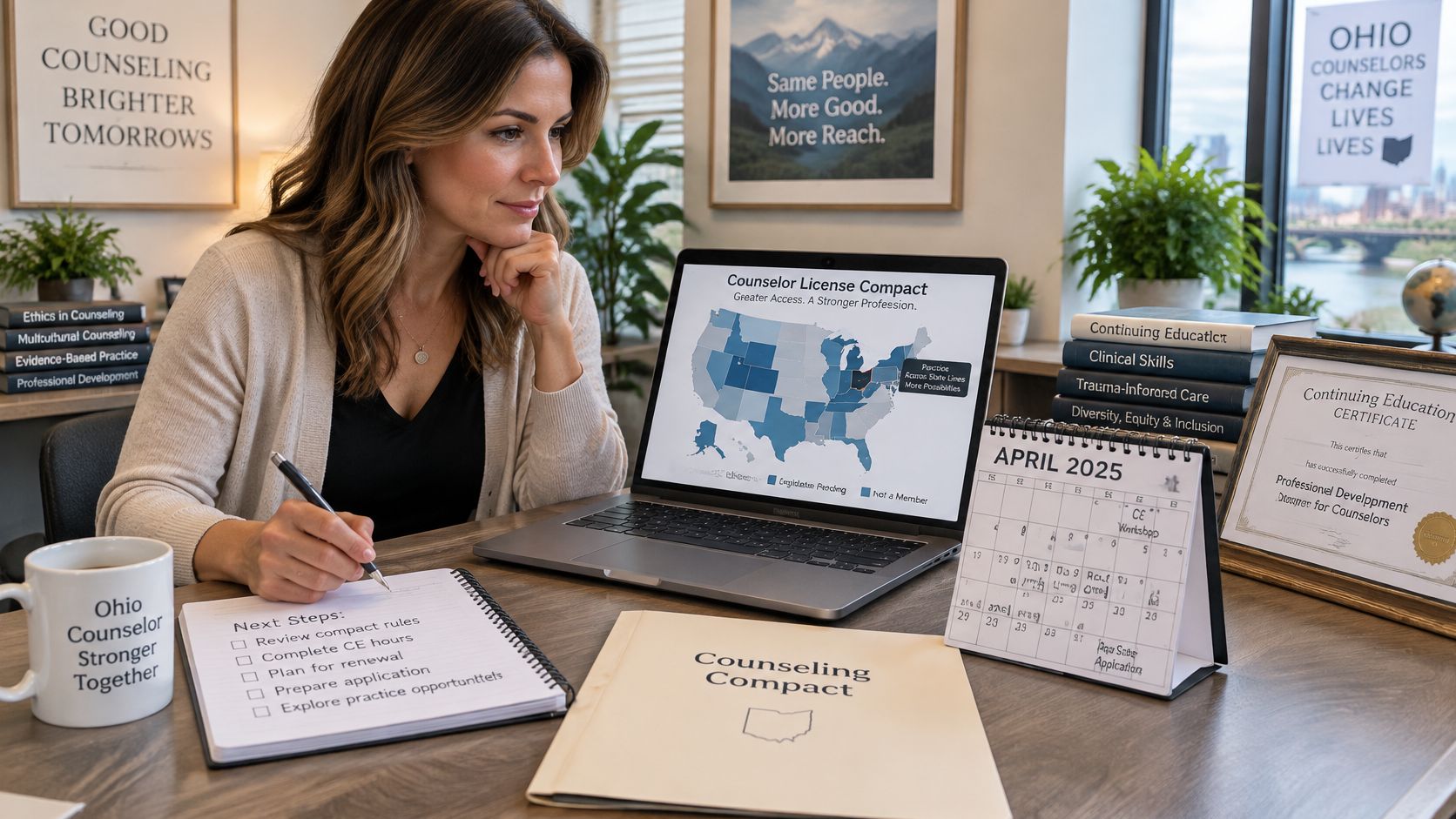
An Ohio LPCC who gains privileges in a second state through the Counseling Compact faces an instinct that often causes paperwork problems: assuming the new state's CE rules now govern renewal too. The home license usually still controls the CE plan, while the privilege adds its own conditions.
The Counseling Compact FAQ draws the line that matters. Eligible counselors generally complete CE only for their home state, each state may still require its own jurisprudence examination, and privileges must be requested state by state. It also separates enactment from operation: a state can have compact legislation on the books and still not be issuing privileges, so membership and portability are different statuses.
Four questions deserve their own line in a decision guide:
- Home renewal: which state's CE rules govern the license being renewed, and which cycle applies.
- Compact privileges: what the privilege itself requires, separate from the license, including any jurisprudence exam.
- Telehealth: which state's rules govern a session with a client sitting in another jurisdiction.
- Jurisprudence: which states require an exam, and when it has to be retaken.
One page, four lines, updated whenever a state's status changes. A counselor who waits until renewal season to check whether a new state has gone operational is doing the work at the worst possible moment.
The practical gain is fewer duplicate courses for some counselors. The practical cost is sharper regulatory mapping: documentation has to hold up in whichever state asks first.
School Counselors Holding Educator Certificates
Some counselors carry two credentials with two renewal engines, and the educator certificate doesn't run on the counseling license's schedule.
Arizona standard educator certificates require proof of 15 clock hours of professional development for each year of the certificate term, which the state's renewal guidance translates into 90 hours for a six-year certificate, 120 for an eight-year certificate, and 180 for a 12-year certificate, per the Arizona Department of Education renewal guidance. One semester hour of college coursework equals 15 professional-development clock hours, and conferences and workshops are capped at 30 clock hours per year.

That conversion is what makes the math usable. An Arizona school counselor renewing a six-year certificate could document six semester hours of qualifying coursework, provided the coursework relates to Arizona educator standards, a taught subject, or an additional certificate or endorsement.
Arizona law adds two constraints. It caps what covered certificate renewals may require at no more than 15 continuing-education hours per year, and it sets an early-career obligation for elementary and early-childhood certificate holders: within three years of issuance, at least 45 classroom hours, three college-level credit hours, or an equivalent amount in each of two research-based areas identified by law, per the Arizona Revised Statutes section on certificate renewal. A district tracking only the annual hours will miss the second obligation entirely.
Mississippi runs the opposite way, putting the plan at the district level. The state's school staff development framework directs districts to maintain in-service plans on file, reserves part of each plan for beginning-teacher development, and dedicates part of administrator and teacher training to applying and using disciplinary techniques, per the Mississippi school staff development legislation. A superintendent-appointed committee that includes teachers, administrators, school-board members, and lay people prepares the plan, and districts generally keep it on file rather than submitting it for Commission approval.
For Mississippi: ask the district office for the current in-service plan instead of tracking an individual state hour total. The district plan is what governs the training.
The two systems reward different habits. Arizona rewards individual record-keeping against a published hour count. Mississippi rewards knowing which committee approved which plan. Browse the educator continuing education catalog for the school-facing side, and the state overviews on Arizona educator CE requirements and Mississippi school staff and administration CE carry the details for each.
Records to Keep So Renewal Goes Smoothly
What a board accepts is a record, not a recollection of a course. Build the file at the moment of completion, and renewal day becomes a short review.
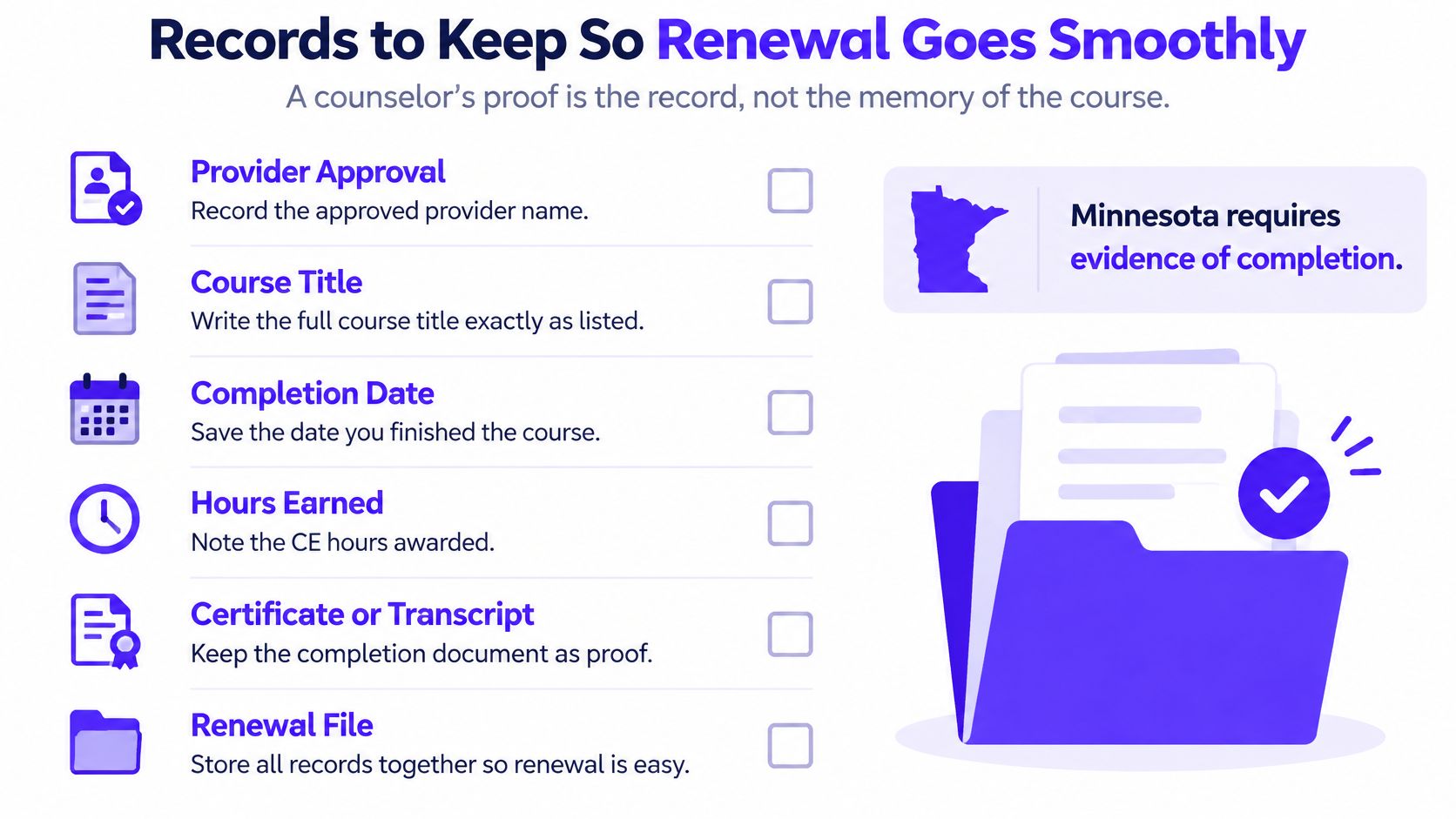
The fields to capture for every course:
- Provider approval: the approved provider's name and the basis for approval, recorded while it's still visible on the course page.
- Course title and completion date: copied exactly as printed, because a board comparing a record to a provider's catalog needs a match.
- Clock hours and category: two separate fields, so a general course never lands in the ethics column.
- License jurisdiction and credential: which state and which license the hours are tagged to.
- Delivery type and specialty endorsement: formal versus other, plus any supervision endorsement the hours relate to.
- Certificate file: a PDF in a folder named for the renewal cycle, saved the day the course closes.
The certificate is the document a board treats as evidence of completion, because it shows the hours and the subject. That file matters more than anything else in the folder.
A counselor licensed in two states needs one spreadsheet with a column per state. A course tagged to a mandated topic in one jurisdiction may count only as general hours in the other, and a shared log that tracks nothing but totals fails both licenses at once. Separate columns for delivery type, topic category, and provider approval basis keep the two ledgers honest, so the same completed course gets evaluated correctly under each board's rules.
Boards differ on whether they accept electronic reporting directly from approved providers, so confirm the arrangement with each one. Premiere Education reports course completions automatically to CE Broker for participating states. Automated reporting removes the data-entry step, and the counselor's own copy still matters. Keep one anyway.
Put the renewal date on a calendar with a 90-day reminder, and keep records through the full renewal cycle plus a margin, because an audit can arrive long after the renewal is filed.
Premiere Education maps its catalog by profession and state, so a counselor can filter to the right credential and jurisdiction before spending a dollar on hours. If the board's language is thin or a provider rule is unclear, the CE specialists will help sort out which listing fits by chat, email, or phone. Visit Premiere Education to find the courses that match your license, your state, and the mandated topics your renewal requires.
Latest Posts





25% off Sitewide→
Use Code: PCECYBERSALE2025→