
.avif)
Social Work Ethics CEUs: A Practical Guide for 2026

Six weeks before a license expires, a newly licensed clinical social worker notices a problem: the renewal tracker shows plenty of general continuing education, but a recent trauma course doesn't clearly say whether it counts as ethics. The certificate lists contact hours and a course title, yet nothing identifies professional boundaries, confidentiality, or ethical decision-making. That uncertainty is common, and it's exactly why social work ethics CEUs deserve separate attention during a renewal cycle.
Ethics training isn't just another clinical skills class. It focuses on how a social worker handles gray-area decisions involving clients, colleagues, agencies, records, technology, and professional power. The safest approach is to confirm the board's rule before enrolling, choose content that clearly fits an accepted ethics category, and preserve records that explain what was completed and why it qualifies.
What Social Work Ethics CEUs Are and Why They Exist
Social work ethics CEUs are continuing education hours devoted to professional conduct and ethical judgment. Common subjects include boundaries, confidentiality, dual relationships, informed consent, mandatory reporting, supervision, and ethical decision-making. A trauma-treatment course may strengthen clinical practice, but it won't automatically satisfy an ethics requirement unless its approved content clearly includes the required ethics material.
A useful distinction is simple:
- General CEUs build knowledge about assessment, treatment, documentation, populations, or practice methods.
- Ethics CEUs help a practitioner decide what should happen when duties conflict, information is sensitive, or a relationship risks becoming harmful.
- Mixed-topic courses may count when the board permits ethics content to be embedded, but the certificate or course description should identify the ethics portion clearly.
A school social worker who receives a friend request from a former student may need to consider privacy, power, dual relationships, social media, and the possibility that the former student could later become a client. The issue isn't solved by asking whether the contact feels harmless. Ethical training supplies a structured way to identify risks, consult policy, document reasoning, and protect the person receiving services.
The recurring subject areas
Boards and approved providers commonly organize ethics instruction around professional boundaries, confidentiality, dual relationships, legal issues, and mandatory reporting. Oregon's continuing education guidance specifically identifies those domains as relevant ethics content, while Missouri requires ethics instruction from a suitably educated social worker or ethics-qualified professional. Oregon's social work continuing education guidance provides a useful example of how a board connects ethics training to practice risks.
Other courses may address telehealth boundaries, cultural humility, supervision ethics, scope of practice, and digital communication. The reason is practical. A social worker's ethical judgment appears in ordinary decisions about texting, releases of information, referrals, consultation, documentation, and agency procedures.
The Compliance Framework Behind Ethics CEUs
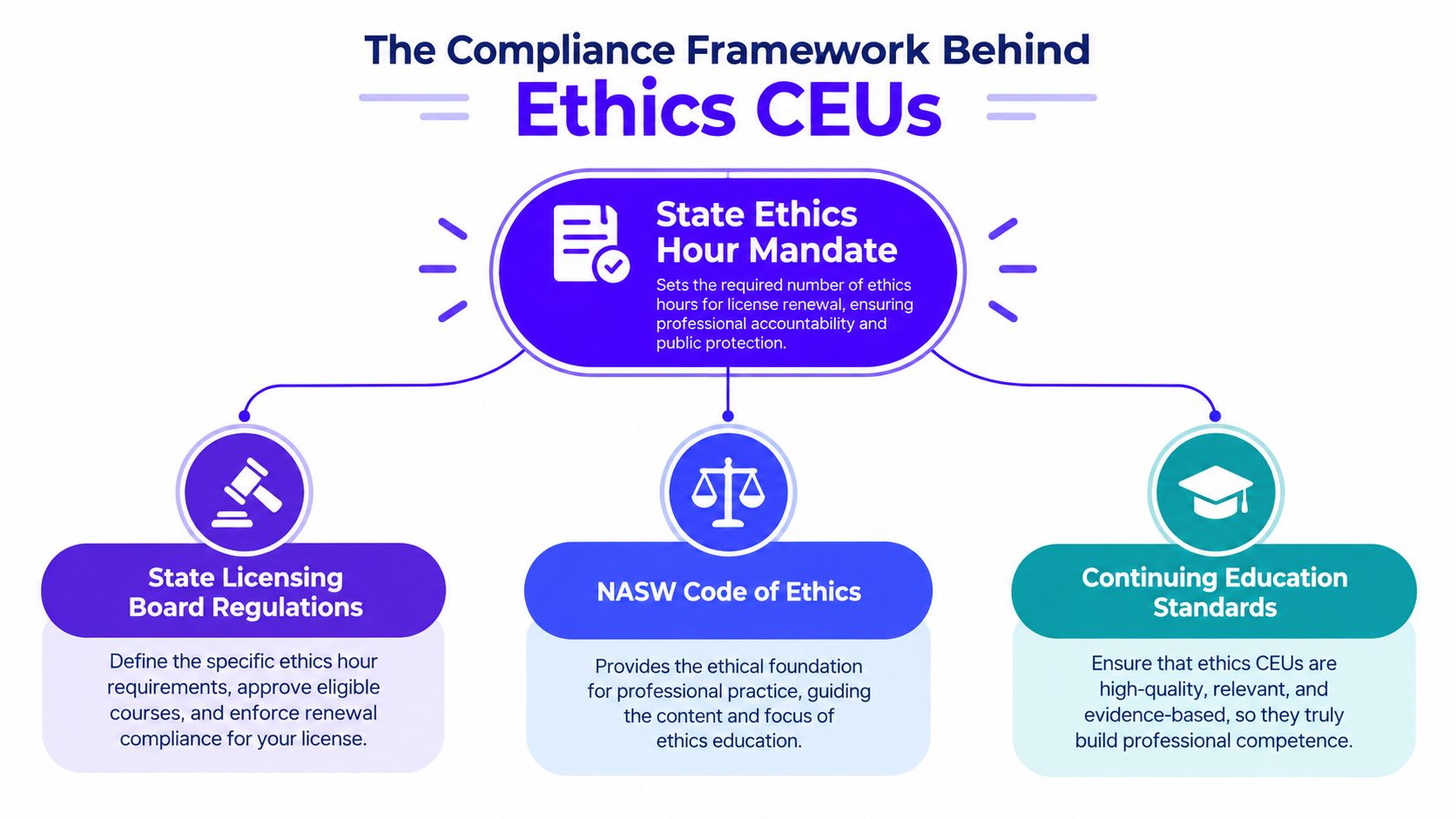
Ethics renewal rules rest on more than a course catalog label. Three connected sources shape the obligation: the profession's ethical standards, state licensing rules, and continuing education approval requirements.
The NASW Code of Ethics provides a central professional reference for values such as service, dignity, competence, integrity, and protection of client interests. It also addresses organizational responsibility. NASW directs social work administrators and supervisors to take reasonable steps to provide or arrange continuing education and staff development addressing current knowledge and emerging developments in practice and ethics. A hospital manager might apply that expectation by scheduling training on informed consent and confidentiality for new employees and recurring refreshers for supervisors handling complex discharge decisions. The NASW Code of Ethics supplies the professional context for that responsibility.
State boards turn those principles into renewal rules. The ASWB Approved Continuing Education framework requires approved providers and courses to adhere to social work values and ethics. Its ethics course development guide describes four historical phases, the morality period, the values period, the ethical theory and decision-making period, and the ethical standards and risk management period. That progression shows why ethics CEUs are part of the profession's development, not a recent administrative add-on.
Why documentation matters
A board needs to determine whether a course was approved, relevant, completed during the correct period, and supported by reliable evidence. Missing certificates, unclear ethics designations, or unverifiable provider information can create problems even when the learner completed meaningful training.
The same compliance logic appears in other regulated professions. Dental Ethics and ProfessionalismLegal, Ethical, and Professional Standards in Practice is described as a practical 2-hour course covering dental ethics and professionalism, including ethical treatment planning, communication, and billing practices. The example illustrates a broader principle: strong ethics education identifies the professional decisions it addresses rather than relying on a vague title.
Core Topics You Can Expect to Train On
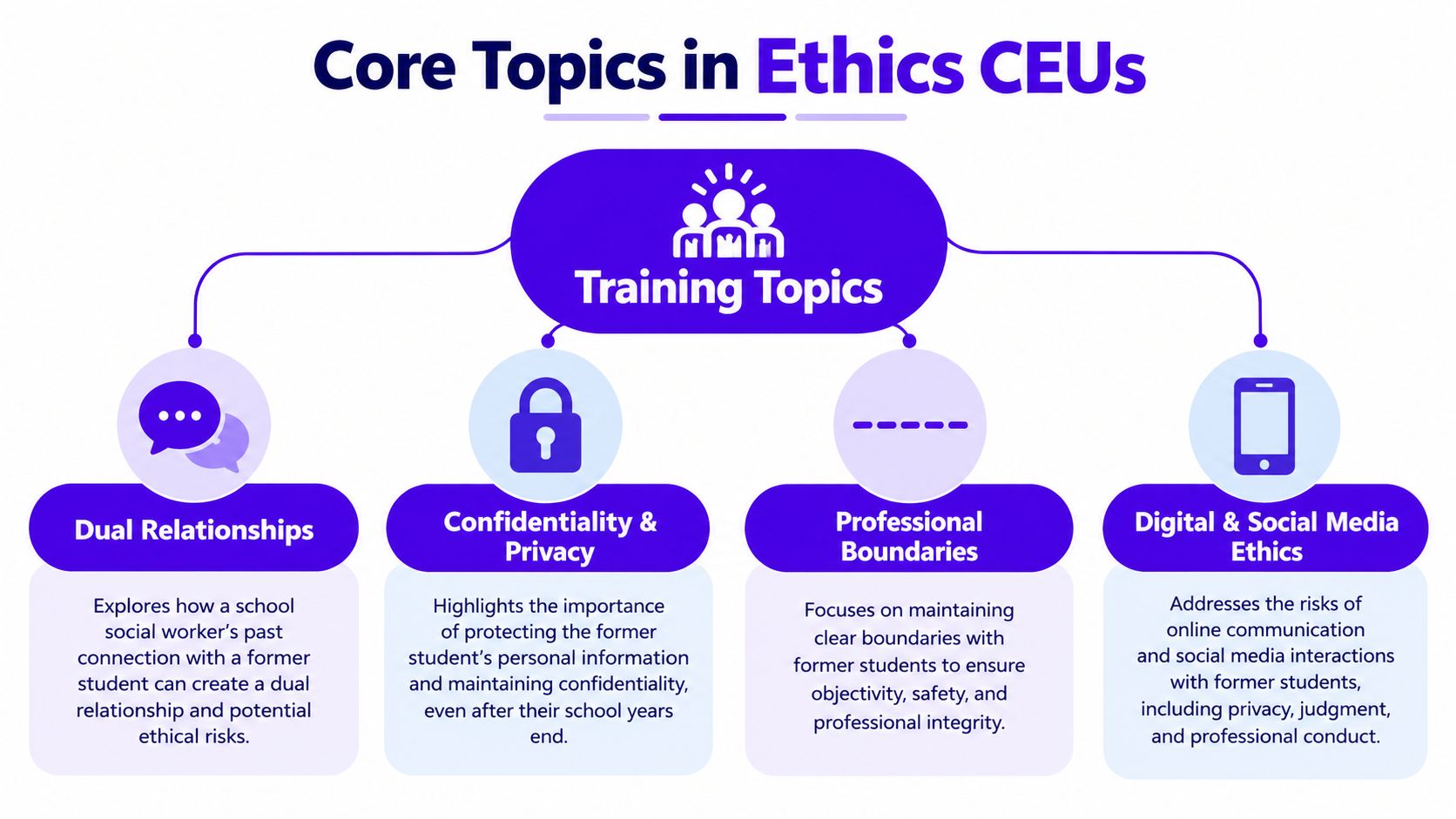
A boundary problem often reveals several ethics domains at once. Consider a school social worker contacted by a former student who is now an adult and asks for counseling. The social worker may feel familiar with the person and may believe that the prior relationship creates trust. That familiarity can also create role confusion, privacy concerns, or an uneven power dynamic.
Dual relationships deserve careful analysis. The social worker should ask whether the prior school relationship could affect objectivity, whether the former student expects special access, and whether another provider would reduce risk. In a small community, avoiding every overlapping relationship may be unrealistic, so the ethical task involves consultation, boundaries, transparency, and documentation.
Confidentiality and informed consent become more complicated when records are shared electronically. A social worker may need to determine who can view a note, what information a release permits, and whether a message sent through an agency portal is appropriate. Access to a shared record doesn't mean every staff member needs every detail.
Mandatory reporting requires a separate decision path. If the former student discloses suspected abuse or neglect involving a child, the social worker must understand the applicable reporting duty, consultation process, documentation standard, and limits of confidentiality. Ethics training helps distinguish supportive conversation from a situation requiring action under law and policy.
Technology, culture, and supervision
Telehealth raises questions about privacy, informed consent, emergency planning, technology limitations, and practice across state lines. Digital communication creates additional boundary issues through texting, social media, and personal devices. Cultural humility asks the practitioner to examine assumptions, respect the client's context, and avoid treating one cultural framework as the default.
Supervision ethics involves competence, delegation, conflicts of interest, feedback, documentation, and the supervisor's responsibility to protect clients. A course on professional boundaries and provider sexual misconduct addresses a particularly serious boundary risk and can help learners distinguish ordinary role questions from conduct that threatens client safety.
Practical rule: A course counts because its approved content satisfies the board's rule, not because the word “ethics” appears in the title.
A course focused only on treatment technique, diagnosis, or clinical theory may be valuable but still fail to meet an ethics category. The boundary scenario works as a training test because it connects relationships, privacy, reporting, technology, and professional judgment in one realistic situation.
How State Boards Shape the Requirement
State boards set the details, so a social worker should never rely on a national rule of thumb. Ethics hours may be part of the total renewal requirement, the board may specify an accepted delivery method, and the required topics can differ by jurisdiction. License level can matter too, particularly where clinical, master's, and school-based roles follow different renewal rules.
The following comparison uses selected board examples. It's illustrative, not a substitute for checking the current rule for the license held.
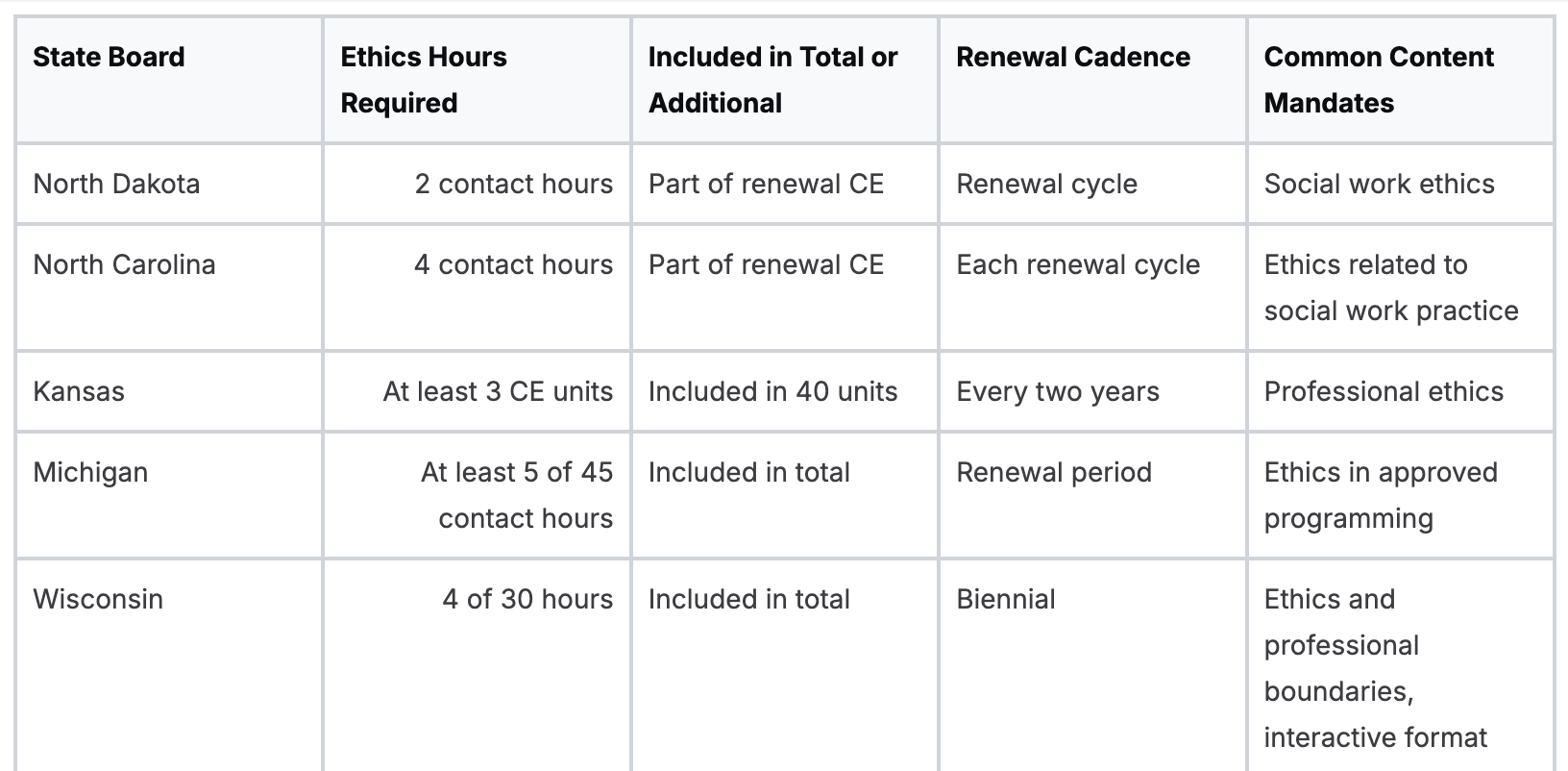
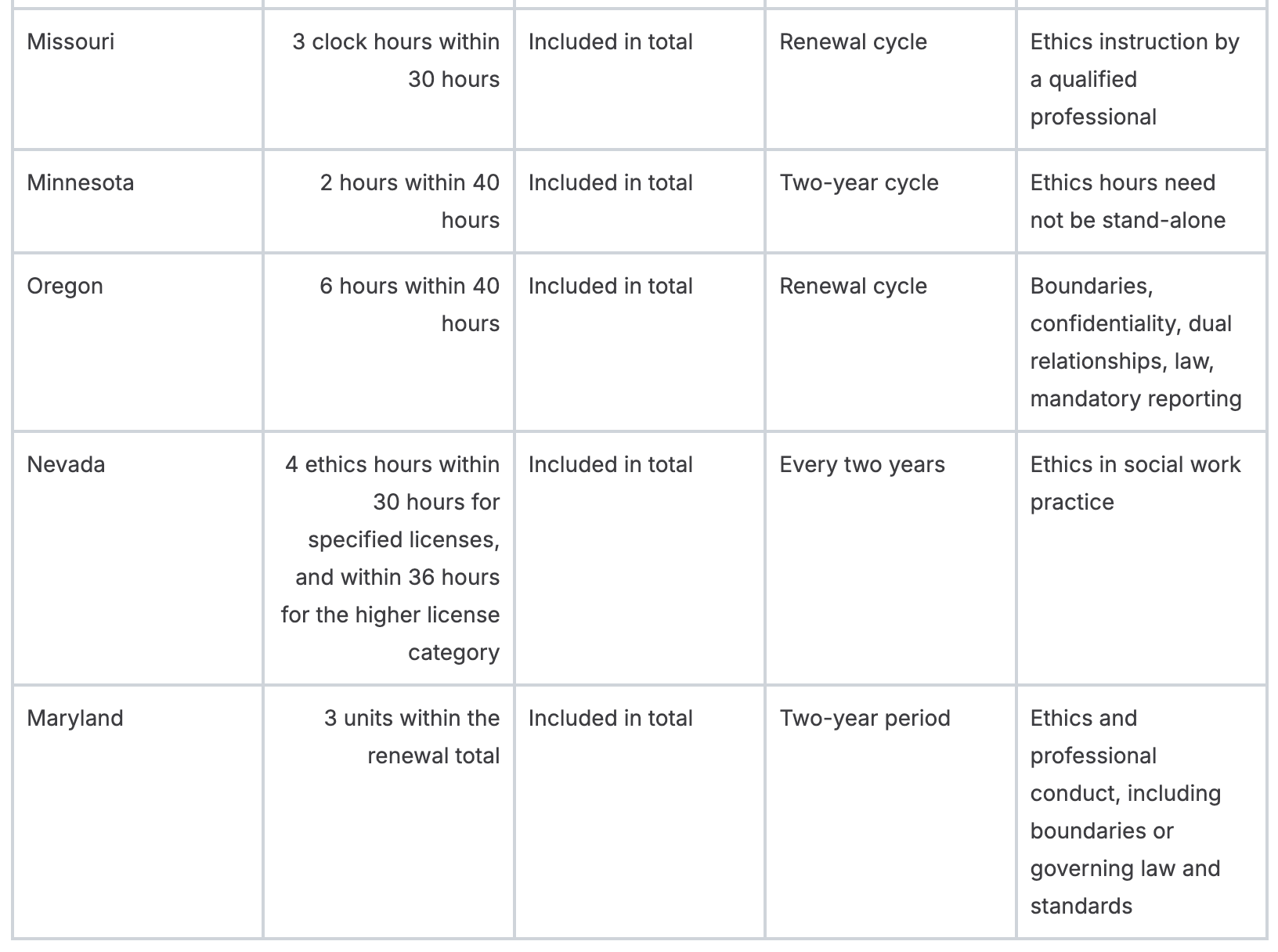
The North Dakota board guidance demonstrates that delivery can include face-to-face or self-study and distance learning. North Carolina's rule requires four ethics contact hours in each renewal cycle, and its 2026 position statement says a shortened initial license period requires 30 total CE hours while retaining the four-hour ethics requirement. Kansas requires 40 approved units every two years, including at least three professional ethics units. Michigan requires at least five ethics contact hours within 45.
Wisconsin adds an important format warning. Its social worker continuing education guidance requires the ethics and professional boundaries credit to be completed interactively. A self-paced course may be ethically relevant but still fail that state's format rule.
Board-reading habit: Separate the required topic, the required hours, the accepted format, and the recordkeeping rule. Each answers a different compliance question.
A state-specific social work course catalog can help a learner locate relevant offerings, but the licensee remains responsible for confirming board acceptance.
Stand-Alone Course or Bundled Training
Many social workers ask whether ethics CEUs must come from a dedicated course. The answer depends on the board's wording. Some boards define ethics as a content category, while others add conditions about interactivity, approval, or documentation. The course packaging alone rarely answers the question.
Minnesota explicitly says ethics hours don't need to come from a stand-alone ethics program. North Carolina allows ethics hours through approved distance learning when the course is approved and related to social work practice. Those examples show why a learner should separate content rules from format rules. Minnesota's continuing education FAQs are especially useful for resolving the stand-alone-course question.
How bundled credit can work
A conference might contain a broader clinical program with a clearly identified ethics presentation. A certificate that separately records the ethics portion gives the learner stronger evidence than a certificate listing only the conference's overall subject. The same principle applies to supervision training, agency in-service programs, and mixed-topic courses.
A course can be packaged in several ways:
- Dedicated ethics course: The entire course focuses on ethical decision-making, boundaries, confidentiality, or related approved domains.
- Embedded ethics module: A broader program includes a distinct ethics segment with identifiable hours and content.
- Agency training: An employer provides a documented session with an agenda, qualified presenter, attendance record, and stated ethics objectives.
- Distance learning: The board accepts online or self-paced education, and the provider supplies completion evidence that identifies the approved content.
A label such as “professional behavior” should prompt closer review. It might address workplace courtesy rather than confidentiality, dual relationships, reporting, or professional responsibility. Provider approval, learning objectives, hour designation, and certificate detail matter more than a catchy title.
Real Examples of Acceptable Ethics CEUs
A defensible ethics CEU has a traceable chain from approved provider to completed learning to retained documentation. The following examples show how that chain can look in practice without assuming that every board accepts every format.
A self-paced clinical ethics module
A social worker selects an online course titled Ethical Decision-Making in Clinical Practice. Before enrolling, the learner verifies that the provider is approved for the relevant license and that the course description identifies ethics content. After completion, the downloadable certificate lists the provider, course title, completion date, contact hours, approval information, and ethics category.
The learner saves the certificate with the course outline and completion confirmation. If the board asks why the course qualifies, the file answers that question without requiring the learner to reconstruct the course months later.
A live telehealth boundaries webinar
A professional association offers a live webinar on telehealth boundaries. The social worker attends the session, completes the required post-event quiz, and receives a certificate identifying the live format, ethics subject, provider approval, and awarded hours.
The learner also retains the registration confirmation and agenda. Those records help establish that the training addressed confidentiality, informed consent, technology limits, and cross-border practice concerns rather than general telehealth technique.
A supervisor-led hospital in-service
A hospital social work supervisor conducts an in-service on documentation ethics and dual relationships. The agency keeps an agenda, learning objectives, attendance roster, presenter credentials, and signed attestation. The social worker stores a copy of the attendance evidence and the agency's description of the ethics content.
This format can be useful for teams, but the board's rules control. If the jurisdiction requires a particular provider approval, interactive format, or certificate type, an internal attendance sheet alone may not be enough.
Audit test: Another person should be able to identify who provided the training, what the training covered, when it occurred, how many hours were earned, and why the board would accept it.
Formats that often create problems include unaccredited free webinars, informal discussion groups without attendance evidence, certificates that omit the ethics designation, and courses whose subject matter is too general to map to the board's rule. Free or low-cost doesn't automatically mean unacceptable, but missing documentation can make a completed course difficult to defend.
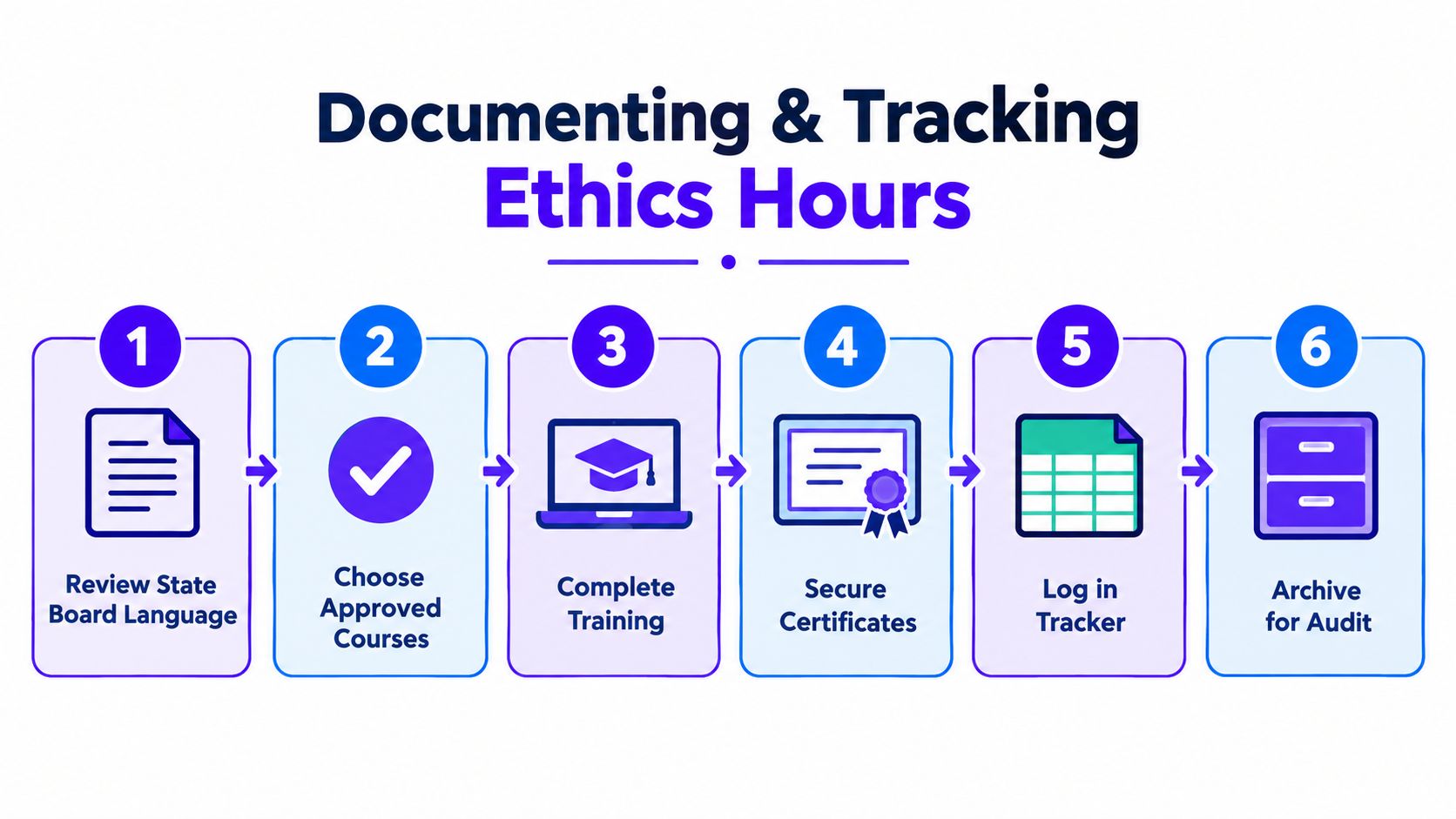
Documenting and Tracking Your Ethics Hours
A reliable tracking process begins before course selection. The social worker should copy the board's ethics language into a dedicated renewal worksheet and treat that sentence as the decision standard for every course. This prevents a common mistake, completing many hours while overlooking the smaller mandatory ethics category.
A six-step recordkeeping workflow
- Read the board rule carefully. Record the ethics hours, total hours, renewal dates, accepted formats, provider requirements, and any topic restrictions. Note whether the license category changes the obligation.
- Choose approved courses. Save the course page, approval details, learning objectives, and provider information before enrollment. A course title isn't enough evidence.
- Complete the training. Record the completion date and the exact credit awarded. If the provider separates ethics hours from general hours, preserve that distinction.
- Secure the certificate. Download the certificate immediately. Check that it includes the learner's name, course title, provider, date, hours, approval information, and ethics designation when applicable.
- Log the course. A simple tracker should include provider name, course title, completion date, clock hours, approval number, renewal cycle, and a one-line explanation connecting the content to boundaries, confidentiality, reporting, supervision, or another accepted domain.
- Archive the file. Create a desktop folder by license and renewal cycle, then maintain a mirrored cloud backup with date-stamped uploads. Keep agendas, presenter credentials, rosters, transcripts, and correspondence with the certificate.
Make the file understandable to an auditor
The record should tell a coherent story. A reviewer shouldn't have to guess whether a mixed-topic course included ethics content or whether an agency training met the board's format rule.
A CE broker transcript can support the file when the applicable system reports completions, but it shouldn't replace personal records. If a random audit request arrives, a well-organized folder lets the social worker respond promptly, including when the board sets a short response window such as 72 hours. Premiere Education's completion-notification help information can help learners understand how electronic completion records may be handled for applicable courses.
Putting It All Together for Your Next Renewal
Ethics CEUs work best when they're treated as practice preparation, not a last-minute checkbox. A social worker who studies boundaries and confidentiality early can apply that reasoning during the renewal period, long before a board asks for a certificate.
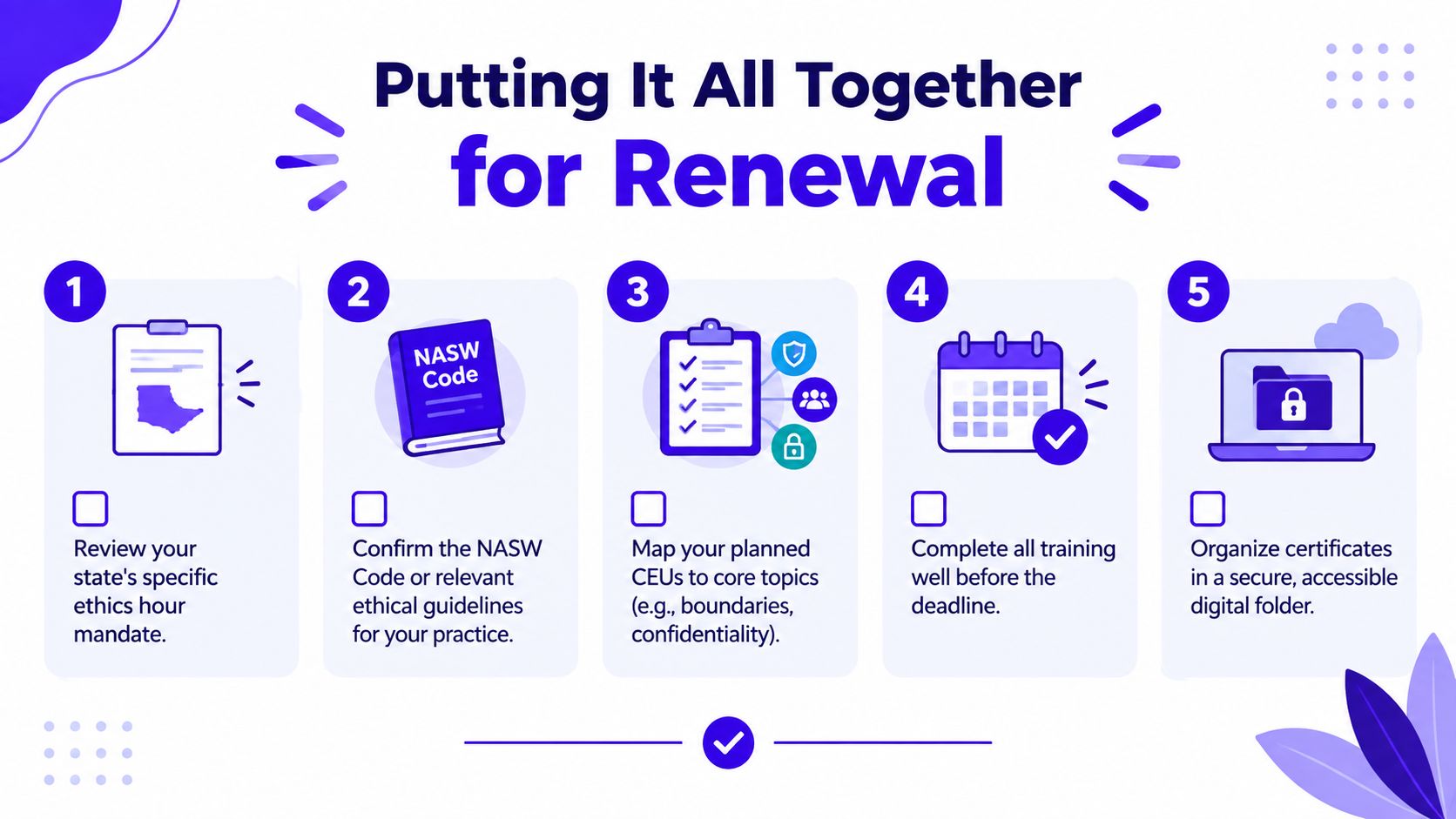
A focused renewal plan can begin with five actions:
- Confirm the exact mandate. Check the current board rule for the license category, renewal cycle, total CE, ethics hours, approved provider status, and accepted delivery method.
- Find the gap. Compare completed courses with the required ethics domain. A trauma course may count as general education while leaving a separate ethics obligation unresolved.
- Map content to risk. Select training that addresses boundary drift, confidentiality, dual relationships, mandatory reporting, telehealth, supervision, or cultural humility.
- Finish early. Complete the planned training at least 60 days before the renewal deadline, allowing time for certificate corrections, transcript posting, or questions about format.
- Store the evidence. Keep certificates, course descriptions, agendas, approval details, and agency records in a secure digital folder organized by renewal cycle.
The practical payoff reaches beyond renewal. A social worker may encounter a dual relationship during a school transition, a confidentiality question in a shared electronic record, a mandated reporting concern in supervision, or a telehealth privacy issue during an ordinary week. Ethics education gives the practitioner a clearer process for slowing down, consulting appropriately, documenting the reasoning, and protecting the client.
The final check is straightforward. The ethics hours should match the board's language, the course content should match the professional risk, the delivery method should be acceptable, and the records should stand on their own. Passing an audit matters, but carrying stronger judgment into the next clinical or school year matters just as much.
Premiere Education offers online continuing education courses and certifications, with tools for assignment, tracking, certificates, and documentation for individuals and organizations. Social workers and compliance teams can visit Premiere Education to review available training and organize renewal records around their applicable requirements.
Latest Posts





25% off Sitewide→
Use Code: PCECYBERSALE2025→