
.avif)
CE Credits for Psychologists: 2026 Renewal Guide

A renewal notice lands in a psychologist's inbox, and the deadline feels closer than expected. The license holder may know the total number of hours, but still need to answer harder questions: Which credits count in the state of practice? How many must cover ethics, diversity, or suicide prevention? Will an asynchronous course satisfy the format rule? Can one activity meet more than one obligation?
Those questions make CE credits for psychologists more than a simple hour-counting exercise. Continuing education supports license maintenance, professional development, and public protection by helping psychologists keep their knowledge and practice current. State boards usually regulate psychologist CE rather than a single national authority, so the rules can change significantly from one jurisdiction to another. The Premiere Education psychologist CE catalog offers one place to review psychology-focused learning options, but each license holder still needs to confirm the rules that apply to the license being renewed.
The most manageable approach treats CE like a plan with several parts. First, the psychologist identifies the total credit requirement and renewal cycle. Next, the psychologist checks topic quotas, delivery-format limits, sponsor rules, and any practice-specific requirements. Finally, every certificate and credit entry gets recorded before the renewal deadline becomes urgent.
A psychologist licensed in Georgia, for example, can't collect any convenient collection of online hours and assume the renewal file is complete. The state requires a specific ethics component and a defined renewal total. A psychologist practicing through telepsychology may also need technology-focused learning connected with PSYPACT participation. The right question isn't only, "How many credits are required?" It's, "Which credits satisfy the license, the practice model, and the documentation standard together?"
Introduction to CE Credits for Psychologists
Continuing education exists because licensure protects more than a professional title. Psychologists work with people who may be experiencing serious distress, impaired judgment, trauma, safety concerns, or complex clinical needs. Ongoing education gives licensing systems a way to require continued learning after graduate training and initial licensure.
The compliance side is only part of the picture. A useful CE activity can sharpen clinical judgment, update ethical decision-making, or help a psychologist respond more thoughtfully to changes in technology, culture, and patient safety. A course on telepsychology, for instance, may be more valuable to a psychologist conducting remote sessions than a general topic that adds hours without addressing the risks of that practice model.
The basic system is local
In the United States, psychologist CE is generally regulated by state boards rather than by one national rule. Requirements vary widely by jurisdiction, and renewal terms may be one, two, or three years. The APA's state CE summary shows requirements ranging from 10 credits in Connecticut to 60 credits in Washington and Vermont, with many major states requiring 40 credits per renewal cycle.
That variation creates a practical responsibility for every license holder. A psychologist with licenses in more than one state can't assume that a course accepted in one jurisdiction will fill the same category in another. The total, cycle length, topic allocation, sponsor status, and delivery format may all differ.
Practical rule: Treat each license as its own compliance file, even when the same psychologist holds every license.
A strong plan starts well before renewal. The psychologist identifies the board, checks the active cycle, lists required topic categories, and then chooses courses that support both compliance and current practice. This approach turns CE from a last-minute purchase into a professional development budget, with every credit assigned a purpose.
How CE Credits Work for Psychologists
The simplest way to understand the APA credit system is to treat a CE credit like a unit of currency with a fixed exchange rate. Under APA and APA-approved sponsor standards, one hour of instructional time equals one CE credit. Joint Accreditation's APA Standards for Awarding Credit use the same relationship, while APA distinguishes 10 hours as one CE unit.

That conversion makes basic planning easy. A three-hour instructional ethics seminar produces three CE credits, assuming the activity meets the applicable approval and completion requirements. The difficult part comes afterward, because state boards decide which activities, sponsors, subjects, and formats qualify for a specific renewal.
What a valid record should show
A completion certificate isn't just a souvenir from a course. APA provider standards require documentation that identifies the activity name and date, the CE credits earned, and sponsor verification. Providers must keep records available for at least three years after completion.
For the three-hour ethics example, the psychologist's file should show the seminar title, date, three credits, and the relevant sponsor approval details. If a board later asks how the hours were earned, the certificate should answer those questions without requiring the psychologist to reconstruct the event from email history.
The phrase “CEU” can also create confusion. Some organizations use CEU terminology broadly, but psychologists should follow the unit language used by the relevant board and provider. The APA framework distinguishes the credit calculation from the larger CE unit, so a course catalog's wording should be checked carefully before enrollment.
A nursing course can illustrate why professional scope matters. Nurse Licensure Compact Essential Information: An Ohio Category A Nursing CE Offering addresses Ohio's participation in the NLC, including rules, regulations, and continuing education standards for nursing practice across state lines. Its relevance to nurses doesn't make it a psychology CE activity, so psychologists should verify that a course is intended for their license and accepted by their board.
State Requirements and Renewal Cycles Explained
State variation is the central compliance challenge. The credit calculation is relatively consistent, but enforcement is local. The APA notes that one hour equals one credit, while state boards determine how many credits a psychologist must earn, when the cycle closes, and which subjects or formats are mandatory. The APA continuing education overview describes this broader system and gives examples of recurring state requirements.
A comparison makes the differences easier to see:
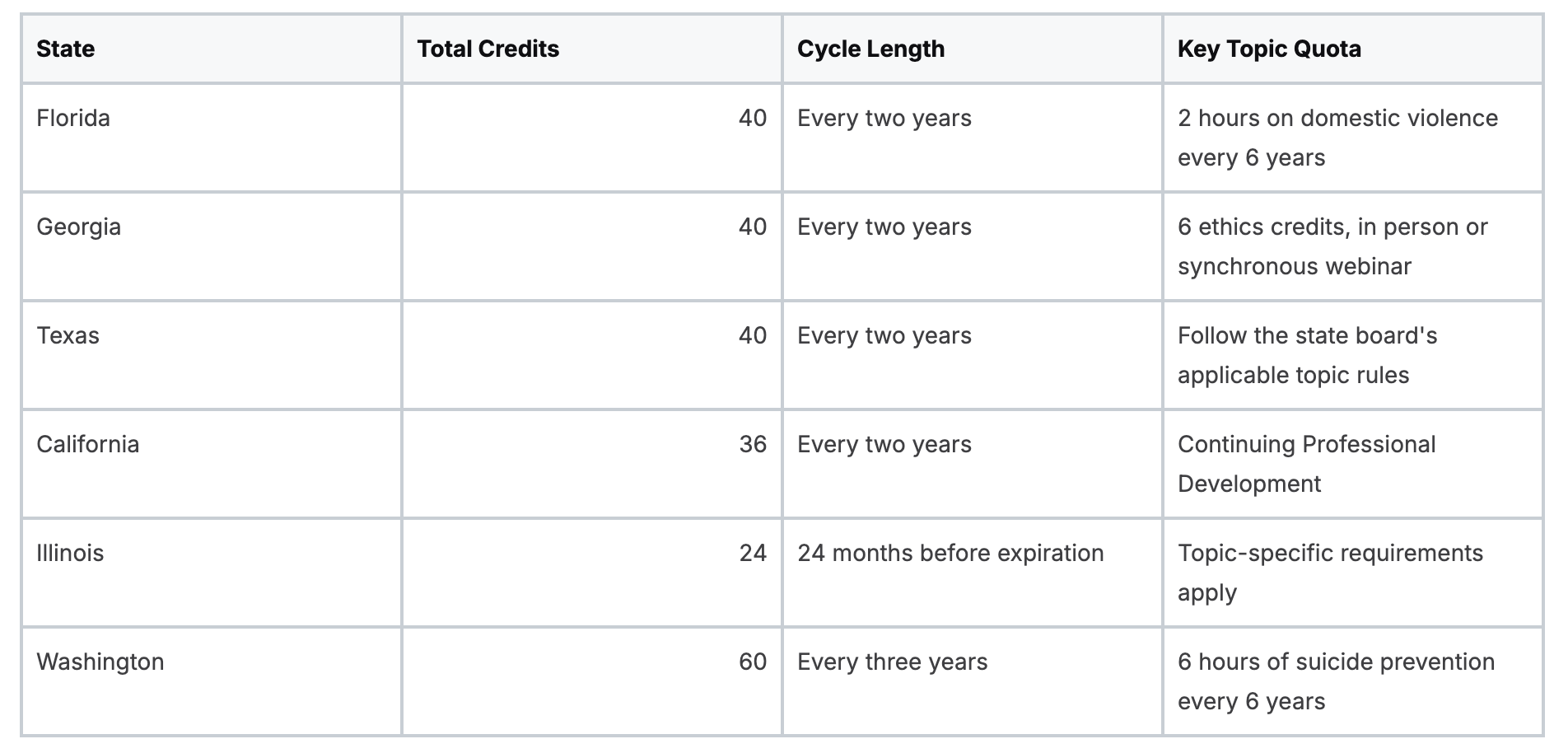
The underlying state examples come from the APA state summary, the Georgia psychology rules, the Washington psychologist CE rules, and Illinois requirements summarized in the state CE requirements reference.
How to read a board rule
A psychologist should extract four details before choosing courses:
- Total requirement: The number of credits due for the active cycle.
- Renewal term: Whether the license renews annually, biennially, or on another schedule.
- Topic allocation: Required credits in ethics, suicide prevention, diversity, cultural competency, or other subjects.
- Format and sponsor conditions: Whether distance learning, live interaction, or approved sponsors affect eligibility.
Pennsylvania demonstrates why the total alone isn't enough. The state requires 30 hours, including 3 hours of ethics, 1 hour of suicide prevention, and 2 hours of child abuse recognition and reporting, according to the Pennsylvania psychology renewal information. A psychologist who completes 30 general credits may still have gaps if those categories aren't represented.
California licensees can use the California psychologist CE resource as a starting point for locating state-specific information, then confirm the current rule with the board. A course catalog can organize choices, but the licensing authority determines compliance.
A dental ethics course shows the same principle from another profession. Dental Ethics and Professionalism: Legal, Ethical, and Professional Standards in Practice is a practical two-hour course on dental ethics and professionalism, including ethical treatment planning, communication, and billing practices. Its subject matter doesn't automatically make it valid psychology CE, so psychologists should avoid treating a familiar topic label as proof of cross-profession acceptance.
Accepted Formats and Provider Standards
A course's subject may be appropriate while its format fails a state rule. Psychologists commonly encounter four delivery models: live in-person education, live interactive webinars, asynchronous online modules, and home study. Each can be useful, but convenience doesn't override a board's acceptance conditions.
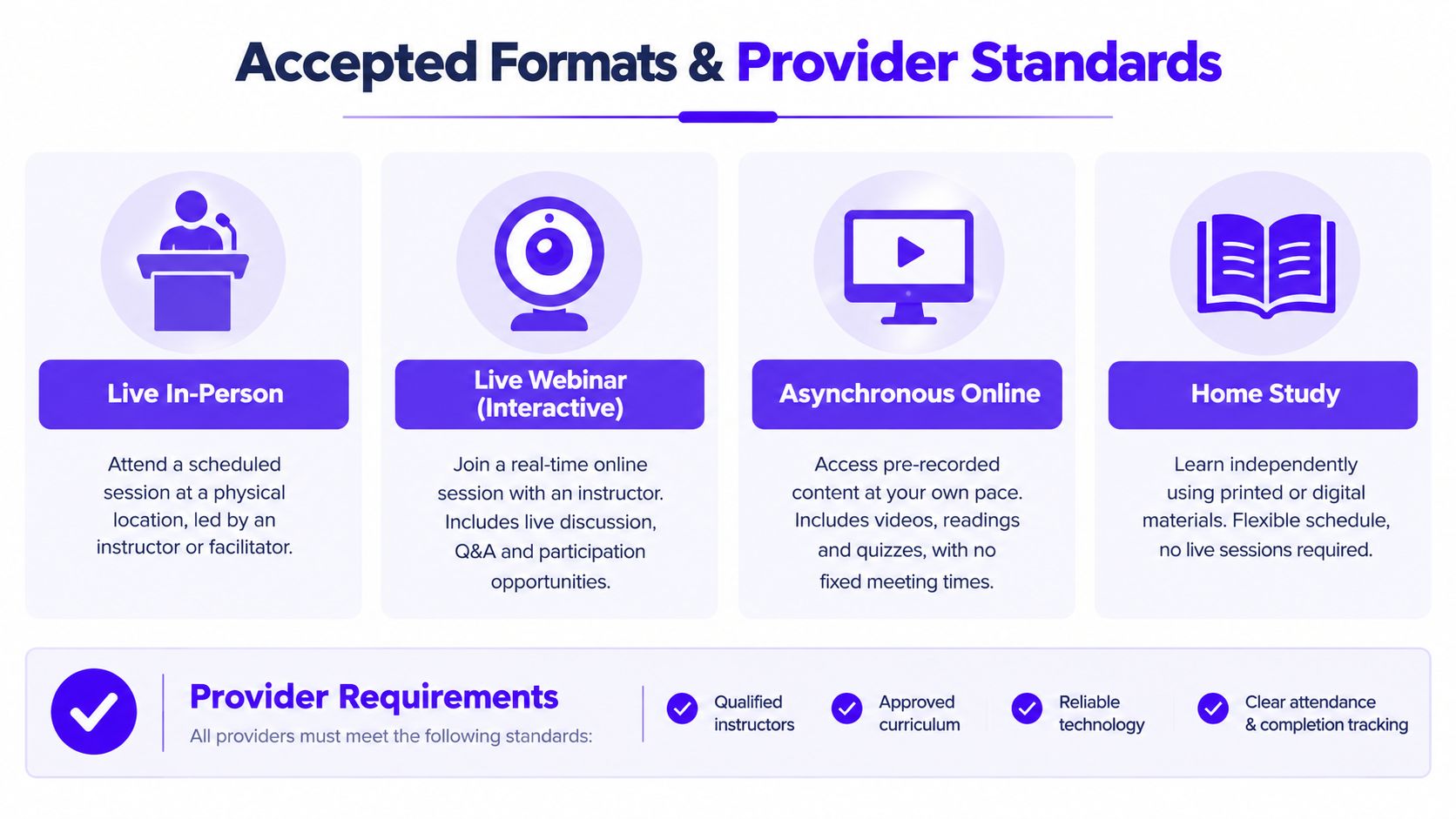
Format choices have different tradeoffs
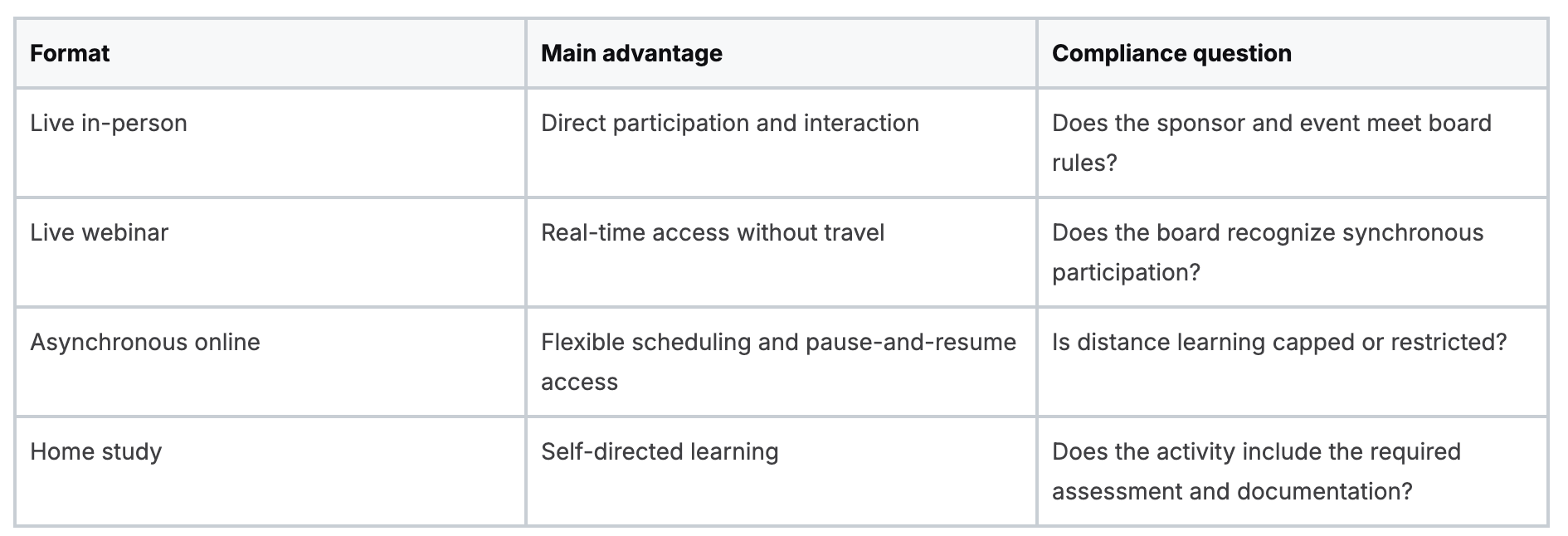
Utah permits unlimited hours from formally established classroom courses, seminars, or conferences, but caps distance learning at 18 hours per cycle, even when the activity includes an exam and completion certificate. Utah also requires at least 6 hours in ethics and law, according to the Utah administrative rule.
Tennessee creates a different planning problem. Psychologists need 40 hours every two years, with at least 20 hours involving real-time interaction and at least 9 hours from an APA-approved sponsor, as described in the Tennessee rule. A psychologist who completes only self-paced modules may have plenty of total hours but still miss the interactive portion.
A flexible course is only useful for renewal when its format matches the license rule.
Sponsor metadata deserves attention
Before enrolling, the psychologist should check the provider's approval designation, course type, instructional hours, assessment method, and certificate details. The Premiere Education accreditations page provides accreditation information for its professional education offerings, but licensees should still compare that information with the specific board's rules.
A practical mixed-format plan might place required interactive ethics learning in a live webinar, then use asynchronous courses for general clinical topics where the board permits them. That combination preserves scheduling flexibility without assuming every credit has the same compliance value.
Tracking Reporting and Staying Audit Ready
A reliable tracking system prevents a completed course from becoming an undocumented course. The psychologist doesn't need an elaborate workflow. A personal CE ledger, a consistent certificate folder, and a calendar reminder can create a defensible record when maintained throughout the renewal cycle.
Build the ledger before taking the next course
A useful ledger records the course title, completion date, credits, sponsor, format, topic category, and license or state to which the activity applies. The topic field matters because a psychologist may need to distinguish general hours from ethics, diversity, suicide prevention, or another mandated category.
After completing a three-hour ethics seminar, the psychologist should log the activity immediately as three credits, attach the certificate, and note whether it was live, synchronous, or self-paced. That small habit prevents uncertainty later, particularly when a renewal application asks for a category breakdown.
The file structure can stay simple:
- Certificates: Store the completion document with the activity name, date, credits, and sponsor verification.
- Board rules: Save the applicable renewal instructions and any approval notes used during course selection.
- Cycle summaries: Keep a running total by state, topic, and format rather than relying on one combined number.
- Submission records: Retain confirmation from any board or reporting system used for renewal.
Reporting should follow the board's process
Some jurisdictions request documentation before renewal, while others require the psychologist to retain records for possible audit. North Carolina, for example, requires 24 hours biennially, including 3 hours of ethics and at least 15 hours from a Category A sponsor, with CE documentation submitted online before renewal, according to the North Carolina psychology board information.
Platform dashboards can reduce manual counting, and CE Broker reporting may apply where a board uses that system. Automation helps, but it doesn't replace review. The psychologist remains responsible for confirming that the recorded course belongs to the right license and category.
Real World Examples and Common Scenarios
The most effective CE plan begins with the psychologist's practice situation, not with the most convenient course in a catalog. A license transfer, a first renewal, telepsychology, or prescribing authority can change which credits deserve priority.

A Georgia renewal
A Georgia psychologist practicing through the full biennial cycle must earn 40 credits, including 6 ethics credits taken in person or through a synchronous webinar. A practical schedule could reserve one live ethics workshop for the required ethics category and use the remaining 34 credits for relevant clinical, legal, or practice-focused education, as long as the activities meet Georgia's rules. The Georgia rule also reduces the first-year requirement to 20 credits, including 3 ethics credits, for a newly licensed psychologist in the first year of the biennium, while someone licensed in the second year owes no CE for the first renewal.
This example shows why timing matters. A newly licensed psychologist shouldn't copy the plan of a colleague who practiced through the entire cycle.
A Washington psychologist using telepsychology
Washington requires 60 hours every three years and 6 hours of suicide prevention every six years, according to the Washington CE requirements. A psychologist can avoid a deadline scramble by tracking the suicide prevention obligation separately from the three-year total and spacing appropriate learning across the longer period.
A psychologist using PSYPACT telepsychology has another layer to monitor. Maintaining an E.Passport requires 3 hours of technology-focused CE annually, according to the PSYPACT telepsychology information. A general telehealth course may be useful, but the psychologist should verify that its content and sponsor meet the E.Passport condition rather than assuming every online practice course qualifies.
Prescribing authority in Illinois
Illinois requires 24 hours during the 24 months before license expiration for licensed clinical psychologists. The state also includes topic quotas for diversity, sexual harassment prevention, implicit bias awareness, Alzheimer's disease and other dementias, and cultural competency, while prescribing psychologists must add 20 pharmacology hours, according to the Illinois CE requirements reference.
The strategic choice is to map every course before purchase. A prescribing psychologist might first fill the base cycle with courses that satisfy required topic categories, then schedule the additional pharmacology education as a separate block. A course should only be counted once for the categories the board permits, so the ledger needs clear labels rather than an optimistic combined total.
Your Next Steps for Staying Compliant
A manageable renewal plan can fit on one page. The psychologist should begin by identifying every active license, recording each renewal date, and checking the current board rule rather than relying on a colleague's cycle or an old certificate.
The planning sequence is straightforward:
- Confirm the total: Record the required credits and the renewal term for each state.
- Map the categories: List ethics, diversity, suicide prevention, cultural competency, telepsychology, pharmacology, or other applicable mandates.
- Check the format: Separate live, synchronous, asynchronous, and home-study hours where the board distinguishes them.
- Verify the sponsor: Review approval status, certificate details, and any Category A or APA-approved sponsor condition.
- Audit the ledger: Compare completed credits with each requirement and identify gaps before the final renewal period.
- Set reminders: Schedule checkpoints for course completion, certificate filing, and board submission.
The core principle is strategic selection. One credit is one instructional hour, but not every hour solves the same compliance problem. A psychologist who tracks topics, formats, sponsors, and dates will have a clearer path through renewal and a stronger record if an audit occurs.
Premiere Education provides online continuing education courses, certificates of completion, tracking tools, and documentation support for professionals and organizations. Psychologists can visit Premiere Education to review available learning resources and choose CE activities that fit their state requirements and practice needs.
Latest Posts





25% off Sitewide→
Use Code: PCECYBERSALE2025→