

Pharmacogenomics and Safer Medication Choices

In U.S. care from 2011 through 2016, exposure wasn't rare or experimental. The U.S. study covering 11 health systems found that between 15,719 and 17,335 patients per 100,000 were exposed each year to at least one CPIC Level A drug. That scale reframes pharmacogenomics as a routine prescribing question. The useful question isn't whether to order a test in the abstract. It's which result should change an order, who will act on it, and whether the evidence and allele coverage fit this patient's ancestry.
Why Pharmacogenomics Matters in Everyday Prescribing
In a Swiss hospital cohort, the analysis of actionable pharmacogenetic variation found that 97.26% of participants carried at least one pharmacogenetic variant with CPIC-based prescribing guidance behind it, while 82.58% carried at least two actionable alleles and 54.86% carried at least three.
Numbers that large live in ordinary hospital rooms. Two patients leave a cardiac unit on the same antiplatelet drug after stent placement. One activates it as expected. The other stays underprotected despite taking every dose on time. That gap is where precision prescribing stops being theoretical.
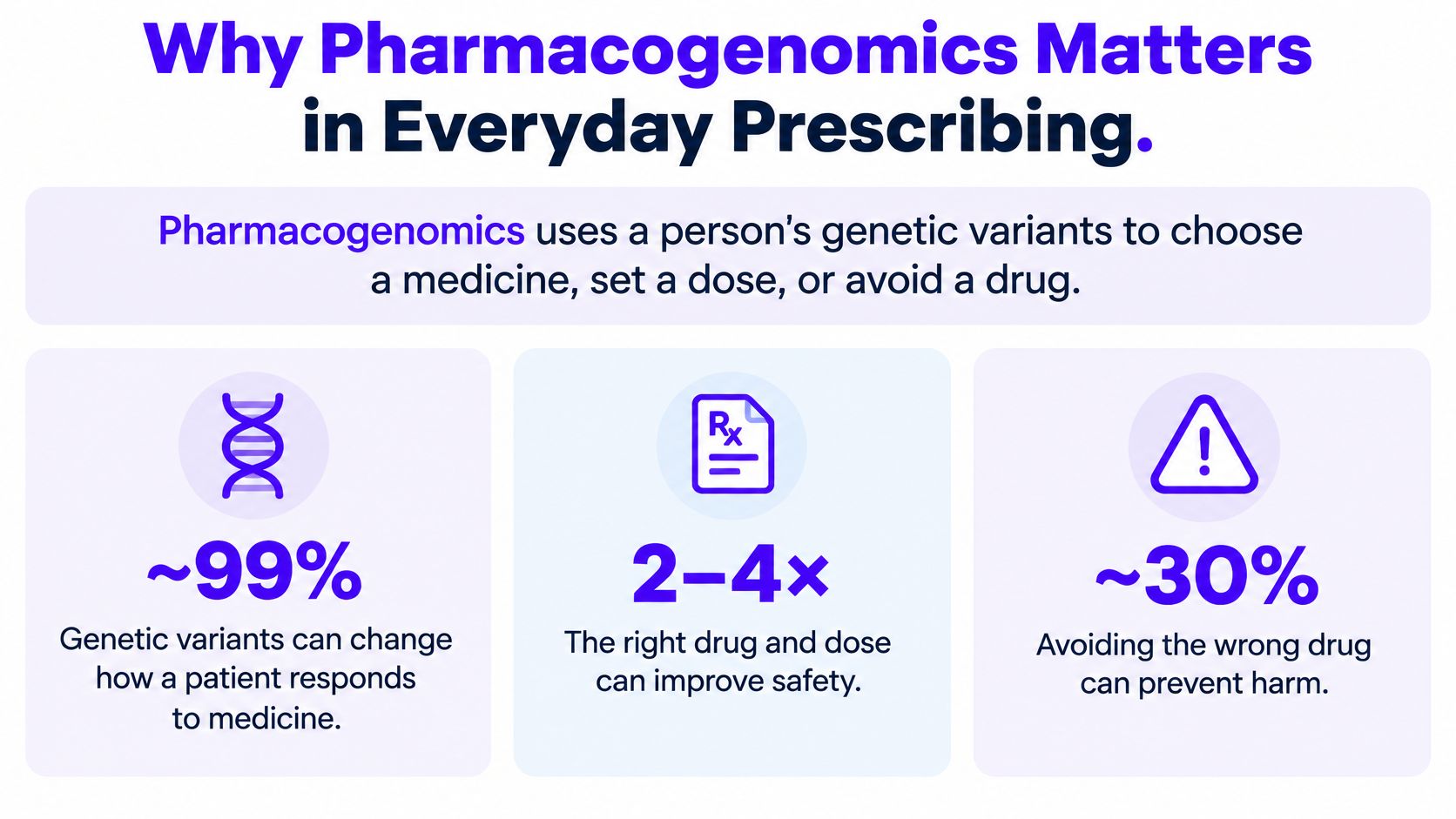
Pharmacogenomics uses a person's genetic variants to choose a medicine, set a dose, or avoid a drug. It works the way a renal function check works before a renally cleared drug: routine safety information that can change the order. Clinicians still weigh age, kidney and liver function, interacting drugs, adherence, and patient preference. Genetics adds a layer that explains why a standard dose helps one patient, fails another, and harms a third.
Ordinary Medicines, Common Variants
The prescribing exposure is just as common as the variants themselves. In the same hospital-based study, 31% of patients had been prescribed at least one medicine tied to a high-risk gene and drug interaction for which international guidance recommended changing the drug or the dosage. A separate estimate in that report put the share of people carrying at least one actionable pharmacogenetic variant at more than 90%, and counted 4,748 potentially genotype-guided prescribing opportunities per 100,000 prescribing events. Those opportunities cluster around familiar problems: heart disease, depression, pain, and seizure or gout treatment.
A variant matters when it meets a drug. A genotype result protects the patient only when a prescribing action follows it.
A lock-and-key picture keeps the mechanism straight. The drug is the key, and the patient's enzymes and immune markers decide how that key turns. Most keys turn at a normal speed. Some turn slowly, so drug levels build toward toxicity. Some spin fast, clearing the medicine before it can work. A smaller group involves immune recognition, where the wrong drug can trigger a severe hypersensitivity reaction rather than a simple dose problem.
That distinction keeps expectations honest. A clinician never tests everyone for everything and improvises. The work is recognizing validated gene and drug pairs, separating results that change an order from results that only inform, checking that the panel's allele coverage fits the patient's ancestry, and making sure a named person acts before the patient is harmed. Training in medical and medication error prevention builds the same habit: catching a preventable problem before the order reaches the patient.
Gene and Drug Pairs That Change the Prescription
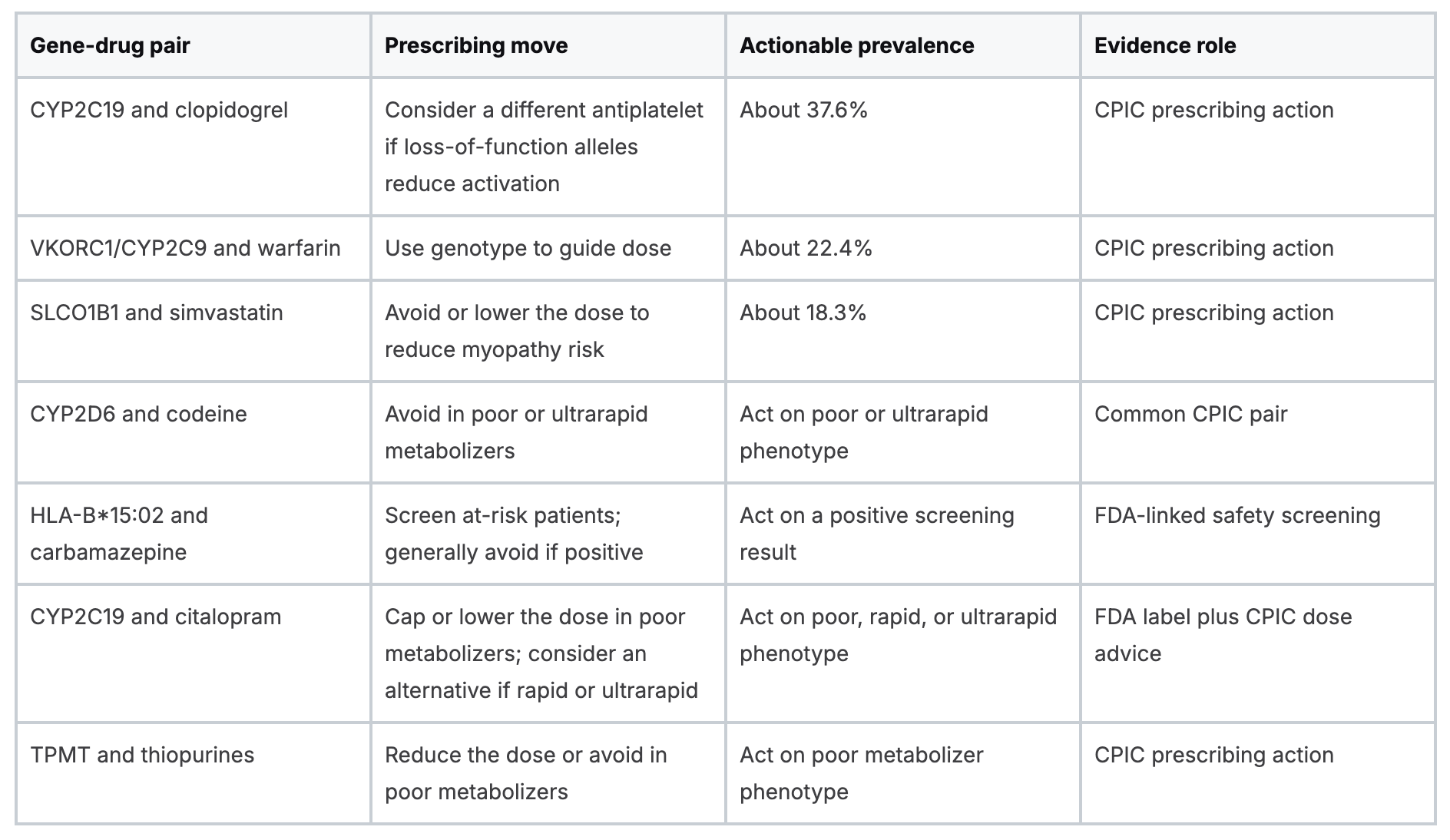
A report earns attention when it names a concrete move. Scan for a drug change, a dose change, or avoidance, then check whether that move applies to the medicine in front of the prescriber right now.
How to Read One Row
Start with the second column, not the gene name. CYP2C19 and clopidogrel is mainly a drug-selection problem when loss-of-function alleles reduce activation. VKORC1/CYP2C9 and warfarin is mainly a dosing problem. SLCO1B1 and simvastatin points toward avoiding the drug or lowering the dose to reduce muscle toxicity risk.
The CPIC genes and drugs listing classifies pairs from Level A to D, and only Level A and B pairs have sufficient evidence for a prescribing recommendation. The same listing supports the table's estimates of approximately 37.6%, 22.4%, and 18.3% for CYP2C19 and clopidogrel, VKORC1/CYP2C9 and warfarin, and SLCO1B1 and simvastatin, respectively. Level A means genetic information should be used to change prescribing. Level B means it may be used because an alternative therapy or dose is highly likely to be similarly effective and safe.
Other rows work as ceilings or stops rather than fine tuning. HLA-B and abacavir is a safety exclusion when the risk allele is present. CYP2D6 and codeine can also become avoidance at both ends of metabolism, too little effect in poor metabolizers and too much active drug in ultrarapid metabolizers. TPMT and thiopurines usually leads to a major dose reduction or avoidance in poor metabolizers.
When an Alert Should Fire
Only Level A and B pairs should fire a prescribing alert, and only under two conditions. First, the patient is receiving, or is being considered for, that exact drug. Second, the lab result has been translated into a defined phenotype that matches a guideline action.
- Drug matches: A CYP2C19 result matters for clopidogrel or citalopram only when one of those drugs is under consideration.
- Phenotype matches: A loose variant comment without poor, intermediate, normal, rapid, or ultrarapid status isn't ready for an order change.
- Action matches: The row must support switching, resizing the dose, capping the dose, or avoiding the drug.
Practical rule: If a row doesn't name a drug change, a dose change, or avoidance, the result stays in the chart as information, not as an order.
Phenotype terms in the table, such as poor and ultrarapid metabolizer, are defined in the next section. Read the table first for the clinical move, then read the mechanism for why that move makes sense.
How a Gene Result Becomes a Drug Decision
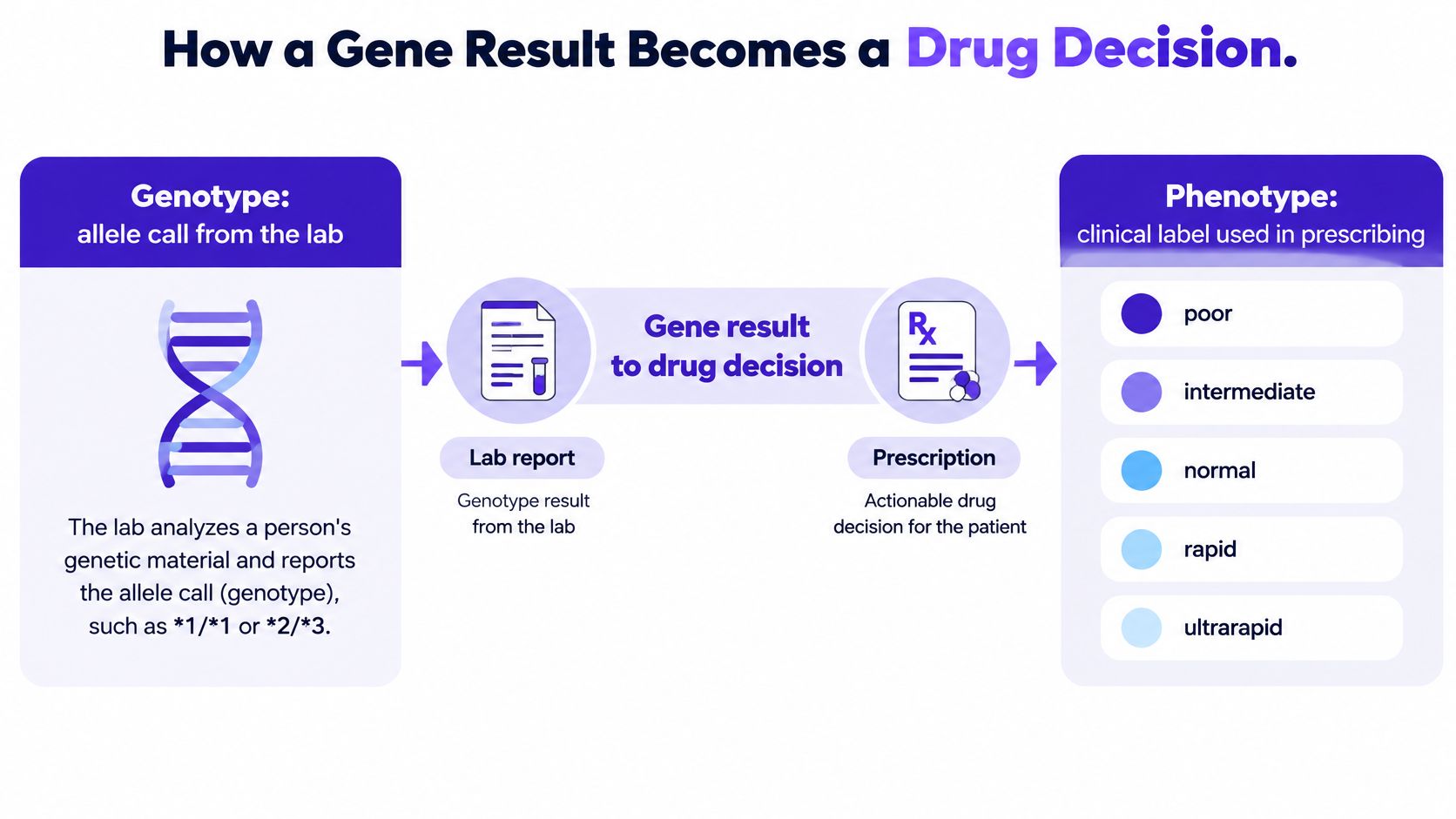
The jump from lab language to prescribing language confuses many readers, so separate the two steps. The lab reports a genotype, the allele call found in the sample. The clinician acts on a phenotype, the standardized label that predicts how that genotype behaves with a drug.
The diagram below maps that translation from allele call to clinical label.
The Kitchen Line Comparison
Think of drug-processing enzymes as a kitchen line handling every order the body sends through. A normal metabolizer has a line that keeps pace at the usual dose. An intermediate metabolizer works a little slower, so exposure can rise and a lower dose may be safer.
A poor metabolizer has a slow line. Dishes pile up, and in drug terms that means higher levels, stronger effects, and more side effects at a dose that suits the average person. A rapid or ultrarapid metabolizer clears orders unusually fast. The usual dose may then fall short because the active drug disappears before it can do enough work.
Codeine flips that logic because it's a prodrug that needs activation. An ultrarapid metabolizer can convert it too quickly and produce too much active medicine. A poor metabolizer may convert so little that pain relief is weak. Same gene family, opposite prescribing worries, which is why phenotype alone never replaces reading the specific drug pairing.
The short video that follows reinforces that chain, from lab result to the words a prescriber can use.
Three Different Genetic Jobs
Not every actionable result is about metabolism speed. Treating all results as dose problems leads to the wrong response, especially when the correct response is to avoid a drug completely.
- Enzymes change speed: CYP enzymes such as CYP2C19, CYP2D6, and CYP2C9 change how fast a drug is cleared or activated.
- Transporters change access: SLCO1B1 changes how much drug moves into tissue, so a standard dose can expose muscle to more simvastatin than intended.
- HLA variants change immune risk: HLA results flag risk of severe skin reactions or hypersensitivity, where dose reduction often isn't the safe answer.
A patient can be a normal metabolizer for one CYP gene and a poor metabolizer for another, because each gene handles different drugs. That mosaic pattern is normal human biology, not a contradiction in the report. Nurses and prescribers should avoid telling patients they're fast or slow metabolizers in general.
A printed variant without a phenotype and a matched guideline isn't yet a medication decision. It's raw material. The decision appears when genotype becomes phenotype, the phenotype pairs with a specific drug the patient needs, and a guideline converts that pairing into switch, resize, cap, or avoid.
Two Cases From Dose Change to Drug Avoidance
Case One Citalopram and a Lower Starting Dose
The clinical question is what a CYP2C19 poor metabolizer result does to the first order for citalopram in a patient with depression. The answer arrives before side effects do. The prescriber no longer waits through weeks of exposure to learn that the patient handles the drug poorly.
CYP2C19 poor metabolizers may show higher citalopram exposure and an increased risk of QT-interval prolongation, which is why the dosing ceiling exists. The CPIC guideline for serotonin reuptake inhibitor antidepressants describes an FDA labeling limit of 20 mg per day for CYP2C19 poor metabolizers and recommends considering a 50% reduction of the usual starting dose. A standard 20 mg daily start may therefore become approximately 10 mg, or the clinician may choose an alternative antidepressant.
The opposite phenotype pushes a different decision. According to that guideline, CYP2C19 ultrarapid or rapid metabolizers are candidates for an alternative antidepressant because faster metabolism may reduce drug exposure and treatment effectiveness. A better-fitting drug serves the patient more than dose increases do when the genotype predicts the drug will never reach a useful level.
That guideline also draws an evidence boundary. It doesn't recommend using SLC6A4 or HTR2A results to guide SSRI prescribing because available evidence is mixed or insufficient. A clinician who orders a large panel still needs to ignore genes that haven't earned a prescribing action.
Case Two Carbamazepine and a Drug to Avoid
Carbamazepine raises a sharper question: whether the drug belongs on the order at all. For a patient from a genetically at-risk population who hasn't taken it before, the allele check happens before the first dose. The pharmacogenomic information on HLA-B*15:02 and carbamazepine recommends screening patients from genetically at-risk populations for HLA-B*15:02 before starting carbamazepine, particularly when they haven't previously taken the drug and alternative agents are available. A patient who tests positive should generally not receive carbamazepine unless the expected benefit clearly outweighs the risk, because the allele is associated with Stevens-Johnson syndrome and toxic epidermal necrolysis.
- Check before the first dose: Verify whether the relevant HLA result already exists in the record.
- Document the status: Record positive or negative clearly where future prescribers will see it.
- Act on a positive result: Select an alternative rather than lowering the carbamazepine dose.
The same avoidance logic applies elsewhere. HLA-B*58:01 positivity is a reason to avoid allopurinol because of severe cutaneous adverse reaction risk. Across these pairs, a positive HLA result converts into a stop order rather than a smaller dose, which is the distinction that keeps patients safe.
Some results resize a prescription. Others remove a drug from the list entirely. Confusing those two actions is where harm creeps in.
These cases show the two outputs a useful report can justify. One is a lower start or a firm dose ceiling. The other is a clear statement that the patient shouldn't receive that drug. Both beat trial and error when the evidence supports acting before the first dose.
How Clinicians Put a Test Result to Work
A PDF that nobody opens at prescribing time doesn't protect anyone. Teams need a workflow that moves a result from the lab to the next order, even when the next order comes months later from a different clinician.
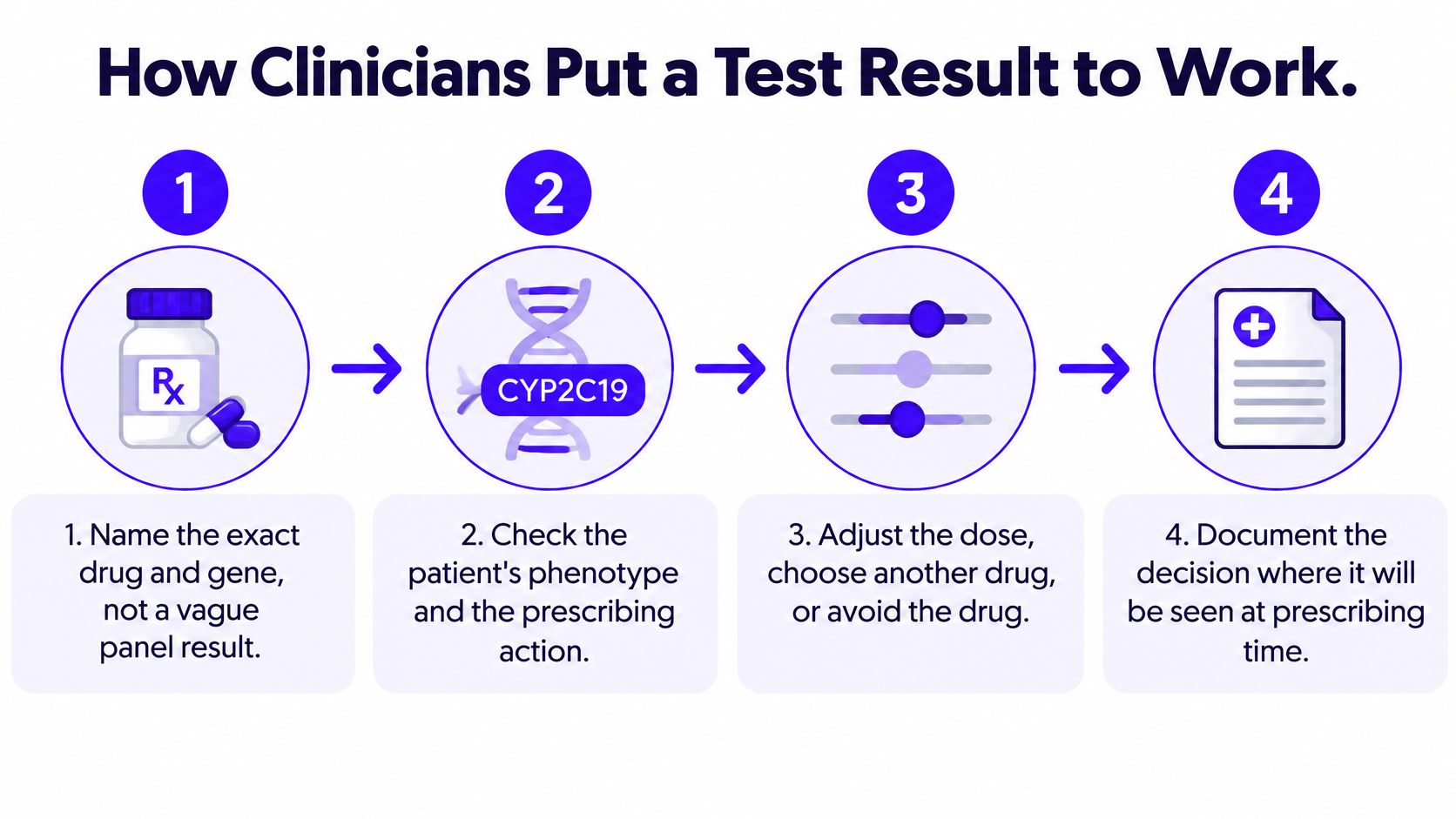
The process summary below condenses that handoff into four visible steps.
Choose the Timing First
Reactive testing happens when a drug is first considered, so timing depends on turnaround and urgency. Preemptive testing stores multi-gene results for later prescribing, which helps only if the stored result is visible when a future drug is ordered. Either approach can support nurses who are deepening their medication role, a theme explored in how pharmacology for nurses can reshape a healthcare role.
Seven Steps From Result to Order
- Name the pair: State the exact drug and gene, not a vague panel result.
- Confirm the authority: Check that a current CPIC recommendation or FDA label action exists for that pair.
- Sort the evidence: Place it in one of three states, testing required or strongly safety-relevant, testing recommended and prescribing-actionable, or biomarker text that's only descriptive.
- Check the logistics: Confirm the lab detects the relevant alleles, review turnaround time, and check whether the payer covers this indication.
- Translate the result: Convert alleles into a standard phenotype such as poor or ultrarapid metabolizer.
- Assign and store: Record who will interpret the result, store it where the next prescriber can see it, and write the drug or dose decision in the record.
- Reopen it later: Revisit the result when the medicine list or the guideline changes.
Practical barriers explain why those steps can't stay informal. Guidelines, FDA labels, and payer policies can disagree, reimbursement is uneven, and clinicians may be unsure how strongly to act. Results also fail to follow patients between clinics, so a finding known in cardiology may be invisible in primary care.
Cost-effectiveness isn't fixed either. It shifts with test price, local drug prices, baseline risk of harm, and whether the team can deliver an alternative in time. Those workflow and cost concerns are central to the NEJM Evidence review of pharmacogenomic implementation, which frames total cost and accountability as part of the clinical decision.
The benefit side deserves equal clarity. A documented result can prevent a serious reaction, justify a lower starting dose before toxicity, or steer the prescriber to a more effective drug. Every team should finish with one accountability question. Who acts, when, and what exactly changes in the order?
When Results Are Less Reliable Across Ancestries
An apparently normal result can be the least trustworthy line on a report. It may mean low genetic risk, or it may mean the test never looked for the variants that matter in that patient. Busy clinicians need to know the difference before they reassure anyone.
The implementation literature on population underrepresentation notes that many CPIC and DPWG recommendations rely disproportionately on European and East Asian data. Allele frequencies, linkage patterns, variant coverage, and genotype-to-phenotype translation differ among populations. Results may therefore be less reliable for people with African, Indigenous, highly admixed, or other underrepresented ancestries.
Four Questions Before Trusting a Result
- Was it validated here: Was this drug and gene association studied in populations like this patient?
- Does the assay look widely enough: Does the laboratory test detect variants common in this patient's ancestry?
- Could normal be incomplete: Could an indeterminate or apparently normal result reflect incomplete variant coverage rather than low risk?
- Can the system follow through: If testing expands but the alternative drug or follow-up visit isn't available, is the care gap widening?
That last question matters because unequal access to genotype-guided medicines can compound weak evidence. Testing more patients without better interpretation, drug availability, and follow-up care may widen disparities instead of reducing harm. Education on racial disparities in healthcare from awareness to equitable action addresses that broader pattern beyond a single lab report.
Ancestry is a clue about evidence gaps and variant coverage, not a shortcut that assigns a drug by race. Clinicians shouldn't convert a social category into a dose. They should ask which alleles were tested and how confident the phenotype assignment is.
A test can be technically correct and clinically incomplete at the same time.
Documentation should preserve that nuance. Record the alleles tested, the phenotype assigned, any uncertainty about coverage, and the guideline used for the decision. Consent conversations also need that honesty, particularly when a result may be less settled for the patient's ancestry than the printed report suggests.
Build the Skill to Act on the Next Report
Competence looks specific. The clinician reads a report, names the phenotype, matches it to a CPIC or FDA action, and documents the drug or dose that follows. The Premiere Education courses catalog includes medication-focused coursework for that translation work, such as Pharmacological Foundations: Psychotropic Medications and Beyond Opioids: A Modern Guide to Controlled Substance Prescribing.
That coursework is designed for healthcare professionals involved in prescribing, medication management, or patient support. The course information is not meant to serve as a guideline for patient management, which is exactly why the skill is worth drilling before a real report lands.
One drill builds the habit quickly. Pick clopidogrel, citalopram, or abacavir. Write the action for each phenotype from memory, listing poor, intermediate, normal, rapid, and ultrarapid where they apply, then check every answer against the guideline. A clinician who can produce the action without looking it up will catch the same pairing on a live order. A clinician who only recognizes the term will scroll past it.
Skill stays personal only until the first handoff. The nurse who receives the report, the pharmacist who checks the interaction, and the prescriber who signs the order each need the same answer to two questions: does a validated gene-drug pair apply here, and who acts on it if one does. Teams that assign that ownership in advance avoid the report that gets read, noted, and filed.
For adjacent context on where clinical tooling is heading, Artificial Intelligence in Medicine: Innovations Shaping Healthcare Today covers how AI is reshaping diagnosis, treatment, and healthcare delivery while addressing ethical and regulatory considerations. Before the next new prescription, decide which result would change the order and whose job it is to make that change.
Premiere Education offers structured continuing education that helps prescribers, nurses, and medication teams turn unfamiliar gene results into documented, safer drug decisions. Readers who want to build that skill before the next report lands in a chart can explore the available courses at Premiere Education.
Latest Posts





25% off Sitewide→
Use Code: PCECYBERSALE2025→