

OSHA Bloodborne Pathogens Training Requirements Explained

A lot of teams land on this topic when something already feels off. A new hire is about to start specimen collection, the annual roster shows a few people are overdue, or a supervisor realizes the online module everyone completed never explained where the exposure control plan lives. That's usually the moment when bloodborne pathogens training stops looking like a certificate problem and starts looking like an operations problem.
The hard part isn't usually finding a course. It's deciding who needs training, what content must be site-specific, and when a workplace change triggers retraining before the next annual date. OSHA's rule is specific, but many workplaces still run it like a generic once-a-year safety talk. That gap is where compliance trouble starts.
Why Bloodborne Pathogens Training Is Not Just a Box to Check
A school custodian finds a trash liner leaking from a nurse's office can. Gloves are available, but no one has recently reviewed which gloves are appropriate, where spill supplies are stored, or who to call if liquid reaches exposed skin. On paper, the facility may still show “training completed.” In practice, the employee is guessing.
That difference matters. OSHA's Bloodborne Pathogens Standard requires training for covered employees, but it also treats training as part of a larger exposure-control system, not as a standalone annual event. The rule was finalized on December 6, 1991, and it requires training for employees with occupational exposure at initial assignment and at least annually thereafter, with retraining due within one year of the previous session, under 29 CFR 1910.1030.
Audit proof vs program proof
On audit day, weak programs reach for sign-in sheets and completion certificates. Strong programs can show more:
- Workers know the plan: A phlebotomist can explain where the written exposure control plan is stored.
- Response steps are clear: A dental assistant knows what to do after a splash exposure.
- Controls match the job: Housekeeping staff can identify the right cleanup supplies and disposal route for contaminated waste.
Practical rule: If employees can't explain how the training applies to the tasks they perform this week, the program isn't defensible.
OSHA also requires the training to be at no cost, during working hours, and with an opportunity for interactive questions under the same OSHA standard text. That operational detail is a clue to how OSHA views the subject. This isn't awareness training. It's job-facing instruction tied to exposure risk, equipment, procedures, and incident response.
What the Bloodborne Pathogens Standard Actually Covers
A facility can hold a clean annual class, file every sign-in sheet, and still miss the point of the standard. OSHA's bloodborne pathogens rule applies where job duties create reasonably anticipated occupational exposure to blood or other potentially infectious materials. That threshold drives the whole program. Job title does not.
The standard itself sits at 29 CFR 1910.1030 on OSHA's site, but training is only one part of what employers have to put in place. In audits, the weak spot is usually not the slideshow. It is the gap between the training record and the way work is assigned, supervised, and equipped on the floor.
What does the rule cover in practice? More than many employers plan for:
- A written exposure control plan
- Exposure determination by task and assignment
- Engineering controls and safer work practices
- PPE selection and availability
- Housekeeping, cleanup, and regulated waste handling
- Hepatitis B vaccination and follow-up process
- Post-exposure evaluation and medical follow-up
- Training that matches current duties and procedures
Those pieces have to work together. If a clinic draws blood, the employer needs more than a training roster. Staff need sharps containers in the right locations, a clear cleanup process, PPE that fits the task, and a post-exposure process that people can describe without guessing.
Role-based decisions matter. A school nurse is an obvious inclusion. A front-office employee who is assigned to respond to student injuries may also fall inside the standard. Environmental services staff who turn over contaminated treatment rooms often do. Employers get into trouble when they classify coverage by department instead of by assigned duties.
That is also why I do not treat bloodborne pathogens training as a yearly event that stands on its own. It has to reflect the exposure control plan the facility is using, the devices employees handle, and the incidents the site is realistically trying to prevent. For readers comparing job-duty scenarios, Premiere Education has a useful background piece on bloodborne pathogens training requirements. The practical question is simple: can this employee reasonably be expected to contact blood or OPIM while doing assigned work? If yes, the rest of the program has to line up behind that answer.
Required Training Topics and Practical Examples
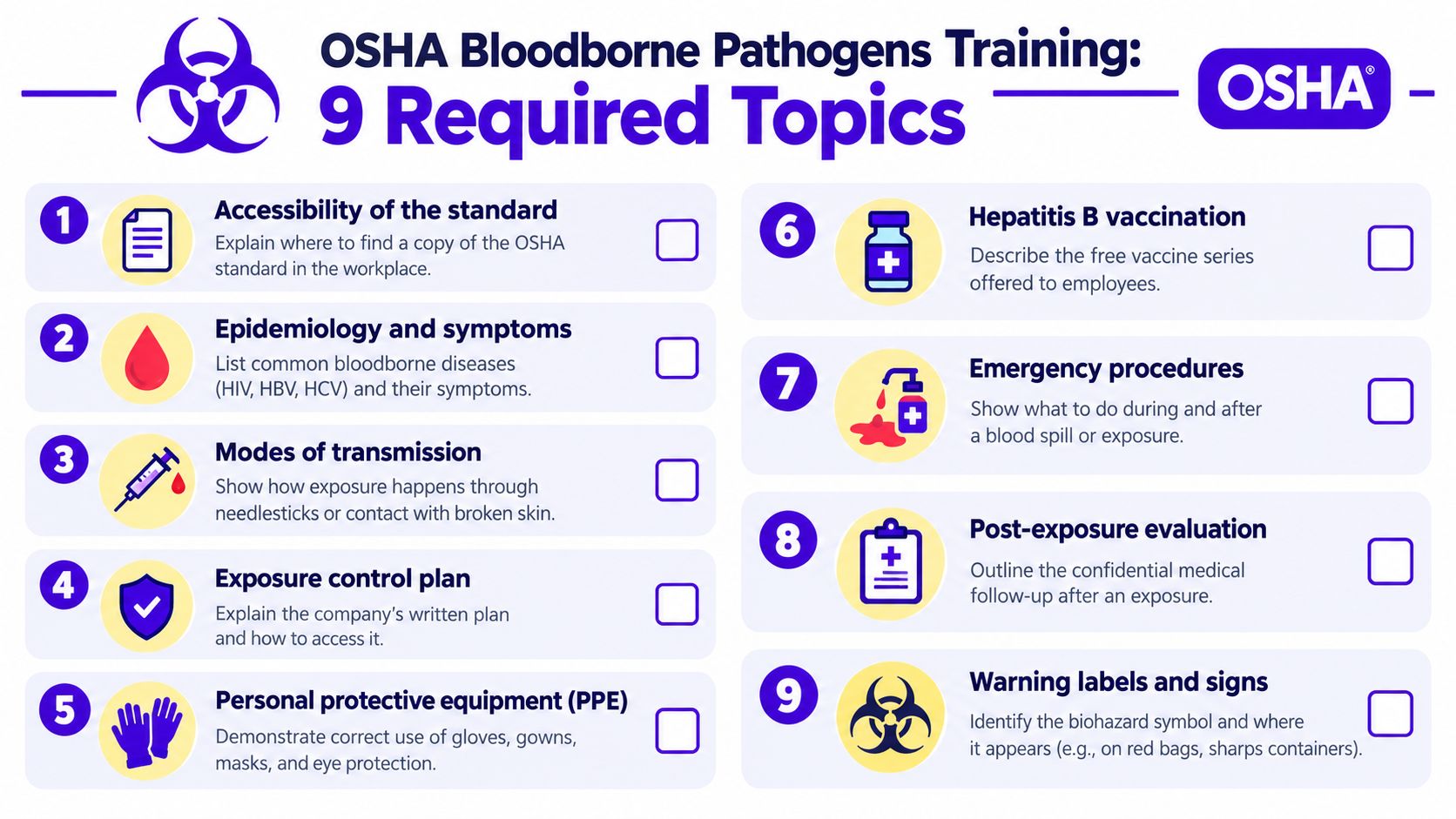
OSHA doesn't allow generic safety talk here. The content must cover the standard itself, epidemiology and symptoms, transmission routes, the employer's exposure control plan, recognition of exposure tasks, and the use and limitations of engineering controls, work practices, and PPE, as described in OSHA publication 3186.
A working checklist for real sessions
Nine topics should show up clearly in the training content, and each one should connect to actual tasks in the workplace.
- Access to the standard
Employees should know where the regulation can be found. In a dental office, that may mean a printed compliance binder at reception and a digital copy on the shared drive. - Epidemiology and symptoms
Staff need a practical explanation of bloodborne disease basics. In a clinic huddle, that may mean reviewing the symptoms and significance of HIV, HBV, and HCV before discussing exposure prevention. - Modes of transmission
The training should explain how exposures happen. A specimen processor needs to understand that a needlestick, splash to the eye, or contact with broken skin creates a different risk profile than sealed transport. - The employer's exposure control plan
Workers must know what the plan says and how to get it. In a school health office, that means more than saying “it exists.” It means showing the exact binder or folder location. - Exposure tasks and activities
Employees should be able to identify the parts of the job that create risk. A housekeeper cleaning a restroom after a bloody nose incident needs to recognize that task as covered work.
What applied instruction looks like
The rest of the content should stay just as concrete:
- Controls and PPE: A phlebotomist should learn not only to wear gloves, but also the limitations of gloves, the location of sharps containers, and what to do if blood splashes during collection. That practical style aligns with North Carolina labor guidance on bloodborne pathogens training content.
- PPE selection rationale: Staff doing splash-prone debridement need to understand why gown and eye protection selection changes with the task.
- Hepatitis B vaccine information: The offer must be explained in a way employees can act on at hire, including where to go and how to document acceptance or declination.
- Emergency and post-exposure steps: In a lab or dental setting, employees should know who to notify immediately, where eyewash or first response supplies are located, and how the follow-up process works.
A strong class always answers the employee's unspoken question: “What do I do here, in this building, with this equipment, if something goes wrong?”
Training support often works best when compliance topics are managed alongside related onboarding systems. For organizations that also maintain HR process education, resources like HR training for benefit administration can help frame how role-based training responsibilities are assigned and tracked across departments.
For teams that need a course format tied to this subject, OSHA Compliant Bloodborne Pathogens and Infection Control Training 3HR covers OSHA's Bloodborne Pathogens Standard and practical infection control strategies including hand hygiene, PPE, and exposure prevention.
Training Frequency and the Triggers That Reset the Clock
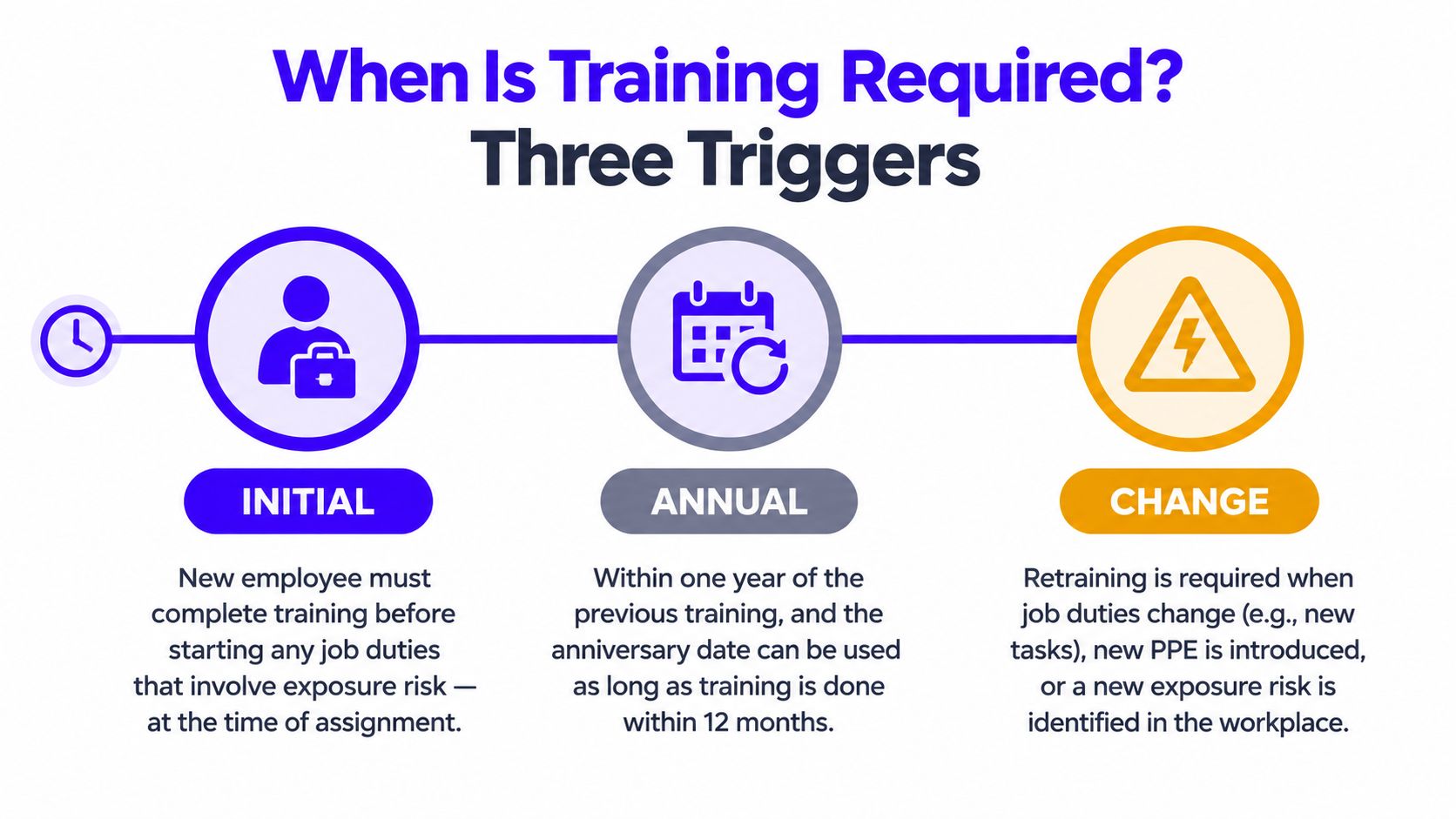
The most common mistake with OSHA bloodborne pathogens training requirements is treating them as a single annual calendar event. OSHA's rule creates three timing triggers.
The three events that matter
Under the standard, covered employees must receive training:
- At the time of initial assignment
- At least annually thereafter
- Whenever changes in tasks or procedures affect occupational exposure
OSHA's regulatory text also makes clear that annual retraining is due within one year of the previous session, and additional training is required when changes in tasks or procedures affect exposure, under 29 CFR 1910.1030.
A practical timeline
A phlebotomist hired in March shouldn't wait for the facility's fall training day. That employee needs training at assignment, before performing exposure-risk duties. If the next full retraining cycle is due the following March, that's the annual trigger. If the lab adopts a new retractable sharps device in October, that's a separate change-based trigger.
That reset point catches a lot of employers. They roll out new containers, updated PPE procedures, or revised specimen workflows and assume the annual class will cover it later. OSHA's framework doesn't work that way. If the change affects exposure risk, employees need additional instruction tied to the new reality of the job.
Missed training dates are visible. Missed change-based retraining is what usually reveals that the program is being run from a calendar instead of from the work itself.
A clean record should show not just that training happened, but which trigger the session satisfied.
Employer Responsibilities Beyond the Annual Class
Employers carry more than a scheduling duty. They have to make the training usable, accessible, and specific enough to support the actual work. Generic slides borrowed from another facility won't do much for a tattoo studio, school clinic, dental practice, or municipal response team.
OSHA expects training to be interactive and site-specific. Workers must have an opportunity to ask questions, and generic computer programs must be supplemented with workplace details such as the location of the exposure control plan and post-exposure procedures, as summarized in CASRAI guidance on bloodborne pathogens training for research personnel.
What employers need to deliver

What works better than attendance alone
A short verbal check at the end of training often reveals more than a roster. Ask a custodian where spill cleanup supplies are stored. Ask a dental assistant who receives the first exposure report. Ask a school nurse where the current exposure control plan is located.
If the room goes quiet, the employer may have completed a training event without building readiness.
Who Counts as Having Occupational Exposure
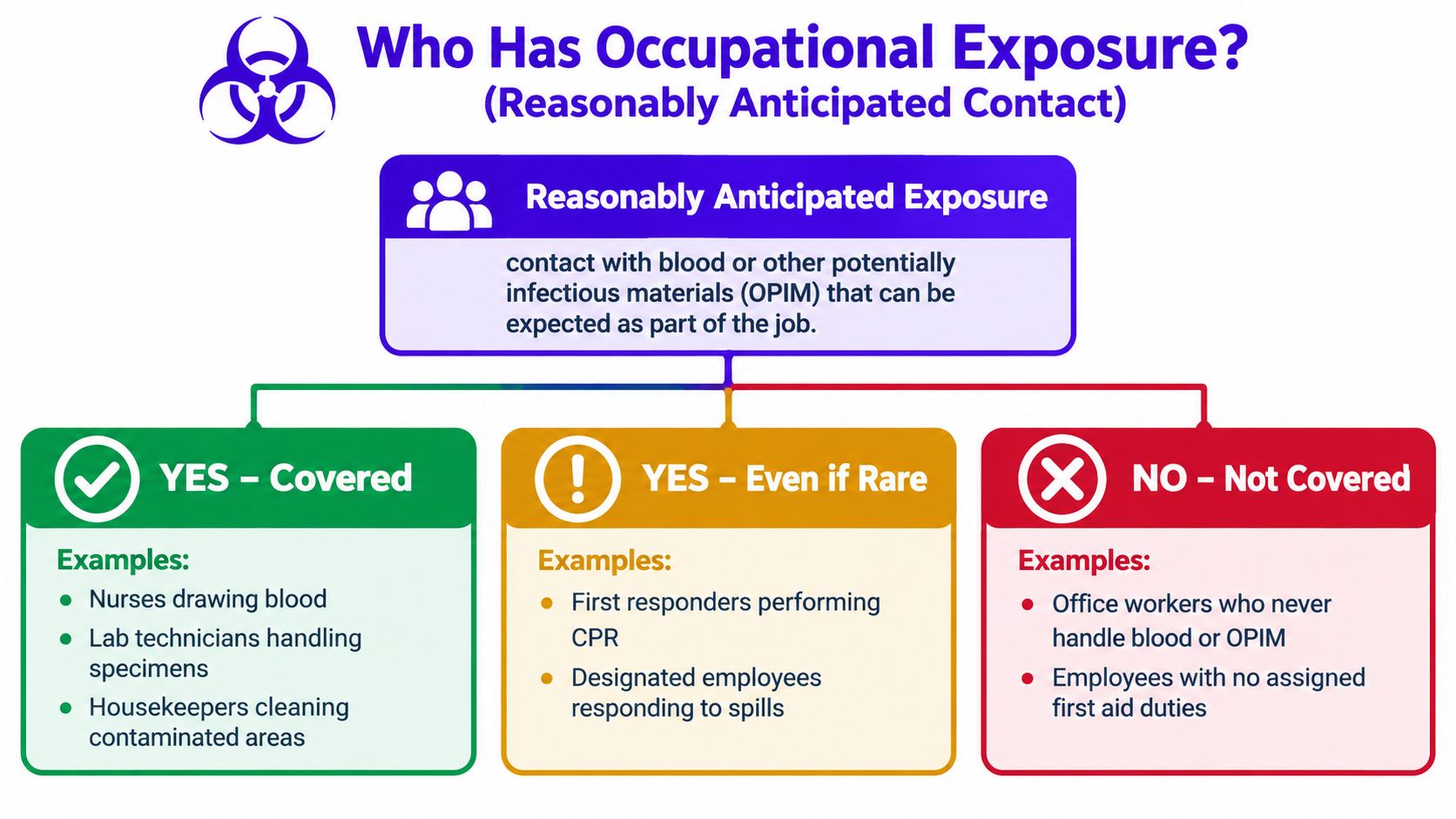
The compliance decisions happen. The standard applies when exposure is reasonably anticipated, not merely possible in theory. That sounds simple until an employer has to classify school staff, contracted cleaners, maintenance workers, or designated first-aid responders.
Roles that are usually covered
A nurse drawing blood is an easy call. So is a lab technician handling specimens, a dental assistant working chairside, or housekeeping staff assigned to clean contaminated areas. First responders and designated employees expected to provide first aid also fit when blood contact is part of assigned duties.
The same logic reaches beyond healthcare. A tattoo artist handling needles and blood contamination issues is usually easier to classify than an office receptionist in the same building.
Borderline roles that often get misclassified
The harder cases are the employees who only encounter exposure risk occasionally, but predictably:
- School staff assigned to injury response
- Janitorial staff expected to clean blood spills
- Supervisors who step into first-aid response
- Maintenance staff who routinely enter treatment or specimen areas
- Contract workers whose scope includes contaminated cleanup
These are the roles that often get left out because the exposure isn't frequent. Frequency isn't the test. Assigned duties are.
If a role predictably moves toward blood or OPIM when something goes wrong, that role deserves a serious exposure review.
For employers trying to map borderline scenarios, this practical overview of what bloodborne pathogens training is can help frame the distinction between awareness and OSHA-covered exposure. The safer practice is to document why a role is included or excluded, rather than relying on informal assumptions.
Recordkeeping and Documentation Requirements
A training file should answer an inspector's questions without forcing anyone to reconstruct events from memory. OSHA requires employers to maintain training records for the length of employment plus three years under the bloodborne pathogens standard at 29 CFR 1910.1030.
What the record needs to show
The rule requires records that identify the training clearly enough to prove what happened, when it happened, and who delivered it. At minimum, an audit-ready file should connect:
- employee names and job titles
- training dates
- a summary or outline of the session content
- the trainer's name and qualifications
A certificate alone usually isn't enough. If the certificate says only “BBP complete,” it won't show whether the required topics were covered or whether the trainer was qualified to answer interactive questions.
A better file structure

A sample paper file might include a roster, content outline, trainer resume or credential note, and a copy of the slide deck with site-specific inserts. An electronic file can do the same thing if it stays organized and retrievable.
Connecting Training to a Real Exposure Control Program
An inspector asks a supervisor how a recent sharps device change was rolled out. The supervisor points to the annual BBP certificate. That answer usually does not hold up well, because the question is whether the facility updated its plan, trained the affected staff on the new device, and kept proof that the change reached day-to-day practice.
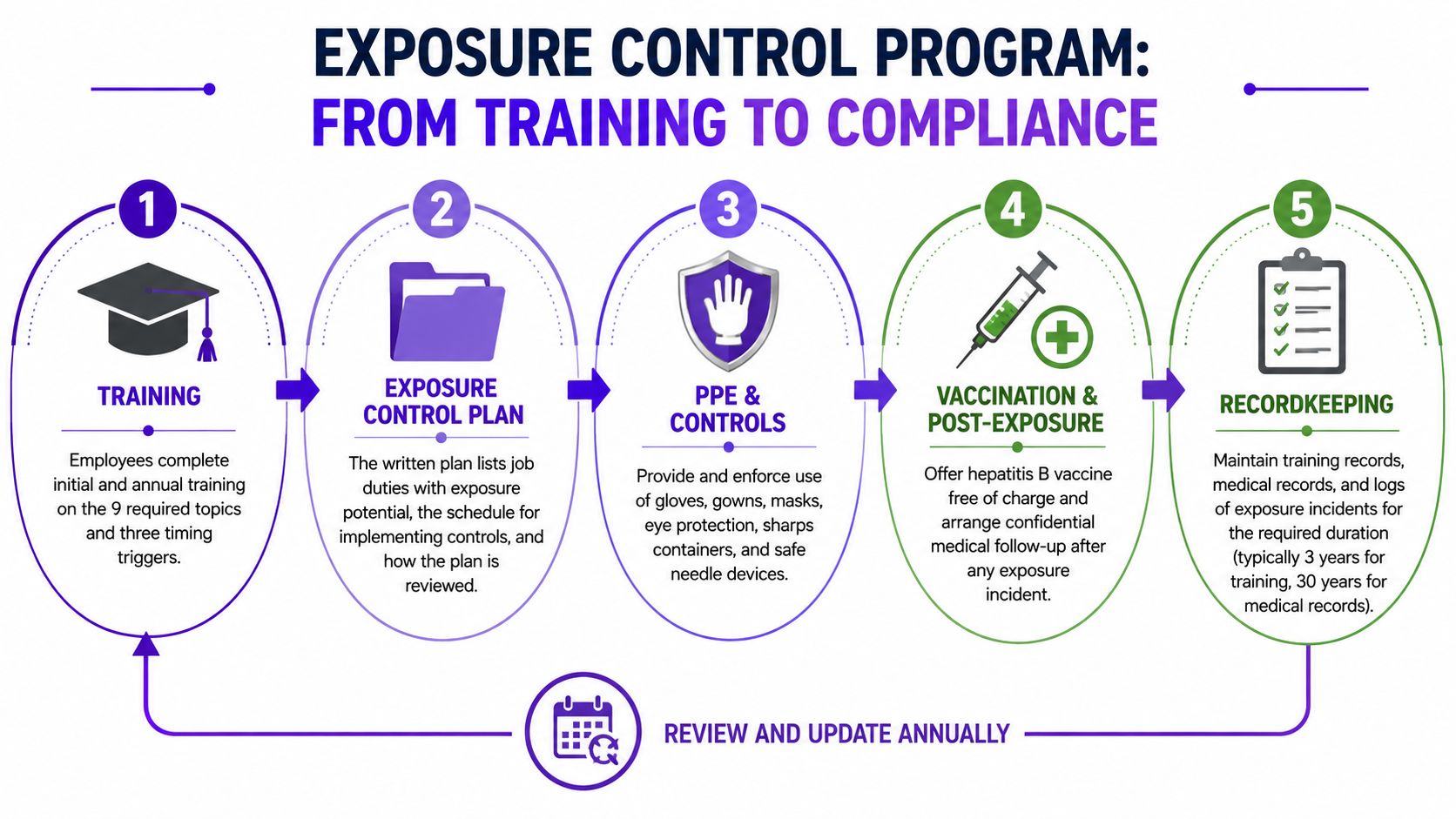
Training belongs inside an exposure-control system. On its own, it shows that people attended a class. Paired with the written plan, device selection, incident review, and site procedures, it shows that the employer is managing actual exposure risk.
That distinction matters during audits and after incidents.
How the pieces should work together
A workable program usually runs in a cycle tied to the tasks that create exposure.
- A task creates foreseeable exposure
Blood draw, specimen transport, spill cleanup, instrument reprocessing, or sharps disposal puts specific employees at risk. - The exposure control plan assigns the response
The plan should identify which roles have occupational exposure, what controls apply, what PPE is used, how waste and sharps are handled, and who receives post-exposure follow-up. - Training turns the written process into job-specific action
Staff need instruction that matches the way work is done in that facility. A generic overview may help with baseline knowledge, but it will not replace site procedures for reporting, device use, cleanup, or access to the plan. - Incidents, near misses, and workflow changes feed program updates
If a splash occurs during specimen handling, or a new lancet system is introduced, the employer should revisit the task, confirm whether controls are still adequate, and update instruction for the affected roles. - Documentation ties the whole system together
The file should show more than course completion. It should connect training activity to plan revisions, device changes, and the jobs affected by those changes.
A concrete example
A clinic changes to a safer sharps device after reviewing an exposure event. Purchasing can document the order, but that is only one piece of the record. A defensible program also updates the exposure control plan, adjusts the procedure used by nurses or medical assistants, and documents that those employees were trained before the new process became routine.
I see this missed often with mixed-role workplaces. The nurse gets updated instruction, but front-desk staff who handle specimen handoff do not. Environmental services receives spill cleanup duties, but no one updates the role-based training. The annual class still gets assigned, yet the actual exposure-control program has drifted away from how work is being performed.
For employers that use a standardized course as part of that process, bloodborne pathogens and infection control training for healthcare staff can cover the core BBP subject matter. It works best when the employer adds site-specific steps, local reporting contacts, device instruction, and direct access to the current exposure control plan.
That is the practical standard. Training should reflect the plan in use, and the plan should reflect the work being done.
Why 2026 Compliance Looks Different From a One-Time Course
The once-a-year course model is aging badly. OSHA's current emphasis places needlestick prevention near the center of bloodborne pathogens compliance, and employers should expect scrutiny beyond whether an annual module was assigned.
OSHA issued a new Bloodborne Pathogens and Needlestick Prevention fact sheet in June 2026, and current OSHA materials emphasize that the exposure-control plan must cover engineering and work-practice controls, training, medical surveillance, hepatitis B vaccination, and other required provisions, as reflected on OSHA's bloodborne pathogens exposure control page.
What that changes in practice
That shift matters because many employers still present compliance as one refresher course per year. Current OSHA-facing guidance points in a different direction. It suggests a living system that includes:
- documented review of the exposure control plan
- attention to engineering and work-practice controls
- safer-device consideration
- medical follow-up and training that stays matched to current procedures
A school setting shows the point well. If the nurse's office changes disposal practices, spill response supplies, or designated responders, those changes should flow into the plan and into employee instruction. A certificate from months ago won't prove that the workforce knows the new process.
Programs survive scrutiny when the paperwork matches the floor. If the written plan says one thing and employees do another, the annual class won't save the employer.
Compliance Checklist for Training and Documentation
A short audit checklist works better than a stack of unlabeled files. The goal is to let a safety lead or HR manager verify coverage quickly and show an inspector where each item lives.
Training
- Current completion: Covered employees have initial or current annual training documented.
- Site-specific content: The materials identify local PPE locations, reporting contacts, and plan access.
- Interactive format: Employees had a real opportunity to ask questions.
- Trainer support: The file includes the trainer's name and qualifications.
Plan
- Current exposure control plan: The written plan is accessible and reflects current tasks.
- Role mapping: Job categories with occupational exposure are listed clearly.
- Control alignment: Device use, cleanup procedures, and response steps match actual work.
Documentation
- Session records: Dates, attendee names, job titles, and content summaries are retained.
- Organized evidence: Sign-in sheets, LMS completions, or acknowledgments are easy to retrieve.
- Cross-references: Related incident, vaccine, or follow-up documentation can be located without hunting.
Follow-up
- Vaccine process: Eligible employees received the required information and offer process.
- Post-exposure pathway: Reporting and evaluation steps are documented and known.
- Change management: New tasks, new devices, or revised procedures trigger added instruction when needed.
A binder or digital folder built around those four groups tends to hold up much better than a folder named “annual OSHA training.”
Frequently Asked Questions on Training Requirements
Do contracted janitorial staff need BBP training
If their assigned duties include cleaning blood or other potentially infectious materials, they should be evaluated under the same reasonably anticipated exposure standard used for direct employees. The deciding factor is the work they perform, not whether they're on the employer's payroll.
Do school cafeteria workers count
Usually not, unless the role includes assigned first-aid response or predictable cleanup of blood or OPIM. A cafeteria worker who might witness an incident isn't the same as a designated responder.
Do construction workers need this training
Not automatically. Construction is often a source of confusion in mixed workplaces. The key question remains whether the worker's assigned duties create reasonably anticipated occupational exposure. Many construction roles won't meet that threshold, but designated first-aid or remediation duties can change the analysis.
Is online-only training enough
Not by itself if it doesn't allow interactive questions and doesn't include site-specific instruction. A generic module can support the program, but employers still need a way to answer questions and explain local procedures, plan access, and post-exposure actions.
How long must records be kept
Training records must be kept for the employee's period of employment plus three years under the bloodborne pathogens standard. Electronic storage can work if records remain accessible and organized.
Can a supervisor conduct the training
Yes, if that supervisor is knowledgeable in the subject matter and can deliver the required content, answer questions, and connect the rule to the facility's actual exposure risks and procedures. Title alone doesn't qualify the trainer. Knowledge and practical command of the subject do.
Is a general awareness course the same as OSHA-required annual training
No. General awareness may help introduce the topic, but OSHA-covered employees need site-specific instruction tied to their duties, controls, PPE, reporting chain, and exposure control plan.
Premiere Education offers bloodborne pathogens and infection control training options that fit individual learners and employer-led compliance programs, along with tools for assignment, tracking, and documentation. For teams that need a course component tied to OSHA expectations and audit-ready records, visit Premiere Education.
Latest Posts





25% off Sitewide→
Use Code: PCECYBERSALE2025→