
.avif)
OSHA Bloodborne Pathogens Course: What It Covers
A staff member finishes a routine task, notices a torn glove, and then sees a small smear of blood on the wrist. A dental worker finds a puncture after a sharp procedure. A school employee helps a bleeding student without knowing whether broken skin was exposed. In each situation, the important question isn't whether the worker intended to take a risk. It's whether the workplace had prepared that person to recognize exposure, prevent it, report it, and obtain follow-up care.
An OSHA bloodborne pathogens course provides that preparation, but the course isn't the entire safety system. Its value depends on how well it connects regulatory requirements with the employer's written Exposure Control Plan, safer devices, work practices, PPE, vaccination procedures, and incident reporting. The federal standard behind that system is 29 CFR 1910.1030, OSHA's Bloodborne Pathogens Standard.
Table of Contents
Why This Training Exists in the First Place
The uncertainty after a needlestick or splash is precisely what structured training is meant to reduce. A worker may need to identify the exposure, provide immediate first aid, report it to the correct supervisor or occupational-health contact, and obtain prompt post-exposure evaluation. A clear overview of these bloodborne pathogens training requirements places those actions within the broader compliance system.
The course is one layer of prevention, much like a map used alongside road signs and traffic controls. It explains the route, but the employer must also provide the written Exposure Control Plan, appropriate equipment, work practices, PPE, vaccination procedures, and incident response. Each part connects to 29 CFR 1910.1030, which gives employers and workers a standard they can check when deciding what the course covers and what must exist beyond the classroom.
The diseases behind the rule
Bloodborne pathogens are infectious organisms that can cause disease when infected blood or other potentially infectious materials reach a worker through a needlestick, contaminated sharp, mucous membrane, or non-intact skin. The standard addresses hepatitis B virus, HIV, and other bloodborne pathogens, while courses commonly include hepatitis C to provide practical disease context.
The health consequences may be serious and long-lasting. Treating blood contact as harmless can lead a worker to delay care or skip reporting, even though documentation and professional evaluation guide follow-up decisions. Personal caution supports safety, but it cannot replace equipment, procedures, training, and a response system.
Why a federal standard matters
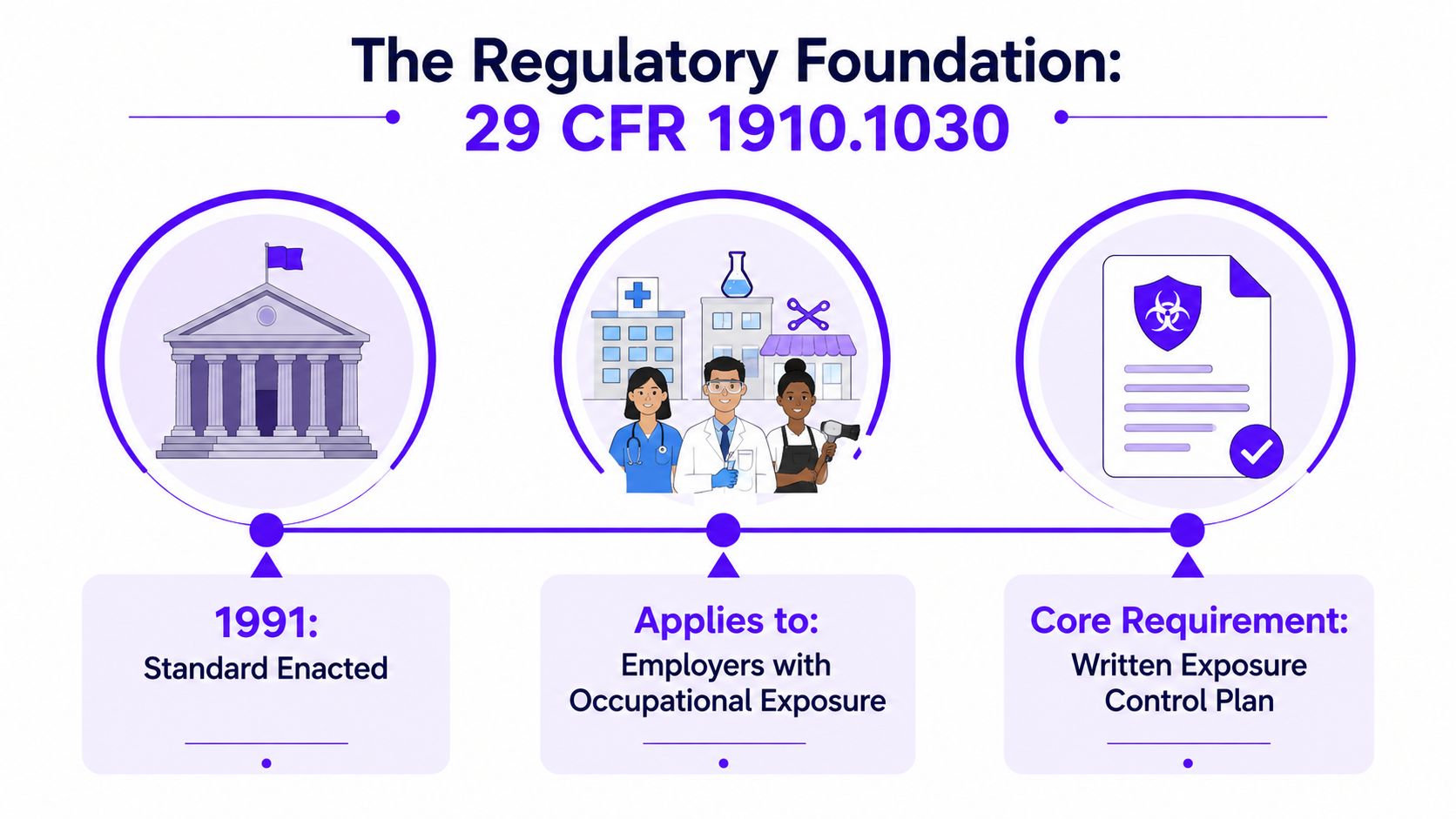
OSHA finalized 29 CFR 1910.1030 on December 6, 1991, and the rule became effective on March 6, 1992. It established coordinated requirements for exposure control plans, engineering controls, PPE, training, vaccination, hazard communication, and post-exposure procedures. The standard has been amended multiple times, including a significant revision connected to the Needlestick Safety and Prevention Act.
OSHA's standard remains the reference point for checking the regulatory foundation. Reading it alongside the employer's plan helps clarify which responsibilities belong to the course and which belong to workplace implementation.
Practical rule: A worker shouldn't have to improvise after an exposure. The course should make the first response familiar before an incident occurs.
The Regulatory Foundation Behind the Course
The course starts with a regulation, not a generic safety slogan. 29 CFR 1910.1030 applies to employers whose workers have reasonably anticipated contact with blood or other potentially infectious materials, commonly abbreviated as OPIM. In plain English, the question is whether the worker's assigned duties could reasonably bring that person into contact with infectious material.
That scope includes obvious clinical roles, such as phlebotomists and nurses, but it can also reach workers in dental practices, laboratories, schools, behavioral-health settings, clinics, and support operations when their assigned tasks create occupational exposure. A school athletic employee who handles bleeding injuries may need a different example set from a hospital worker, but the governing standard still provides the foundation.
The timeline in plain language
OSHA finalized the standard in 1991, and it became effective in 1992. The rule established the basic framework for reducing workplace exposure, including written planning, safer work methods, PPE, training, and post-exposure protections. Its structure explains why a compliant course must address both knowledge and workplace action.
Congress passed the Needlestick Safety and Prevention Act in 2000, and the revised OSHA standard took effect in 2001. The revision emphasized safer needle devices, employee input during device selection, and contaminated needlestick injury logs. One CDC-linked occupational exposure dataset reported 251 of 349 sharps injuries, or 73%, were needlesticks, which helps explain why modern training gives sharps prevention and immediate response such prominence. The historical summary is available through the University of Georgia's occupational exposure training resource.
What occupational exposure means at work
A worker doesn't need to handle blood every minute to fall within the standard. The relevant issue is whether job duties create a reasonably anticipated opportunity for contact. For example, a phlebotomist drawing blood has a direct exposure pathway, while a school employee assigned to clean blood from injuries may have a different but still foreseeable risk.
Employers must provide training at initial assignment and at least annually, with the annual refresher completed within 12 months of the previous training. The training must be free to the employee, provided during working hours, and delivered at an appropriate educational level. The federal regulation text also supports a practical point for managers: annual training doesn't have to repeat every slide, so relevant examples and updated workplace scenarios can make recurring instruction more useful.
What Every Compliant Course Must Actually Cover
A course description that says only “bloodborne pathogen awareness” doesn't give a buyer enough information. The content should connect the rule to the worker's actual tasks and explain what happens before, during, and after an exposure.
The required knowledge base
The first layer explains the hazards. Learners should receive an accessible discussion of bloodborne diseases, their epidemiology, signs and symptoms, and the ways pathogens can be transmitted. A phlebotomist needs to connect a contaminated needle with a puncture risk. A school employee needs to recognize that blood contacting broken skin or the eyes, nose, or mouth can require immediate action.
A complete course should then address the employer's Exposure Control Plan. Employees need to know where the plan is kept, how to obtain a copy, and how it relates to their assigned duties. The course should also help learners identify tasks with occupational exposure, rather than leaving them to interpret the regulation alone.
Controls that change behavior
Prevention content should distinguish among engineering controls, work practice controls, and PPE. A safety-engineered needle is an engineering control. Activating the safety feature, avoiding recapping, and placing a contaminated sharp into the correct container are work practices. Gloves, gowns, masks, and eye protection are PPE, selected according to the task and exposure route.
The OSHA-compliant bloodborne pathogens and infection control training course page is an example of the kind of topic alignment a buyer can examine when comparing course options. The course itself still needs to fit the employer's site-specific procedures.
Vaccination, response, and communication
Training should explain hepatitis B vaccination and the employer's process for offering it to workers with occupational exposure. It should also cover post-exposure procedures, including whom to contact, how to report the incident, and how evaluation and follow-up are arranged.
Signs, labels, and color-coded containers matter because workers often make disposal decisions under time pressure. A red or biohazard-marked container isn't decoration. It communicates a handling and disposal requirement that should be reinforced through examples.
For organizations managing both training completion and incident documentation, a unified app for compliance teams can help connect assignments, records, and reports. That kind of tool supports administration, but it doesn't replace the employer's Exposure Control Plan or the worker's understanding of safe practice.
The Exposure Control Plan as the Course's Backbone
The course gives workers a framework. The employer's written Exposure Control Plan tells them how that framework operates in a particular workplace. Any employer with occupational exposure must maintain the plan, make it accessible to employees, and review and update it at least annually and whenever new tasks, procedures, or employee positions affect exposure risk. The plan requirements are summarized in this exposure control plan reference.
A clinic provides a useful example. Suppose it adds a new point-of-care blood collection device. The compliance lead can't place the device in a supply cabinet and wait for the next annual training cycle. The employer should evaluate the device, consider employee input where required, identify the related exposure risks, and update the plan to reflect the new workflow.
What changes inside the plan
The revised plan may identify:
- Device use: Which employees may use the collection device and what steps activate its safety feature.
- PPE selection: Which gloves, eye protection, gowns, or other barriers the task requires.
- Disposal procedures: Where the sharp goes immediately after use and which container accepts it.
- Exposure response: Who receives the report and where the worker obtains evaluation.
- Training connection: Which employees need instruction before using the new device.
The course should teach employees how to find and use this information. A general lesson about sharps cannot answer a site-specific question such as where a particular clinic keeps its exposure report form or which occupational-health service handles follow-up.
The slide deck teaches principles. The Exposure Control Plan turns those principles into assigned workplace actions.
That distinction matters during an inspection and during an actual incident. An employer may have a polished online completion record, but the record doesn't prove that workers know the current procedures for a newly introduced device. Managers should audit the plan alongside the course rollout, not treat training completion as a substitute for plan maintenance.
What the Training Looks Like in Real Workplaces
The same standard that governs dental offices also shapes how schools, clinics, and laboratories handle blood contact. A useful course translates 29 CFR 1910.1030 into actions workers can recognize at their own sites, while showing which procedures must come from the employer's Exposure Control Plan.
In a dental office, that may mean explaining how to activate a safety feature, place a contaminated sharp directly into a puncture-resistant sharps container, and avoid recapping, bending, removing, shearing, or purposely breaking it. If an incident occurs, the worker reports it through the employer's process and seeks the required post-exposure evaluation. These lessons connect to the standard's requirements for engineering controls, work practices, PPE, and exposure response. Workers who handle contaminated materials can also read the OSHA guide from WipesBlog.com for practical cleanup and exposure-control context.
The school setting
School examples need to reflect school duties. A coach assisting a student with an open wound should use appropriate gloves, limit contact with blood, protect exposed skin, and follow the school's cleanup and reporting procedure. The coach does not diagnose the student or guess about infection status. The control is consistent treatment of blood and other relevant potentially infectious materials as workplace hazards.
The course should identify where the school keeps PPE, who handles cleanup, how an exposure is reported, and what to do if blood reaches the eyes, mouth, or broken skin. Those details support the standard's training and exposure-control requirements, but the site's own plan must supply names, locations, and reporting routes.
The splash exposure
For a phlebotomist who sees a coworker splashed in the eyes, the sequence is immediate and procedural: use the designated flushing method, notify the responsible supervisor or occupational-health contact, document the event, and follow the employer's post-exposure evaluation process.
The settings differ, while the regulatory framework remains the same. Realistic examples help learners connect each required element of 29 CFR 1910.1030 to a decision they may need to make at work. The course teaches the general rule. The workplace plan supplies the local instructions.
Why a Course Alone Is Not the Whole Answer
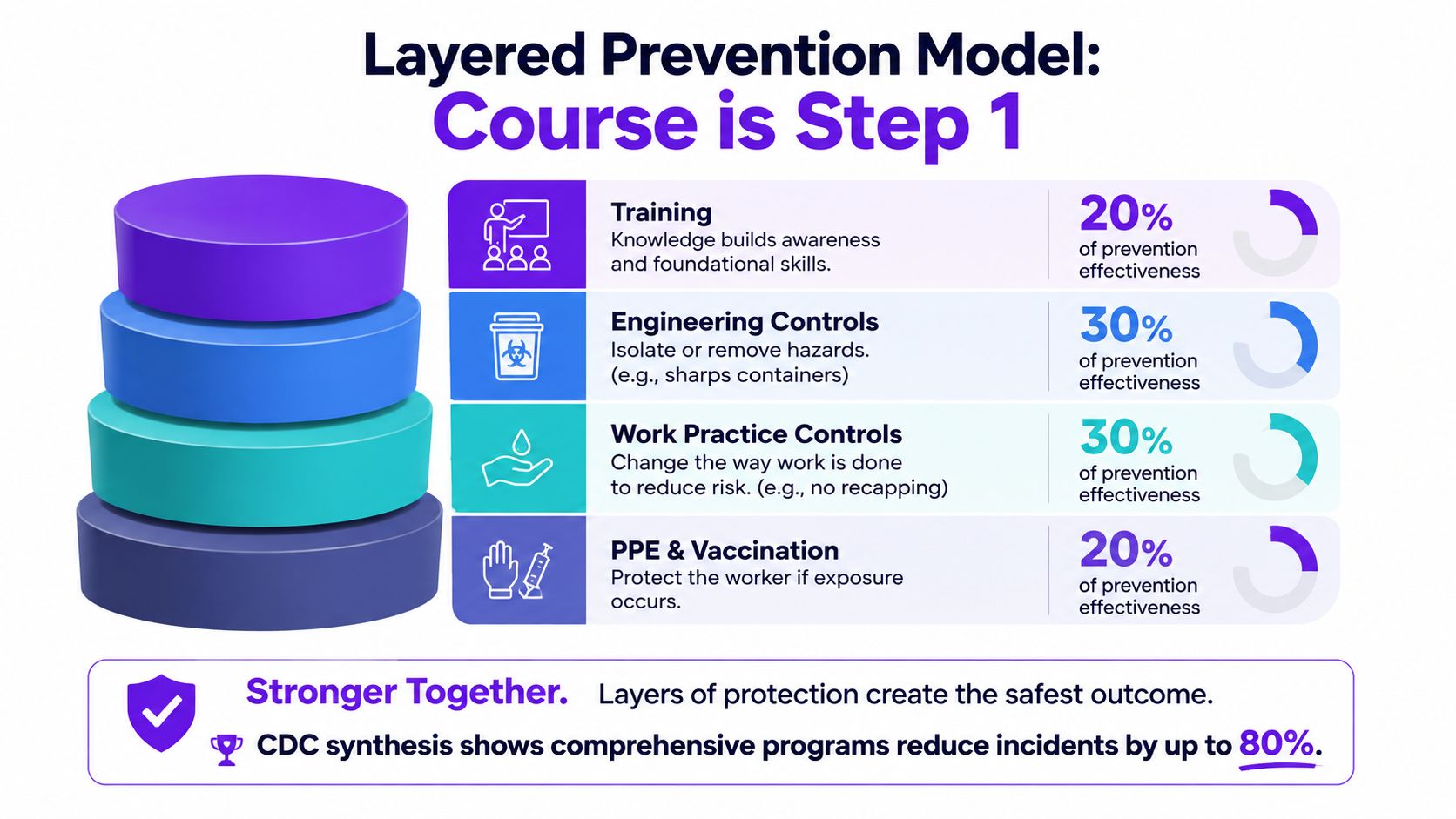
A nurse reaches for a sharps container and finds it overfilled. A teacher has gloves but no clear route for reporting a blood exposure. In both situations, the course is only one layer in a prevention system. Effective protection combines instruction with engineering controls, work practice controls, PPE, vaccination, and post-exposure workflows, as required and described through 29 CFR 1910.1030.
A CDC-reviewed synthesis found that training alone reduced needlestick injuries, with a summary effect of 0.66. Safety devices alone had a summary effect of 0.51, while training paired with safety devices had the strongest result, with a summary effect of 0.38. The figures appear in the CDC-reviewed synthesis of interventions for needlestick prevention.
The operational layers
A hospital may assign annual training while leaving workers with unsuitable sharps containers. A dental office may purchase safety devices without showing staff how to activate or discard them. A school may stock gloves yet lack a clear process for reporting a splash exposure. These gaps connect directly to the employer's duties under 29 CFR 1910.1030, especially the Exposure Control Plan, methods of compliance, PPE, vaccination, and post-exposure evaluation.
A workable program joins the pieces:
- Engineering controls: Safety-engineered sharps and needleless systems reduce dependence on perfect hand movements.
- Work practice controls: No recapping, prompt disposal, hand hygiene, and task-specific procedures reduce opportunities for contact.
- PPE and vaccination: Barriers protect exposed entry points, while hepatitis B vaccination supports worker protection.
- Response systems: Reporting, medical evaluation, documentation, and follow-up give an incident a defined path.
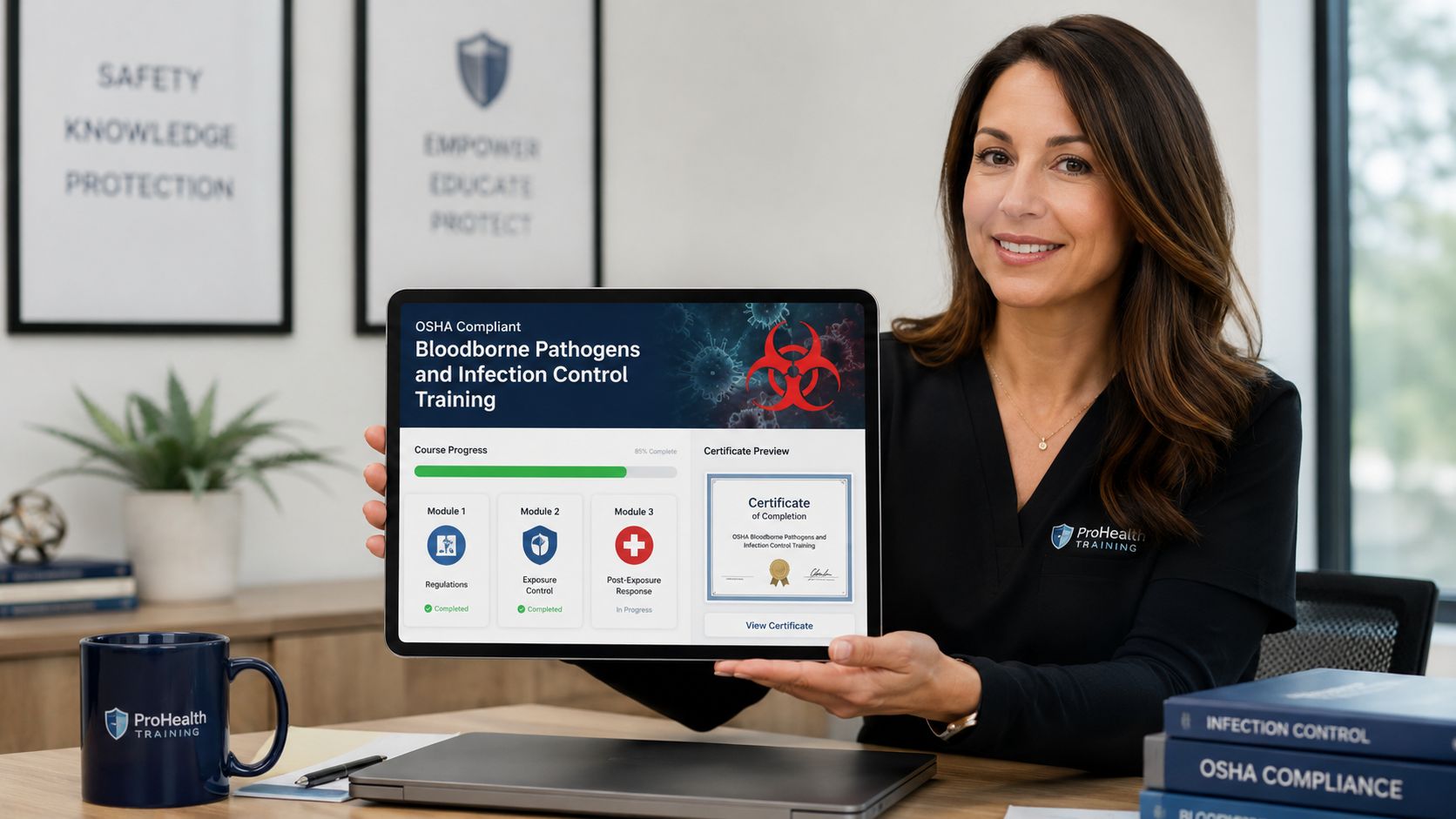
The OSHA Compliant Bloodborne Pathogens and Infection Control Training 3HR addresses the standard alongside practical infection-control topics such as hand hygiene, PPE, and exposure prevention. Employers still need to connect that instruction to their own equipment, procedures, Exposure Control Plan, and reporting contacts.
How Online OSHA Courses Meet the Standard
Online delivery satisfies the training format requirement when course content, timing, educational level, and employer procedures align with 29 CFR 1910.1030. A worker should receive instruction before assigned exposure-prone duties, repeat it within the required cycle, and connect each lesson to tasks performed at the facility. The screen is only the classroom. The employer's procedures complete the lesson.
What buyers should verify
A manager comparing providers should check whether the course:
- Matches 29 CFR 1910.1030: It covers disease risks, transmission, the Exposure Control Plan, controls, PPE, vaccination, labels, and post-exposure procedures.
- Fits the schedule: It supports training at initial assignment and annual retraining within 12 months of the previous session.
- Uses appropriate instruction: Its language and educational level suit the employees taking the course.
- Supports documentation: It provides completion records or certificates the employer can retain.
- Works across shifts: Learners can pause and resume without losing progress, supporting clinical, school, and variable schedules.
- Supports administration: Assignment tools, completion tracking, and reports reduce manual follow-up.
Interactive questions, brief scenarios, narration, and knowledge checks connect a regulatory rule with a workplace task. For example, a question about contaminated sharps can prepare a learner to recognize the correct control, while the employer still explains the facility's equipment and procedure.
The course also should make its boundaries clear. It can teach the requirements mapped to 29 CFR 1910.1030, but it cannot replace the employer's own Exposure Control Plan, reporting contacts, or local instructions. Employers must provide required training at no cost and during working hours, then schedule it as part of the job rather than shifting that burden to employees.
A practical discussion of selecting and managing online instruction appears in these OSHA compliance training tips.
Your Practical Next Steps After This Guide
A learner can turn the standard into a personal checklist. Before starting an OSHA bloodborne pathogens course, the worker should confirm that the course addresses the required OSHA topics and that the employer has identified which duties create occupational exposure.
For the individual learner
- Find the plan: Ask where the current Exposure Control Plan is stored and how employees obtain a copy.
- Check the course content: Look for transmission, disease information, controls, PPE, hepatitis B vaccination, labels, and post-exposure procedures.
- Use workplace examples: Match course scenarios to actual tasks, such as drawing blood, cleaning a spill, handling contaminated laundry, or responding to a bleeding student.
- Save the record: Keep the certificate or completion record according to the employer's documentation process.
- Know the deadline: Complete the annual refresher within 12 months of the previous training and before undertaking newly assigned exposure-prone duties.
For the manager or compliance lead
The manager should verify that the provider's course is appropriate for the organization's employees and that the employer supplies the training at no cost during working hours. The administrator should also document the training cycle, retain completion records, confirm that employees can access the Exposure Control Plan, and review the plan when tasks, devices, or positions change.
A clinic adding a new blood collection device should audit the plan, PPE list, disposal method, reporting workflow, and employee instruction together. A school district should perform the same check when athletic, nursing, custodial, or first-aid responsibilities change.
The shared checkpoint
During the next seven days, the learner and manager can complete three actions: locate the current plan, compare the selected course with the required content, and identify the exact reporting path for a needlestick or splash. That small review turns annual training from a certificate exercise into a practical readiness check.
Premiere Education offers online continuing education and compliance courses for healthcare, education, and adjacent professionals, including OSHA Bloodborne Pathogens and infection-control training. Organizations and individual learners can review the relevant options at Premiere Education and connect course completion with their broader documentation process.
Latest Posts





25% off Sitewide→
Use Code: PCECYBERSALE2025→