
.avif)
5 Online CME Courses for Physician Assistants

A physician assistant finishes a full clinic day, still needs CME that fits around patient care, and doesn't want a certificate that becomes difficult to verify at renewal. The right online course must match the PA's specialty or compliance gap, use an accepted credit designation, work in the available delivery format, and leave documentation that an employer or licensing authority can understand. The best choice depends on the learner's clinical goals and state rules, not solely on the size of a course catalog.
The five options below represent different use cases, from focused clinical education to state-specific compliance training. They shouldn't be treated as a universal ranking. Before enrolling, each reader should verify current accreditation, AAPA or AMA PRA Category 1 Credit™ eligibility, fees, expiration dates, and state-board acceptance directly with the provider. A PA building a broader professional-development plan can also review courses that improve your practice.
1. California Responsible Beverage Service Training
A California PA working in occupational medicine, urgent care, emergency medicine, or community health may encounter injuries, intoxication, unsafe consumption, and questions about alcohol-related risk. The California Responsible Beverage Service Training course is designed for a different professional setting, alcohol service and delivery, so its relevance depends on the learner's actual compliance need.
That distinction matters. A PA searching for CME for physician assistants online may find a state-specific course that looks useful because it addresses public safety, but a course's subject matter doesn't automatically make it acceptable for NCCPA certification or state licensure. The provider should confirm whether the activity carries PA-eligible CME, which credit category applies, and whether the learner's board or employer accepts it.
The course's practical value is strongest for professionals connected to hospitality operations, workplace training, public-health programs, or organizations that oversee alcohol service. It addresses the laws, risks, and responsibilities associated with serving alcohol in California, including recognizing warning signs and supporting responsible service. For a PA who advises an employer on workplace safety or participates in community prevention work, that context may be more useful than another broad clinical survey.
Where this option fits
Premiere Education lists the course under alcohol-service-and-delivery and presents it as a first-party product in its own catalog. That makes the enrollment path straightforward, but it doesn't remove the need to validate credit eligibility. A PA should open the course details, review the stated approval information, and save the provider's documentation before starting.
The practical workflow is simple:
- Define the use case: Decide whether the course supports a California workplace or public-safety responsibility rather than assuming it will satisfy clinical CME.
- Verify credit status: Confirm the exact credit designation, accrediting body, and eligible profession with Premiere Education.
- Match the renewal rule: Check the relevant NCCPA, employer, or state-board requirement before counting the course toward a cycle.
- Retain proof: Save the completion certificate, course title, completion date, and any approval details.
A useful explanation of the training context appears in Premiere Education's article on what professionals need to know about RBS training. The course works best when the PA needs a targeted California responsibility module, not when the PA needs general clinical credits quickly.

2. Fundamentals of Alzheimer's Disease for Healthcare Providers
A PA in primary care, geriatrics, neurology, home health, or long-term care often needs education that can be applied during an actual family conversation. A patient may present with memory concerns, a caregiver may need guidance, and the clinician must separate a routine complaint from a problem requiring further assessment. The Fundamentals of Alzheimer's Disease for Healthcare Providers course fits that clinically oriented use case more naturally than the previous option.
The course addresses risk factors, diagnosis, treatment, and evidence-based strategies for patient support. Those topics give a PA a practical framework for connecting clinical assessment with communication and care planning. The value isn't just in naming disease features. It lies in helping the learner organize the next conversation, clarify uncertainty, and direct patients and caregivers toward appropriate support.
Clinical relevance before credit volume
Specialty relevance ranks high for this option. A PA who sees older adults regularly may gain more from a focused dementia course than from a general activity selected only because it is available on demand. At the same time, the course should be counted only after the provider confirms its CME designation and the applicable board accepts it.
The online format can fit a busy workflow when the learner needs to study between clinic obligations rather than attend a scheduled conference. A PA might complete part of the activity after reviewing charts, return to it later, and record the certificate with the rest of the renewal documentation. Whether that flexibility is available, and whether a course expires, should be checked on the product page before purchase.
Premiere Education categorizes the course under alzheimers-and-dementia-2 and identifies it as a first-party course in its catalog. The provider also publishes a clinical resource covering Alzheimer's treatment for healthcare workers, which can help a learner judge whether the subject aligns with current responsibilities.
Clinical fit matters: A course earns its place in a PA's learning plan when its content changes how the PA assesses, explains, documents, or follows up on a patient problem.
The accompanying course image reflects the underlying subject clearly.
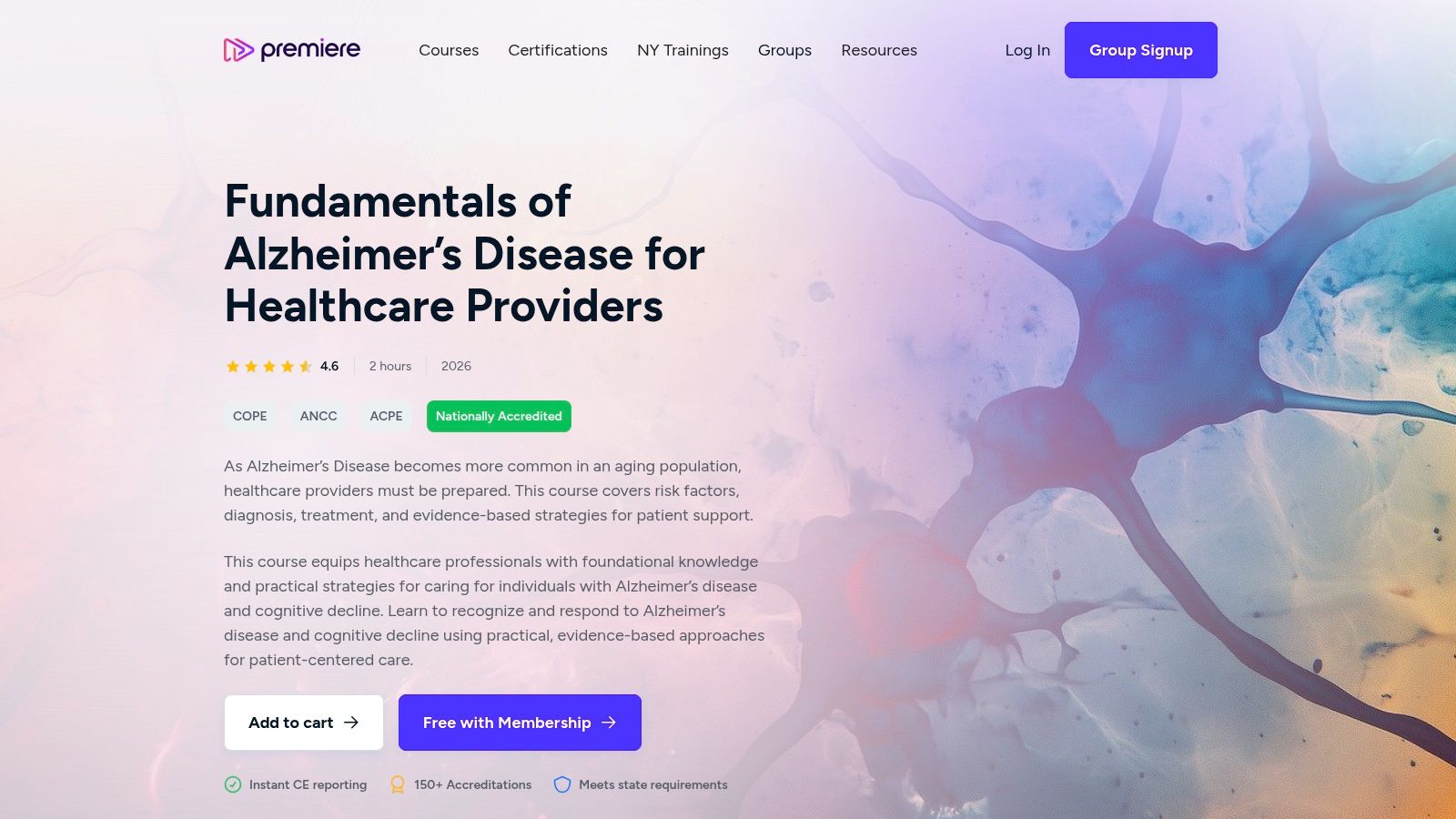
This option is strongest for a PA who wants focused neurological and caregiver-support education. It isn't automatically the best choice for a PA seeking a state-mandated topic, a live participation requirement, or a particular Category 1 threshold. Those decisions require a direct check of the current course record and the PA's renewal rules.
3. Human Trafficking for Healthcare Providers An Analysis of Cases
Trafficking is often hidden inside a routine chief complaint. A PA can use case analysis to move from a concerning observation to a safe, appropriate referral. The Human Trafficking for Healthcare Providers An Analysis of Cases course supports that process by connecting recognition, communication, referral, and compassionate care. Its subject is most relevant to PAs in emergency departments, pediatrics, urgent care, sexual-health services, and other settings where patients present without scheduled appointments.
The case-based format gives the topic practical value. A learner can examine how details such as an inconsistent history, anxiety, infection, or injury may require a safeguarding response alongside routine clinical care. The course does not replace local policy. Before applying its guidance, the PA should review the organization's safeguarding procedure, escalation pathway, privacy rules, and referral contacts.
From recognition to safe action
Premiere Education lists the activity under violence-and-abuse-prevention, infection-control-and-safety, and a popular category. These tags help with course discovery, but they do not establish board approval or CME credit. Confirm whether the activity is designed for the PA profession, what credit it issues, and whether the relevant state board accepts it for a mandated topic.
A practical workflow connects the course to the PA's existing responsibilities:
- Before enrollment: Locate the local policy for suspected exploitation and identify who receives a concern.
- During the course: Record observable indicators, communication risks, and referral principles that fit the patients the PA treats.
- After completion: Save the certificate and note how the activity relates to an employer requirement or state rule.
- At renewal: Count the activity only under the designation confirmed by the provider and relevant authority.
Premiere Education also publishes guidance on recognizing signs of human trafficking in hospitals and pediatric care. A practice manager can use that resource to support a team discussion, while the formal course record and local safeguarding protocol remain the documentation and operational references.
A completion certificate proves participation. It does not replace a clinic's escalation process, reporting duties, or clinical judgment.
The course image conveys the seriousness of the subject without presenting it as entertainment.
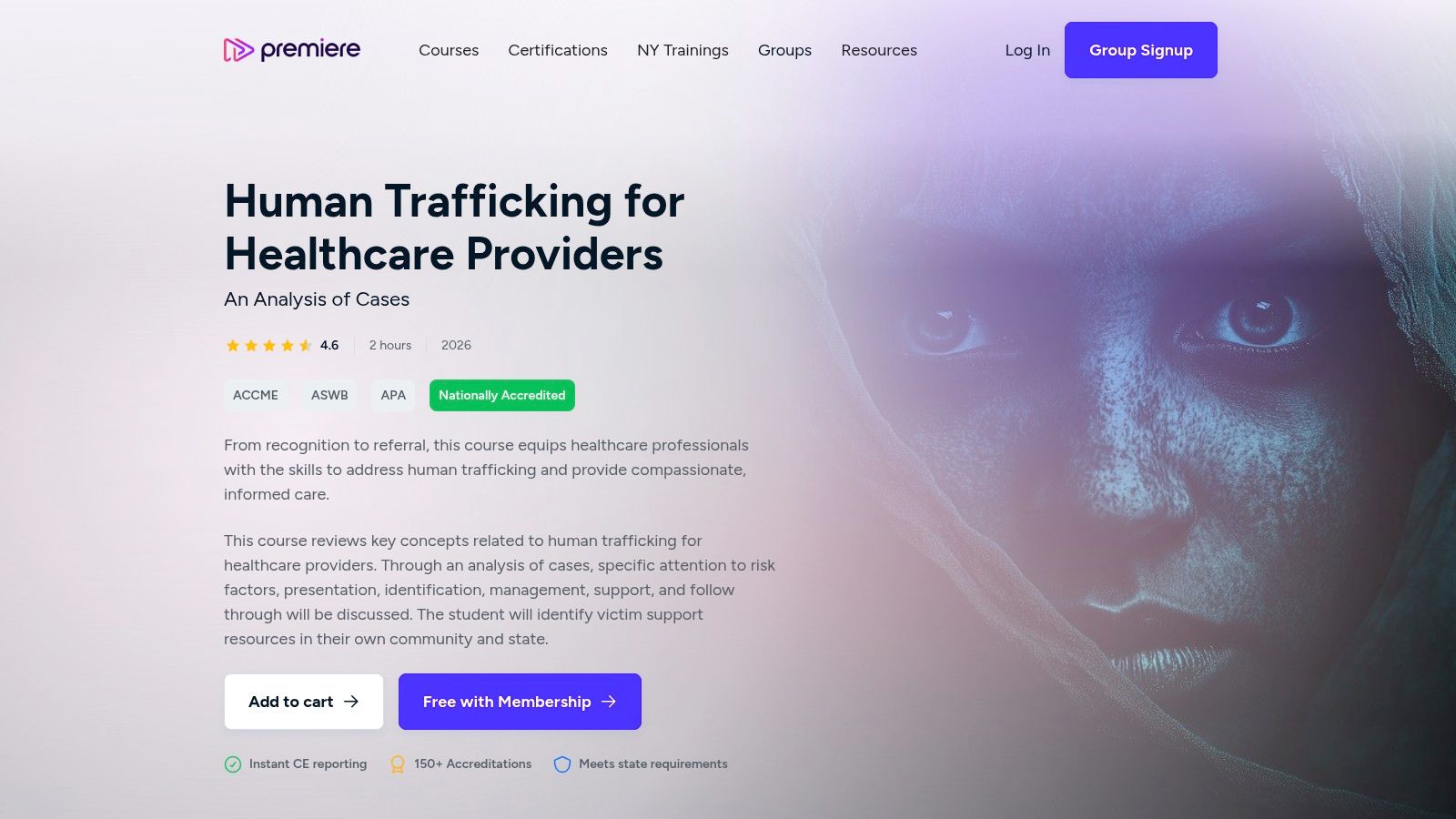
Choose this option when the PA's learning gap involves recognizing and responding to vulnerable-patient concerns. A specialty treatment course or a high-volume credit plan may fit better when those are the immediate priorities. Check specialty relevance, credit verification, delivery requirements, pricing transparency, and licensure documentation before adding it to a renewal plan.
4. Implicit Bias Training For Healthcare Providers
When two patients present with identical chest pain but one is referred to cardiology and the other is sent home with follow-up, implicit bias may be operating below awareness. Implicit Bias Training For Healthcare Providers examines how unrecognized assumptions can affect treatment decisions, communication, and outcomes. Premiere Education presents the Implicit Bias Training For Healthcare Providers as a first-party course rather than an external directory listing.
The useful question is what changes after completion. A PA can apply the material to intake questions, pain assessment, interpreter use, shared decision-making, triage language, and documentation. A clinic can assign the course through its group portal and schedule a 15-minute debrief where staff map one bias finding to a documented intake change.
A reflective course needs operational follow-through
Premiere Education categorizes the activity under implicit-bias, cultural-competence-and-humility, and a popular category. Those labels describe the course context, but they do not prove that it meets a particular PA CME rule. Before enrolling, verify the credit type, approval status, completion requirements, and whether the relevant state board accepts online delivery for the topic.
The strongest use case pairs reflection with a defined workflow review. A PA might check whether notes consistently record patient preferences, whether language access is available, and whether standardized education materials are offered. A manager can use group completion reporting to identify unfinished assignments, then review one patient-facing process with the team. Completion alone does not show that care improved.
Use this decision test:
- For reflection: Choose the course when communication, cultural humility, or equitable care is the learning gap.
- For a mandate: Enroll only after confirming that the activity matches the exact state or employer requirement.
- For team learning: Schedule a short debrief and assign one procedure change, such as a revised intake prompt or interpreter-use check.
- For renewal: Save the certificate with the verified credit designation instead of relying on a catalog label.

This option fits a PA or clinic addressing communication and cultural competence. A specialty treatment course may serve a more immediate clinical gap, while a high-volume credit plan may better support renewal coverage. Compare specialty relevance, credit verification, delivery format, pricing transparency, and licensure documentation before adding the activity to a renewal plan.
5. Minnesota Bloodborne Pathogens Training for Body Art Professionals
The fifth option is deliberately narrow. Minnesota Bloodborne Pathogens Training for Body Art Professionals is designed around body-art practice, bloodborne pathogen risks, precautions, and compliance in Minnesota. For most PAs, it won't be a routine clinical CME choice. For a PA who consults with body-art businesses, supports occupational-health programs, or oversees infection-prevention education in an adjacent setting, the course may address a specific responsibility that a general medical activity misses.
The key trade-off is specialization versus transferability. A narrowly scoped course can be highly relevant to a defined workplace, but it may have limited value for a PA whose renewal plan requires clinical topics or a particular CME category. The course's title and catalog categories should prompt verification, not an assumption that the activity counts toward certification maintenance.
Verify the rule before counting the course
Premiere Education lists the training under body-art, bloodborne-pathogens, and infection-control-and-safety. That positioning makes the intended audience clear. A PA should compare the course's stated audience and credit information with the actual requirement, especially if an employer needs OSHA-related documentation, a local public-health authority has a specific mandate, or a state board requires PA-eligible credits.
A practical example is a PA serving as a medical advisor for a tattoo studio. The PA could use the course to understand exposure risks, prevention procedures, and training expectations, then review the studio's written exposure-control plan with the appropriate safety personnel. The certificate would document course completion, but it wouldn't by itself prove that the studio's entire compliance program is adequate.
The course should be evaluated through four checks:
- Audience check: Confirm that the activity is appropriate for the learner's role and intended use.
- Credit check: Ask Premiere Education whether PA CME is issued and identify the exact credit designation.
- Authority check: Verify acceptance with the Minnesota authority, employer, or other organization that requested the training.
- Record check: Keep the certificate, completion date, course title, and approval information together.
The image represents the training's infection-control focus.

This option works when a PA has a defined Minnesota body-art or occupational-safety responsibility. It doesn't work as a generic replacement for a clinically relevant PA CME plan.
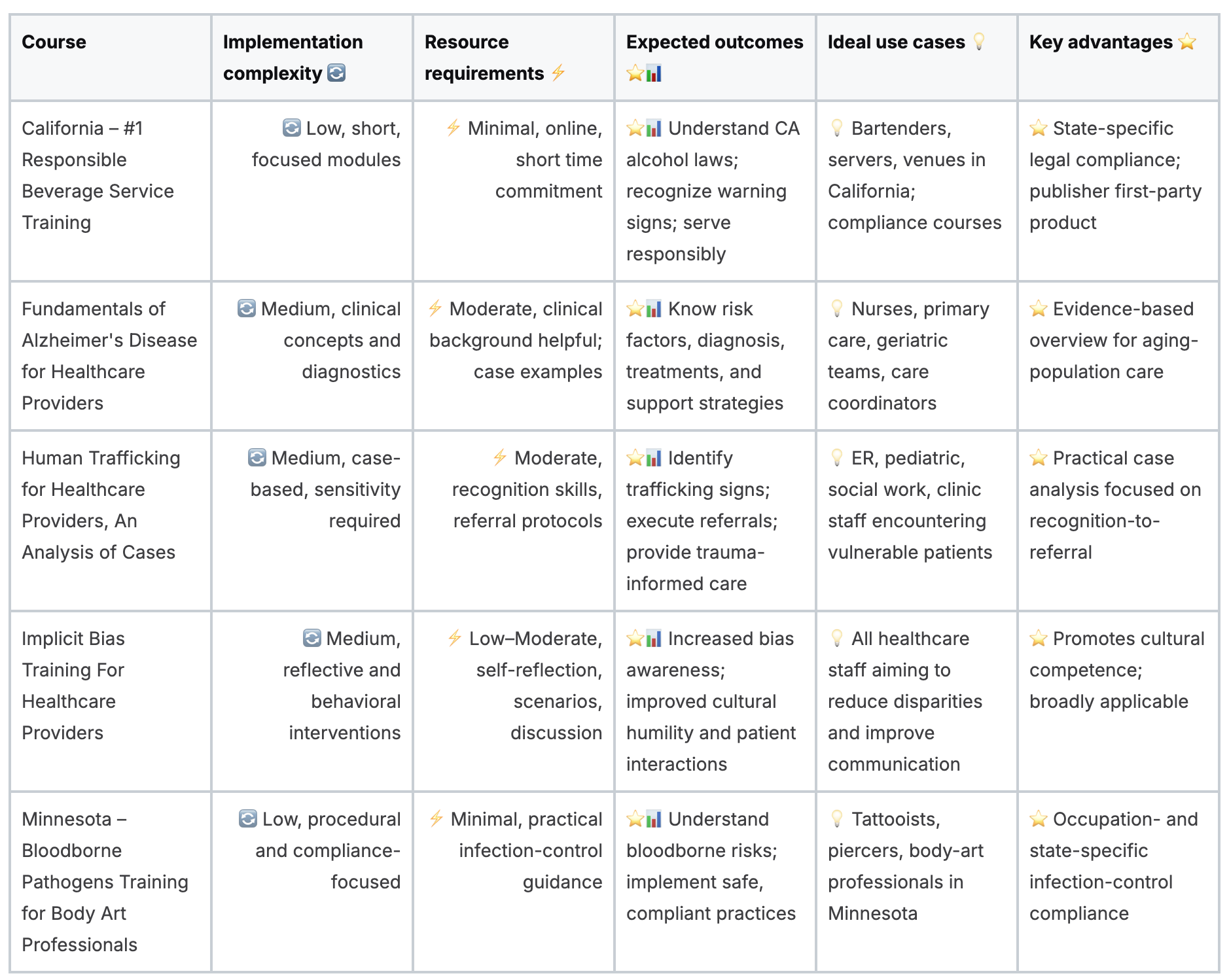
PA Online CME, 5-Course Comparison
Turn Online CME Into Renewal-Ready Records
A PA's renewal plan should start with the gap, not the catalog. If the goal is certification maintenance, NCCPA requires 100 CME credits every two years, with at least 50 Category 1 credits. The remaining credits can be Category 1, Category 2, or a combination, as described by NCCPA's CME requirements. That rule creates a useful starting point, but it doesn't answer every state or employer question.
State requirements can add topics, documentation rules, or alternative proof. Florida, for example, requires 100 total CME hours per two-year licensing biennium, including 50 Category I hours, plus specified modules such as prevention of medical errors and domestic violence, with HIV/AIDS required for first renewal, according to the Florida Board of Medicine's PA guidance. Mississippi takes a different approach, allowing NCCPA-certified PAs to demonstrate current certification as proof of state compliance, according to the Mississippi State Board of Medical Licensure.
Before purchasing any online course, the learner should:
- Identify the gap: Decide whether the activity addresses clinical practice, certification, a state mandate, employer training, or more than one purpose.
- Confirm the credit: Verify the exact designation, accrediting organization, PA eligibility, and whether the activity is Category 1 or another accepted type.
- Check the rule: Compare the course with the applicable NCCPA, state-board, employer, and controlled-substance requirements.
- Review delivery and price: Confirm whether the course is self-paced, live, blended, time-limited, or subject to additional fees.
- Save the evidence: Download the completion certificate and retain the course description and approval information.
A simple renewal log should include the course title, provider, completion date, credit type, number of credits, certificate location, and supporting documentation. That record reduces last-minute searching and makes an audit conversation more straightforward. Online tracking is especially useful because NCCPA's certification-maintenance history includes web-based CME logging, reflecting the role of digital documentation in PA credentialing.
Premiere Education can serve as a broader option for self-paced healthcare education, certificates, tracking, and reporting where applicable. Its catalog spans healthcare and adjacent professional topics, but a PA should never assume that a specific course satisfies PA CME or licensure requirements without confirmation from the provider and the relevant authority.
Premiere Education offers self-paced continuing education, professional certificates, tracking, and documentation tools across healthcare and related fields. PAs and clinical teams can review the catalog, confirm course-specific credit details, and choose training that fits their practice and renewal workflow by visiting Premiere Education.
Latest Posts





25% off Sitewide→
Use Code: PCECYBERSALE2025→