
.avif)
What Is Bloodborne Pathogens Training and Who Needs It

Bloodborne pathogens training is OSHA-required safety training under 29 CFR 1910.1030 for anyone with occupational exposure to blood or other potentially infectious materials, required at initial assignment and at least annually thereafter at no cost during working hours. Additional training is required when changed tasks or procedures affect exposure risk.
A dental assistant reaches for a used instrument, a school employee helps a child with a bleeding cut, or a nurse disposes of a needle after an unexpected procedure. Each situation can turn routine work into an exposure event if the worker doesn't recognize the hazard or follow the right controls. The training exists to make the safe response familiar before pressure makes decisions harder.
Introduction to Bloodborne Pathogens Training
Bloodborne pathogens training teaches workers how to recognize blood and other potentially infectious materials, prevent contact, use protective equipment, handle contaminated items, and respond after an exposure. It connects everyday actions, such as changing gloves or disposing of a sharp, to the employer's written safety procedures.
Core definition: Bloodborne pathogens training is recurring workplace safety instruction that helps employees prevent occupational exposure and respond correctly when exposure may occur.
The word recurring matters. OSHA's Bloodborne Pathogens Standard requires employers to train each employee with occupational exposure at initial assignment and at least annually afterward. The annual refresher must be completed within one year of the previous training, and the employer must provide it at no cost during working hours. These requirements appear in OSHA's Bloodborne Pathogens Standard.
A certificate can show that a learner completed a course, but the certificate alone isn't the safety system. The system includes the exposure control plan, available PPE, sharps containers, vaccination information, reporting procedures, and post-exposure follow-up. Training helps employees understand how those pieces work together at a particular workplace.
Consider a phlebotomist who completed similar training at a previous clinic. The person may already know how to wear gloves, but a new clinic might use different sharps containers, devices, cleanup procedures, or reporting contacts. Annual training gives the employer a chance to review those local details and gives the employee an opportunity to ask questions.
The subject also reaches beyond hospitals. Dental practices, laboratories, emergency response settings, schools, body art workplaces, and other environments may involve reasonably anticipated occupational exposure. The deciding issue is the work performed and the possibility of contact, not just the employee's job title.
This guide explains the hazard, OSHA's timing requirements, the subjects a compliant course should address, and practical ways for individuals and organizations to document completion. It also helps CE seekers distinguish a meaningful compliance course from a certificate that doesn't match the learner's duties.
Understanding Bloodborne Pathogens and How Exposure Happens
A used needle can injure a nurse, a bloody instrument can expose a dental assistant, and a bleeding student can put a teacher in contact with potentially infectious material. These situations look different, but the safety question is the same: could blood or another potentially infectious material reach the worker's body?
Bloodborne pathogens are infectious microorganisms that may be present in human blood and other potentially infectious materials. Workplace training commonly addresses hepatitis B, hepatitis C, and HIV. The material may appear during patient care, cleanup, laboratory work, emergency assistance, or while handling contaminated equipment.
Blood does not need to look unusual to require precautions. The hazard works like a hidden electrical problem. A live wire can look ordinary, and potentially infectious material can look harmless. Employees therefore learn to treat relevant blood and body fluids as potentially infectious instead of trying to judge another person's health status.
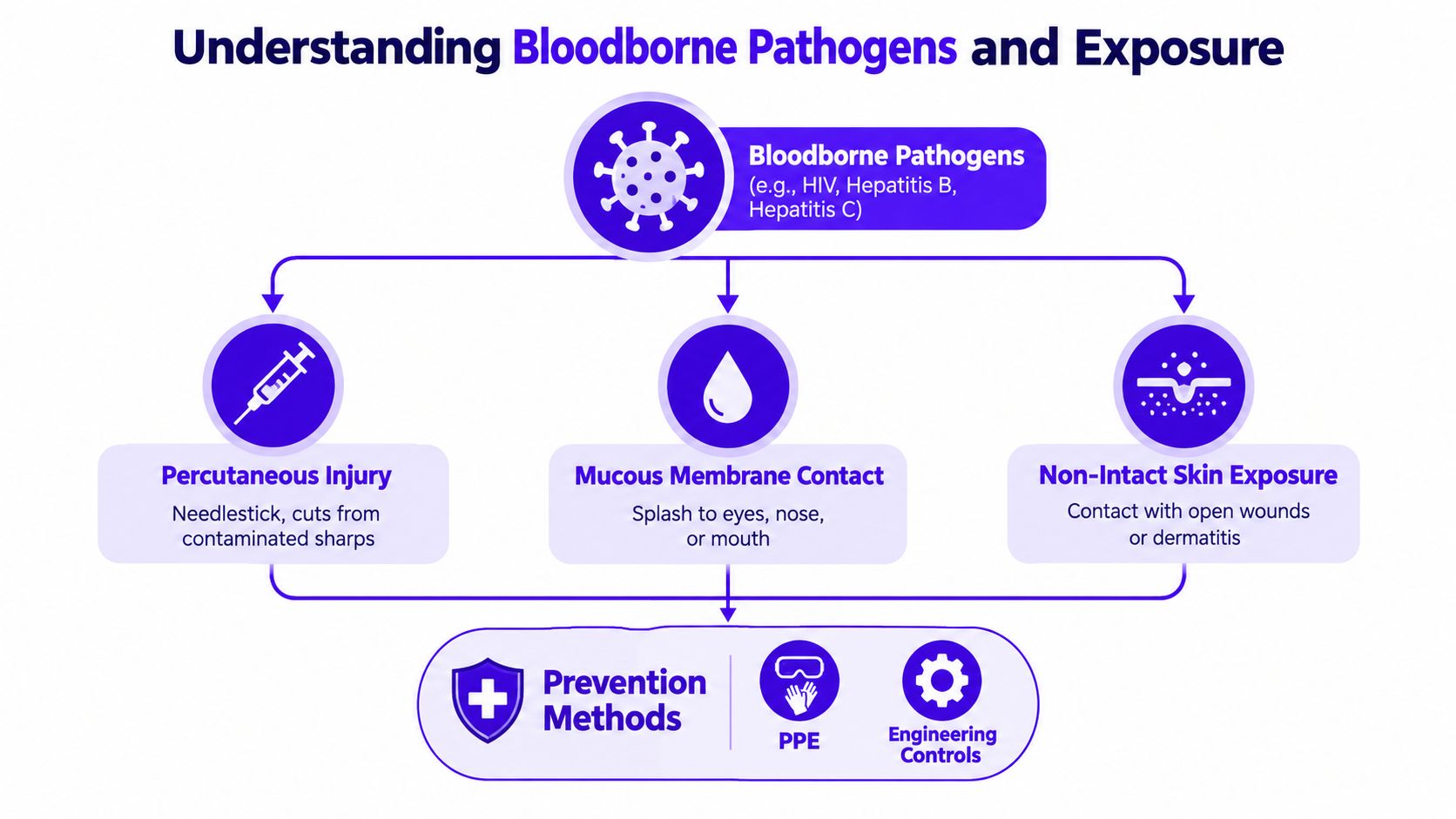
Exposure occurs when the material reaches the body through a pathway such as:
- Percutaneous injury: A contaminated needle, razor, broken glass item, or other sharp pierces the skin.
- Mucous membrane contact: Blood or potentially infectious material splashes into the eyes, nose, or mouth.
- Non-intact skin contact: Material reaches an open wound, cut, abrasion, or skin condition that has weakened the skin barrier.
Why ordinary tasks can create exposure
Exposure is not limited to the procedure that produced the blood. A housekeeper removing a contaminated dressing, a worker wiping a blood-stained surface, or an employee transporting a sharps container may face risk during cleanup and disposal.
The response depends on the task. A worker identifies the material, considers how contact could occur, and chooses controls that block or reduce exposure. Eye protection may be appropriate when a splash is reasonably anticipated. A contaminated injury should be reported rather than dismissed as a minor mishap.
Training makes these decisions practical. A dental assistant may focus on instruments, surfaces, and cleanup. A teacher may need guidance for assisting with a nosebleed. A laboratory worker may concentrate on specimen handling and contaminated equipment. The exposure control plan connects those role-specific decisions to the workplace's procedures, supplies, and reporting process.
The OSHA Compliant Bloodborne Pathogens and Infection Control Training 3HR course addresses OSHA's standard and practical infection control topics, including hand hygiene, PPE, and exposure prevention.
The goal is an operating habit, not a one-time certificate. Recurring training helps workers recognize exposure routes and apply the controls their workplace uses before, during, and after each task.
Why OSHA Requires Bloodborne Pathogens Training
OSHA treats bloodborne pathogens training as an employer responsibility because employees with occupational exposure need more than general safety awareness. They need instruction tied to the actual procedures, equipment, and hazards found in their workplace.
Under 29 CFR 1910.1030, training occurs at initial assignment and at least annually afterward. OSHA also requires additional training when a change in tasks or procedures affects exposure risk. The employer must provide the training free of charge and during working hours, so employees shouldn't have to pay for required instruction or complete it on personal time. The regulatory requirements are set out in OSHA's bloodborne pathogens regulation.
Timing is only one part of compliance
The annual schedule doesn't make the course a generic yearly video. Training must relate to the employee's duties and include an opportunity for questions. A phlebotomist should be able to connect the lesson to blood collection, sharps disposal, and splash protection. A dental assistant should understand the instruments, surfaces, PPE, and cleanup procedures used in that practice.
Prior education or experience doesn't remove the requirement. OSHA states that exposed employees must receive annual refresher training regardless of previous education or experience, as explained in its annual bloodborne pathogens training interpretation. A seasoned nurse, phlebotomist, or dental assistant still needs the yearly update, even if a similar course was completed for a former employer.
The training also connects to the employer's exposure control plan, a written framework describing how the workplace prevents and responds to occupational exposure. OSHA guidance reinforces annual review of that plan. When the plan changes because equipment, duties, or procedures change, training helps employees understand what they must do differently.
Practical rule: A completion date answers whether training happened. Role-specific content and workplace questions help answer whether employees know how to work safely.
Managers should therefore track more than certificates. They should confirm that the course matches the employee's exposure category, that the annual date stays current, and that workers receive updated instruction after relevant procedural changes. The OSHA bloodborne pathogens fact sheet can support that review by giving teams a concise reference for the standard's core requirements.
The result is a compliance cycle rather than a one-time orientation. The employer identifies exposure, establishes controls, trains affected employees, reviews the plan, and updates instruction when the work changes.
What Bloodborne Pathogens Training Covers
A compliant course should explain how several safeguards fit together. The employee isn't just memorizing disease names or watching a demonstration. The employee is learning how the workplace's written plan, equipment, PPE, hygiene practices, and response procedures reduce exposure.
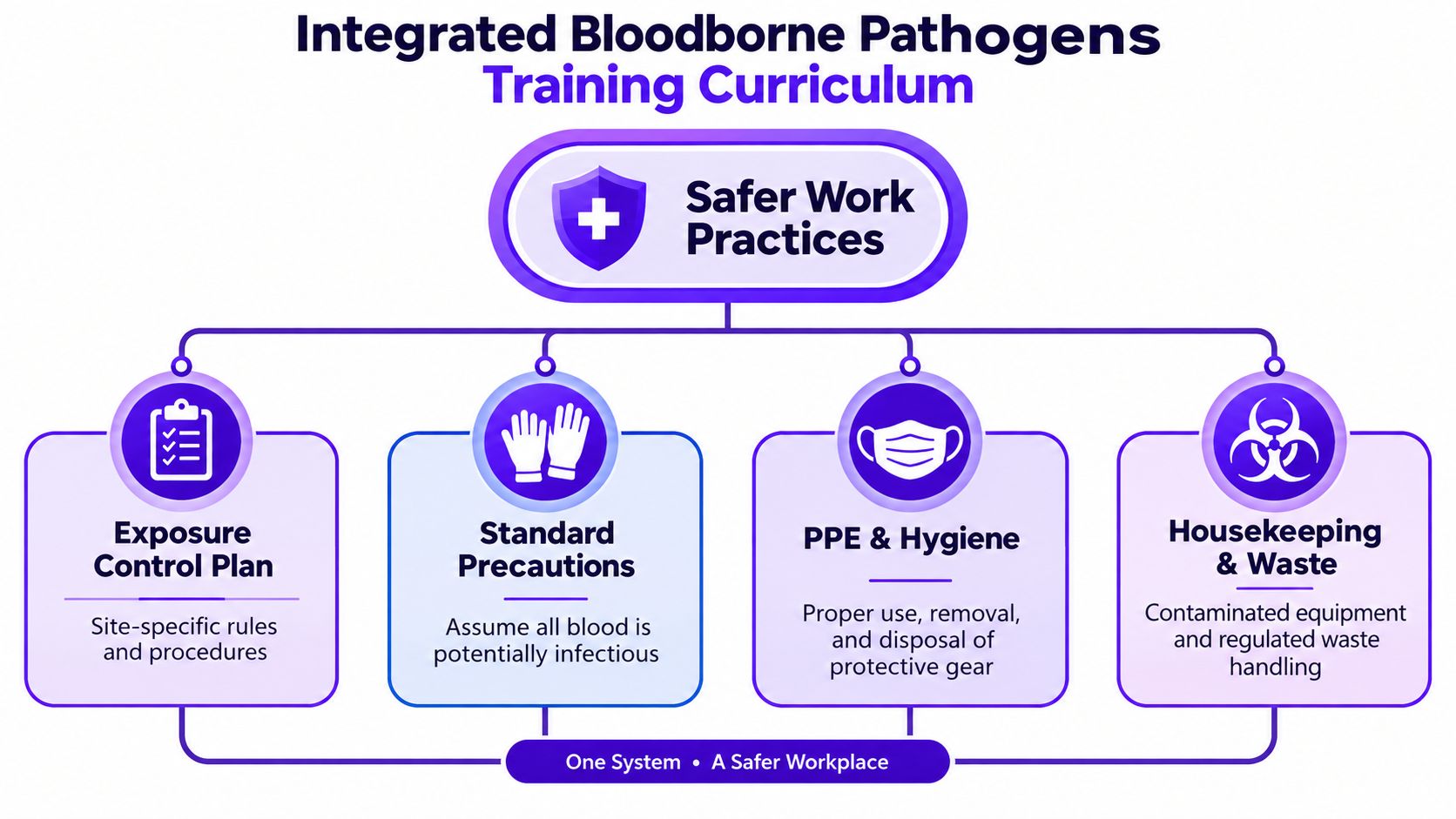
The exposure control plan
Training introduces the employer's exposure control plan, including the exposure risks identified for different job classifications and the procedures used to reduce them. For example, a clinic's plan may explain which employees draw blood, where sharps containers are located, how contaminated laundry moves through the facility, and whom an exposed worker must contact.
The plan gives general OSHA requirements a local application. Employees need to know not only that sharps must be discarded safely, but also which container, location, and reporting process their workplace uses.
Transmission and standard precautions
Learners review how bloodborne pathogens can enter the body and why blood or relevant potentially infectious materials must be handled carefully. The training connects transmission routes to practical choices. Eye protection becomes important when a splash could reach the eyes. Gloves become necessary when hands may contact blood or contaminated materials.
The lesson also covers infection epidemiology in a way that supports hazard recognition. Employees don't need to diagnose a patient or coworker. They need to understand why appearance, job seniority, or assumptions about a person's health don't provide a safe basis for skipping precautions.
Engineering and work-practice controls
Engineering controls isolate or remove a hazard. A puncture-resistant sharps container is one example. Work-practice controls change how an employee performs a task, such as placing a contaminated sharp directly into the appropriate container instead of carrying it across a room.
OSHA-related guidance gives concrete examples. Workers should use puncture-resistant containers for contaminated needles or broken glass, avoid bending or recapping contaminated needles unless no alternative exists or a procedure specifically requires it, and use a one-handed technique or mechanical device if recapping is necessary. These examples are summarized in OSHA-related work-practice guidance.
PPE, vaccination, and response
The curriculum covers PPE selection, limitations, removal, disposal, and replacement. If blood splashes are reasonably anticipated, an employee may need more than gloves, such as face protection. A worker also needs to know when gloves or face protection must be changed and how removal can prevent contamination.
The standard also requires instruction about hepatitis B vaccination, emergency actions, and post-exposure follow-up. OSHA's bloodborne pathogens safety publication describes training that includes the exposure control plan, engineering and work-practice controls, PPE, hepatitis B vaccination, emergency actions, and post-exposure procedures.
Safe needle handling shows how the topics connect. The employee identifies the hazard, uses the available control, wears suitable PPE, disposes of the sharp correctly, cleans the area according to policy, and knows how to report an injury or splash. That sequence is the practical meaning of an integrated curriculum.
More detail about the connected requirements appears in bloodborne pathogens training requirements to mitigate risks, which can help managers compare course content with workplace procedures.
Who Needs Bloodborne Pathogens Training With Practical Examples
The best question isn't “Does this job title appear on a list?” It's “Could this employee reasonably expect occupational contact with blood or other potentially infectious materials?” A job that looks administrative may still involve first aid, specimen handling, contaminated equipment, or cleanup.
A registered nurse who starts an IV, a phlebotomist who collects a specimen, and a dental assistant who handles blood-contaminated instruments clearly face exposure risks. A school employee who provides emergency assistance may also need training if the assigned duties create occupational exposure. A laboratory worker, first responder, body art professional, or employee handling contaminated waste may fall into the same category.
Hospitality and custodial roles require a task-based review. A hotel housekeeper who only cleans ordinary rooms may have a different exposure profile from a worker assigned to remove blood-contaminated materials. A school custodian cleaning a bathroom after a bleeding incident may need procedures that differ from those used for routine cleaning.
A practical decision matrix
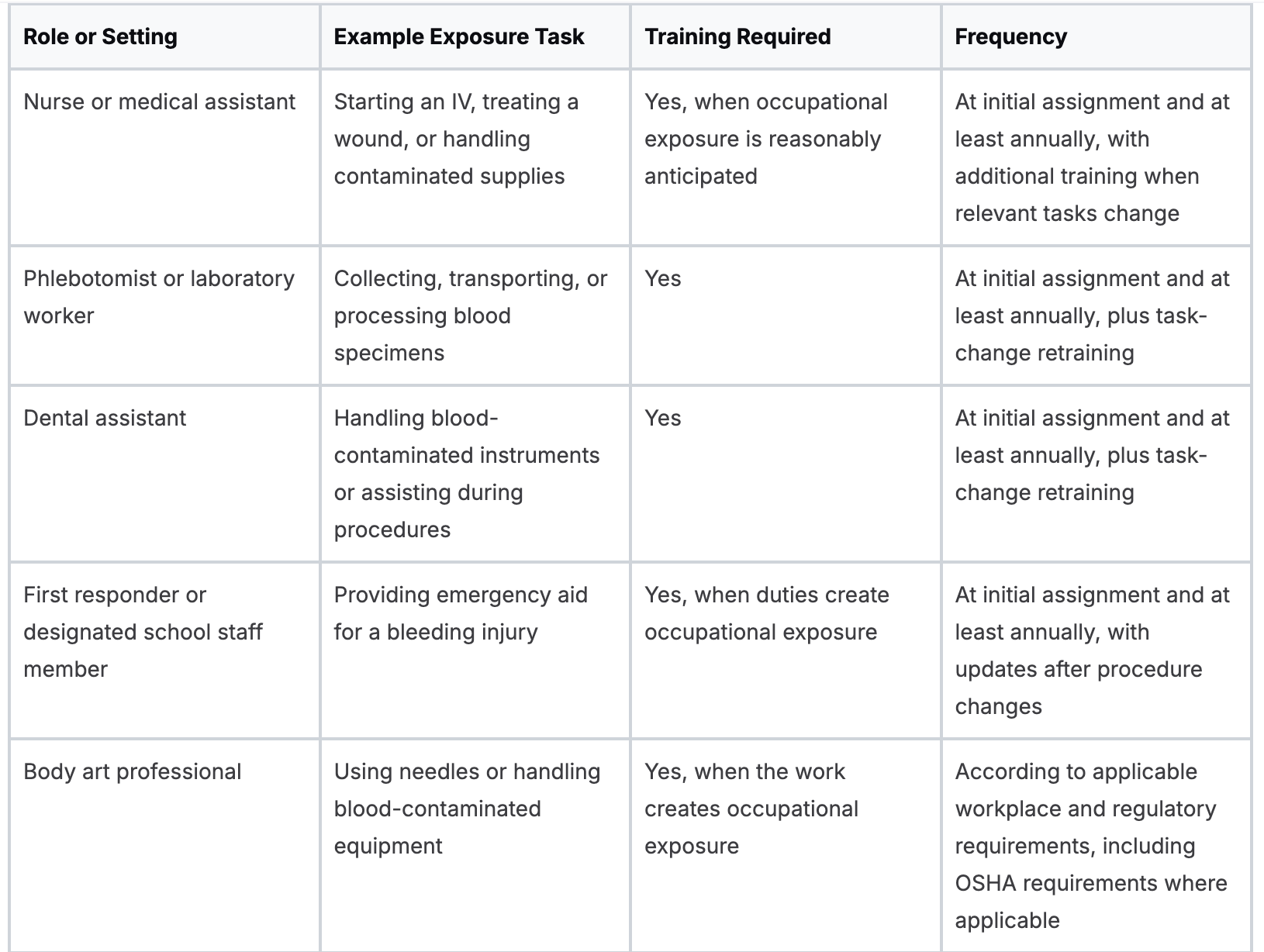
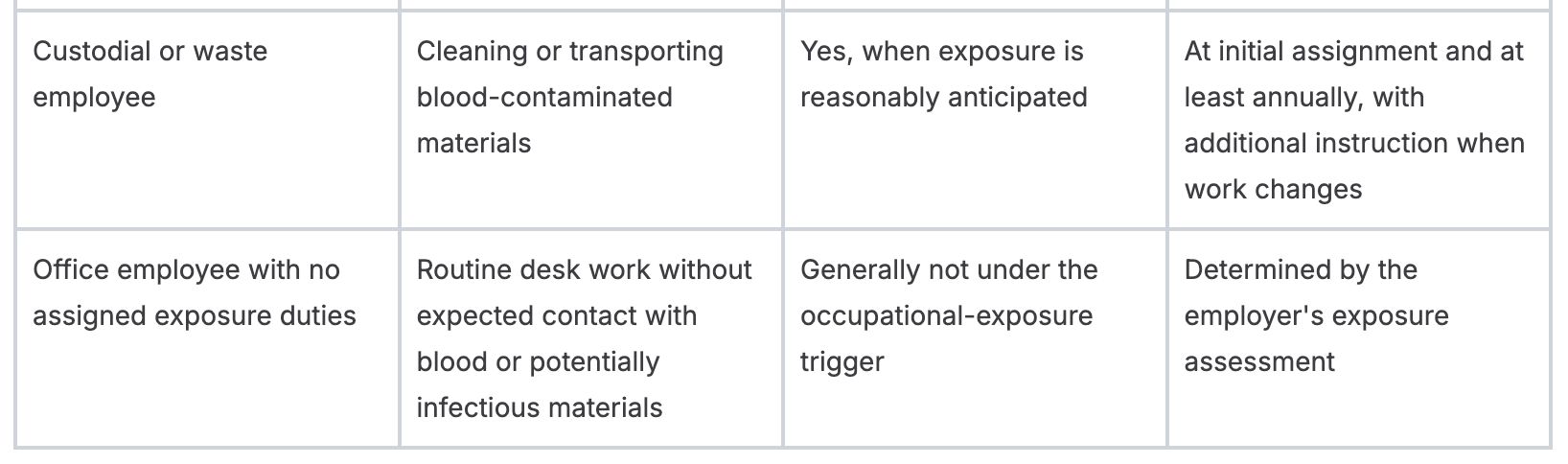
The table supports a manager's initial review, but the employer's exposure determination controls the assignment. A person's experience doesn't replace the requirement. OSHA specifically says an experienced worker still receives the annual refresher, even when that worker completed similar training elsewhere.
A task change also matters. If a medical assistant begins assisting with a procedure that creates splash or sharps exposure, the employer should review the exposure control plan and provide relevant instruction rather than waiting for the next scheduled refresher.
Certification CE Credit and How to Get Compliant
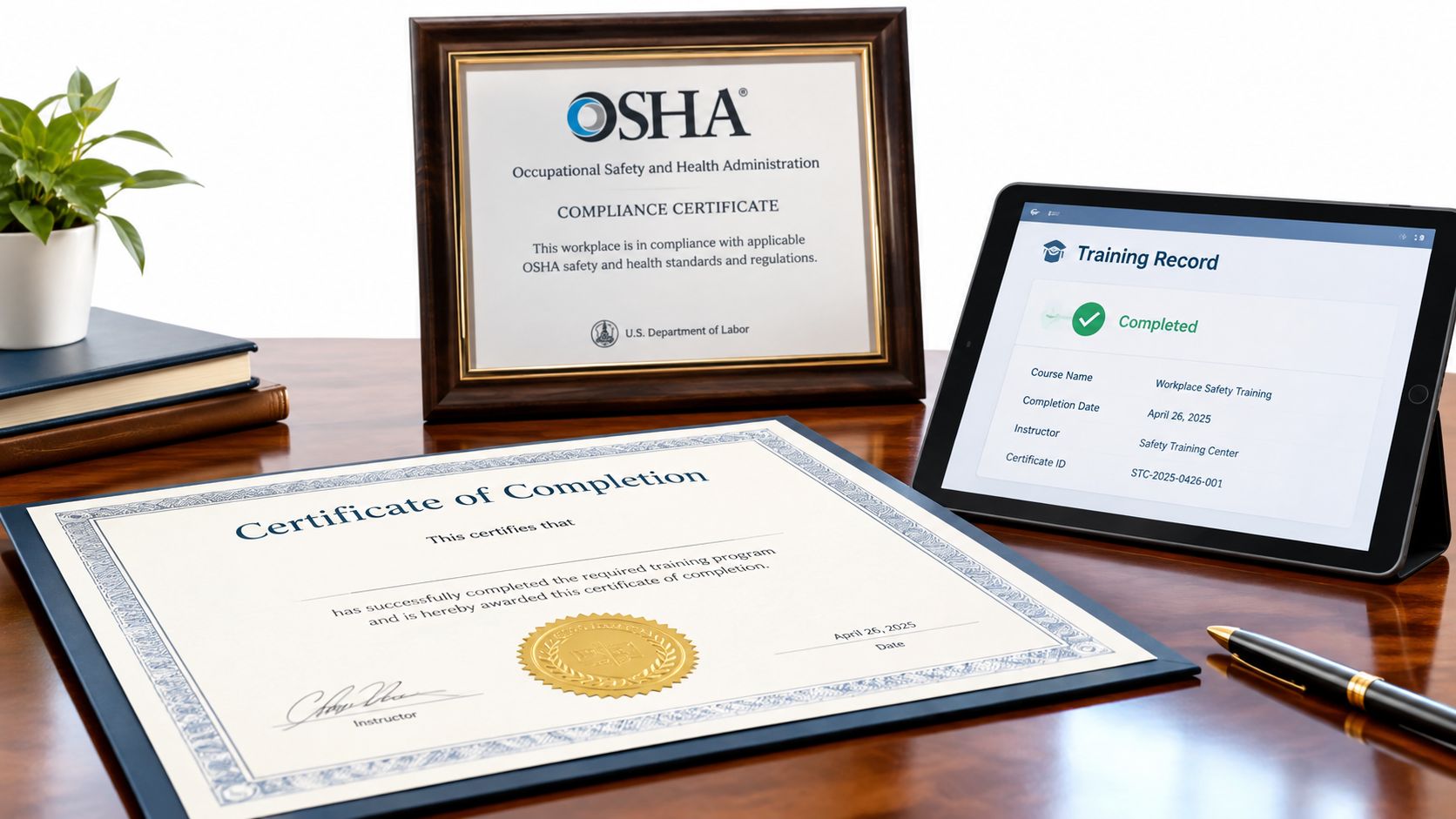
A certificate can show that a learner completed training, but it does not automatically satisfy every workplace or professional requirement. It should identify the learner, course subject, and completion details. Licensed professionals also need to check whether the activity meets applicable CE rules, employer policy, and reporting requirements. Confirm both OSHA alignment and professional credit eligibility before enrolling.
A sensible selection process
A nurse seeking CE can begin with the state board or employer requirement, then compare the course objectives with the OSHA curriculum. A clinic manager should confirm that employees can complete the training during working hours, ask questions, and retrieve records during an audit.
Useful evaluation points include:
- Content alignment: The course covers the exposure control plan, transmission, engineering and work-practice controls, PPE, hepatitis B vaccination, emergency response, and post-exposure follow-up.
- Workplace relevance: Employees can connect the lesson to their actual sharps, cleanup, PPE, and incident-reporting procedures.
- Documentation: The provider supplies completion records that both the learner and employer can retain.
- CE handling: The learner can verify whether the activity carries applicable professional credit and whether reporting to CE Broker or another agency is required.
- Access and tracking: Individuals can use a practical course format, while organizations can assign training and monitor completion.
Premiere Education offers an OSHA Compliant Bloodborne Pathogens and Infection Control Training 3HR course covering OSHA's standard and infection control practices such as hand hygiene, PPE, and exposure prevention.
What a certificate can't replace
A course does not install a sharps container, revise a procedure, or create a post-exposure contact pathway. The NCBI Bookshelf review of occupational exposure prevention discusses occupational bloodborne risks and the value of targeted training, simulation, and monitoring hepatitis B immunization status for new and trainee workers.
Training functions as part of a recurring compliance system. After completion, managers still need to connect the lesson to the exposure control plan, workplace procedures, available PPE, and incident-reporting process. If a procedure changes, the training system may need an update rather than waiting for the next scheduled course.
A certificate records learning. Workplace readiness depends on how that learning is assigned, applied, documented, and reviewed over time. CE seekers should choose a course that fits their role, employer policy, and applicable professional credit rules, then confirm that the resulting record can support both personal CE reporting and workplace compliance.
Next Steps to Stay Protected and Compliant
A practical compliance check can start with the employee's last completion date and current duties. The individual or manager should then compare the training content with the workplace exposure control plan, confirm that relevant PPE and engineering controls are available, and verify the procedure for reporting an exposure.
The maintenance checklist is straightforward:
- Confirm the exposure determination: Identify employees whose assigned tasks may involve blood or other potentially infectious materials.
- Check the training date: Schedule the annual refresher before the current training period expires.
- Review changes: Provide additional instruction when tasks, procedures, equipment, or exposure risks change.
- Verify local procedures: Make sure employees know the location of sharps containers, cleanup supplies, PPE, and reporting contacts.
- Retain documentation: Keep completion records accessible for employees, managers, and audits.
- Test response readiness: Ensure post-exposure follow-up and hepatitis B vaccination information are part of the workplace process.
Safe sharps handling should remain visible in daily work. OSHA-related guidance recommends puncture-resistant sharps containers for contaminated needles or broken glass, avoiding bending or recapping contaminated needles unless no alternative exists or a procedure requires it, and using a one-handed technique or mechanical device when recapping is necessary.
The answer to “what is bloodborne pathogens training” is therefore broader than “an annual certificate.” It's a recurring compliance practice that helps employees recognize exposure, use controls, follow workplace procedures, and respond correctly when something goes wrong.
Premiere Education provides online continuing education and certification courses for healthcare, education, and adjacent professionals, including OSHA-aligned bloodborne pathogens and infection control training. Visit Premiere Education to review course options and choose a documented training path that fits the learner's role and compliance needs.
Latest Posts





25% off Sitewide→
Use Code: PCECYBERSALE2025→