
.avif)
OSHA Bloodborne Pathogens Fact Sheet: 2026 Guide
A nurse wipes a gloved hand on a gown sleeve, looks down, and realizes a needle just nicked a finger during a blood draw. In a dental room, a splash reaches an assistant's eye before anyone can step back. Those moments are exactly why an OSHA bloodborne pathogens fact sheet still matters in 2026, because the rule is built around real exposure, not abstract policy.
The standard behind it, 29 CFR 1910.1030, was first issued in 1991 and later updated in 2001 after the Needlestick Safety and Prevention Act strengthened safer sharps practices and exposure control (NCBI Bookshelf). OSHA identifies it as the core U.S. framework for protecting workers from occupational exposure to HIV, HBV, and HCV. That history matters in clinics, schools, behavioral health sites, and outpatient settings, because the hazard didn't disappear when the paperwork got simpler.
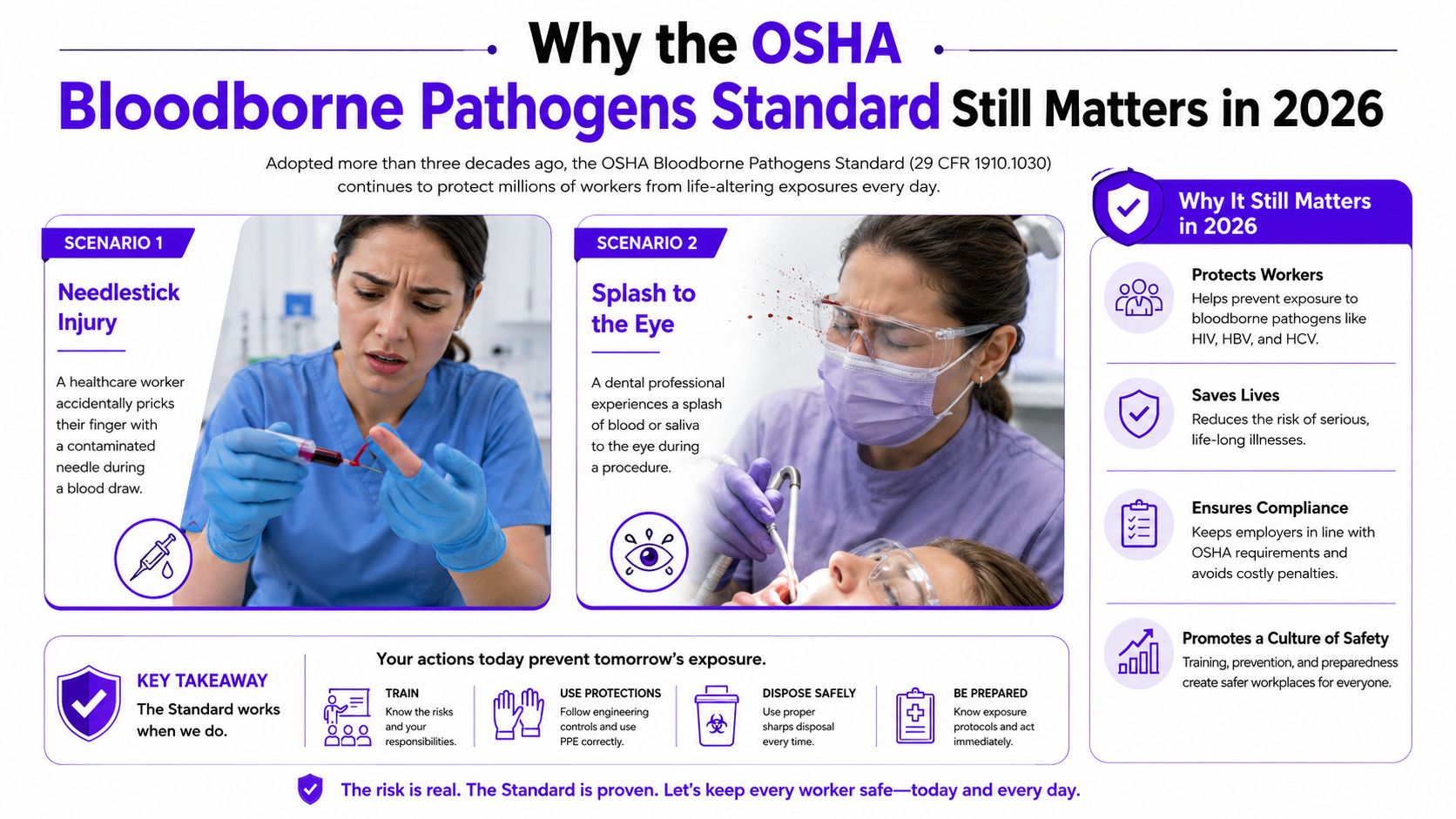
Why the OSHA Bloodborne Pathogens Standard Still Matters in 2026
A blood draw isn't complicated until a needle slips. A dental suction isn't routine until fluid hits an eye. The Bloodborne Pathogens Standard exists for those exact moments, because the employer's duty starts before the incident and continues after it.
OSHA's rule, 29 CFR 1910.1030, was promulgated in 1991 and later amended under the 2000 Needlestick Safety and Prevention Act to strengthen worker protection against bloodborne pathogen exposure (OSHA general page). The standard was written to reduce occupational exposure to blood and other potentially infectious materials, not to create a filing exercise. That's why compliance training has to cover exposure control planning, vaccination access, sharps handling, and post-exposure follow-up in one system.
The reason it still matters is scale. OSHA estimated 5.6 million workers in health care and related occupations were at risk, while other sources cited about 18 million health care workers in the broader industry potentially at risk. Historical estimates also showed more than 200 deaths and about 9,000 bloodborne infections per year tied to occupational exposure before the standard matured into current practice (NCBI Bookshelf). That history still shapes how trainers frame the rule today, because the hazard is persistent, measurable, and preventable.
Practical rule: if a job can reasonably put someone in contact with blood or OPIM, the standard isn't theoretical. It's the operating rule.
What the Standard Covers and Who It Applies To
The scope turns on one phrase, reasonably anticipated occupational exposure. If a worker's duties can reasonably involve blood or other potentially infectious materials, the employer has to treat that role as covered under the standard (OSHA fact sheet).
That's why the same workplace can have covered and noncovered roles side by side. A phlebotomist drawing blood is in scope. A billing clerk working in the same building usually isn't, unless the assigned tasks change. A school nurse handling playground injuries is in scope when first aid or blood cleanup is part of the job. A front desk employee who never touches blood typically isn't, but the exposure determination still needs to be documented if duties can change.
OSHA's requirements for covered employers are concrete. They must implement a written exposure control plan, use engineering and work practice controls, provide PPE, offer hepatitis B vaccination, provide post-exposure evaluation and follow-up, communicate hazards with labels and signs, deliver training, and maintain medical and training records and a sharps injury log unless exempt under Part 1904 (OSHA fact sheet).
For a practical training comparison, the rule also lines up well with the way bloodborne pathogens training requirements are explained in a structured compliance guide. That kind of mapping matters when roles aren't neat on paper.
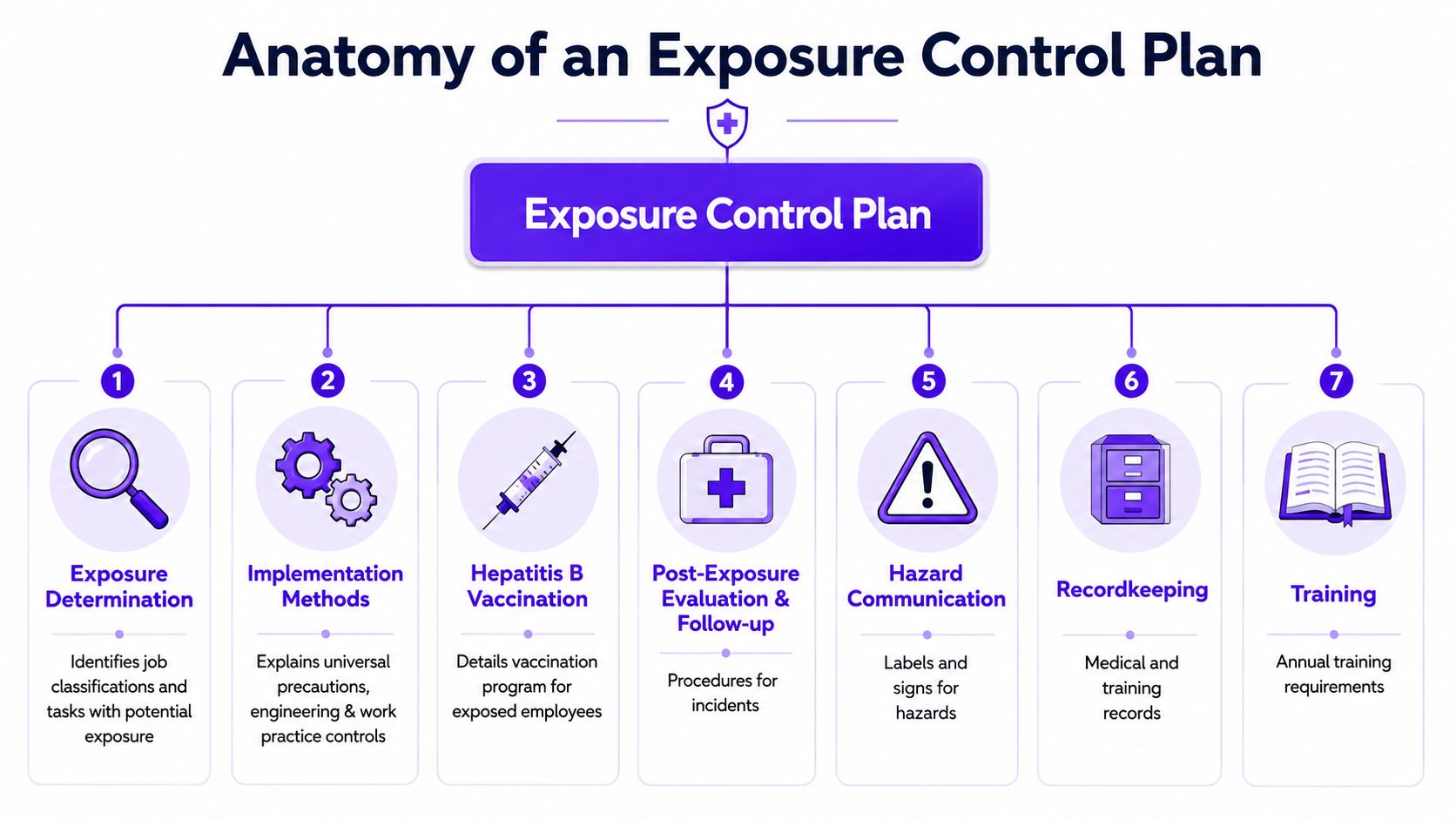
Anatomy of an Exposure Control Plan
A strong exposure control plan is a working document, not a binder on a shelf. OSHA expects the plan to identify who has exposure risk, explain how the workplace controls that risk, and show how the employer responds when something goes wrong (CDC/NIOSH).
What belongs in the plan
The first layer is exposure determination. The employer lists the job classifications and tasks where exposure can happen, then updates that list when duties change. A clinic that adds phlebotomy to a medical assistant's role needs to revise the plan, not just retrain the staff member in the hallway.
The second layer is methods of compliance. That means engineering controls, work practice controls, PPE, and housekeeping. In a primary care clinic, a safety-engineered needle is an engineering control, a no-recap rule is a work practice control, gloves and eye protection are PPE, and a clear cleanup procedure keeps blood-contaminated surfaces from becoming the next incident.
The third layer is hepatitis B vaccination access and post-exposure procedures. Employees with exposure risk need a path to vaccination, and the process for post-incident evaluation has to be written before the event occurs. Training and recordkeeping close the loop, because a plan that can't be taught or documented won't hold up in practice.
A clinic using sharps disposal containers, safety-engineered needles, and written phlebotomy procedures is implementing the exact control framework the rule requires (CDC/NIOSH). For teams that want a course option tied to those basics, OSHA Compliant Bloodborne Pathogens and Infection Control Training 3HR is described as covering OSHA's Bloodborne Pathogens Standard with hand hygiene, PPE, and exposure prevention.
Employer Duties Versus Employee Duties
The fastest way to miss compliance is to assume one side of the relationship is handling everything. Employers build the system. Employees use it correctly and report when it fails.
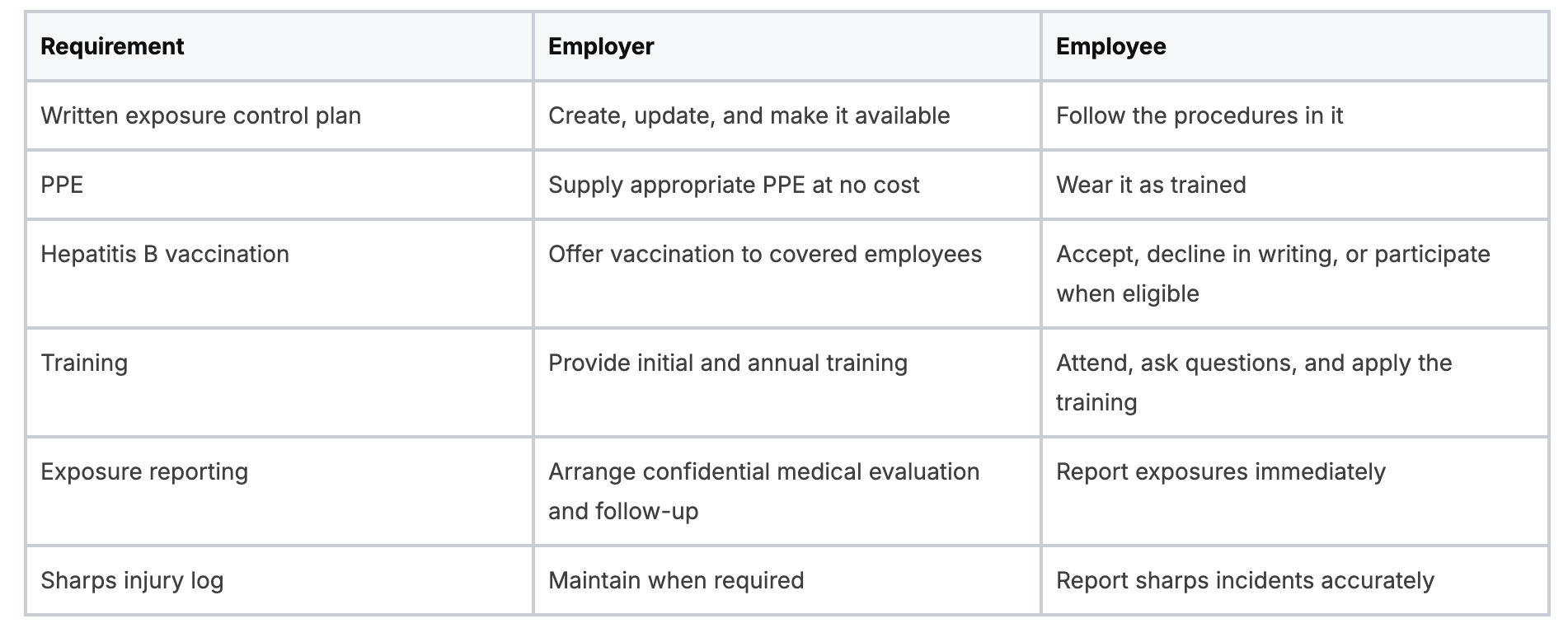
A hospital often centralizes these duties through occupational health. A home-care agency may have the same obligations, but the supervisor has to be more deliberate because staff work alone, travel between sites, and may hesitate to report a minor nick. The rule doesn't change with the setting. The workflow does.
Bottom line: an employer can't delegate the plan, and an employee can't delegate the reporting.
Employees also have to use universal precautions, respect the engineering controls already installed, and avoid improvising when a safer device or procedure exists. That's where a lot of training fails, because staff remember the policy but not the behavior that makes the policy real.
Universal Precautions, Engineering Controls, and PPE
Universal precautions are the simplest part to say and the easiest part to drift away from. Treat blood and OPIM as potentially infectious every time, not only when the situation looks messy. That mindset keeps workers from deciding too late that a spill, splash, or used needle was “probably fine.”
Engineering controls come first because they remove the hazard before behavior has to manage it. In phlebotomy, that means safety-engineered needles, sharps disposal containers placed at the point of use, and devices that reduce hand contact with contaminated sharps. OSHA and nursing-sector summaries cite an estimated 384,000 hospital-based percutaneous injuries each year, or more than 1,000 per day, while broader U.S. estimates put total needlestick and other sharps injuries across health care at 600,000 to 800,000 annually.
Work practice controls shape the behavior around the device. No recapping needles unless there's a very specific, justified method in place. Dispose of sharps immediately at the point of use. Keep hand hygiene before and after glove use. Up to one-third of sharps injuries happen during sharps disposal, and the CDC estimates 62% to 88% of sharps injuries could be prevented with safer medical devices such as blunt suture needles (ANA/Nursing fact sheet).
PPE is the last line, not the first fix. In dental suctioning, that usually means gloves, eye protection, and a face barrier selected for the exposure expected during the task.
What Counts as an Exposure Incident
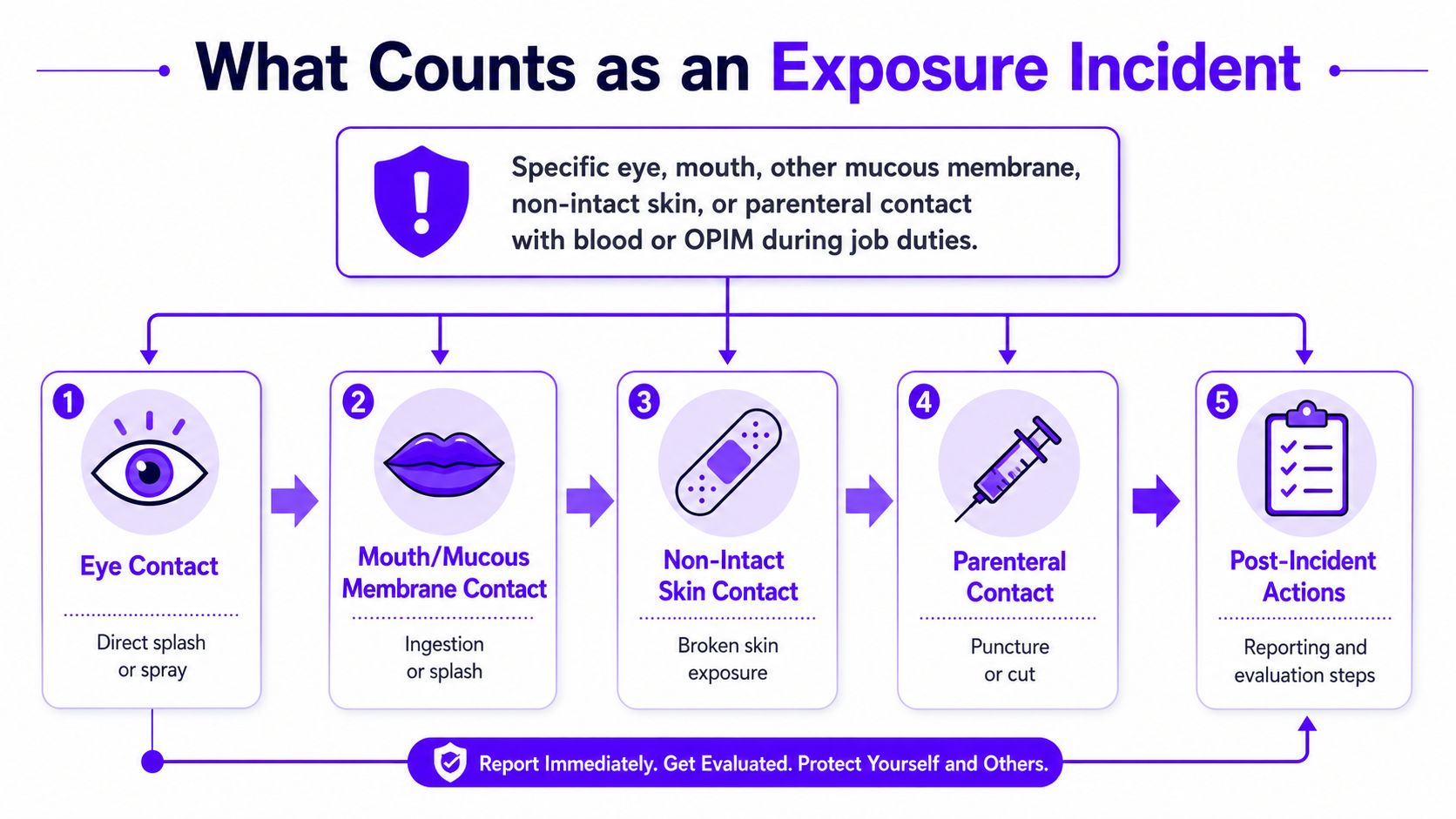
A dental assistant is suctioning during treatment when blood splashes into the eye. That's not a minor inconvenience under the standard. It's an exposure incident, defined as specific eye, mouth, other mucous membrane, non-intact skin, or parenteral contact with blood or other potentially infectious materials during job duties (OSHA exposure incidents fact sheet).
The response sequence matters
The first step is immediate first aid, then reporting. The second step is confidential medical evaluation and follow-up by a qualified healthcare professional. OSHA says the employer must provide that evaluation and follow-up after the incident, not leave the worker to sort it out alone.
After that, the employer handles the clinical and documentation chain. Baseline testing, source individual testing where lawful, and post-exposure prophylaxis when indicated all belong inside the process. The healthcare professional's written opinion goes back to the employer, while the detailed medical record stays confidential.
That is the part many supervisors miss. They tell the employee to wash the area and go back to work, but the standard expects a documented evaluation path. A splash to the eye during suctioning is exactly the kind of incident that should be rehearsed in training, not interpreted on the fly.
Hepatitis B Vaccination, the Sharps Log, and Training Cadence
Three requirements get forgotten between annual reviews because they look administrative. They aren't. They're the recurring controls that keep the rest of the program functional.
Hepatitis B vaccination must be offered to covered employees, and it has to be handled as part of the exposure-control system, not as a casual benefit. If a worker declines, the declination has to be documented. If that same worker later has an exposure incident, the vaccination offer has to be revisited.
The sharps injury log is another common miss. For employers not exempt under Part 1904, the log has to capture enough detail to show what device was involved, where the injury happened, and how it occurred. That record is useful because it points directly to unsafe patterns, not just individual mistakes.
Training cadence is straightforward on paper and easy to neglect in practice. It has to happen at assignment and at least annually, and it has to match the actual exposure risk in the workplace. A school nurse doesn't need the same examples as a dialysis technician, but both need content tied to what they do.
If a team needs a course option encompassing the standard and practical infection control, the OSHA Compliant Bloodborne Pathogens and Infection Control Training 1HR course is positioned around the essentials of 29 CFR 1910.1030 and workplace safety basics.
How the Standard Applies in Schools, Clinics, and Behavioral Health
A school nurse who handles playground cuts, nosebleeds, and cleanup after an incident is working inside the standard when those tasks create anticipated exposure. A behavioral health aide who provides first aid after an aggressive episode can be covered for the same reason. A primary care medical assistant drawing labs, disposing of sharps, or cleaning contaminated surfaces is clearly in scope.
The hard question is never the hospital example. It's the mixed-duty workplace. OSHA and FAQ material cover the core requirements, but they don't always answer the most common operational question, Does this job role count as occupational exposure in my setting?
That's why exposure determination has to be task-based and role-based, not title-based. A part-time employee with sporadic exposure may still need the same vaccination offer and training if the duties place them at risk. A counselor who sometimes assists with bleeding injuries may shift from out of scope to in scope depending on the assignment list that week.
Quick Compliance Checklist for 2026
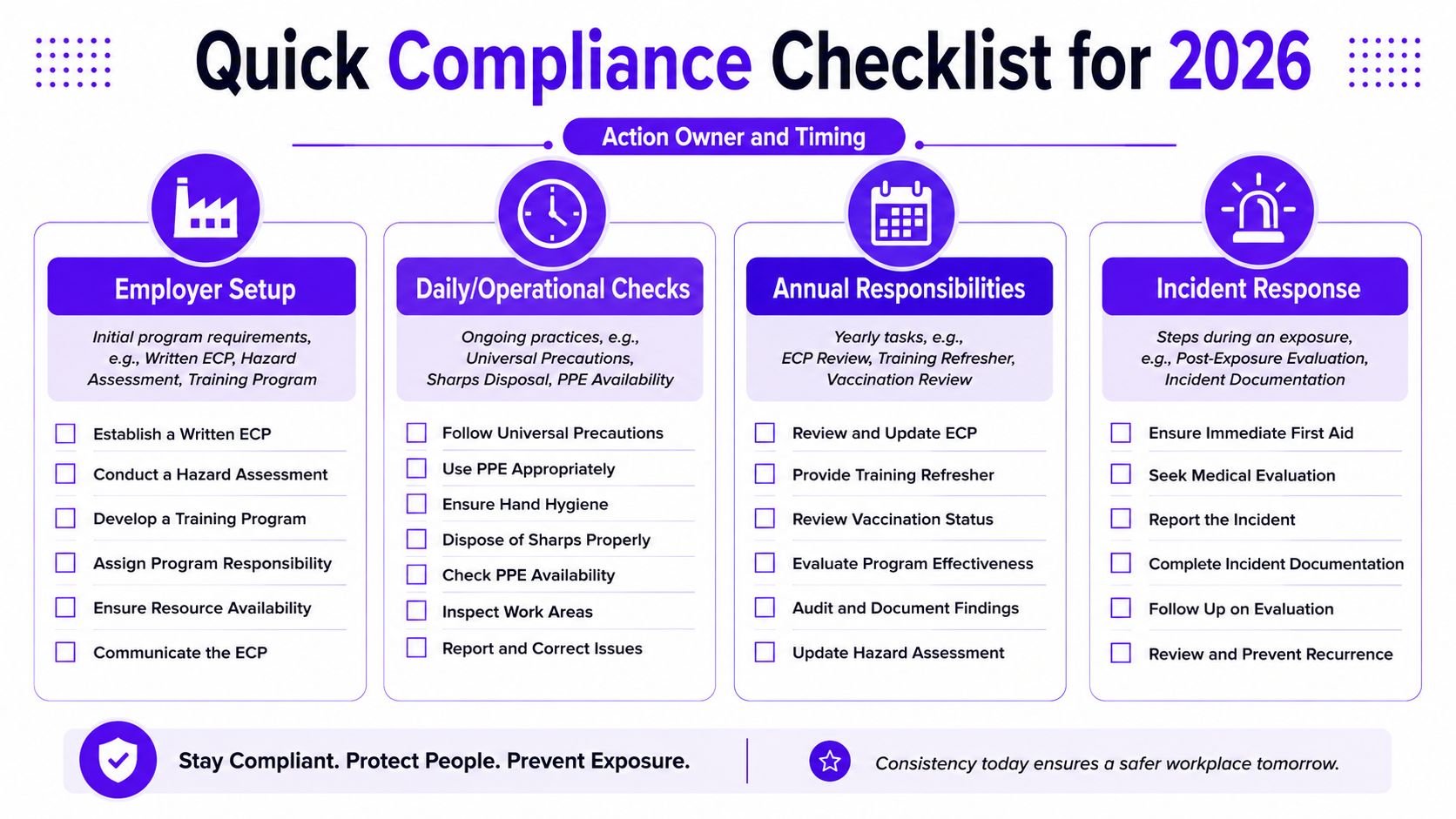
Use this as the shortest possible audit pass.
- Employer setup: Maintain a written exposure control plan, list covered tasks, stock PPE, and verify sharps containers and engineering controls are in place.
- Daily checks: Follow universal precautions, use sharps containers at the point of use, and replace damaged PPE before the shift continues.
- Training: Provide training at assignment and annually, and keep the record current.
- Vaccination: Offer hepatitis B vaccination to covered employees, document declinations, and re-offer after qualifying exposure incidents.
- Post-exposure: Start confidential evaluation immediately, document the incident, and keep medical follow-up private.
- Recordkeeping: Protect medical records, retain training records, and keep the sharps injury log when required.
A workplace that wants bloodborne-pathogens training to fit school operations, clinic routines, and incident response can use a structured compliance program alongside its internal policies. That's the same logic behind actionable school safety practices, because prevention only works when the steps are easy to repeat.
Key Terms and Where to Find Authoritative References
Bloodborne pathogens are infectious microorganisms in blood that can cause disease. OPIM, or other potentially infectious materials, is the broader category that keeps the standard from being too narrow. Percutaneous means through the skin, usually by a needle or sharp object. Mucous membrane exposure means contact with the eyes, mouth, or similar tissue.
Engineering controls are the devices that reduce exposure by design, like safety needles and sharps containers. Work practice controls are the behavior rules, like proper sharps disposal and hand hygiene. EPINet is the injury surveillance system OSHA cites in sharps-injury monitoring. The sharps injury log is the employer's record of what happened, where it happened, and what device was involved.
The main references stay consistent. OSHA's Bloodborne Pathogens Standard and fact sheet define the obligations, CDC/NIOSH guidance explains how controls work in practice, and the Needlestick Safety and Prevention Act is the key amendment behind safer sharps practices. Premiere Education's OSHA Bloodborne Pathogens courses, offered in 1-hour and 3-hour versions, fit as a training delivery option for individuals and organizations that need a structured way to assign and document completion.
Premiere Education offers OSHA Bloodborne Pathogens training that fits the needs of healthcare, school, and behavioral health work. Its courses help teams cover 29 CFR 1910.1030, document completion, and keep training aligned with workplace duties. Visit Premiere Education to review the course options and match the right training format to your staff.
Latest Posts




25% off Sitewide→
Use Code: PCECYBERSALE2025→