
.avif)
Learning Management System for Healthcare: A Practical Guide

A nurse moves from one unit to another, a physician's certification is approaching expiration, and the annual infection-control assignment is still incomplete for several employees. Meanwhile, the compliance administrator is reconciling spreadsheets, email confirmations, state board rules, and certificates that live in different systems. A generic training platform may show that someone opened a course, but healthcare organizations need to know whether the right person completed the right requirement, demonstrated competence, and remains eligible to practice.
A learning management system for healthcare must therefore do more than deliver videos and record completion. It must connect clinical education with licensing requirements, credential expiration, competency evidence, audit documentation, and the operational realities of shift-based work. The strongest systems reduce fragmented tracking without turning compliance into a false promise that completion alone proves readiness.
The Compliance Administrator Daily Reality
Every Monday morning, a healthcare compliance administrator may start with three urgent checks. Which staff members still need annual bloodborne-pathogens training? Which newly credentialed physicians have submitted current life-support documentation? Which nurses are approaching renewal in states with different continuing-education rules?
The work becomes difficult when the organization operates across units, clinics, or hospitals. A nurse may be assigned to a new department, a contractor may need facility-specific training, and a policy revision may require reassignment to only selected roles. In a spreadsheet, each change creates another manual task and another opportunity to assign the wrong course or overlook an expiration date.

Why generic platforms fall short
A general LMS usually handles users, courses, quizzes, and completion reports. Those functions matter, but they don't resolve clinical credentialing. A healthcare administrator also needs role, location, license type, certification status, renewal date, course version, and evidence of assessment.
For example, a clinic may assign infection-control training to nurses, medical assistants, and laboratory staff based on exposure risk. The system should set a recurring due date, preserve the completion certificate, connect the course to the current exposure-control plan, and show managers who remains overdue. OSHA's Bloodborne Pathogens Standard requires annual employer-funded training for employees with occupational exposure, and its training materials must include the standard and the facility's exposure-control plan, as summarized in this clinical compliance reference.
Practical rule: If an administrator has to combine three reports to determine whether one employee is eligible to work, the training infrastructure is fragmented.
A specialized platform also supports engaging delivery rather than passive click-through modules. Guidance on interactive compliance training is useful when mandatory content needs scenarios, decisions, and assessments that reflect the employee's actual role.
The operational test is simple. Can the administrator filter by department, role, location, and expiration status, then export defensible evidence without rebuilding the record manually? If not, the organization isn't managing compliance. It's managing paperwork.
Understanding Healthcare Learning Management Systems
A healthcare LMS starts with a structured record for each learner. That record should connect employment details and clinical role with assigned education, professional credentials, assessment results, and renewal dates. The architecture matters because a nurse, physician, billing specialist, and environmental-services employee shouldn't receive identical learning paths.

Build the system around evidence
A practical implementation begins with six connected capabilities:
- Clinical certification tracking: Record ACLS, BLS, and PALS credentials, issuing bodies, completion dates, and expiration dates.
- Role-based assignment: Map learning to the employee's clinical role, facility, department, and exposure profile.
- Competency validation: Use scenario questions, pass thresholds, remediation, and repeat assessment rather than treating course access as mastery.
- Regulatory version control: Preserve the policy or guideline version assigned at the time of training.
- Audit-ready reporting: Export learner histories, certificates, timestamps, assessment outcomes, and retraining dates.
- Integration: Exchange employee and credential data with HR, credentialing, scheduling, and other workforce systems.
Spaced learning should be part of that design. A 2024 systematic review of 23 studies found that spaced online education or digital simulation improved post-intervention knowledge compared with massed learning, with a standardized mean difference of 0.32 and a 95% confidence interval of 0.13 to 0.51, based on moderate-certainty evidence; knowledge retention also favored spaced education, with an SMD of 0.38 and a 95% confidence interval of 0.10 to 0.65 in the systematic review. In practice, that means automated review intervals, short reassessments, renewal reminders, and targeted reinforcement for weak topics.
A platform should distinguish initial completion from later retention. It also shouldn't imply that stronger test results automatically prove better patient outcomes. Evidence in digital healthcare education commonly measures knowledge, skills, attitudes, or satisfaction, while transfer into clinical practice is evaluated less often.
The system's value appears in the audit trail. A report should answer who completed a course, which version they took, whether they passed, whether remediation followed a failed attempt, and when retraining is due. A completion dashboard without those details is a participation report, not a competency record.
State-Specific Compliance Requirements and Course Mapping
A multi-state workforce exposes the limits of universal training rules. Nebraska and California provide a clear example. Nebraska requires licensed practical and registered nurses renewing through one continued-competency pathway to document at least 500 hours of nursing practice during the previous five years and 20 contact hours of approved nursing continuing education during the previous two years. Nebraska explicitly permits all required hours through home-study or internet courses, according to the Nebraska nursing renewal guidance.
California uses a different threshold. Active registered nurses must complete 30 contact hours every two years through a provider recognized by the California Board of Registered Nursing, as described in the same state-specific compliance source.
Those rules shouldn't be stored as a note in an administrator's inbox. They should drive the learner profile and assignment logic.
.png)
What automated mapping should control
A specialized LMS should capture:
- Jurisdiction and license type: The employee's state, profession, license category, and renewal cycle.
- Eligible education: Courses accepted by the relevant board, including provider information and contact-hour details.
- Practice requirements: Separate practice-hour evidence from continuing education, rather than combining them into one progress bar.
- Time windows: Assignments must reflect the applicable renewal period, not a generic annual schedule.
- Evidence export: Certificates, completion dates, objectives, and provider records should be downloadable for the individual record.
A practical scenario makes the difference clear. A healthcare system employs nurses licensed in both Nebraska and California. Applying a universal “20-hour” or “30-hour” rule would create errors in both directions. The administrator needs state-specific assignments, dates, certificates, and reminders tied to each employee's applicable board.
The required continuing education for nurses should be evaluated in the same way as any other catalog resource, by checking the applicable profession, state, provider status, and renewal period before assignment.
Not every training item in a healthcare catalog belongs in a nursing pathway. For example, California, #1 Responsible Beverage Service Training covers California alcohol-service laws, risks, responsibilities, warning signs, and responsible service. It may be relevant to a particular operational audience, but it shouldn't be mapped to a nurse's licensure requirement without confirming the governing rule.
The system should also preserve the reason for an assignment. “Required by California renewal profile” is more useful than “assigned by administrator,” especially when a board, accreditor, or internal reviewer asks why one employee received different coursework from another.
Essential Features for Clinical Certification Management
Certification management fails when it treats every credential as a course. A course has an enrollment and completion event. A clinical certification has an issuing body, validity period, renewal evidence, and often an operational consequence if it expires.
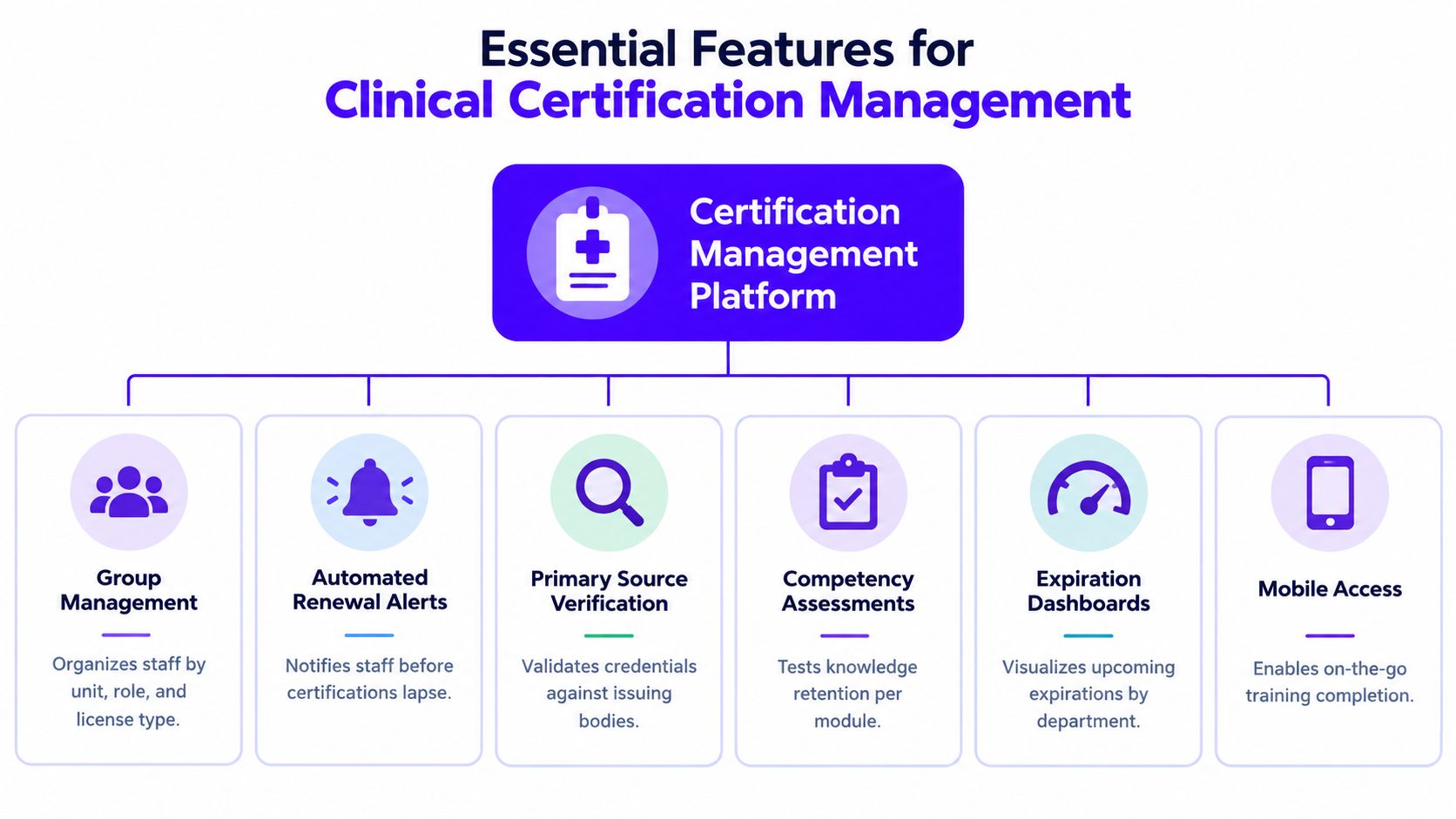
A useful decision matrix separates basic delivery from workforce control:

Compare the operational trade-offs
A centralized group portal is useful when an organization needs to create teams, purchase seats, enroll learners, assign courses, and monitor completion by department. It reduces the need for one administrator to manage every employee record individually.
Course breadth also matters, but a large catalog isn't automatically a better clinical solution. Healthcare organizations may need infection-control modules, OSHA Bloodborne Pathogens training, state-mandated education, and ACLS, BLS, or PALS preparation. The selection question is whether the content can be mapped to roles and renewal rules, not just whether the catalog contains many titles.
Certification workflows should support both uploaded evidence and platform-issued records. For a newly credentialed physician, an administrator may need to verify an ACLS document, record its expiration, assign a related renewal course, and alert the medical staff office before the credential lapses.
For nurses needing Advanced Cardiovascular Life Support certification training, the LMS should keep the education record connected to the individual credential profile. It should also distinguish a course certificate from a certification issued through a separate validation process.
A dashboard is useful only when someone can act on what it displays.
Mobile access supports staff who don't work at a desk, but mobile delivery alone doesn't solve accessibility. WHO identifies barriers including English-only content, disability access limitations, and uneven connectivity. Its Africa training program generated more than 125,816 attendances from 173 countries and regions across 287 virtual sessions from 2020 to 2023, exceeding the pre-pandemic in-person participation rate by more than 15 times, according to the WHO training report. Participation at that scale doesn't prove equal learning outcomes, so platforms should also support captions, transcripts, screen readers, translation workflows, low-data formats, and offline continuity.
Selection Criteria for Healthcare LMS Platforms
The selection process should begin with the compliance workflow, not the vendor demonstration. A polished interface can hide weak state mapping, limited evidence exports, or an inability to distinguish a certificate from a verified clinical credential.
Start with the audit question
Write the question an auditor, licensing board, or medical staff leader is most likely to ask. It might be, “Which medical assistants assigned to this facility completed the current infection-control module, passed the assessment, and remain current?” Then require every shortlisted platform to produce that answer without spreadsheet assembly.
The evaluation should cover:
- Assignment logic: Can administrators assign by role, unit, location, license type, and exposure risk?
- Evidence quality: Does the record include course version, objectives, score, remediation, certificate, and completion timestamp?
- Accreditation fit: Are relevant courses recognized by ANCC or accepted by the applicable state board and profession?
- Content authorship: Are modules built by practicing experts and supported by cases, narration, scenarios, and multimedia?
- Access conditions: Can shift workers pause and resume on a phone or tablet, and can staff in low-bandwidth settings use downloadable or low-data materials?
- Integration depth: Can the platform connect through SSO, APIs, HR systems, credentialing tools, and scheduling workflows?
- Security controls: Are staff records protected through role-based access, encryption, audit trails, and controlled administration?
A hospital with strong connectivity may prioritize integrations and complex reporting. A rural clinic may place offline access, language support, and device flexibility higher. A multi-state group needs accurate mapping before it needs gamification.
Test the content, not the sales deck
Give evaluators a real policy, a current employee roster, and a sample renewal scenario. Ask them to build a pathway for a nurse moving departments, a contractor joining for a short assignment, and a staff member who fails an assessment. The platform should show how each pathway changes and what evidence remains.
The gap between completion and competence deserves special attention. A systematic review of digital education on clinical practice guidelines found digital learning at least as effective as traditional education for knowledge acquisition and more effective than no intervention; one study reported a moderate long-term knowledge benefit at six months, with an SMD of 0.73 and a 95% confidence interval of 0.09 to 1.38. The same evidence base shows why assessment design matters: knowledge gains don't automatically demonstrate clinical transfer.
The best fit is the platform that makes the organization's real compliance decisions easier to document. A system that requires workarounds for license rules or competency evidence will remain expensive even if its subscription appears manageable.
Implementation Best Practices for Hospitals and Clinics
Implementation should begin with a risk inventory. List recurring training, clinical certifications, state licenses, evidence locations, overdue workflows, and reports required by internal or external reviewers. Include state-specific differences in license and continuing-education rules. This inventory shows whether the organization needs course delivery, credential management, or a connected workforce system.
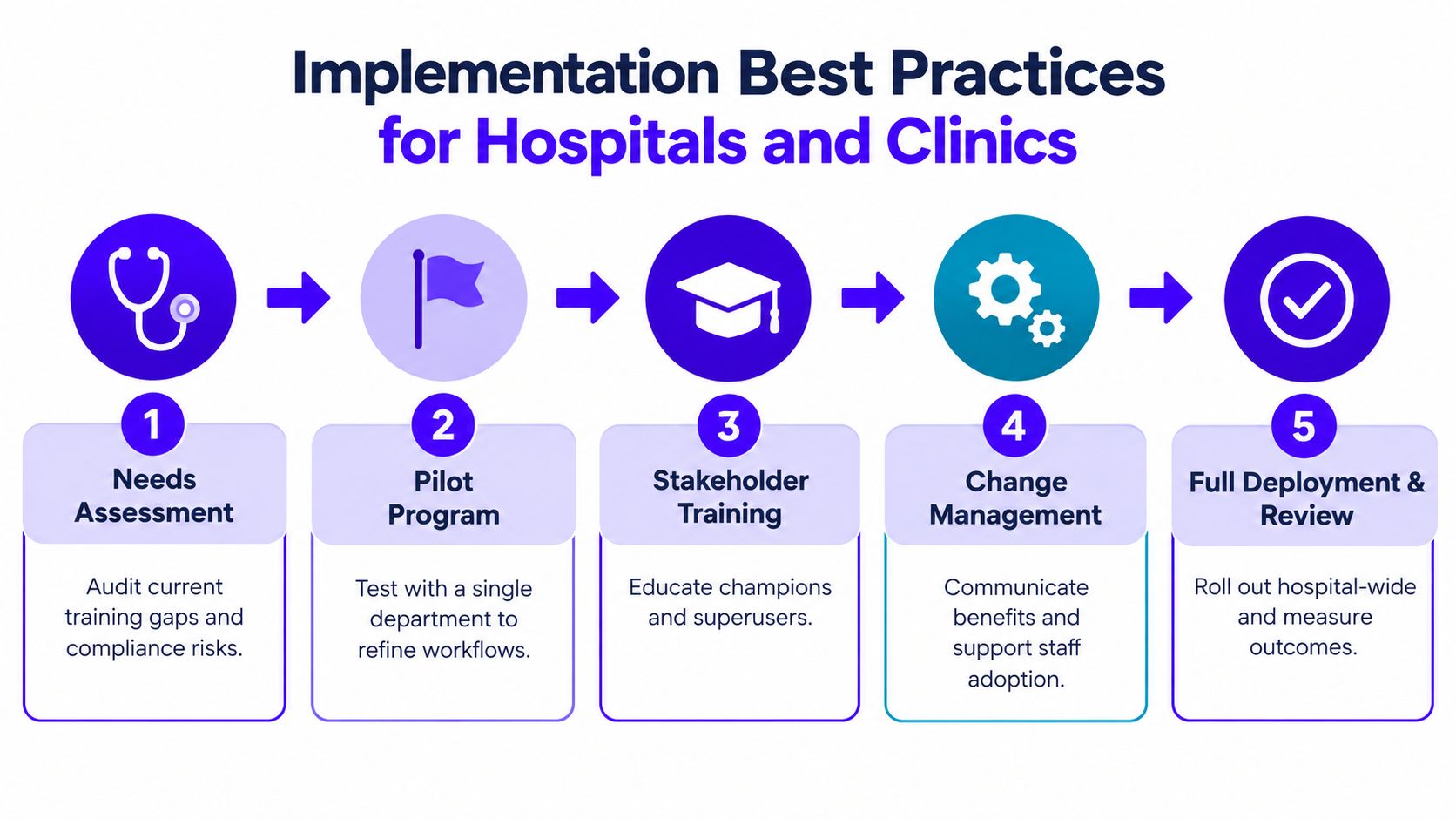
Use a controlled rollout
A practical rollout includes:
- Needs assessment: Find duplicated spreadsheets, missing certificates, unassigned requirements, and renewal risks.
- Pilot program: Test one department with varied roles, shifts, and technical confidence.
- Stakeholder training: Prepare compliance administrators, managers, educators, and superusers to interpret reports and resolve exceptions.
- Change management: Explain which manual workflows the system replaces and how staff can pause, resume, and complete assigned learning.
- Full deployment and review: Expand only after assignment rules, escalation paths, competency evidence, and exports work in the pilot.
The pilot should include a real exception. A nurse may change units after completing general orientation but before finishing a unit-specific competency. The LMS should assign the missing requirement without duplicating unrelated training, while showing the manager why it appeared. Completion alone cannot confirm clinical readiness, so assessment results, observed competencies, and remediation records need defined owners.
Test credentialing workflows across states before launch. A course may satisfy one jurisdiction while requiring different content, approval, or renewal evidence elsewhere. Map each requirement to the applicable role, location, license, expiration rule, and evidence type. This prevents a generic completion record from being treated as proof of competency or compliance.
Dedicated group solutions let administrators create organizational structures, purchase seats, enroll learners, assign courses, and monitor status systematically. Reports should include certificates and, where applicable, submissions to agencies such as CE Broker. Test those outputs before launch, not during an audit.
Scale is also a reliability question. Premiere Education's publisher information describes a platform serving 300K+ professionals and recording 1M+ course completions. Those figures indicate platform scale, not a guarantee that every implementation will succeed. Workflow ownership, data cleanup, state-rule mapping, and manager follow-up determine whether records remain dependable.
Integration with Existing Healthcare Systems
A hospital's LMS rarely works alone. Employee roles may originate in an HR platform, credentials may sit in a medical staff system, schedules may be managed elsewhere, and clinical access may depend on records that the education team can't edit directly.
Consider a nurse transferred to a new unit. The HR system updates the department, the LMS receives the role change, the credentialing system retains the license record, and the scheduling platform identifies upcoming shifts. If those systems don't exchange data, an administrator may assign the wrong training, a manager may miss the transfer, and the nurse may receive duplicate reminders.
Connect records to decisions
Useful integrations include:
- HR synchronization: Import hires, role changes, locations, and departures.
- Credentialing exchange: Share certification status, documents, verification results, and expiration dates.
- Scheduling connection: Align learning assignments with shifts and clinical coverage.
- Single sign-on: Reduce access friction while preserving centralized identity controls.
- Reporting APIs: Send clean training data to analytics and workforce dashboards.
- EHR-related controls: Where appropriate, connect completion status to access or readiness workflows without exposing unnecessary patient information.
Integration shouldn't mean sending every available field everywhere. The project team should define the minimum data required for assignment, verification, reporting, and escalation. It should also test what happens when an employee changes role, goes on leave, loses a credential, or completes learning offline and reconnects later.
Healthcare organizations that make those boundaries explicit gain more than cleaner reports. They build training infrastructure that supports workforce readiness, safer digital transformation, and continuous professional development without forcing compliance administrators to reconcile disconnected systems by hand.
Premiere Education provides accredited continuing-education courses and certifications, state-specific course mappings, group enrollment tools, completion tracking, certificates, and reporting support for healthcare organizations. Visit Premiere Education to review options for organizing staff learning and building more audit-ready credential records.
Latest Posts





25% off Sitewide→
Use Code: PCECYBERSALE2025→