
.avif)
Required Continuing Education for Nurses: State Examples

A renewal notice arrives between medication passes, a short-staffed shift, and the handoff that ran late. The nurse sees a familiar question: How many continuing-education hours are required, which topics count, and when must everything be finished? The answer depends less on a universal number than on the license, state board, renewal period, practice role, and sometimes the nurse's other licenses.
That's why required continuing education for nurses is best treated as a jurisdictional puzzle, not a simple hour-counting exercise. A single-state RN may need one straightforward course plan. A nurse practicing across state lines may need to compare several boards. An APRN may need general renewal hours plus role-specific and pharmacology education.
This guide translates those rules into practical decisions. Examples involving California, Arkansas, New Jersey, Illinois, Florida, Pennsylvania, and multistate practice show how a nurse can identify the controlling rule, select courses that satisfy both hour and topic requirements, and keep documentation ready for renewal or audit. A broader overview of nursing continuing education requirements can also help nurses build a personal compliance reference.
Introduction to Required Continuing Education for Nurses
Continuing education can feel like an administrative task because it often appears on a renewal checklist beside fees, attestations, and license information. Clinically, though, the purpose is more meaningful. Nursing practice changes as treatments, safety expectations, regulations, and professional standards develop, so boards use continuing education as one way to support ongoing competence.
The confusion starts when nurses assume that all boards use the same formula. They don't. One state may require a fixed number of contact hours, another may recognize verified practice hours, and another may focus on mandatory topics rather than a general hour total. A nurse who moves, holds licenses in more than one state, or changes from RN to APRN practice can quickly discover that an old renewal routine no longer fits.
Consider an RN who works regular shifts in Ohio but occasionally accepts assignments connected to multistate practice. That nurse shouldn't begin by searching for the most convenient course. The safer starting point is a license map: identify every active license, record each renewal date, list each board's hour requirement, and mark required topics separately. The Nurse Licensure Compact Essential InformationAn Ohio Category A Nursing CE Offering addresses rules, regulations, and continuing-education standards relevant to nursing practice across state lines under Ohio's participation in the NLC.
A practical CE plan answers four questions:
- Which board controls renewal? The answer may differ from the state where a nurse currently works.
- What type of credit counts? A course certificate must use credit language the board accepts.
- Which topics are mandatory? Required subjects can sit on top of general hours.
- What proof must be retained? Completion records should remain easy to retrieve if the board audits the license.
The sections that follow turn those questions into a repeatable workflow. The goal isn't to memorize every state rule. It's to know how to locate the applicable rule, interpret it carefully, and build a plan that survives a busy clinical schedule.
What Required Continuing Education Means for Nursing Licensure
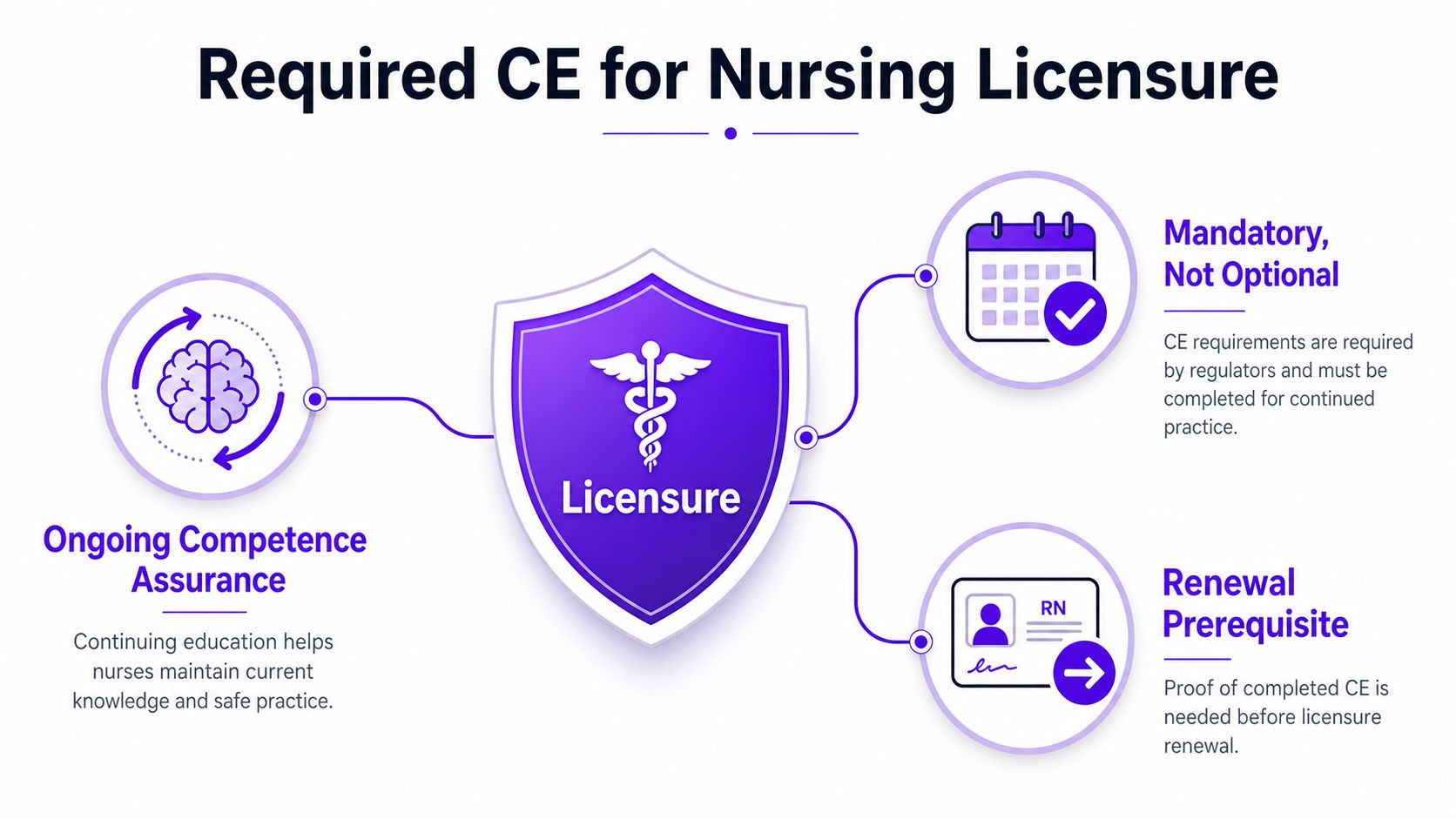
A license renewal works like a clinical competency check. Before a nurse practices independently, an employer may verify skills. Before a board keeps a license active, the nurse must complete the renewal steps set by that jurisdiction. Required continuing education is the regulatory learning component of that renewal process.
The history explains why the rules can feel uneven. The first recorded continuing nursing education course appeared in 1894. The modern CE framework took shape in 1967, after the National Advisory Committee on Health Manpower urged professional associations and regulators to support ongoing competence. In the United States, CE became a formal licensure issue in the 1970s, but states adopted it at different times. By 2015, 32 states plus Puerto Rico required ongoing CE for nursing licensure, according to the Journal of Nursing Regulation30344-6/fulltext). Because no single national nursing authority sets every renewal detail, the applicable board remains the controlling reference.
The terms that control a renewal decision
A renewal cycle is the period covered by a board's rules. Qualifying education must fall within the board's recognized window. A course completed years earlier may support professional growth but still fall outside the current cycle. The license remains active only when the nurse meets the board's education, application, and other renewal conditions.
A contact hour usually means an hour of organized learning accepted for professional credit. CEU, or continuing education unit, uses a different measurement label and may not equal a contact hour under a particular board's rules. The certificate should identify the credit type, provider approval, topic, and completion date.
Practical rule: A completed course is not automatically a qualifying course. The licensing board decides whether its subject, credit type, provider, and completion date satisfy renewal.
That distinction applies to experienced nurses as well. Safe practice and employer training can strengthen competence, yet neither automatically replaces a board-mandated course. For a single-state license, map one board's rules. For multistate practice or an APRN license, treat each active license as its own checkpoint and confirm which education applies before enrolling.
How State Requirements Vary and What That Means for Your Renewal
State variation is the central difficulty in required continuing education for nurses. A 2023 state-by-state analysis found that annual RN requirements ranged from 0.67 hours to 40 hours per year, while Arizona, Colorado, Missouri, and Wisconsin had no fixed hour requirement, as reported in this state-level analysis of nursing CE requirements. Another summary of current rules places many states between 15 and 30 contact hours every two years, with some boards adding subjects such as laws and rules, human trafficking, domestic violence, or opioid and substance-abuse education.
The range makes a one-size-fits-all study plan risky. A nurse who finishes a course bundle designed for one state may still lack a mandatory topic in another. A nurse who holds licenses in multiple jurisdictions may need to plan for the strictest applicable rule rather than the easiest one.
A quick comparison of state examples
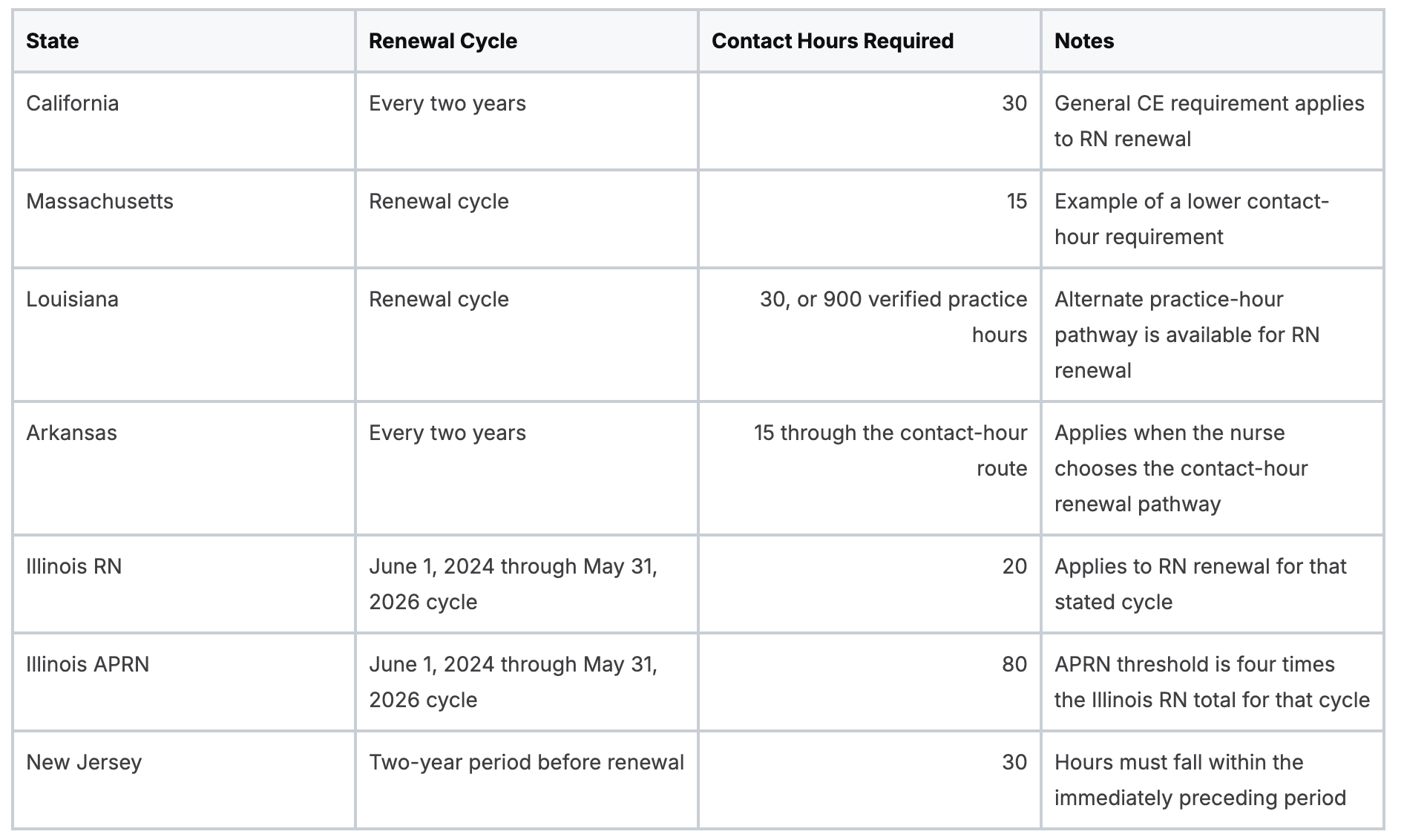
The table illustrates why “How many hours do nurses need?” is incomplete. The better question is, Which license is being renewed, under which board, during which window, and with which alternate options?
A multistate nurse can create a simple matrix with one row per license. The columns should include renewal date, base hours, mandatory topics, accepted alternatives, and documentation method. If the nurse works in a school setting, for example, a New York-specific training such as New York, DASA Dignity for All Students Act Training may be relevant to that professional setting, but it shouldn't be counted toward a nursing license unless the applicable authority recognizes it.
When licenses overlap, the strictest applicable board rule is the safer planning anchor. A practice-hour alternative accepted by Louisiana doesn't automatically replace contact hours required by another state.
Nurses should also check whether a rule applies to the license status, not merely the job location. A nurse may live in one state, hold a multistate privilege, and maintain another license with separate renewal requirements. Board websites remain the controlling source when rules change.
Understanding Contact Hours CEUs and Mandatory Topic Rules
Hour totals are only one layer of compliance. A nurse can complete the apparent total and still fall short because the courses don't cover a required subject, use an unaccepted credit type, or apply to a different license category.
Contact hours and CEUs shouldn't be treated as automatic synonyms. A course certificate should identify the credit awarded, the provider's approval or accreditation, the subject, and the completion date. The board's terminology controls whether that credit can be applied.
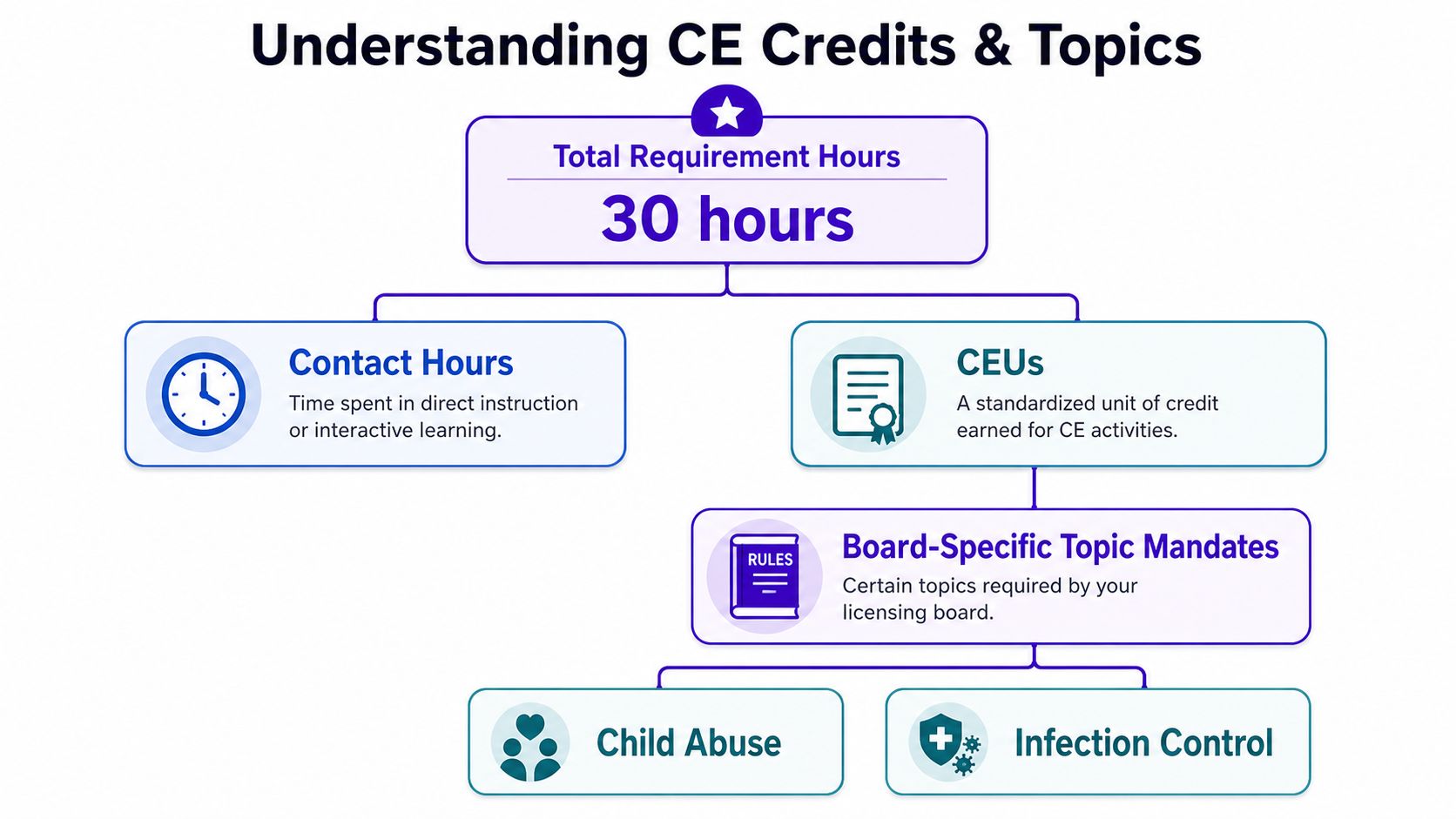
The topic layer creates the common trap
Florida illustrates the problem clearly. Its requirements can include modules covering medical errors, laws and rules, human trafficking, and impairment recognition. Pennsylvania adds a child abuse recognition and reporting requirement. A nurse who completes general clinical education may have enough broad learning but still need a separate mandated-topic course. The board-specific examples are summarized in this nursing CE guide.
For an APRN, the map can become more specialized. ANCC states that CNS or NP certification renewal requires 75 contact hours related to the role, including 25 pharmacology contact hours. Those certification requirements may sit alongside state licensure requirements, so an APRN should distinguish the state board's renewal rule from the national certification body's maintenance rule.
Before enrolling, a nurse can evaluate each course against a two-column checklist:
- Credit match: Does the course award the required contact hours or CEUs?
- Topic match: Does it satisfy a named board subject?
- Role match: Is it intended for RN, LPN, APRN, CNS, NP, or another scope?
- Timing match: Does the completion date fall inside the renewal window?
- Proof match: Will the certificate show enough information for an audit?
A course that satisfies only the first item may still leave a compliance gap. The safest record labels each completion with both its general credit contribution and its topic contribution. For New York nurses dealing with child-abuse education, the new child-abuse CE renewal requirement in New York offers a focused reference for interpreting that subject-specific obligation.
How to Choose Accredited Providers and Plan Your CE Smartly
A low-stress CE plan starts with provider verification, not course browsing. The nurse first checks the state board's current requirements, then confirms that the provider's accreditation or approval is accepted for that license. ANCC accreditation is a useful signal for nursing education, but state acceptance still deserves a direct check.
A California RN provides a clear planning example. California requires 30 contact hours every two years, and the state board says those hours are in addition to the renewal fee, as stated on the California Board of Registered Nursing CE renewal page. An Arkansas nurse using the contact-hour route needs 15 contact hours every two-year renewal cycle, according to the Arkansas State Board of Nursing FAQ. The course plan should reflect the applicable board, not a generic national package.
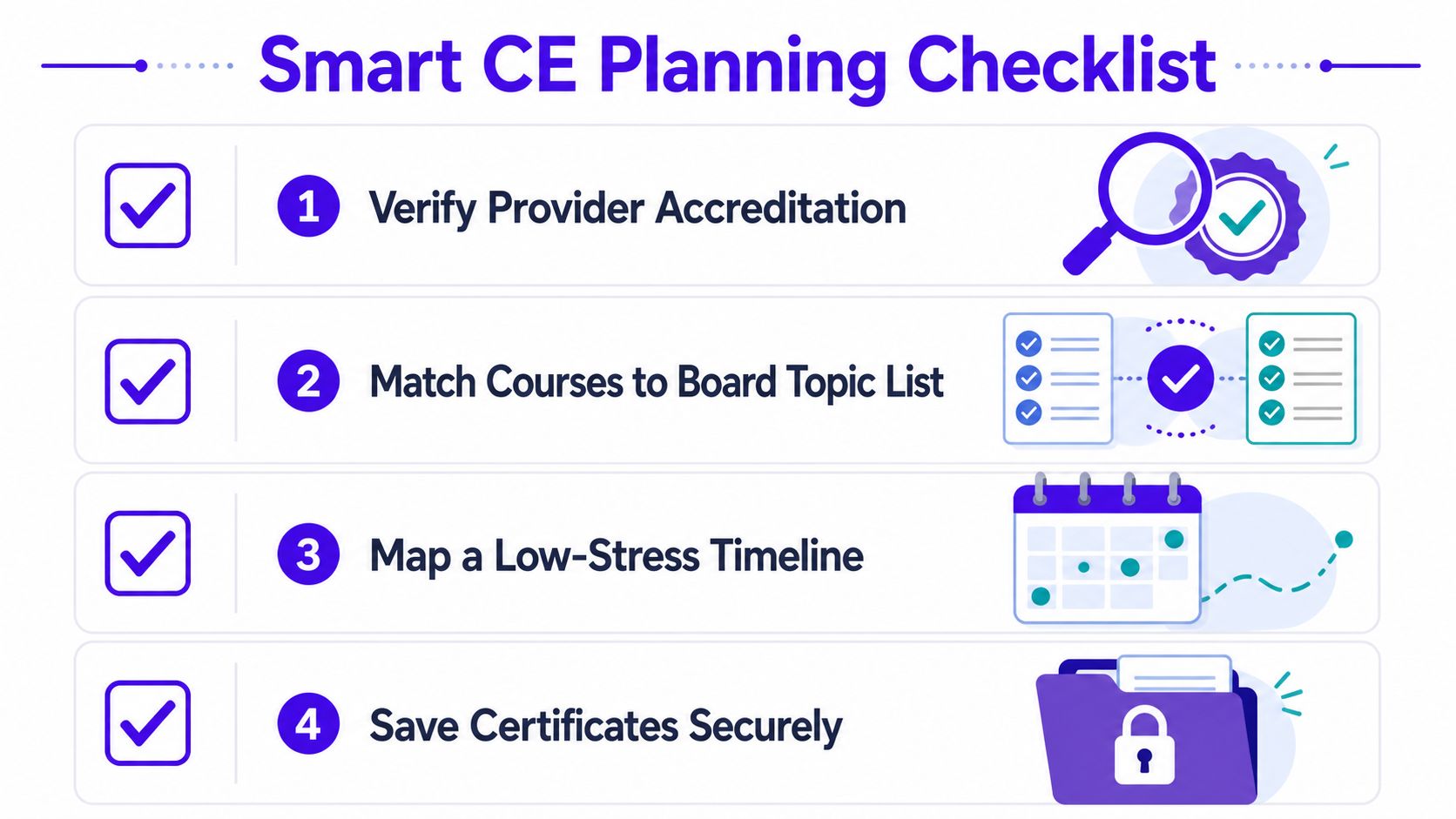
Four checks before enrollment
- Verify the provider. Look for recognizable nursing accreditation, clear provider information, and certificates that identify the awarded credit.
- Match the board topics. Separate general hours from required subjects such as laws and rules, impairment, or child-abuse reporting.
- Spread the work across the cycle. A nurse working rotating shifts can use short, self-paced blocks rather than postponing every course until the renewal month.
- Protect the records. Save certificates in a labeled digital folder and keep a simple tracking sheet with course title, date, credit, topic, and license.
For nurses comparing education formats, self-paced online learning can fit around night shifts, weekend coverage, and unpredictable overtime. The format matters less than whether the course is accepted, relevant, documented, and completed inside the board's recognized period.
The accredited versus state-approved CE guidance is useful when a nurse needs to distinguish provider credentials from a board's specific acceptance rules. Premiere Education offers accredited online courses, state-specific mappings, self-paced access, certificates, and reporting to CE Broker or other relevant agencies where applicable. Those tools can support individual nurses and organizations, but the nurse remains responsible for confirming the rule governing the license.
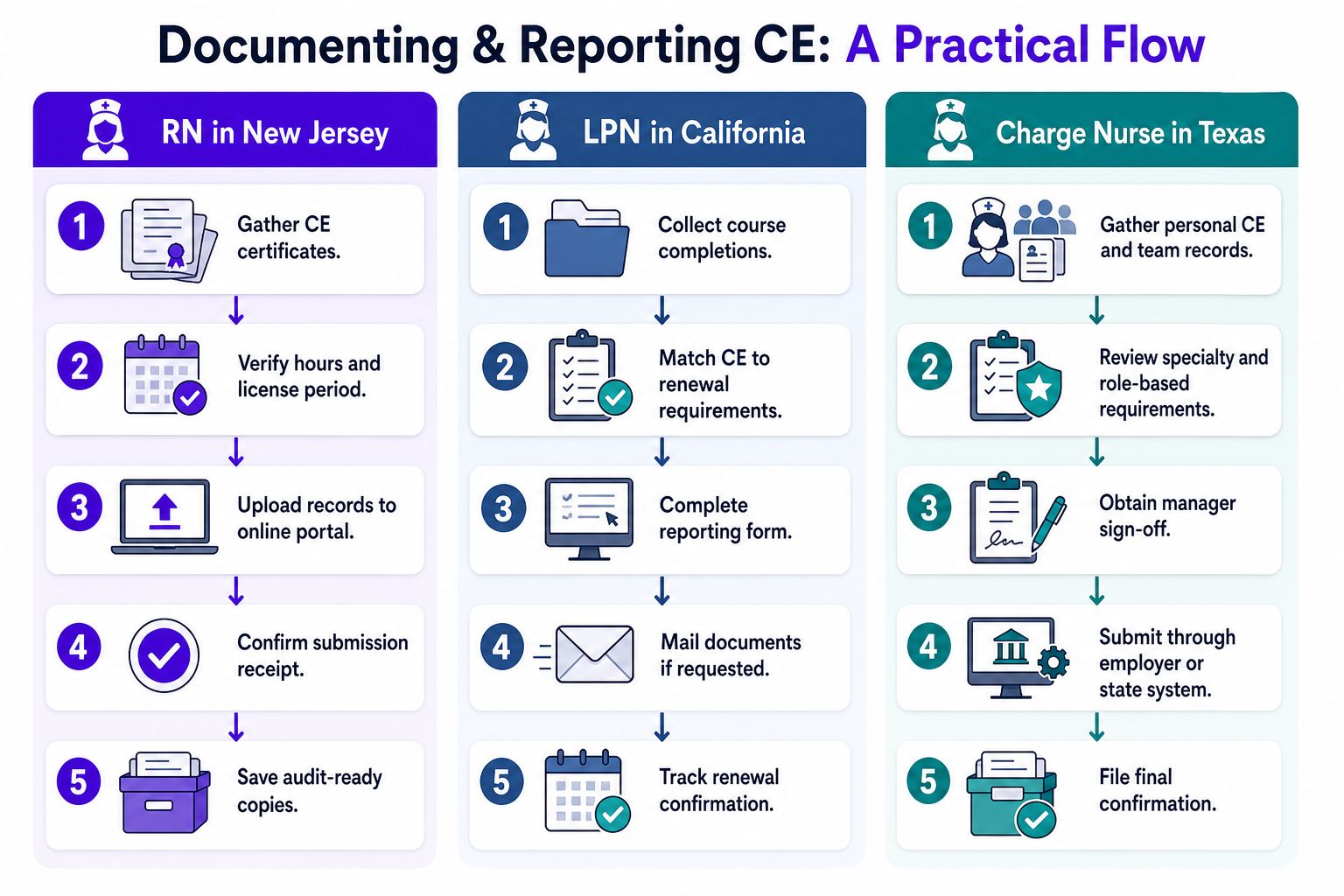
Practical Examples of Documenting Tracking and Reporting CE Completion
Documentation becomes important after the learning is finished. A certificate sitting in an email account isn't the same as an organized renewal record, especially when a nurse holds multiple licenses or an employer needs evidence for several staff members.
The New Jersey RN
A New Jersey licensee must complete 30 contact hours during the two-year period immediately preceding renewal, according to the New Jersey Board of Nursing. The board gives a concrete example: for a May 2019 renewal, the qualifying period ran from June 1, 2017, through May 31, 2019.
An RN preparing for renewal can create a folder named for the license and cycle, then save each certificate as soon as a course ends. A tracking sheet should show the completion date and identify any course used for a mandatory topic, preventing an older course from being mistaken for a completion inside the valid window.
The Illinois APRN
Illinois demonstrates why role-specific tracking matters. For the June 1, 2024 through May 31, 2026 cycle, Illinois listed 20 approved hours for RN renewal and 80 approved hours for APRN renewal, as shown on the Illinois Department of Financial and Professional Regulation. An APRN should keep separate records for the state license and any certification maintenance requirement, including role-related and pharmacology education where applicable.
The clinic manager
A clinic manager tracking a team shouldn't rely on a shared spreadsheet alone. A workable process assigns each nurse a profile, records the license type and renewal date, maps courses to board topics, and flags missing certificates. The manager can then review completion status before renewal pressure builds, while each nurse retains personal copies for independent access.
Audit-ready means another person can understand the record without asking the original learner to reconstruct it.
For any state using an agency such as CE Broker, the nurse or organization should verify whether the provider reports completion automatically and whether the record appears under the correct license. Reporting isn't a substitute for retaining proof. A certificate, course title, credit amount, completion date, provider information, and topic designation form the practical evidence trail.
Your Renewal Ready Plan for Staying Compliant Year After Year
A reliable renewal routine treats CE like medication reconciliation. The nurse checks the right patient, confirms the right medication, verifies the dose, and documents the action. CE planning follows the same logic: identify the right license, confirm the right rule, complete the right course, and preserve the right proof.
A reusable plan can stay simple:
- List every license and certification. Include RN, LPN, APRN, CNS, NP, multistate, and specialty credentials.
- Record each renewal window. Don't assume all licenses renew on the same date or use the same lookback period.
- Separate hours from topics. Mark which courses satisfy general credit and which satisfy mandatory subjects.
- Check alternatives carefully. Practice-hour pathways may apply to one board but not another.
- Schedule learning before the final weeks. Shift work, leave, and course availability can disrupt last-minute plans.
- Store evidence immediately. Keep certificates in a secure folder and verify agency reporting when applicable.
- Review rules before renewal submission. Boards can revise requirements, so the current board guidance controls.
The strongest plan is not the one with the most courses. It's the one that matches the nurse's license status, role, jurisdiction, renewal timing, and documentation needs without leaving hidden topic gaps.
Premiere Education provides accredited, self-paced continuing-education courses, state-specific training, certificates, and tracking tools for nurses and organizations managing renewal requirements. Nurses can review the available options through Premiere Education and build a documented CE plan around the boards and licenses that apply to their practice.
Latest Posts





25% off Sitewide→
Use Code: PCECYBERSALE2025→