

Continuing Education for Social Workers Guide

The renewal notice arrives between a crisis call and the next team meeting. A social worker with a full caseload opens the licensing board's website and finds unfamiliar terms, separate rules for online learning, and a deadline that leaves little room for mistakes. Several certificates sit in an email folder, but nobody has checked whether each course matches the right license, topic, format, or renewal cycle.
That situation is common because continuing education for social workers is not one universal checklist. A course can provide useful learning and still fail to satisfy a particular board's modality limit, approval rule, or mandated-topic requirement. The safest approach treats compliance like an audit-ready map, with every activity connected to a state, license, topic, format, cycle, and proof of completion.
When Renewal Sneaks Up on Busy Social Workers
Jordan, an LMSW, notices that renewal is approaching while reviewing a client's care plan. The calendar shows several weeks of appointments, supervision meetings, documentation deadlines, and family responsibilities. Jordan has completed some online training during the year, but the certificates don't identify whether the learning counts as ethics, general practice, or a state-mandated category.
The first instinct is to search for the fastest package of online courses. That can create a second problem. One state may accept a broad range of self-paced learning, while another may limit asynchronous hours or require an examination for remote programs. A certificate showing course completion doesn't automatically prove that the activity fits the license being renewed.
Practical rule: A CE certificate is evidence of completion, not a complete compliance decision.
Continuing education became central to social-work regulation after credentialing and licensing expanded. Formal activity grew during the 1970s, when Title XX of the U.S. Social Security Act supported workshops, conferences, residential institutes, and staff-development programs. Funding weakened during the 1980s, then continuing education expanded again from the 1990s as licensing and credential-renewal systems increasingly required documented professional learning. Annual requirements commonly range from 10 to 24 contact hours, although the exact rule depends on the jurisdiction and credential. (Learn about the history and variation of social-work continuing education)
A practical compliance map answers five questions before a course is booked:
- Which license applies? An LCSW, LMSW, LSW, LSWA, or baccalaureate credential may carry a different rule.
- Which cycle applies? A board may use an annual, biennial, or another reporting period.
- Which topics are mandatory? Ethics, cultural competence, suicide-risk education, substance use, or reporting duties may need separate tracking.
- Which modalities count? Live webinars, asynchronous courses, self-directed study, and in-person events may be treated differently.
- Which proof is required? Certificates, attendance records, exam results, approvals, and course descriptions may all matter.
Social workers also work within wider service systems, so professional tools can be useful alongside licensing resources. Teams reviewing human services tools may find ideas for organizing programs, operations, and documentation, but the licensing board remains the authority for CE acceptance.
By following the process in order, a busy practitioner can move from deadline anxiety to a clear record. The path starts with the renewal rule, continues through state and topic mapping, and ends with certificates stored in a way that can withstand an audit.
How Licensure Renewal and CE Hours Really Work
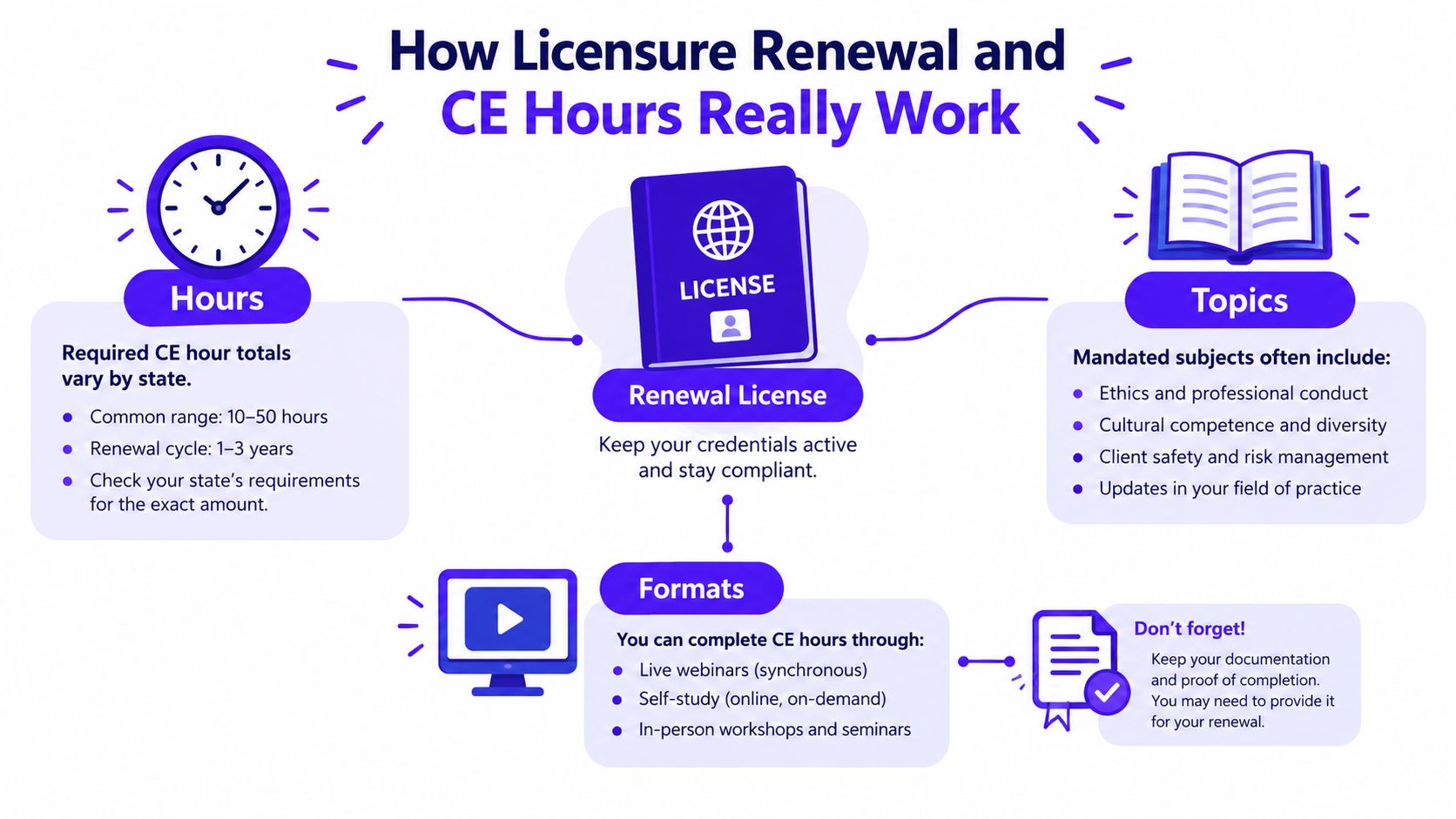
A renewal license works much like a passport. The license is the document that permits professional practice, while CE hours, approved topics, accepted formats, and completion records act like the stamps that make the renewal application complete.
Start with the total hours. The board may state a number for a particular license and cycle, but that total is only the outside boundary. A practitioner then needs to determine whether some hours must be reserved for ethics, cultural competence, reporting, suicide-risk practice, or another subject.
Read the rule in the right order
A reliable reading sequence prevents the common mistake of collecting hours first and checking eligibility later.
- Identify the credential and renewal period. The same state can set different requirements for different license levels.
- Separate total hours from reserved categories. A required ethics course usually counts toward the total, but it may not be replaceable with general clinical content.
- Check approved learning formats. “Online” can include live virtual attendance, asynchronous study, and self-directed activity, but boards may distinguish among them.
- Confirm provider approval. Some boards require approval by a recognized organization or entity.
- Save proof immediately. Store the certificate, course title, date, hours, topic category, provider information, and any exam or attendance evidence.
A contact hour is best understood as documented learning time accepted by the board. A course can be educationally valuable without being eligible for a particular renewal, so the board's language matters more than a provider's general description.
Someone unfamiliar with professional titles may also need to understand RSW before booking, especially when comparing credentials across regions. A clear distinction between a registered social worker and a U.S. licensed credential helps prevent the wrong rule from being applied.
For a profession-specific starting point, the Premiere Education social-work resource can sit beside the relevant licensing-board page during planning. A course such as Classroom Management I Creating Classroom Expectations addresses classroom expectations and a supportive, well-structured learning environment, but a social worker should still verify whether its subject and approval status fit the intended license requirement before counting it.
The final step is record hygiene. A folder labeled only “CE certificates” is difficult to audit. A better file name includes the license, cycle, course topic, modality, date, and hours, while a simple spreadsheet or dashboard shows what remains outstanding.
Why State Requirements Look So Different
There isn't one national CE rule because licensing boards control the details within their jurisdictions. They decide how much learning a credential requires, when the reporting period closes, which providers qualify, how much self-study counts, and which subjects deserve a dedicated place in the renewal record.
Massachusetts illustrates the credential-level approach. During a biennial cycle, the state requires 30 credits for LICSW, 20 for LCSW, 15 for LSW, and 10 for LSWA. Courses must be approved by a recognized entity, which can include qualifying governmental approval in another U.S. state or Canadian province. (Review Massachusetts social-work CE requirements)
Other models use different structures. Requirements can range from New York's monthly accrual model to New Jersey's 20 to 40 credit biennial requirements and Alaska's 45-hour cycle. Those differences make a generic “complete your online CE” recommendation incomplete. The same course format may be accepted in one jurisdiction and restricted in another.
Compare the rule, not just the hour total

A multistate practitioner should maintain separate rows for each jurisdiction and license. A single certificate may be usable in more than one record, but its acceptance still needs to be checked independently.
The most confusing edge cases deserve written answers before renewal. Does employer training count? Is a course accepted after a board rule changes? How can synchronous attendance be documented? What happens after reinstatement? Do multiple licenses require separate topic allocations? A compliance map should include a notes field for each answer, with the source rule and date checked.
Online CE is therefore not interchangeable. A live webinar may create attendance evidence, while an asynchronous course may require a test. Self-directed reading may count only within a cap. Treating all digital learning as the same category is one of the easiest ways to build an incomplete renewal record.
Mandatory Topics and Specialty Tracks Worth Your Time
A renewal plan should connect required topics with the risks and decisions in your daily work. A social worker choosing courses has two jobs: satisfy mandatory categories and build skills that fit the people, settings, and situations encountered in practice.

Ethics is more useful as a decision guide than as a box to check. A clinician working with a former client may need to reason through boundaries, confidentiality, dual relationships, and documentation. A child-welfare practitioner may face a reporting decision where delay creates risk. A school social worker may need to recognize how cultural assumptions affect assessment and referral.
Oregon shows how several categories can fit within one renewal record. Over a two-year reporting period, the state requires at least 20 hours for a registered baccalaureate social worker, 30 hours for a master's social worker, and 40 hours for an LCSW. The LCSW total includes at least 6 hours of ethics, 6 hours of cultural competence, and 2 hours concerning suicide-risk assessment, treatment, and management.
Build a portfolio around practice risk
A useful portfolio can follow the risks in your caseload:
- Ethics and boundaries: Apply these lessons to confidential information, dual relationships, informed consent, and professional communication.
- Cultural competence: Choose training that addresses language, identity, community context, and institutional barriers affecting assessments, treatment plans, or service access.
- Suicide-risk practice: Focus on risk assessment, documentation, safety planning, treatment, and care coordination when working in clinical or crisis settings.
- Mandatory reporting: Study duties involving children, older adults, dependent adults, or other protected populations.
- Substance-use practice: Build knowledge relevant to behavioral-health, hospital, community, and integrated-care settings where substance use affects safety and treatment planning.
- Population-specific competency: Select a defined population, such as veterans, older adults, people experiencing homelessness, or families involved with child welfare.
A practitioner in an elementary school might pair ethics with reporting and culturally responsive family engagement. A behavioral-health clinician could reserve mandated categories first, then add suicide-risk assessment and approaches related to the caseload. A community practitioner serving older adults might choose capacity, caregiver stress, benefits navigation, and population-specific competency.
Social-work ethics CE resources can support the ethics portion of that plan. Course selection still requires a check against the applicable board's approval and modality rules. Online ethics training is not automatically interchangeable with live attendance or another delivery format.
The strongest record connects each certificate to a requirement, license, modality, and practice topic. Before a course, record a short knowledge baseline. Afterward, use a case simulation or written application to test whether the material changes a professional decision.
A 2023 systematic review screened 133 peer-reviewed studies published from 2011 through 2023 and found only seven that met its criteria for evaluating continuing-education outcomes among social workers. Reported effects included professional development, improved practice skills, increased knowledge, preliminary effectiveness, and greater self-confidence. The studies had no randomized controlled trials or comparison groups and were limited by small samples and potential bias. (Read the systematic review of social-work CE outcomes)
That evidence supports a practical habit: select mandatory topics first, then use tests, case exercises, and follow-up reflection to determine whether learning has become usable practice.
How to Choose Accredited CE Without Wasting Money
The safest purchase happens after the board rule is open, not before. A social worker can compare a course with the licensing requirement using a short sequence that checks approval, topic, format, assessment, and documentation.
Verify before paying
First, confirm the credential and renewal cycle. Next, locate the board's wording on provider approval and delivery format. Then check whether the course description identifies the number of hours, learning objectives, subject category, completion method, and certificate details.
A remote course deserves special attention. Some boards treat live online attendance differently from asynchronous study, while others require an examination for remote programs. A course that looks convenient may become risky if it doesn't produce the evidence the board expects.
Cost planning also needs realistic context. A 2025 survey found that 64% of social workers discover CE through online search. The same survey reported uneven annual spending: 22% spent less than $100, 17% spent $100 to $250, 20% spent $250 to $500, and 12% spent more than $500. The categories leave a substantial share unreported, so the figures describe uneven access rather than a complete budget for every practitioner.
A limited budget should prioritize requirements that cannot be substituted. If ethics is mandatory, that category comes before an optional specialty course. If the board requires cultural competence or bias-related learning, the practitioner should verify that the course explicitly maps to the required category rather than assuming a general diversity course will qualify.
Keep an audit trail from the first course
For every activity, retain:
- Approval evidence: The provider or recognized entity connected to the course.
- Completion proof: The certificate, completion date, hours, and learner name.
- Format evidence: Attendance confirmation, participation record, or examination result when applicable.
- Topic mapping: The category assigned to the course and the license rule it satisfies.
- Payment and reimbursement notes: Employer reimbursement requests, receipts, or hardship documentation where relevant.
Employer in-service training may count in some jurisdictions and not in others. Independent contractors, nonprofit employees, rural practitioners, and people returning to practice should check reimbursement, waiver, reinstatement, and hardship-extension rules early. The least expensive course isn't always the safest choice if it lacks recognized approval or adequate records.
A sound decision is not “buy the cheapest hours.” It is “buy the hours that can be verified, applied to the right category, and defended if the board asks for proof.”
Real Plans From Texas Delaware and Connecticut
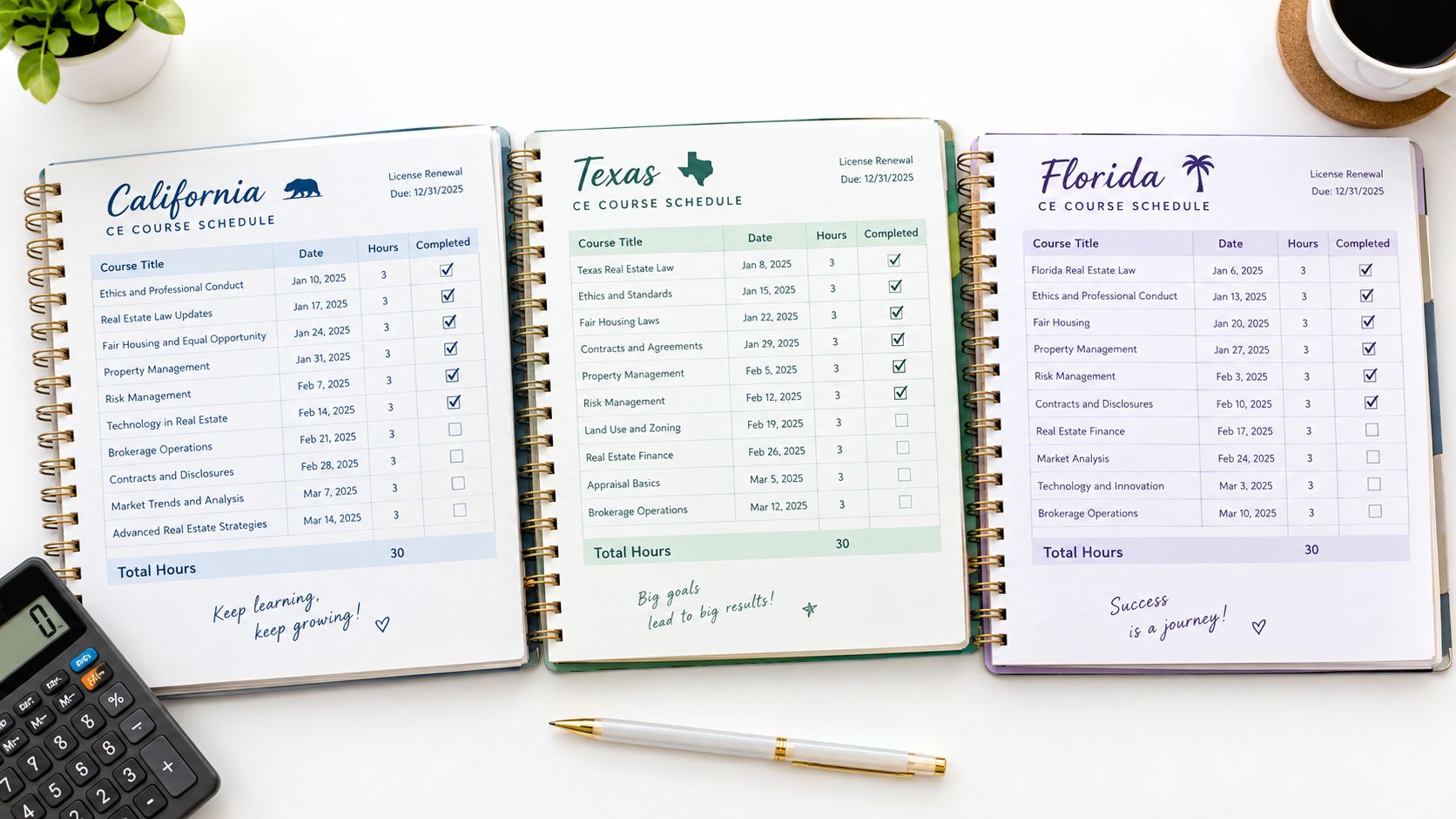
Three practitioners can all complete online learning and still need different plans. The difference comes from the state rule, the license, and the format used.
A Texas LMSW allocates categories first
A Texas LMSW needs at least 30 hours during each renewal period. The plan must include 6 hours of ethics and 3 hours developing competency in serving a distinct population, with the remaining 21 hours devoted to approved practice-relevant education. (Review Texas social-work renewal requirements)
The practitioner might reserve the ethics course first, select a population-focused course concerning veterans or older adults, and then choose general clinical or community-practice learning. Each certificate is filed under ethics, distinct-population competency, or general CE. The Texas social-work CE resource can be used as one planning reference, while the Texas board remains the controlling source.
A Delaware LCSW respects the self-directed limit
A Delaware LCSW needs 40 approved hours, including at least 6 hours of professional ethics and 1 hour of mandatory reporting. No more than 10 hours may come from self-directed activity, so independent reading cannot supply the entire renewal record. At least 30 hours must come from other qualifying formats. The state also performs random audits, making topic, format, approval, and certificate details important. (Check Delaware CE and audit information)
A careful plan labels self-directed hours as they are earned instead of discovering the cap at renewal. The LCSW might complete the reporting requirement through a recognized course, reserve ethics hours, and use live or structured online learning for the remaining balance.
A Connecticut practitioner controls asynchronous learning
Connecticut requires licensed social workers to complete 15 continuing-education credit hours annually, a requirement in place since October 1, 1999. Asynchronous learning is limited to 10 hours, so a practitioner who completes all 15 hours through self-paced courses could exceed the permitted modality even if the total looks correct. (Review Connecticut continuing-education requirements)
The practical plan reserves at least 5 hours for an accepted non-asynchronous format, such as a qualifying live webinar or in-person activity, then records the remaining asynchronous hours separately. A Connecticut social worker also checks whether any mandated subject applies and saves attendance evidence for the live portion.
Stay Compliant With Tracking Certificates and Support
A renewal file should answer two questions quickly: did the social worker complete the required learning, and can they show how it supports practice? Certificates document attendance, while brief checks of knowledge or application provide a clearer picture of learning.
As noted earlier, only seven of 133 screened studies met the systematic review's inclusion criteria. The included studies lacked randomized trials and comparison groups, so attendance alone cannot demonstrate durable competence. When feasible, add a pre- or post-course test, an observed case simulation, a delayed follow-up assessment, or a practice reflection. (Use outcome measures described in the systematic review)
Keep the tracking routine small enough to use throughout the renewal cycle:
- Check the board rule early in the cycle.
- Create a row for every license and jurisdiction.
- Map each course to its topic, modality, and approval status.
- Save the certificate immediately after completion.
- Review remaining hours before renewal deadlines approach.
- Record a short knowledge check or case reflection when appropriate.
This mapping works like a labeled filing system. Each activity has a place, so an online ethics course does not get mistaken for a live requirement, a restricted modality does not exceed its cap, and a mandated topic does not disappear among general credits.
Organizations can apply the same method across teams. Premiere Education provides online CE courses and certifications, state-specific course mappings, self-paced access, completion certificates, assignment workflows, dashboards, and group tracking. Its catalog covers 500+ topics, while its reports can support documentation and agency reporting where applicable. Each practitioner or organization still verifies that a course satisfies the relevant board rule.
A manager can assign ethics to the correct license group, monitor completion, export records, and find missing certificates. A solo practitioner can use a spreadsheet and clearly named digital folders.
The goal is an audit-ready record connecting each activity to the correct license, state, cycle, topic, modality, approval status, and completion evidence.
Premiere Education offers state-mapped online CE, completion certificates, self-paced access, and tracking tools. Visit Premiere Education to review courses and organize renewal records.
Latest Posts





25% off Sitewide→
Use Code: PCECYBERSALE2025→