

Social Determinants of Health Training: A Practical Guide

The completion report looks clean. Every learner finished the module, the satisfaction ratings came back high, and the folder is ready for whoever audits it. Then someone asks the question the report can't answer: did anyone's practice change?
That question sits underneath most social determinants of health training right now. Nurses, physicians, counselors, teachers and school administrators are being asked to complete SDOH coursework, and the completion data arrives long before any evidence about screening rates, referral follow-through, or whether a family got connected to help. Courses get judged on satisfaction. Practice gets judged on behavior. The two rarely meet in the same report.
What follows is a working guide for the people who have to close that gap: the clinical educator building a staff workshop, the nurse practitioner choosing a renewal course, the principal deciding whether a training counts toward a certificate. It covers what good SDOH training teaches, how to measure whether it worked, and where a course cannot help.
Why SDOH Training Became a Core Competency
The refill sat in the pharmacy bin for eleven days. The chart said nonadherence. The next appointment was booked three months out. What nobody recorded was the bus route that changed in March, the shift rotation that moved the patient to overnights, and a pharmacy counter that closes at six.
Social determinants of health are the conditions in which people are born, grow, live, work, learn and age. Income, housing, transportation, food security, education, employment, discrimination and community safety all sit inside that definition, and each one shapes health alongside clinical care rather than behind it.
The push to teach this material has a documented starting point. The WHO Commission on Social Determinants of Health, established in 2005, delivered its final report in July 2008, framing health inequities as the result of social, economic and political conditions rather than healthcare access alone. Its milestone report, Closing the Gap in a Generation, called for action in three areas: improving daily living conditions, addressing the unequal distribution of power and resources, and measuring the problem through evidence and workforce capacity.
That scope explains why the audience is broader than clinicians. Nurses, nurse practitioners, physicians, behavioral health staff, public health workers, teachers, counselors and school administrators all need to spot barriers involving housing, income, transportation, discrimination and food security. Each profession meets the same barrier through a different door.
Health is shaped by the conditions people live in, not only by the care they receive.
Five Core Domains and What Training Covers
Public-health frameworks, including the Healthy People 2030 structure used across U.S. programs, group social determinants into five domains. The grouping is useful because each domain points to a specific question and a specific training topic, not a general instruction to be more sensitive.

The version worth handing to a course designer is the one that ties each domain to something a learner can be observed doing.

Reading the table against one patient
Take a nursing assistant who works nights and keeps missing hypertension follow-ups. Row one applies, because hours were cut and a daytime visit means losing a shift. Row three applies, because the clinic's only late slot falls on the day the bus line stops running at seven. Row five applies, because the patient is the sole caregiver for a parent with dementia and can't disappear for a two-hour block.
A trainer who teaches the domains alone leaves the learner with a list. A trainer who teaches the interaction leaves the learner with a plan: switch the next check to telehealth, arrange pharmacy delivery so the refill isn't a separate trip, and ask about the caregiving schedule before booking anything. Nothing about the patient's motivation changed. The plan did.
The intake habit that makes the domains routine
One question per domain, asked the same way every time, with the answer stored in a structured field rather than free text
- Economic stability: "In the last month, has it been hard to cover food, rent, or medication?"
- Education access: "How comfortable are you reading instructions in English?"
- Health care access: "Do you have a way to get here, and does the cost of a visit worry you?"
- Neighborhood and built environment: "Is your housing safe and stable right now?"
- Social and community context: "Who helps you at home, and do you feel safe there?"
Five questions run under two minutes. The record they produce is what makes a pattern visible later, when fifty patients in a row report the same transportation problem.
Learning Outcomes a Strong Course Should Define
Write learning outcomes as things a learner does, not things a learner knows. "Understands social determinants" can't be observed, scored, or audited. The five below can be.
- Screen with a fixed script. Same questions, same order, every patient, asked with the door closed.
- Explain in plain language and confirm understanding. Teach-back at the end of the conversation, not a rhetorical "any questions?"
- Complete a referral and confirm connection. Who made the call, when, and whether the patient reached the resource.
- Document consistently. Need, resource, date and outcome in the same fields each time.
- Tell individual from structural. Recognize when no referral exists and escalation is the correct response.
Each one can be scored against a rubric inside a case exercise. That's the difference between a course that certifies attendance and one that predicts behavior on a Tuesday afternoon.
What the course design evidence says
A scoping review of SDOH curricula in postgraduate medical education found that 67% of programs were longitudinal, 92% included patient or community exposure, and 83% included classroom-based instruction. Among studies reporting learner outcomes, 78% documented improvement in at least one participant-level measure, including examination performance, SDOH awareness, confidence, screening behavior or referrals to support services.
Translate that into an online format and the shape changes. Branching cases where the learner chooses a referral and sees what happens next. Documentation exercises scored against a fixed template. Resource-selection tasks using a real local agency list. Short assessments spread across several weeks instead of one sitting. The review measured learner outcomes rather than patient health outcomes, so a course should claim competency and practice behavior, not population impact.
Catalog sequencing matters too. When Medicine Fails WomenThe Cost of Gender Bias in Diagnosis and Treatment is a related title for programs building a longer sequence around bias in clinical decision-making.
Rule for course writers: one observable behavior per module. If a lesson can't be checked against practice, it's a reading assignment wearing a certificate.
Measuring Whether Training Changes Practice
Here's where most programs lose the thread. A review of 33 SDOH training studies using the Kirkpatrick evaluation framework found that 79% evaluated only Levels 1 and 2, meaning learner reactions, knowledge or attitudes. Just 21% assessed behavior or outcomes, and only three studies measured patient outcomes. All studies were graded low or very low quality because observational and quasi-experimental designs dominated, without randomization or blinding.

A measurement plan a clinic can actually run
Baseline comes first. Pull three months of screening completion and referral counts before the course launches, so the comparison isn't a memory. Write a scoring rubric for the case exercises and calibrate it between two educators, so the same work gets the same grade.
Then track screening and referral rates monthly for at least a quarter after training. If the organization runs several sites, start the course at one and compare referral follow-through against a site that hasn't begun. A clinic can run this with spreadsheet columns: date, need identified, resource offered, contact confirmed, days to follow-up.
The gap starts upstream of the learner. A national survey of SDOH educators, drawing responses from 106 educators representing 26% of accredited U.S. medical schools and 23% of accredited physician-assistant programs, found that only 35% said they or their faculty had been trained to assess learners on SDOH curricula. Delivery has outrun evaluation.
The same discipline applies when accessibility or compliance modules sit alongside clinical content. Designing accessibility training that sticks makes the case that completion numbers alone rarely show whether staff behavior shifted.
Completing a course is not proof of better population health. Report what changed in practice, and say plainly what remains unknown.
How to Apply SDOH Screening in a Clinical Visit
Return to the patient with the missed refills. A trained clinician handles that visit in six moves, and each one has a predictable failure mode that undoes it.
- Ask privately, with fixed wording. Family members in the room change the answer, especially around income, housing and safety. Use the same script for the patient with a corner office and the patient on Medicaid, because selective asking is how bias enters the record.
- Name the barrier without assigning a cause. The note reads "patient reports no transportation on Tuesdays," not "noncompliant." Writing the interpretation locks the next clinician into the same wrong assumption.
- Check intersecting factors before choosing a referral. Language, disability, housing status and caregiving duties can each make a sensible referral useless. A transport voucher doesn't help someone who can't leave a parent alone.
- Offer one referral that can be confirmed. A transportation program with a phone number and operating hours beats a printed list of twelve agencies. Confirm the patient has a way to call.
- Document need, referral and outcome in the same three fields. Same format every time, so the clinic can count patterns instead of rereading narratives.
- Schedule the follow-up that closes the loop. A dated call or portal message to confirm the patient connected. Without it, nobody knows whether the referral worked.

The interview skills that carry a screening question also carry a brief intervention, which is why SBIRT training for healthcare professionals overlaps so heavily with this work. Both depend on asking a fixed question, listening without correcting, and closing with a next step the patient agrees to.
When the six steps overlap with identity
Step three is where most referrals fail. A multilingual student with a disability and unstable housing doesn't need one resource; that student needs academic, behavioral, family-engagement and community supports coordinated around intersecting needs. Clinical teams who want a structured method for that analysis can work through Applying Intersectionality in Clinical Practice: A Framework for Inclusive Client Care.
A completed visit looks like this in the chart: need documented in the patient's own words, one named resource with contact details, a confirmed connection or a reason it failed, and a dated follow-up. Four fields. That record is what a clinic can audit, and what a course can teach someone to produce.
SDOH Training Requirements for Educators and School Leaders
State rules decide whether an SDOH course counts as professional development, and Arizona shows how the arithmetic works. The Arizona Department of Education certification renewal rules require 15 professional-development clock hours for each year of a standard certificate term.
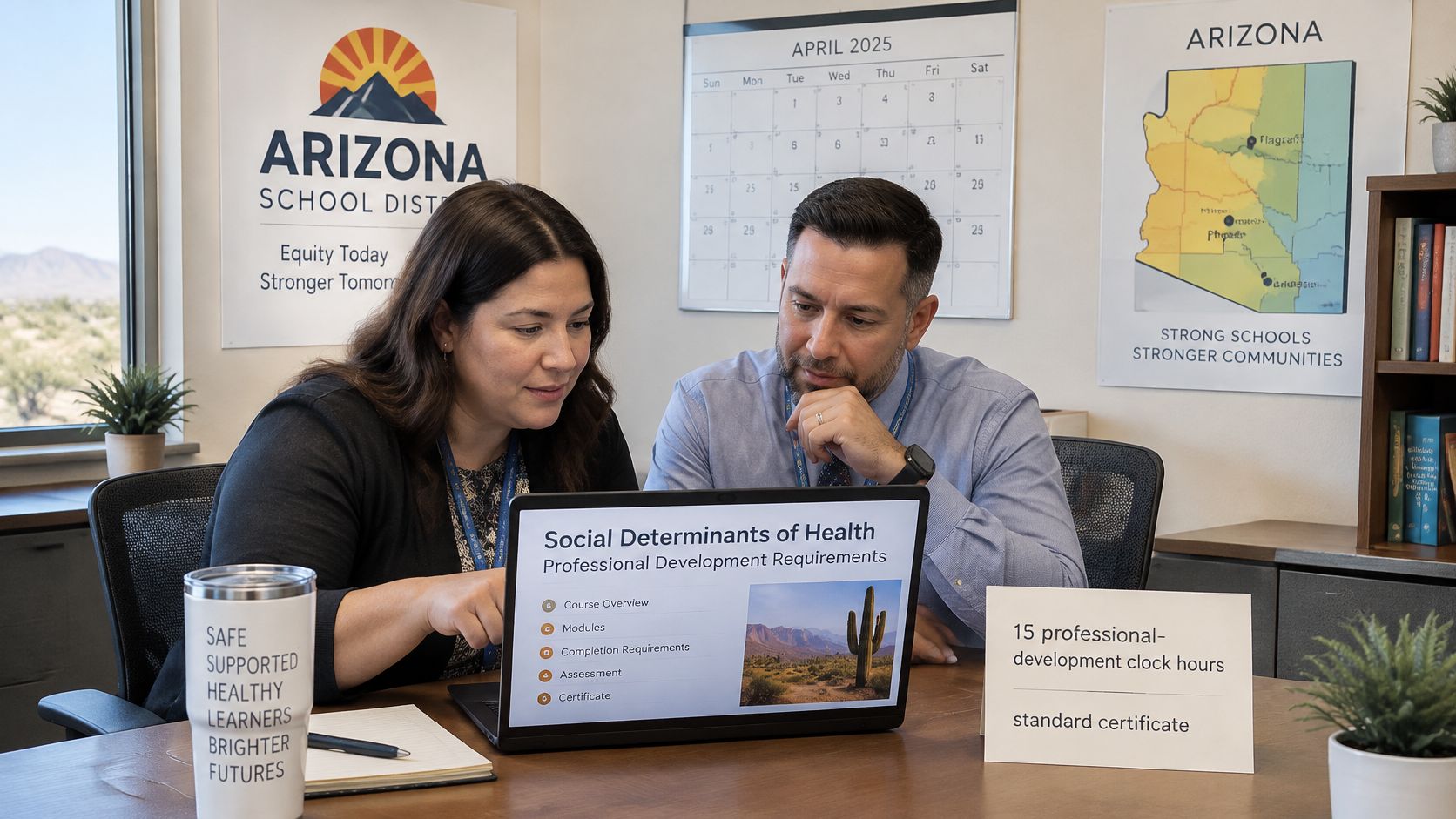

Content must relate to Arizona academic or professional educator standards, or support an additional certificate, endorsement or approved area. Eligible topics include suicide awareness and prevention, child abuse, human trafficking, sexual abuse warning signs, dyslexia interventions and accommodations, and college and career readiness, along with other activities permitted by state law.
Two school cases that fit inside those rules
A school counselor analyzes why a student keeps missing appointments and finds a transportation limitation rather than disengagement. An administrator builds a referral protocol that links families to community services and keeps the evidence. Both are legitimate professional-development activities, and district- or school-sponsored in-service training counts when the sponsor verifies dates and clock hours, with transcripts, certificates, agendas or written verification as documentation.
That verification mechanism is what makes SDOH training practical for compliance. A district retains completion evidence while connecting the content to educator standards and student-support duties.
Leadership standards that make this more than awareness
Arizona's administrative standards for school leaders require administrators to develop staff knowledge, skills and practice through differentiated learning opportunities guided by an understanding of adult learning and development. They also require actionable feedback about instruction using valid, research-anchored supervision systems, and fair, equitable systems for managing conflict among students, faculty, staff, leaders, families and community members.
Put a case in front of that standard. A student is both housing-insecure and receiving special-education services, and staff are reading attendance and behavior through a single lens. A principal can use the case to show how poverty, disability, race, language and family status interact, then coach teachers differently, check whether discipline referrals fall evenly across groups, and coordinate with community resources.
Role matters here too. The Supervisor certificate requirements distinguish instructional staff from personnel whose primary responsibility is administering instructional programs or supervising certified personnel, except for holders of a valid principal or superintendent certificate. A classroom teacher practices recognizing how food insecurity affects concentration. A supervisor builds the referral, documentation and follow-up process across a building.
For staff working with students affected by trauma, How Adverse Childhood Experiences (ACEs) Shape Addiction Risk Across the Lifespan examines how ACEs influence addiction risk, brain development and long-term health, with trauma-informed strategies for screening, prevention and treatment.
Structural Barriers Training Cannot Fix Alone
More SDOH content does not automatically produce more equity. That assumption deserves to be stated plainly, because a lot of course catalogs rest on it.
A 2025 review of SDOH training finds that many education and clinical programs emphasize cultural competence, individual bias, screening and referral workflows while giving limited attention to upstream drivers such as housing policy, labor conditions, governance, racism and unequal resource allocation. Simulation-based teaching can overemphasize cultural competency and skip structural analysis altogether.
That leaves a learner question most courses never answer: what do you do when the barrier is structural and no referral can fix it?
Three moves help. Separate individual-level support from population-level advocacy, so a clinician knows which tool is in their hands. Learn ethical escalation and coalition-building, including who to bring the problem to and what data makes the case. And check whether an intervention reduces inequity rather than merely documenting unmet need.
From fifty referrals to one pattern
A clinic notices repeated transportation barriers across fifty patients. The default response is fifty separate referrals. The stronger response is to pull the counts, show leadership that a third of no-shows trace to a single bus route change, and ask whether a telehealth slot or a pharmacy delivery arrangement addresses the pattern instead of the individual.
Scale matters globally. WHO projects a global shortfall of 11.1 million health workers by 2030, concentrated mainly in low- and lower-middle-income countries, so training built only for well-resourced institutions risks being impractical where social services are scarce. Low-resource case studies, community-led solutions and policy literacy belong in the curriculum for that reason.
Practical Test: track whether the same need keeps appearing after a policy or process change. If fifty patients still report the same bus problem a year later, the training documented a barrier. It didn't touch it.
Who Should Be Trained and Who Defines the Problem
SDOH is not a clinician-only competency, and treating it as one is where a lot of training goes wrong. Three questions sort out the design: who gets trained, who defines the problem, and how the course avoids paternalism or cultural stereotyping.
The WHO guidance on SDOH education states that this education should involve patients, families, professionals from other sectors and groups experiencing marginalization, and that people from the communities served should be trained as well.

A worked example shows the difference. A community health worker from a neighborhood with a large immigrant population co-designs a language-access case with a clinic team. The scenario that results includes the intake form nobody could read, the interpreter line that routed to voicemail, and the family member who was asked to translate a diagnosis. Written by clinicians alone, the same case would have been about "language barriers" in the abstract.
A 2025 systematic review cited in that guidance found uneven integration of gender equality, disability and social inclusion, with many studies showing only moderate or low attention to inclusive program design, representation and disaggregated data.
Three practice rules for co-design
- Review before launch. Pay community members to read case scenarios and flag anything that reads as a stereotype.
- Ask before labeling. Have patients name the barrier in their own words before a clinician assigns a category to it.
- Train across sectors. Include social-service, housing and transportation staff in joint sessions so referral paths get built by the people who have to walk them.
A course written only by clinicians for clinicians tends to reproduce the assumptions it set out to correct. Interdisciplinary exercises and cases built around intersecting identities rather than single-category disadvantage are the fix, and how intersectionality in healthcare is changing lives shows what that looks like in practice.
Organizations wanting a structured start can use Closing the Gaps Advancing Equity in Social Determinants of Health, which covers how income, education and access to care drive disparities and what practical strategies promote equity in clinical and organizational settings.
Choose the SDOH Training Path That Fits Your Role
Match the course to the outcomes the role requires, not to the broadest title on the shelf.
Clinicians, including nurses, nurse practitioners and physicians, want case-based content that practices screening and referral, plus confirmation that the contact hours count with their licensing board. Behavioral health professionals should prioritize courses covering intersecting identities and documentation, since both show up in every record they write.
Educators and school staff should verify state clock-hour rules and topic eligibility before enrolling, using the Arizona and Mississippi pages above. Administrators get the most from training that supports a consistent referral protocol and shared case discussion across a building.
For clinical settings, Applying Intersectionality in Clinical Practice: A Framework for Inclusive Client Care meets continuing education requirements across multiple states and professions and offers ANCC Contact Hours for nursing continuing education.
Premiere Education builds the courses that make this practical, with case-driven modules on social determinants of health, intersectionality in clinical practice, and trauma-informed care, and a group portal that lets a clinic or district assign training, track completion and export the records an auditor will ask for. If the completion report on your desk still can't answer whether practice changed, start by choosing a course with a defined behavior outcome and a measurement plan attached. Browse the catalog at Premiere Education and put one measurable change on the calendar for the next quarter.
Latest Posts





25% off Sitewide→
Use Code: PCECYBERSALE2025→