Nursing Best Practices for Patient Care

At 3 a.m., a patient tells the nurse that something feels wrong. The monitor still shows stable numbers, the medication round isn't finished, and another call light is flashing. The decision that matters is whether the nurse pauses to assess the change or treats the reassuring screen as the end of the conversation.
What Caring Means Beyond Comfort at the Bedside
The patient might be breathing differently, struggling to follow a conversation, or describing discomfort that wasn't present at handoff. A caring response begins with taking that report seriously, checking the patient rather than only the monitor, and comparing the findings with the earlier assessment. Reassurance comes after assessment, not instead of it.
A nurse caring for a patient provides continuous assessment, relational support, and timely escalation. These activities work together. Listening helps uncover a symptom; assessment establishes its significance; escalation brings the right help when the bedside findings warrant it.
The nurse acts as the hospital's early-warning sensor, repeatedly checking the patient across a shift. Unlike a monitor, the nurse can connect a new symptom with medication exposure, reduced mobility, family observations, and the patient's usual behavior.
Caring needs enough nursing capacity
A systematic review of hospital nurse staffing identified 81 studies examining outcomes including mortality, failure to rescue, pressure injuries, pneumonia, urinary-tract infections, falls, medication-administration errors, and length of stay, with higher registered-nurse staffing consistently associated with safer outcomes. These findings support treating bedside presence as a clinical resource, not merely a hospitality measure.
The evidence is primarily observational. Patient severity, hospital resources, and care processes also influence outcomes, so staffing alone can't explain every complication or recovery.
A reassuring monitor doesn't cancel a meaningful change in the patient.
For the overnight patient, compassionate care might mean staying long enough to clarify the symptom, repeating observations, reviewing recent medication, and contacting the appropriate clinician. It also means explaining what is happening so the patient isn't left interpreting silence as dismissal.
Observable caring therefore includes more than a warm manner:
- Recognition: The nurse identifies what has changed from baseline.
- Response: The nurse takes an appropriate action and checks its effect.
- Continuity: The next clinician receives the findings, unresolved concerns, and follow-up plan.
Bedside duties, assessment routines, communication, escalation, and documentation turn that intent into work another nurse can verify. Compassion becomes dependable when the patient's concern leads to a clear clinical response.
Core Bedside Duties and How Often to Do Them
The following working checklist describes a typical medical-surgical shift, with facility protocols, orders, and patient acuity setting the actual schedule.
Core bedside duties, frequency and purpose

These are working defaults, not permission to wait until the next scheduled check. A new symptom, procedure, medication effect, or concerning trend changes the plan.
Consider a hypothetical patient on the first postoperative day compared with a stable patient on the fourth postoperative day. The newly postoperative patient may need closer observation of breathing, bleeding, pain treatment, and mobility tolerance; the stable patient may need more concentrated discharge preparation. A room-by-room routine that gives both patients identical attention misses those differences.
Priorities when several tasks compete
Comfort isn't always a lower priority. Severe new pain may be the sign that moves a patient into the urgent assessment group.
- Identify instability: Assess deteriorating patients and activate emergency support when indicated.
- Protect time-critical treatment: Secure medications and interventions whose delay could cause harm.
- Complete scheduled checks: Coordinate observations, device care, mobility, and reassessment.
- Integrate comfort and education: Address symptoms and learning needs without postponing them automatically until the shift ends.
How to Run a Bedside Assessment in Order
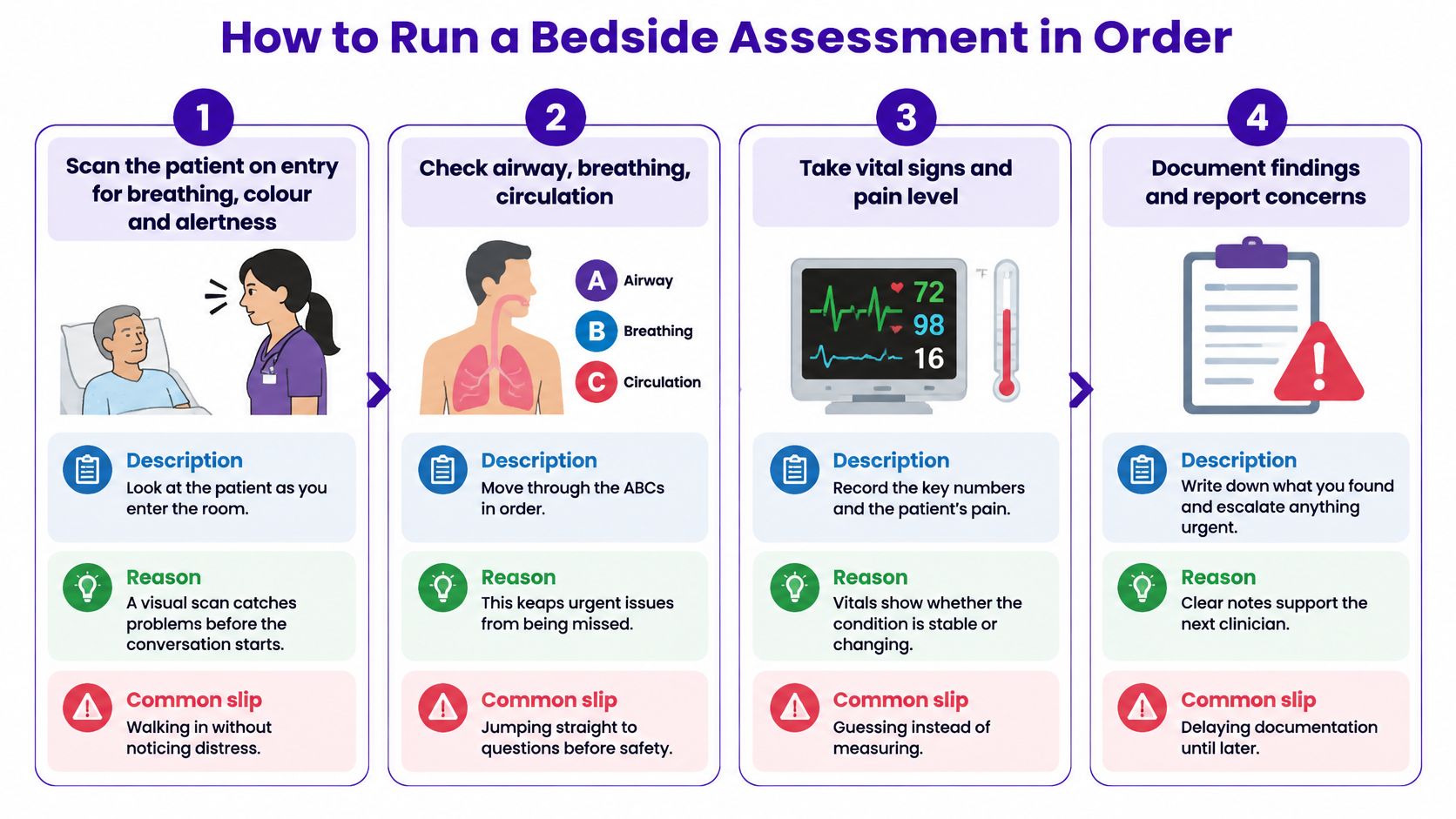
A patient's breathing changes while you are preparing a medication. A consistent assessment sequence helps you catch the change, pause the routine, and decide what needs attention first. The duty table sets timing; this sequence guides the assessment, with airway, breathing, and circulation taking priority when an urgent problem appears.
The visual summarizes the assessment flow.
A repeatable bedside sequence
- Scan the patient on entry. Look at breathing effort, color, and alertness before focusing on the monitor. Apparent distress calls for immediate assessment, even when the routine checklist is unfinished.
- Measure vital signs and compare trends. Compare the current readings with previous observations and the facility's early-warning score, where used. Interpret changes as well as recording numbers.
- Assess pain consistently. Use the same appropriate scale to compare intensity, location, quality, and effect on function. If you change scales, document why so the next clinician can interpret the trend.
- Check neurological status. Assess orientation, speech, grip, and pupils as appropriate to the patient and protocol, then compare with baseline. New confusion may signal hypoxia, infection, medication effects, or another acute problem. Assess the change rather than assuming a sleepy patient is only tired.
- Inspect skin and devices. Check pressure areas, wounds, dressings, lines, drains, and catheters while considering mobility needs. Look beneath the patient for tubing and inspect covered areas as the care plan allows.
- Review medications due and allergies. Use the medication administration record, not memory. Check relevant observations, laboratory results, and hold parameters. If interrupted, restart the safety checks before administration.
- Compare findings with baseline and decide. Determine whether the patient needs routine care, an earlier reassessment, or escalation. Record the decision and who will follow up.\
For example, a hypothetical respiratory rate rising from 16 to 24 over four hours, despite a normal temperature, warrants prompt evaluation and earlier reassessment. Verify the measurement, assess breathing effort and associated findings, and escalate according to the clinical picture rather than waiting for fever.
The accompanying video provides another learning format.
Make the assessment usable
Document the time, measured findings, comparison with baseline, action taken, and planned review. For the hypothetical patient, record the respiratory trend and associated symptoms, with the time and the action taken.
Practice with nursing triage skills for managing patients can help learners distinguish a routine task from a finding that changes priority.
Two-Way Communication That Protects Patients
A clear explanation isn't proof that a patient can safely manage treatment at home. The patient may understand the instructions yet disagree with the plan, fear an adverse effect, or lack the resources to follow it.
A 2025 observational study published through PubMed involving 56 patients and 14 nurses in four Dutch heart-failure clinics found that nurses usually initiated and dominated medication conversations, while patients more often initiated discussion of worries and personal concerns. A technically accurate explanation can therefore leave the most important barrier undiscovered.
Understanding isn't the same as agreement
Consider a patient with heart failure who has stopped taking a diuretic because nighttime urination makes sleep difficult. Repeating the medication name and dose won't uncover that problem. Asking how the medicine fits into the patient's day may reveal the reason for missed doses.
The nurse should establish the prescribed regimen, clarify what the patient is really taking, and bring timing or treatment concerns to the prescriber or pharmacist. Changing the prescription independently isn't the solution.
Useful communication skills in nursing careers become observable through specific behaviors:
- Invite the patient's agenda: Ask which concern about discharge or treatment needs attention first.
- Use teach-back: Ask the patient to explain or demonstrate the next scheduled medication routine, framing this as a check of the explanation rather than a test.
- Name the unresolved issue: Record whether cost, side effects, cognitive load, conflicting advice, or another barrier still prevents safe self-management.
Plain language and short information chunks help keep the conversation manageable, particularly when health literacy is limited. The nurse can explain a single task, check understanding, and then continue rather than delivering the entire discharge plan without a pause.
A patient who can repeat instructions may still be unable to carry them out.
Documentation should distinguish those situations. A useful note describes the medication routine the patient demonstrated, the barrier identified, who received the concern, and what remains pending. Education completed says little about whether the actual problem was resolved.
Admission communication check
- Understanding: The patient can describe the immediate care plan.
- Agreement: The patient's concerns and preferences have been elicited.
- Feasibility: Practical barriers have an owner and a follow-up plan.
SBAR and Closed-Loop Escalation
SBAR means Situation, Background, Assessment, Recommendation. It gives the nurse a structure for communicating the immediate problem, relevant context, current findings, and a specific request without relying on memory alone.
A systematic review of SBAR found moderate evidence of improved patient safety, particularly for telephone communication. The practical benefit is a more complete message, not a guarantee that the receiving clinician will understand the urgency or act.
SBAR script with sample wording
The following hypothetical wording illustrates the structure. The situation shown requires immediate escalation under the facility's emergency response policy, not an unattended wait.

For a non-emergency review, a request might specify bedside attendance within 15 minutes. That timeframe wouldn't be appropriate for the unstable patient in this example.
Close the loop, not just the call
For a different hypothetical patient with new confusion after an opioid, the nurse should lead with the change in alertness, then provide the medication, administration time, baseline cognition, respiratory findings, and other relevant observations. The recommendation should request an urgency-appropriate review and clarify medication instructions.
Closed-loop communication requires confirmation of the plan. The nurse reads back orders according to policy, establishes who will attend, confirms the monitoring interval and escalation criteria, and documents the response.
This is especially important for:
- Mental-status changes: New confusion, reduced responsiveness, or unusual behavior.
- Respiratory or vital-sign concerns: Findings that require urgent reassessment or emergency response.
- Medication and end-of-life decisions: Situations where unclear instructions can produce treatment inconsistent with safety or patient goals.
Escalation also applies to wound deterioration. Wound Services' pathway to advanced wound evaluation offers a focused resource for considering referral rather than repeatedly continuing an unsuccessful routine.
If the clinician doesn't respond within the urgency-appropriate interval, the nurse restates the concern, uses the chain of command, and documents each escalation. Emergency activation must not wait for a routine callback.
Documentation and Workload When Time Runs Short
At 14:10, a patient reports pain, a time-sensitive reassessment is due, and another patient needs help repositioning. Caring depends on making the risks visible, preserving what care can be delivered, and recording what remains outstanding.
The 2025 Royal College of Nursing workforce report reports that 33% of hospital nurses were dissatisfied with their jobs and 36% experienced high burnout, linking unsafe workloads and burnout with retention problems and compromised care. Give the charge nurse specific information about patients at risk, tasks that cannot be completed on time, and the support needed. That makes it possible to address assignment priorities rather than relying on a general report of being busy.
Record the care and the gap
Each clinical entry should identify the observation and its time, the action taken, the patient's response, and who was informed. Add the medication, route, relevant findings, and clinician identity in the appropriate record fields.
Pain 6/10 at 14:10, PRN medication administered as documented in the medication record; reassessed at 14:50, pain 3/10.
Repositioning delayed due to staffing. Patient's condition and interim protection documented; charge nurse [name] informed at 14:30. Repositioning completed at 15:00.
For delayed care, document the patient's condition, any interim protection, the named person informed, and whether the task was completed or further escalated. A staffing explanation alone does not show how the patient was protected or what happened next.
Make workload problems actionable
- Identify time-critical risks: Tell the charge nurse which reassessment, treatment, or safety intervention is at risk and when it is due.
- Cluster with consent: Combine compatible tasks while preserving the patient's choices about rest, toileting, and personal care.
- Transfer deferred work explicitly: State what remains incomplete, why it matters, and who has accepted follow-up.
- Use formal channels: Report unsafe assignments through facility procedures and complete required safety reporting.
A 2025 Massachusetts Nurses Association survey based on Beacon Research data found that 67% of Massachusetts registered nurses said they didn't have enough time to provide patients with the care and attention they needed. Clear records of unmet needs help managers examine staffing and workflow, while the patient's condition and follow-up remain central to the chart.
Build Caring Into Your Next Shift
A workable improvement starts with a behavior that colleagues can observe. A nurse doesn't need a new slogan about compassion; the patient needs a reliable response when something changes.
The assessment sequence, SBAR script, and documentation examples offer distinct starting points:
- At first contact: Complete the bedside assessment sequence and compare findings with baseline.
- When escalation is needed: Use the SBAR script, then confirm the receiving clinician's plan through read-back.
- When care remains unmet: Record the timing, patient risk, action taken, and named person informed.
Match learning to the work
Facility protocols determine assessment frequencies, medication safeguards, and escalation thresholds. This guidance supports those requirements rather than replacing them, and learners should complete unfamiliar assessments with appropriate supervision.
For example, a nurse preparing to care for patients with cognitive impairment could select Fundamentals of Alzheimer's Disease for Healthcare Providers, which covers risk factors, diagnosis, treatment, and evidence-based patient-support strategies. The practical learning target might be better baseline documentation and more individualized support, rather than course completion alone.
Nursing continuing education requirements vary by state. Premiere Education provides nursing continuing education requirements by state, its nursing CE courses are ANCC-accredited and offer ANCC Contact Hours, and CE specialists are available by chat, email, or phone when a requirement needs confirming.
The first bedside action remains straightforward: at the next patient's first contact, the nurse should run the assessment sequence and establish what has changed from baseline.
Premiere Education offers nursing continuing education that supports clinical learning and state-specific renewal needs. Nurses seeking structured learning around patient safety, communication, and patient support can visit Premiere Education to select education relevant to their bedside responsibilities.
Latest Posts