
.avif)
OSHA Bloodborne Pathogens Training Schedule

OSHA requires bloodborne pathogens training at initial assignment and at least annually thereafter, not every 3 years. The 3-year figure refers to training-record retention, not the retraining schedule.
The advice that “bloodborne pathogens training must be provided every 3 years” sounds precise, but it's wrong for workers covered by OSHA's Bloodborne Pathogens Standard. Managers who follow it can leave employees without timely refresher training, even when a spreadsheet appears complete.
The mistake usually starts with a genuine OSHA requirement. Employers must retain bloodborne pathogens training records for 3 years from the training date, while retraining must occur at least annually. Those are separate compliance duties, and an inspection can expose the difference quickly.
A sound program therefore tracks two dates for every covered employee: the date training is due and the date records may be removed. The first protects workers from an overdue refresher. The second supports document retention. Treating them as one interval is the operational error this article addresses.
The Bloodborne Pathogens Training Misconception
Many healthcare, dental, education, and facilities managers have heard that bloodborne pathogens training must be provided every 3 years. That belief often comes from reading “retain training records for 3 years” and assuming the retention period is also the retraining period. OSHA's Bloodborne Pathogens Standard separates the obligations clearly: training happens at initial assignment and at least annually thereafter, while training records remain available for 3 years from the training date.
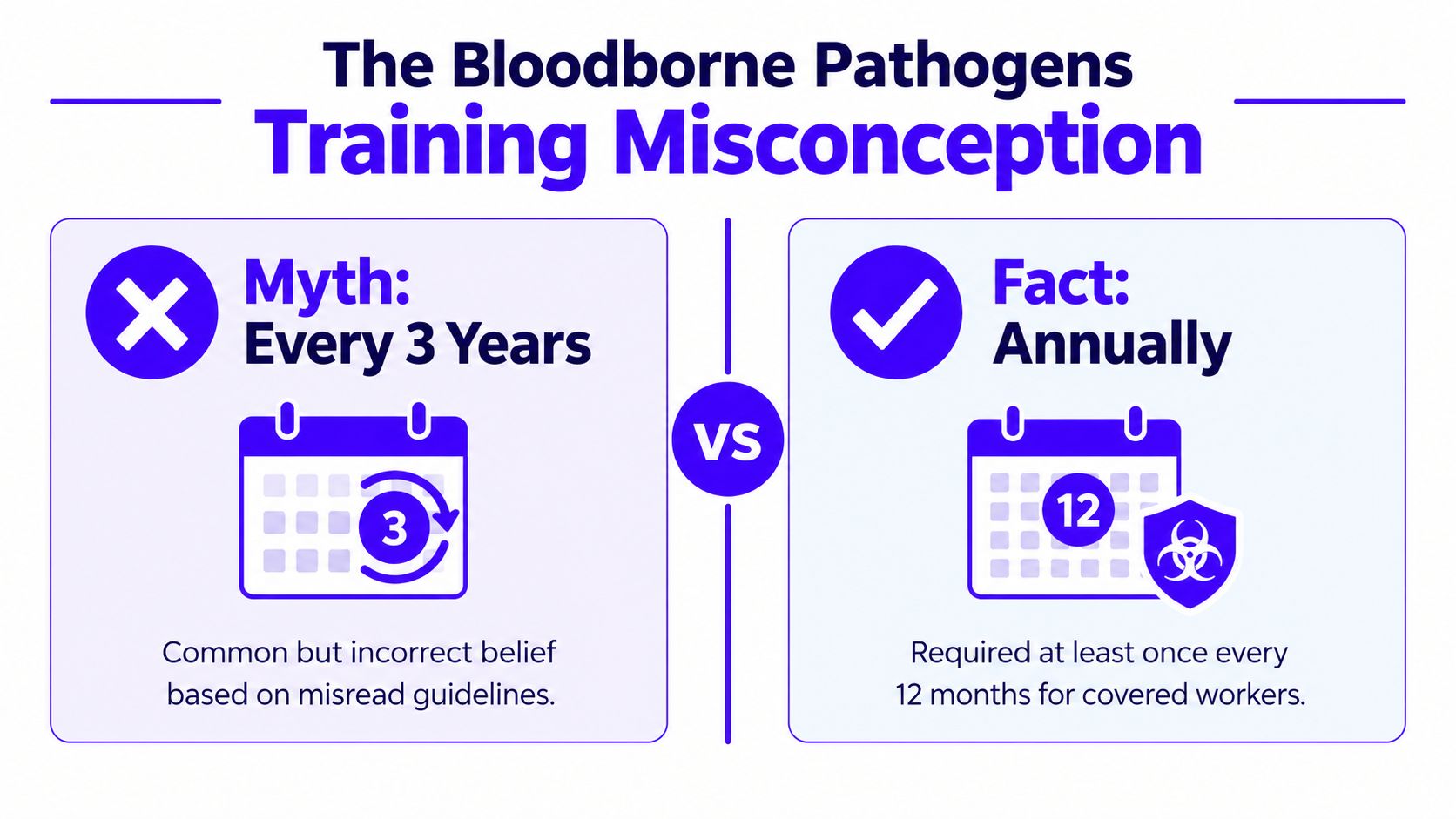
The distinction matters because the two rules answer different questions:
- Training frequency: When must the covered employee receive instruction again? At least annually.
- Record retention: How long must the employer keep documentation of that instruction? 3 years from the training date.
- Change-based retraining: When must the employer provide additional instruction outside the ordinary cycle? When task or procedure changes affect occupational exposure.
A manager who schedules one course every three years may have a training certificate on file, but that certificate doesn't demonstrate current annual compliance. Conversely, an employer can conduct annual training correctly and still mishandle records by deleting documentation before the required retention period ends.
Practical rule: A retention deadline is not a renewal deadline.
The misconception persists because “three years” is easier to remember than a date-based annual cycle, particularly in organizations that use general compliance calendars. It also gets confused with other workplace or transportation requirements that may use different intervals. A compliance officer should never transfer a schedule from another subject to bloodborne pathogens training without checking the applicable OSHA rule.
Managers who need plain-language background on exposure hazards can also consult VirusFAQ.com on bloodborne risks. For a foundational explanation of the subject, see what bloodborne pathogens training covers, then compare that content with the employer's own Exposure Control Plan.
Understanding OSHA Annual Training Requirements
OSHA's requirement has three practical timing points. A covered employee receives training at the time of initial assignment, receives refresher training at least annually after that, and receives additional training when workplace changes affect exposure. The Electronic Code of Federal Regulations also establishes that the employer must provide the training at no cost and during working hours.
Initial assignment comes before exposure
A new dental assistant shouldn't begin duties involving blood, contaminated instruments, or potentially infectious materials and wait for the next group training session. The employer needs to complete the applicable training at initial assignment, before the employee performs work that creates occupational exposure.
The same principle applies to a new clinical employee, designated first-aid responder, laboratory worker, or custodian assigned to clean blood or other potentially infectious materials. Job title alone doesn't determine the requirement. The relevant question is whether the employee's duties create reasonably anticipated occupational exposure.
Initial instruction should connect general knowledge to the actual workplace. A course may explain transmission, personal protective equipment, exposure response, and engineering controls. The employer still needs to explain the facility's Exposure Control Plan, reporting route, equipment, decontamination procedures, and task-specific hazards.
Annual means within the employee's cycle
OSHA's annual requirement is date-based, not a broad “once during the calendar year” approach. If an employee completes training in March, the employer should assign the next refresher within 12 months of the previous session, rather than assuming a December session will cover the following year.
A calendar-year system can create an avoidable gap. For example, an employee trained late in one year might be placed into the next year's training group months later. The organization may show one completion in each calendar year, yet the interval between sessions can exceed the allowed annual cadence. A dashboard that calculates the next due date from each employee's completion date is safer than a single annual campaign.
Scope can change with prior instruction
Annual training doesn't always require repeating every topic in full when prior instruction adequately covered some material. The refresher still needs to address the employee's current exposure risks and provide the information required for the role and workplace. A manager should review the course scope, workplace procedures, and changes since the previous session instead of treating a certificate as a substitute for meaningful training.
For operational context around exposure cleanup and response, Restore Heroes pathogen cleanup guidance can help managers think through the procedures that should be reflected in site-specific instruction. A separate OSHA bloodborne pathogens course overview can help teams evaluate the general training component before adding workplace instruction.
When Additional Training Is Required
Annual completion doesn't create a permanent exemption from retraining. OSHA requires additional training when a modification to a task or procedure, a new task, or a new procedure affects an employee's occupational exposure. The OSHA interpretation on additional training makes the trigger practical: the employer responds to a change in exposure, not merely to the passage of time.
Changes that should trigger review
Consider a clinic that replaces its sharps containers with a different model. The annual course may still be current, but affected employees need instruction on the new container's placement, handling, fill indicators, removal, and disposal process. If the new process changes how employees encounter or control sharps, the employer shouldn't wait for the next annual assignment.
The same reasoning applies when:
- A new procedure is introduced: A clinic begins a procedure involving blood where the affected role previously had no comparable exposure.
- A task is modified: Staff change how they transport specimens, clean treatment areas, or handle contaminated instruments.
- A safer device is adopted: Employees need to understand how to use and dispose of the new engineering control.
- A position changes: A receptionist begins assisting with patient intake procedures that involve potential exposure, or a custodian takes responsibility for blood-spill cleanup.
- An exposure control method changes: PPE, decontamination steps, reporting routes, or sharps handling procedures are revised.
The additional session can focus on the changed information rather than mechanically repeating every part of the initial course. That approach is more efficient and more defensible because it shows that the employer identified the new risk and trained people on the actual change.
The Exposure Control Plan should drive assignments
OSHA guidance also ties the exposure control plan to an annual review and updates when necessary. The review should account for new or modified tasks, employee positions, and safer medical devices. A plan that changes without a corresponding training decision leaves supervisors guessing about how employees should work.
A current certificate cannot compensate for outdated task instructions.
A useful workflow is to require the safety officer, infection-control lead, or designated compliance owner to review proposed process changes before implementation. That review should ask who may be exposed, what equipment or controls changed, whether the Exposure Control Plan needs revision, and which employees need additional instruction. The answer should be documented with the change-management record.
Employer Responsibilities and Compliance Obligations
Employers carry the operational responsibility for making training accessible, relevant, and documented. They can't shift the burden to employees by requiring covered workers to complete the course unpaid or outside scheduled working hours. OSHA requires training at no cost to employees and during working hours, so a clinic that tells a new assistant to complete mandatory instruction on personal time is using the wrong compliance model.
Training must match the workplace
A compliant program should address the subjects employees need to perform their duties safely, including:
- Hazard recognition: The nature of bloodborne pathogens, transmission routes, and tasks that create exposure.
- Workplace controls: The Exposure Control Plan, engineering controls, work practices, and safer devices used at the site.
- Protective equipment: Selection, availability, use, removal, disposal, and limitations of PPE.
- Exposure response: Immediate reporting, emergency procedures, decontamination, and post-exposure steps.
- Vaccination information: The employer's process for explaining and offering hepatitis B vaccination.
- Labels and signs: Recognition of biohazard warnings and appropriate handling procedures.
General instruction can be delivered through a structured course, but the employer still needs to connect it to the facility. An online module won't tell a new employee where the sharps containers are located, who receives an exposure report, or how the site handles a contaminated spill unless the employer adds that information.
Managers responsible for safety cabinets, regulated materials, and facility controls may also find this guide from Labs USA useful as a supplemental reference. It shouldn't replace the employer's own Exposure Control Plan or workplace-specific instruction.
Documentation has a different clock
Training records should identify the employee, training date, trainer or training provider, and the subjects covered in a way that allows a reviewer to connect the record to the employee's work. OSHA requires training records to be kept for 3 years from the training date, as stated in the OSHA regulatory text. That record-retention period doesn't extend the interval before the next refresher.
The annual Exposure Control Plan review belongs in the same compliance calendar, but it shouldn't be confused with each employee's individual training due date. The plan review checks whether the written program reflects current work. Training assignments then communicate those current requirements to the people performing the work.
For a broader explanation of employer duties and risk controls, organizations can review bloodborne pathogens training requirements for risk mitigation.
Real-World Examples of Compliance Scenarios
A new dental assistant is scheduled to begin chairside duties. The practice manager notices that the assistant's annual staff training is planned for a later group session and assumes the employee can start now because the course is already on the calendar. That approach fails at the point of assignment. The assistant needs applicable bloodborne pathogens training before performing duties with potential blood exposure, and the employer must provide it during working hours and at no cost.

The practice should document the assistant's initial completion, provide site-specific instruction, and record the next due date from that completion. Waiting for a convenient calendar-year session may leave the employee working before the employer has completed the required instruction.
A current certificate doesn't cover a new process
A clinic introduces a new sharps disposal process. The affected nurses and assistants completed their annual training recently, so the supervisor assumes no further action is needed. That assumption overlooks the change trigger. The affected employees need additional instruction on the new disposal steps, even though their ordinary annual training remains current.
The practical response doesn't require discarding the prior training record. The clinic can document a focused session covering the new container, placement, handling, disposal, and reporting procedure, then retain that record with the existing annual training documentation.
Multi-site programs need individual dates
A healthcare organization operates across several locations and assigns annual training by department. One site trains in the spring, another in the summer, and a third during onboarding. A single organization-wide deadline may look tidy, but it can conceal individual due-date problems when employees transfer, change roles, or join between scheduled campaigns.
A stronger process keeps each employee's completion date, worksite, role, and next due date visible to the responsible manager. When a worker moves to a new site, the receiving location can verify the general training record and provide instruction on its own Exposure Control Plan, equipment, and emergency procedures. The record should show both the recurring training and any change-based instruction.
Practical Strategies for Tracking Annual Training
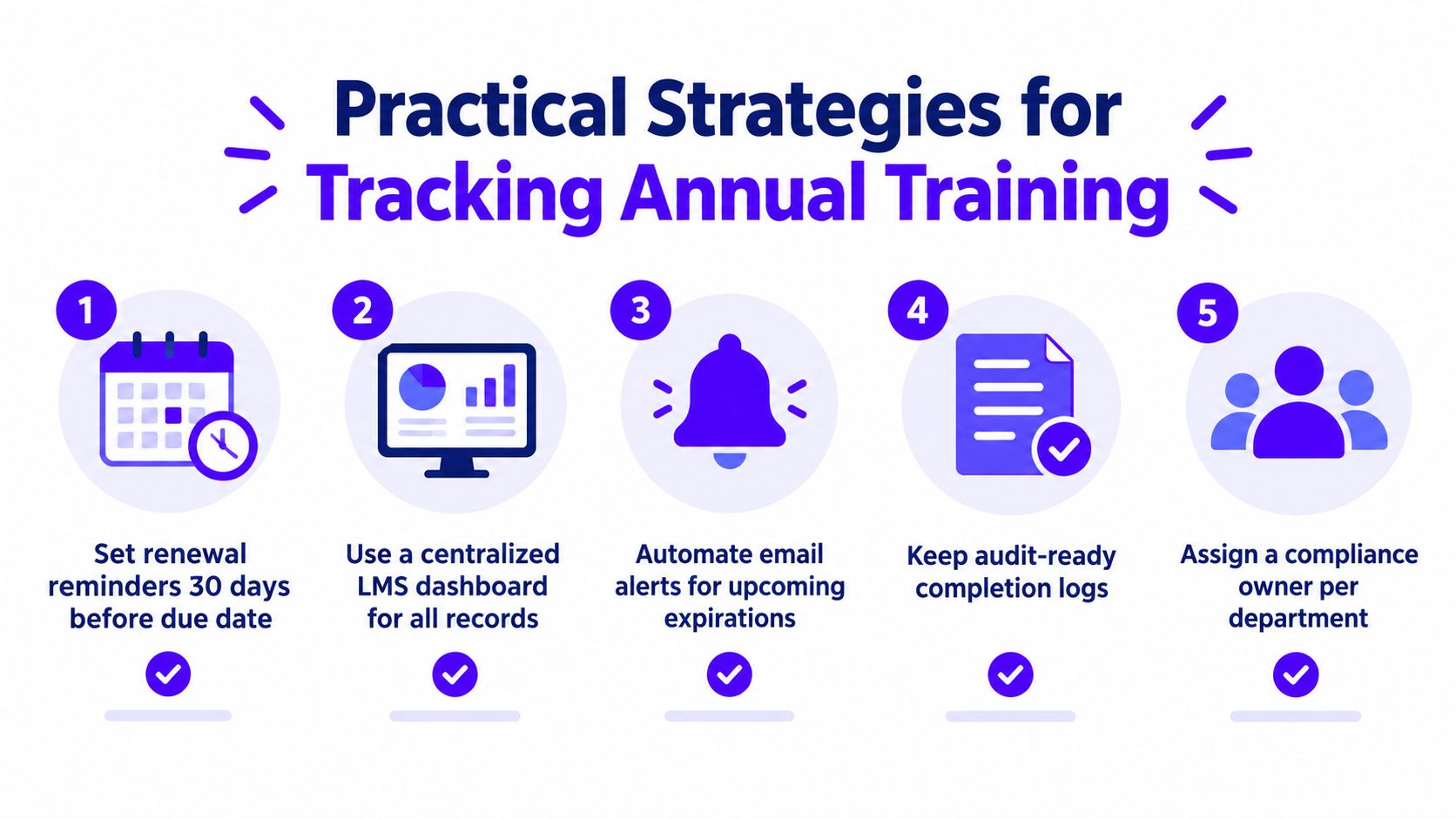
The tracking system should answer four questions without manual detective work: who is covered, when was the last completion, when is the next refresher due, and what changed since the last assignment. A spreadsheet can work for a small team if someone owns it and reviews it consistently. Larger or multi-site employers usually need a centralized learning management system with employee-level due dates, completion records, reminders, and exportable reports.
Build the register around events
Start with a master list of employees whose duties create reasonably anticipated exposure. Include role, location, supervisor, initial assignment date, most recent training date, next due date, additional-training events, and record location. Don't use “trained this year” as the main status field. It hides the difference between a current date-based cycle and a calendar-year completion.
A practical workflow includes:
- Identify covered roles: Review job duties, not just department names. Include employees who may handle blood, contaminated materials, sharps, or cleanup tasks.
- Capture completion dates: Enter the actual date for every initial, annual, and change-based session.
- Set individual reminders: Alert the supervisor before each employee's annual due date, with a second escalation route for overdue assignments.
- Record process changes: Link additional training to the revised task, device, procedure, or Exposure Control Plan update.
- Reconcile monthly: Compare active employees and role changes against the training register so transfers and new hires don't disappear between reporting cycles.
Make audit evidence easy to retrieve
A reviewer should be able to find the employee's completion record, course or session details, and related workplace-specific documentation without searching across personal inboxes. Centralized records reduce the risk that one site retains certificates while another site owns the actual assignment history.
Premiere Education provides OSHA Bloodborne Pathogens and Infection Control training, along with group assignment, completion tracking, certificates, and documentation tools for organizations. Managers can assess that type of platform alongside their existing LMS, provided the chosen process keeps annual retraining separate from the 3-year record-retention requirement.
Training logistics matter, too. Assign courses across shifts, provide a clear route for employees who miss a session, and require a named compliance owner in each department. The system should also track the annual Exposure Control Plan review as a separate action, because a completed employee course doesn't prove that the written plan was reviewed or updated.
Key Takeaways for Compliance Success
The central correction is simple, but the implementation requires discipline. OSHA's rule does not create a three-year bloodborne pathogens training cycle. Covered employees receive training at initial assignment and at least annually thereafter, with additional training when a task, procedure, position, or control changes the exposure risk.
Managers should separate the program into distinct controls:
- Assignment control: No covered employee begins exposure-related work before the applicable initial training is complete.
- Date control: Each employee's next refresher is calculated from the previous training date, within the annual window, rather than from a generic calendar-year campaign.
- Change control: New or modified tasks, procedures, devices, positions, and exposure controls trigger a review and, where exposure is affected, additional instruction.
- Record control: Training documentation remains available for 3 years from the training date, while the next training date is managed on the annual schedule.
- Plan control: The Exposure Control Plan is reviewed annually and updated when workplace conditions require changes.
- Employer control: The organization pays for required training and schedules it during working hours.
A manager preparing for an inspection should test the system with a few practical questions. Can the organization identify every covered employee? Can it show each person's latest completion date and next due date? Can it produce evidence of workplace-specific instruction? Can it show what happened after a new sharps process or exposure-related task was introduced?
The defensible program is the one that connects the employee, the task, the date, and the record.
Organizations should replace any “every three years” reminder with an employee-level annual schedule, then audit the register against current roles and procedures. For each overdue or recently changed assignment, the responsible supervisor should arrange training, document completion, and confirm that the Exposure Control Plan reflects current work. That process prevents the record-retention rule from being mistaken for a retraining rule.
Premiere Education offers OSHA Bloodborne Pathogens and Infection Control training with organizational assignment, completion tracking, and certificate documentation. Visit Premiere Education to review the course and group-management options for keeping covered employees on an accurate annual schedule.
Latest Posts





25% off Sitewide→
Use Code: PCECYBERSALE2025→