

ADHD in Girls: Signs, Presentations and Support Options

Only 7.5% of girls currently have an ADHD diagnosis, compared with 13.3% of boys, according to CHADD's CDC-linked prevalence summary. That gap shouldn't reassure adults that girls rarely need help. A quiet student may understand the lesson, avoid trouble and still struggle to organize almost every part of her day.
Recognizing ADHD in girls requires attention to more than classroom behavior. Teachers, parents and health professionals also need to notice the effort behind acceptable grades, the support holding routines together and the exhaustion that follows an apparently successful school day.
Why ADHD in Girls Goes Unnoticed
ADHD is common in girls, but girls receive diagnoses substantially less often than boys. In the United States, 8.0% of girls ages 5–17 had ever received an ADHD diagnosis in 2020–2022, compared with 14.5% of boys, while prevalence across all children in that age range was 11.3%, according to the CDC's National Center for Health Statistics.
Those figures describe children who had ever been diagnosed, not necessarily children with a current diagnosis. Neither measure identifies every child who might benefit from assessment.
ADHD is a brain-based difference in attention, activity and impulse control that affects daily functioning. A child doesn't have to disrupt lessons to experience substantial impairment.
Why quiet difficulties receive less attention
Schools understandably respond to behavior that interrupts teaching. A student who leaves her seat repeatedly attracts attention sooner than a student who loses track of instructions.
For girls with predominantly inattentive difficulties, adults may notice the outcome without recognizing the process. An unfinished worksheet becomes carelessness. A forgotten book becomes irresponsibility. Slow work becomes lack of motivation.
The historical evidence helps explain that pattern. A University of Gothenburg historical review describes the first U.S. conference devoted to gender differences in ADHD in 1994 and a 1997 meta-analysis of 16 studies that found girls were more likely to go undetected by teachers and less likely to display overt acting-out behavior. The same review describes a 1999 study comparing 144 girls with ADHD with 144 girls without ADHD, alongside equally sized male groups, which found similarly extensive disorder in girls and boys.
Four myths that delay recognition
- Good grades rule out ADHD. Grades don't show how much supervision, lost sleep or repeated checking completion required.
- Social success means no impairment. A girl may maintain friendships while struggling to follow conversations or manage impulsive comments.
- ADHD disappears in adolescence. Less visible movement doesn't establish that planning and organization have become manageable.
- Girls with ADHD are dreamy or emotional. Those descriptions don't explain persistent functional difficulties and shouldn't replace assessment.
For families seeking an accessible starting point before a clinical conversation, ADHD guidance from Wald Behavioral Health provides another resource for understanding the condition.
Practical rule: A child's effort belongs in the assessment alongside her results.
Consider a hypothetical 12-year-old who finishes homework at midnight, rarely gets in trouble and is described as a good student. At home, she says she feels exhausted and behind every day.
That scenario doesn't establish ADHD. It does establish a reason to ask what completing ordinary work costs her. Lower diagnosis rates don't mean lower need, and effort that seems out of proportion to results deserves a closer look.
Common ADHD Presentations in Girls
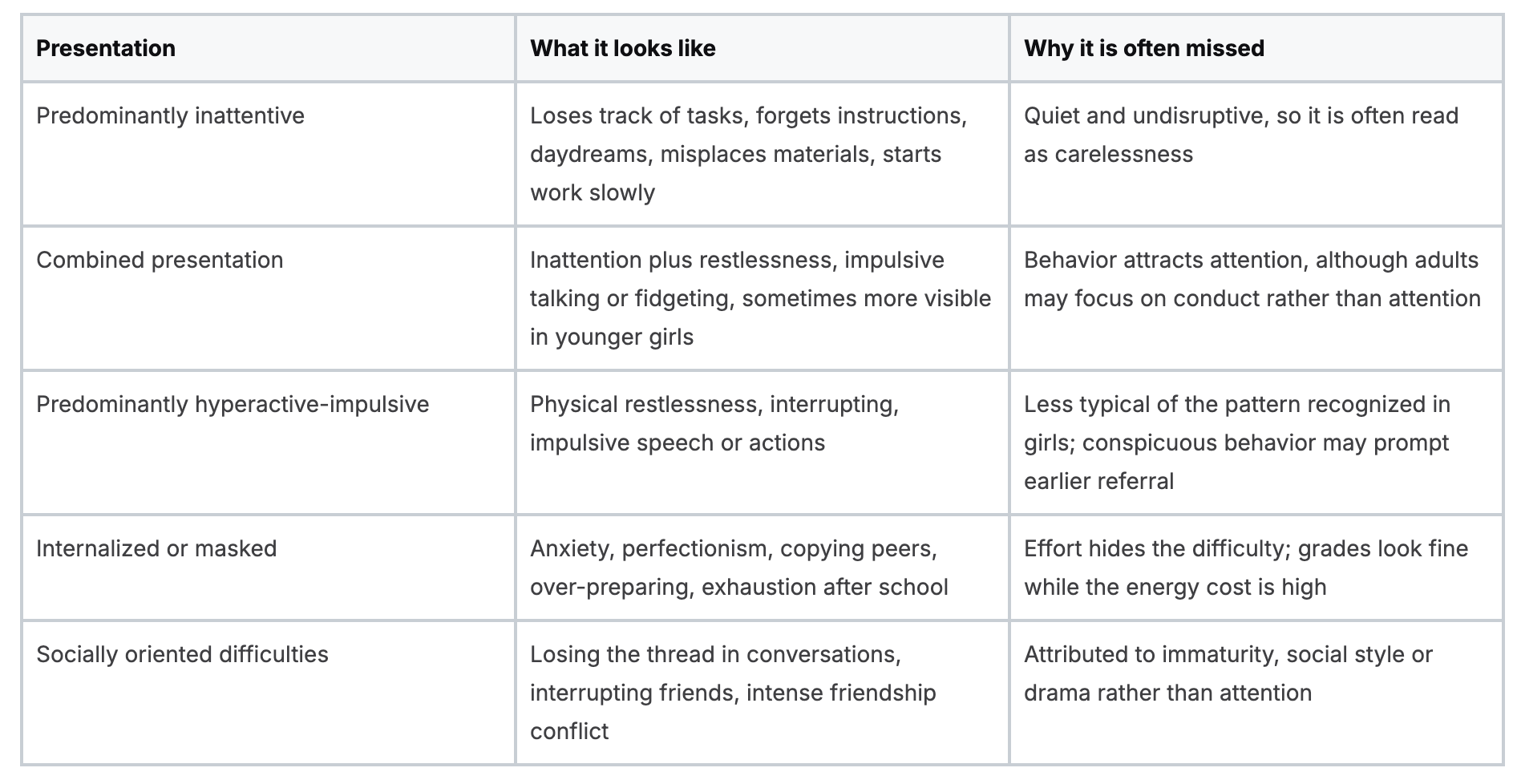
The following comparison distinguishes formal ADHD presentations from descriptive patterns that can make difficulties harder to recognize.
ADHD presentations in girls and why they are missed
Formal presentations and descriptive patterns
DSM-5 recognizes predominantly inattentive, predominantly hyperactive-impulsive and combined presentations. Inattentive difficulties are the pattern most often associated with underrecognition in girls, but girls can have any presentation.
Masked ADHD and socially oriented difficulties aren't additional diagnostic subtypes. They describe how difficulties may appear, or remain concealed, in everyday situations. Anxiety, perfectionism and friendship conflict also have other explanations, so none should be treated as proof of ADHD.
Consider Maya, a hypothetical 11-year-old who copies friends' notes to keep up, doodles rather than interrupts lessons and cries after homework. Her teacher sees a conscientious student; her parents see a child who falls apart each evening.
Both accounts may be accurate. The teacher observes Maya in a structured environment with prompts and examples. Her parents observe the effort required when she must organize work herself.
Successful compensation isn't the same as an absence of difficulty.
The useful question isn't which row describes Maya perfectly. It's which tasks repeatedly break down, what support prevents that breakdown and whether comparable impairment appears elsewhere. A clinician can then determine whether the pattern meets diagnostic criteria or points toward another explanation.
Signs in Girls Across Childhood and Adolescence
A girl's ADHD rarely keeps the same shape as she grows. What adults notice at age five looks different at age fifteen, partly because the demands around her change and partly because many girls learn to hide the effort behind a composed surface.
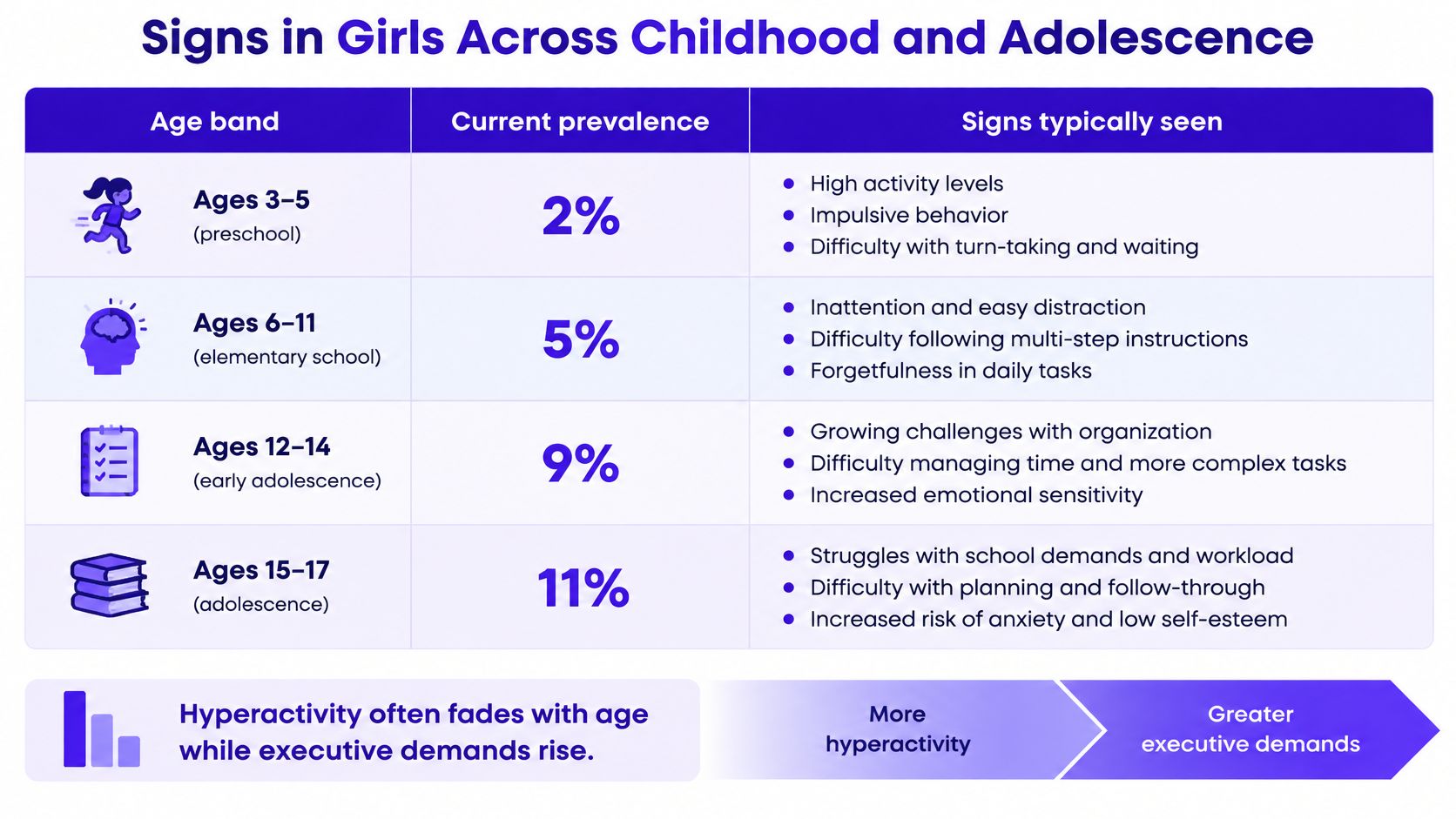
Current ADHD prevalence among U.S. girls in 2024, by age band, with typical signs at each stage. The National Survey of Children's Health summary reports 1.6% at ages 3–5, 8.7% at ages 6–11 and 12.0% at ages 12–17.

Read the right-hand column as observation prompts rather than an age-based diagnostic checklist. A sign earns attention when it persists and interferes across ordinary days. The teenage entries deserve a second look: self-criticism and school avoidance can be the visible edges of a student working very hard to appear fine.
Less movement can coexist with greater difficulty
A preschooler may move between unfinished games and struggle to settle. During primary school, forgotten materials and slow starts on independent work become common concerns. By adolescence, the same student may sit through lessons while privately losing track of assignments across six subjects.
That outward calm is exactly what makes adolescent ADHD easy to miss.
Executive functions help a person hold information in mind, plan, switch tasks and monitor progress. They work like a mental manager coordinating a day's moving parts, and school steadily hands that manager more to coordinate: changing classrooms, longer projects, less adult supervision. A student who coped in primary school can fall behind in secondary school because the demands outgrew the strategies that once covered them.
A prospective study summarized in a review of neurobiological findings in girls with ADHD found performance-based executive dysfunction in 55% of girls with combined-type ADHD and 43% with inattentive-type ADHD at baseline, rising to 75% and 55%, respectively, five years later. Working memory, planning and set shifting were among the functions affected.
Those percentages describe one study sample rather than every girl with ADHD. They still undercut the assumption that a calmer teenager has outgrown her difficulties.
Reassessment at transitions
Transitions expose gaps that structure used to hide. A student moving to secondary school may need help translating an assignment into a sequence: locate instructions, gather materials, draft, check and submit. Compare her functioning before and after the transition; new struggles often mean old coping strategies stopped covering the load.
Caregivers and school staff can compare a child's current difficulties with the neighboring age bands while noting changes in independence, workload and available support. When a girl works harder each year to produce the same result, that rising effort is itself information worth bringing to a clinician.
Where ADHD Signs Appear at School, Home and With Friends
A girl may sit through lessons, chat easily at lunch and then spend a hypothetical two hours unable to begin an essay at home. That difference calls for investigation, not a decision that either the teacher or parent must be mistaken.
Following the same student through her day makes the pattern easier to document.
- Classroom: The student understands discussion but misses directions and starts slowly after transitions. A teacher records the instruction, the prompts provided and whether independent work begins.
- Homework: She rereads the assignment without producing a first sentence. A caregiver notes the task, available help, interruptions and signs of exhaustion.
- Home routines: She forgets essential items despite repeated reminders. The family records which steps require prompting and whether a visible checklist helps.
- Friendships: She loses the thread of conversation or makes an impulsive comment that creates conflict. Adults ask about the sequence without assuming every disagreement reflects ADHD.
- Activities and sports: She manages a demonstrated drill but struggles with a long spoken sequence or unstructured waiting. The instructor records which format supports participation.
Compare demands, not just behavior
A systematic review of ADHD in females describes more frequent inattentive presentations and recognition problems associated with referral patterns that emphasize disruptive behavior. A useful assessment therefore compares structured and unstructured situations, missed deadlines and task initiation, with information from caregivers and teachers.
Compliance and strong verbal ability don't establish that executive demands are manageable. An articulate answer during class doesn't show whether a student can independently organize the written response afterward.
For classroom implementation, best practices for teaching students with ADHD can help staff translate observations into instructional adjustments.
Documentation habit: Record the date, setting, task, support provided and outcome, rather than a judgment such as lazy or careless.
A practical starting exercise is a hypothetical two-week observation period. Records should include successful situations as well as difficulties, because identifying helpful conditions matters as much as identifying problems.
How Clinicians Diagnose ADHD in Girls
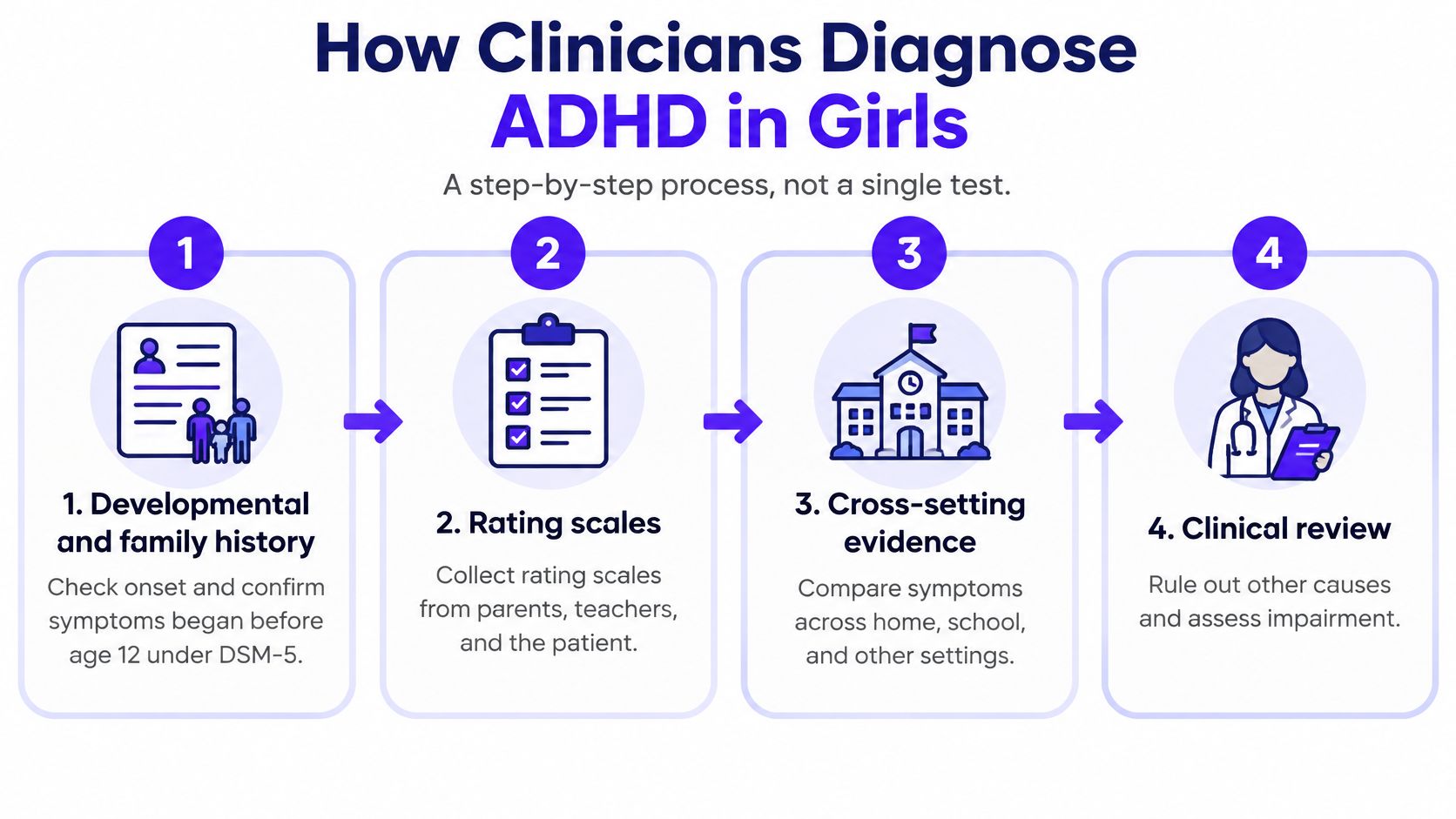
Diagnosis involves a sequence of checks that build one formulation. A clinician integrates developmental history, symptoms, context and functional impairment, with grades or questionnaire scores treated as only parts of the evidence.
A structured clinical assessment
- Take a developmental and family history. The clinician explores early functioning, symptom onset, family patterns and changes in demands. Under DSM-5 criteria, symptoms must have begun before age 12.
- Collect adult-observer rating scales. Parent and teacher reports provide complementary information from different settings. Disagreement should prompt questions about structure, supervision and task demands.
- Ask for the girl's account. Developmentally appropriate interviews and self-report can reveal internal distraction, hidden frustration and compensatory effort that observers don't see.
- Review school records. Grades, missing assignments, teacher comments and test performance help establish whether difficulty reflects understanding, execution or both.
- Assess executive functioning. Structured observation and, when useful, performance measures can examine planning, working memory and task switching. These measures support formulation without independently diagnosing ADHD.
- Consider co-occurring conditions and medical explanations. Assessment includes sleep, mood, anxiety and learning difficulties, with evaluation of thyroid, hearing or vision concerns when clinically indicated.
- Confirm cross-setting impairment. Symptoms must affect functioning in more than one setting and must not be better explained by another condition. The clinician distinguishes symptom presence from clinically meaningful impairment.
- Plan reassessment. Puberty, a school move or another major transition may change demands and make previously supported difficulties more apparent.
The assessment pathway can be summarized as follows.
When adult reports look reassuring
A 2025 dissertation available through Swansea University's research repository reported a sample in which teacher ratings failed to identify probable ADHD despite girls' self-reported difficulties. That finding doesn't make self-report automatically more accurate, and it shows why observer checklists should stay one part of a wider inquiry.
A student in early adolescence can meet grade targets while relying on parent reminders, late-night checking and repeated rewriting to stay on track. If she describes exhaustion and weekly missed deadlines, and executive-function tasks expose weak planning or working memory, the clinician asks how the grades were achieved: who organizes submissions, what happens before homework begins, and whether sleep or anxiety better fits the pattern.
The aim is to explain each discrepancy with converging evidence. A diagnosis provides a basis for support and monitoring, with reassessment planned as demands change.
Conditions That Often Occur With ADHD in Girls
Attention problems can coexist with other conditions, and overlapping symptoms make it easy to attribute everything to one cause. The following distinctions guide questions, not conclusions.
Conditions that overlap with ADHD in girls

Distinguish patterns without forcing a single explanation
A student who avoids reading may need a literacy assessment even when ADHD is established. A previously engaged adolescent who withdraws from friends and loses interest in favorite activities needs a mood assessment, not stronger organizational reminders.
Likewise, improved concentration after better sleep doesn't automatically exclude ADHD. It shows that sleep contributed to the difficulty.
For broader professional learning, The Family Tree of Comorbidities for Adults With ADHD offers a related continuing-education topic, although childhood assessment still requires developmentally appropriate evaluation.
Hormonal changes require careful tracking
A 2025 review in the University of Southampton's research repository describes potential worsening of ADHD symptoms and mood during hormonal transitions while emphasizing limited pharmacological research and evidence on treatment. Hormones may modify symptoms; they don't replace a developmental assessment.
Consider a hypothetical 15-year-old whose focus worsens before menstruation and improves after sleep problems are addressed. A symptom-and-cycle diary can help separate recurring timing from workload, sleep and mood changes.
Beyond adolescence, pregnancy and postpartum sleep loss or mood shifts can complicate attention, while menopause may bring focus or memory complaints. Evidence for sex-specific treatment remains incomplete, so clinicians should track changes and use shared decision-making rather than assume a universal hormonal explanation.
Assessment should also include direct screening for depression and self-harm risk. Immediate safety concerns require prompt clinical attention rather than waiting for an ADHD evaluation.
Choosing Support for Your Daughter

Support should match the child's functional difficulties, not merely her diagnostic label. A student who loses completed assignments needs a reliable submission process. A student who cannot follow written instructions may need a separate learning assessment.
Families and professionals can agree on a small set of observable goals, such as beginning homework with less prompting or submitting finished work consistently. Progress should include the child's experience, not just adult convenience. A girl who has spent years working hard to look fine may describe success differently from the adults around her, so ask her directly what feels easier and what still costs too much effort.
Match each support to its setting
- Home routines: Use a visible morning checklist, a designated place for school materials and external reminders. Break homework into concrete actions instead of repeating a general instruction to get organized.
- School accommodations: Request an evaluation for appropriate support, which may include a Section 504 plan or an IEP when eligible. Written directions, chunked assignments, extended time and carefully chosen seating should address documented needs.
- Parent training and behavioral strategies: Establish predictable expectations, reinforce specific actions and reduce repeated conflict over tasks the child cannot yet manage independently.
- Skills support and psychological care: Organization coaching or developmentally appropriate cognitive behavioral work can address planning, coping and self-criticism. Co-occurring emotional difficulties require their own treatment.
- Medication: A qualified prescriber can discuss options and monitor sleep, appetite, mood and relevant cycle-related changes. Background reading on stimulants versus non-stimulants for ADHD can support that conversation without replacing individualized advice.
School support shouldn't be reduced to discipline. A CDC analysis of school services found that 69.3% of students with ADHD were currently receiving at least one school service, which shows how much of the daily support already runs through schools.
Coordinate the plan and review it
A hypothetical 13-year-old who repeatedly loses assignments might get a school submission checklist paired with a matching home routine, with progress reviewed after six weeks. If academic difficulties dominate, a school-based evaluation is appropriate; emotional or social difficulties warrant assessment alongside ADHD support. Executive demands tend to grow through adolescence even when visible hyperactivity fades, so a plan that worked at ten may need rebuilding at fourteen.
Professional learning can support that coordination. For a course focused specifically on girls' learning experiences, explore ADHD Unmasked: Recognizing and Reshaping Girls' Learning Experiences. Premiere Education also lists ADHD in FocusSpotlight on ADHD in Girls as a related option.
The next step is concrete: request a multi-setting evaluation, share examples of both difficulty and successful support, and agree with school and clinical staff on a review date.
Educators, healthcare professionals and training administrators who want to explore professional learning related to this article can start with ADHD Unmasked: Recognizing and Reshaping Girls' Learning Experiences. Visit Premiere Education to browse additional courses.
Latest Posts





25% off Sitewide→
Use Code: PCECYBERSALE2025→