

CME Requirements Guide for Physician Assistants

A PA can finish a national CME cycle, save every certificate, and still discover that a state license renewal window closed on a different schedule. That situation is common because physician assistant CME requirements aren't controlled by one calendar or one regulator. Certification maintenance, state licensure, credit categories, and topic-specific education must be tracked as related but separate obligations.
The practical risk isn't usually a lack of effort. It's a mismatch between the requirement a PA believes has been satisfied and the requirement a board or certifying organization actually reviews. A reliable compliance process therefore starts with two calendars, a category-aware credit log, and documentation that can be retrieved without reconstructing years of email receipts.
The Dual Track of PA Compliance
A PA completes national CME, checks the total, and assumes the state renewal application is covered. The assumption feels reasonable because NCCPA certification is central to professional practice, but it can fail when a state board uses a different renewal period, category rule, or proof standard.
NCCPA certification maintenance and state licensure renewal are separate tracks. NCCPA manages national certification maintenance. State medical boards manage licenses to practice within their jurisdictions. The requirements may overlap, but one status doesn't automatically erase the other.
Consider a PA whose NCCPA cycle ends after the required certification-maintenance window, while the state license renews according to a separate biennial registration period. The PA may have enough credits for NCCPA and still lack qualifying hours earned inside the state's window. Texas makes this distinction explicit. Its renewal schedule may not match a PA's NCCPA cycle, and its CME is measured from the biennial registration period rather than the calendar year (Texas Medical Board continuing education requirements).
The compliance mistake to eliminate
The dangerous shortcut is treating “certified” and “licensed” as interchangeable. A current NCCPA record proves something about national certification maintenance. It may not prove that a state-specific renewal period, Category 1 threshold, mandated topic, or attestation requirement has been met.
Practical rule: Maintain one record for NCCPA certification and another state-specific record for every license held.
That separation doesn't require duplicating every course. It requires tagging each activity according to where it can be used. A certificate might support both records, but the PA should still identify the applicable cycle dates and category requirements for each.
A dependable starting file contains the NCCPA certification dates, every state license renewal date, Category 1 and Category 2 totals, and a list of state-specific subjects. The file should also identify whether the state accepts current NCCPA certification as an alternative compliance pathway. Without that map, a PA can accumulate education efficiently but document it poorly.
NCCPA Certification Maintenance Cycles
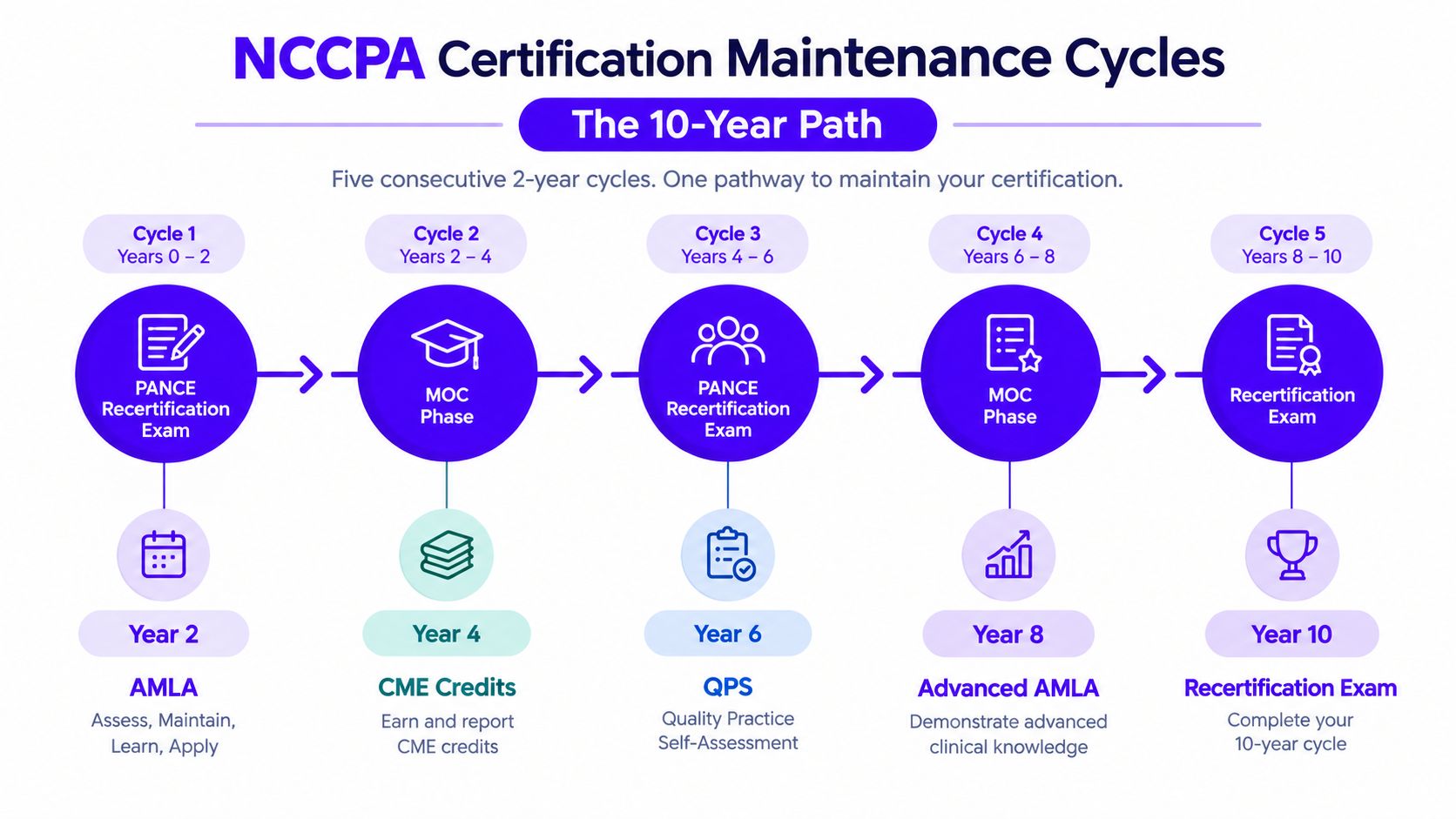
For nationally certified PAs, NCCPA requires 100 CME credits during each two-year certification-maintenance cycle. At least 50 credits must be Category 1, while the other 50 may be Category 1, Category 2, or a combination of both, according to NCCPA's continuing medical education requirements.
NCCPA structures the certification-maintenance process across 10 years and five consecutive two-year cycles. A PA who remains certified throughout the full period must therefore earn and record at least 500 CME credits, including at least 250 Category 1 credits, based on the cycle requirements described by NCCPA.
The dates that control the record
The requirement applies to the certification cycle, not just to a calendar year. NCCPA specifies an earning and logging window that begins May 1 of the certification-issuance year and ends December 31 of the expiration year (NCCPA cycle guidance).
That window matters because a course can be clinically useful yet unusable for a particular cycle if it falls outside the permitted period. A PA should check the cycle before enrolling, then record the completion date and credit category immediately after finishing the activity.
A practical two-year review should answer four questions:
- Cycle dates: Are the activity dates inside the NCCPA earning and logging window?
- Total credits: Has the PA reached the 100-credit cycle requirement?
- Category 1 balance: Are at least 50 credits clearly identified as Category 1?
- Documentation: Can each logged activity be supported by a certificate or completion record?
A clinical course can also serve a professional-development purpose beyond the cycle tally. For example, Advanced Cardiovascular Life Support (ACLS) Certification Training focuses on evidence-based strategies for responding to cardiac emergencies and delivering high-quality care when it matters most. Its relevance to a PA's compliance record still depends on the activity's recognition and the requirement being measured, so the certificate should be retained and classified rather than assumed to satisfy every rule.
Why the 10-year change matters
NCCPA's model evolved from an earlier system. In 1975, certified PAs completed continuing education every two years and underwent recertification by examination every six years. In 2011, the NCCPA Board approved directed CME requirements involving self-assessment and performance-improvement activities, and it approved extending the recertification cycle from six years to 10 years. The transition began on a rolling basis in 2014 and was completed in 2020, as recorded in NCCPA's history.
The operational lesson is straightforward. A tracking system must capture more than a cumulative hour total. It should preserve cycle dates, credit categories, and any directed-learning requirements that apply to the PA's maintenance process.
State Licensure vs National Certification
National certification provides a baseline, but state boards decide how licensure compliance works in their jurisdictions. The most important difference is often timing. A state renewal period can begin and end independently of the NCCPA cycle, creating a gap that won't appear in a national credit total.
Texas offers a clear example. PAs must complete at least 40 CME credits every 24 months, measured from the biennial registration period rather than the calendar year. At least 20 credits must be formal Category 1 CME from an American Academy of Physician Associates-approved sponsor, and the Texas renewal schedule may not match the PA's NCCPA cycle (Texas Medical Board requirements).
Compare the two calendars

Suppose a Texas PA completes the national 100-credit requirement but earns fewer than 20 qualifying formal Category 1 credits during the Texas registration period. The national total may be complete, but the Texas record still needs attention. The reverse can also happen. A PA could satisfy Texas's narrower hour requirement while remaining short of the NCCPA total or Category 1 minimum.
The safest workflow places both periods on one matrix without combining their totals. Each course receives a completion date, category, accrediting organization, and applicability label. A single activity can be assigned to both tracks only after the relevant rules have been checked.
State mapping is a control, not an administrative extra
Organizations that employ PAs should maintain a state-specific rules matrix. It should distinguish certification-cycle dates from license-renewal dates, identify Category 1 thresholds, and show whether a state requires separate certificates, accepts NCCPA certification, or imposes additional documentation.
North Carolina and Maine demonstrate why the NCCPA standard shouldn't be treated as universally sufficient. North Carolina requires at least 100 CME hours every two years, while Maine requires 100 hours per biennial licensing period, with Category 1 minimums defined by state rule (North Carolina medical board CME).
A national completion report answers a national question. It doesn't automatically answer a state board's question.
A PA practicing across states should keep a separate renewal checklist for each license. That takes more setup than a single spreadsheet total, but it prevents the more expensive mistake of discovering a state-specific gap after an application or audit request.
Category 1 vs Category 2 Credits Explained
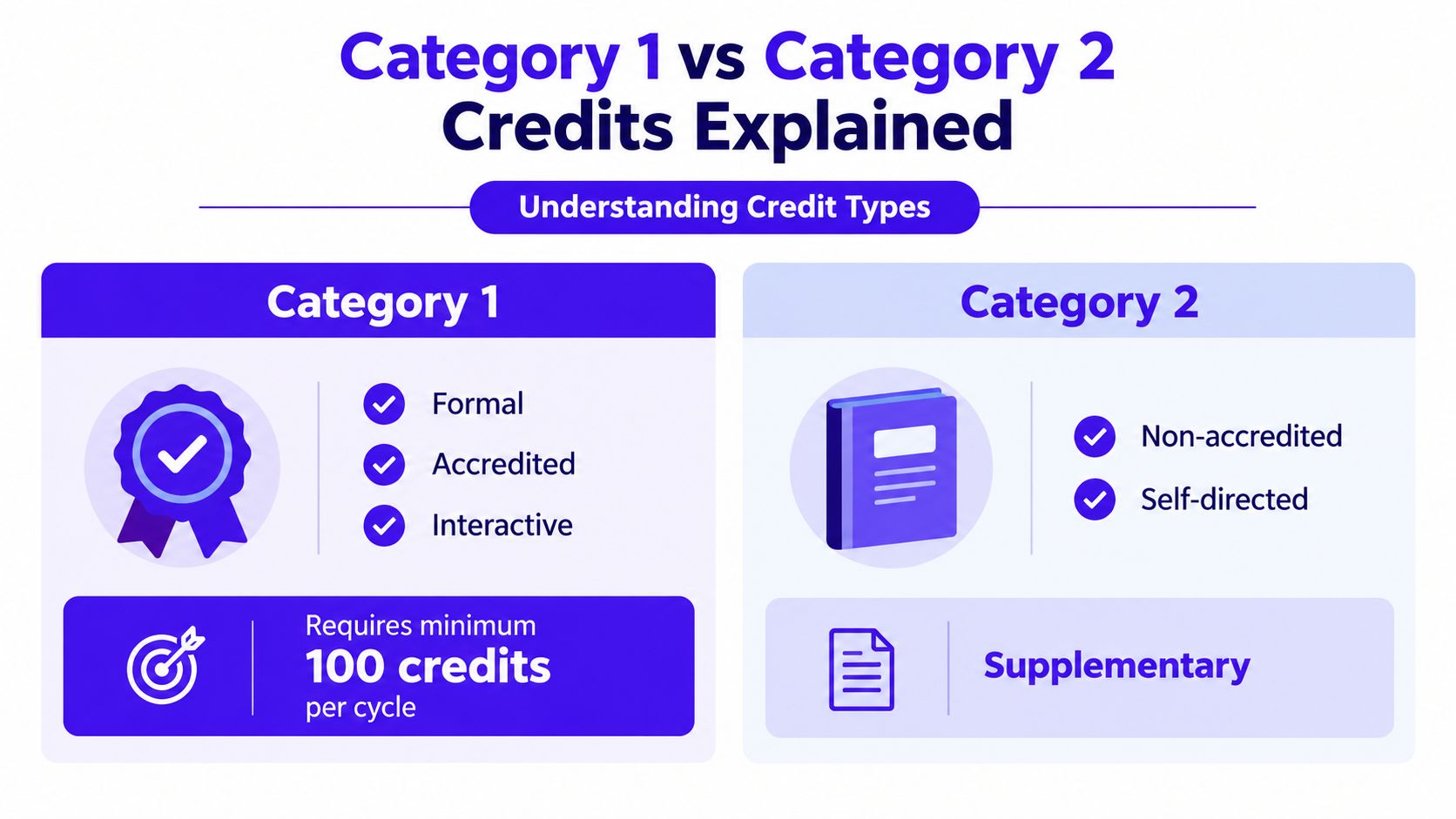
Credit categories determine whether an activity can satisfy the core NCCPA threshold. The practical distinction is simple: Category 1 is the protected portion of the record, while the remaining credits may be filled with Category 1, Category 2, or a combination when the governing rule allows it.
Category 1 generally represents structured, recognized CME delivered through an approved or accredited provider. An accredited online clinical module with documented learning objectives and completion evidence is a typical example. A formal conference session may also qualify, but the PA should rely on the certificate and provider designation, not the event's branding.
Category 2 is generally more self-directed or informal. Reading a medical journal, reviewing a clinical reference, or participating in an unaccredited local educational activity may fall into this category, but acceptance depends on the applicable rule and documentation. A PA shouldn't label an activity based only on personal judgment.
Protect the Category 1 minimum first
A common tracking error is to count 100 total credits and review the category mix only at renewal. That approach can leave a PA with a full total but too few Category 1 credits. Category 1 should be monitored as its own running balance from the first course in the cycle.
A practical record has separate fields for:
- Activity title and provider
- Completion date
- Category designation
- Credits earned
- NCCPA applicability
- State applicability
- Certificate location
For a deeper operational explanation of online learning choices, PAs can review how to complete Category 1 CME credits online. The useful question isn't whether a course is convenient. It's whether the provider clearly identifies the credit type and supplies documentation that supports the intended use.
Use Category 2 deliberately
Category 2 can be useful when the governing requirement permits it, especially for self-directed learning connected to a PA's clinical role. It shouldn't be used as a substitute for the Category 1 minimum. A PA who reads extensively but postpones formal CME may have strong professional development and a weak compliance file.
The best balance protects the mandatory Category 1 threshold early, then uses eligible Category 2 activities to complement the record. Before logging any activity, the PA should verify the rule, retain evidence of completion, and avoid assuming that an unaccredited activity qualifies on the grounds that it was educational.
State Board Variations and Exemptions
State boards use different methods to address CME. Some demand a separate hour log, some accept current NCCPA certification as proof of compliance, and some set an independent threshold that may be lower or differently structured than the national requirement.
California illustrates an alternative pathway. Renewing PAs must complete at least 50 hours of approved CME during each two-year renewal period. However, a PA who holds current NCCPA certification, or certification from another qualifying body recognized by the board, is treated as compliant with California's CME requirement (California physician assistant CME regulations).
Mississippi takes a similar approach. The state lists 100 CME hours for each two-year cycle, including 50 Category 1 hours defined through recognized organizations such as ACCME, AAPA, AMA, or AOA, but states that current NCCPA certification satisfies the entire requirement. The renewal process requires the PA to attest that the requirement has been met (Mississippi physician assistant CME requirements).
State CME Compliance Pathways

The table shows why “state compliant” isn't a single concept. California allows current certification to function as proof, while North Carolina requires a separate state-oriented review of the hours. Mississippi uses certification as an alternative pathway but still requires an attestation during renewal.
Build the record around the state's proof standard
A PA in an exemption state should retain current certification evidence rather than discard course records. Certification status may change, and a board may still ask for supporting information. A PA in a separate-log state should preserve certificates and map each activity to the state period.
For Texas-specific education and licensure context, the physician assistant Texas requirements can be used as a starting point, but the governing medical board remains the authoritative source. The practical decision is whether the state accepts certification, requires hours, or requires both an attestation and accessible records.
Mandated State Topics and Specialized Training
General clinical CME doesn't always satisfy a state-mandated topic. Boards may require education addressing professional boundaries, sexual misconduct prevention, impairment in the workplace, infection control, ethics, or another subject tied to public protection and professional conduct.
The distinction matters because a PA can complete a clinically relevant pharmacology or emergency-care course and still lack a required boundaries or infection-control module. A course should be assigned to the specific mandate it satisfies, not merely added to a general “CME completed” folder.
Start with the renewal rule
The compliance officer or PA should identify mandated subjects directly from the state board's current renewal materials. The review should record the topic name, required format or approval condition, applicable renewal period, and documentation standard.
A useful planning sequence is:
- List the state mandates. Separate topic-specific requirements from general hours.
- Check recognition. Confirm that the provider and course format are accepted.
- Schedule early. Place specialized modules into the learning plan before the renewal window becomes urgent.
- Save proof. Keep the certificate, completion date, and course description together.
- Tag the activity. Mark whether it also contributes to NCCPA Category 1 or another applicable total.
Why substitution creates risk
Specialized training and general CME may overlap in subject matter, but overlap isn't proof of compliance. A broad ethics lecture may not satisfy a state's professional-boundaries requirement. A general clinical infection discussion may not satisfy a board's designated infection-control course.
The safer choice is a course with an explicit title and documentation that identifies the mandated subject. If a state rule permits a recognized Category 1 course to satisfy both a topic requirement and a broader CME total, the PA should document both uses separately while counting the credits only according to the applicable rules. That preserves clarity without double-counting.
Building a Bulletproof Tracking Workflow
A scattered collection of certificates isn't a compliance system. The record must show what was completed, when it was completed, which category applies, and which renewal obligation the activity supports.
Create one source of truth
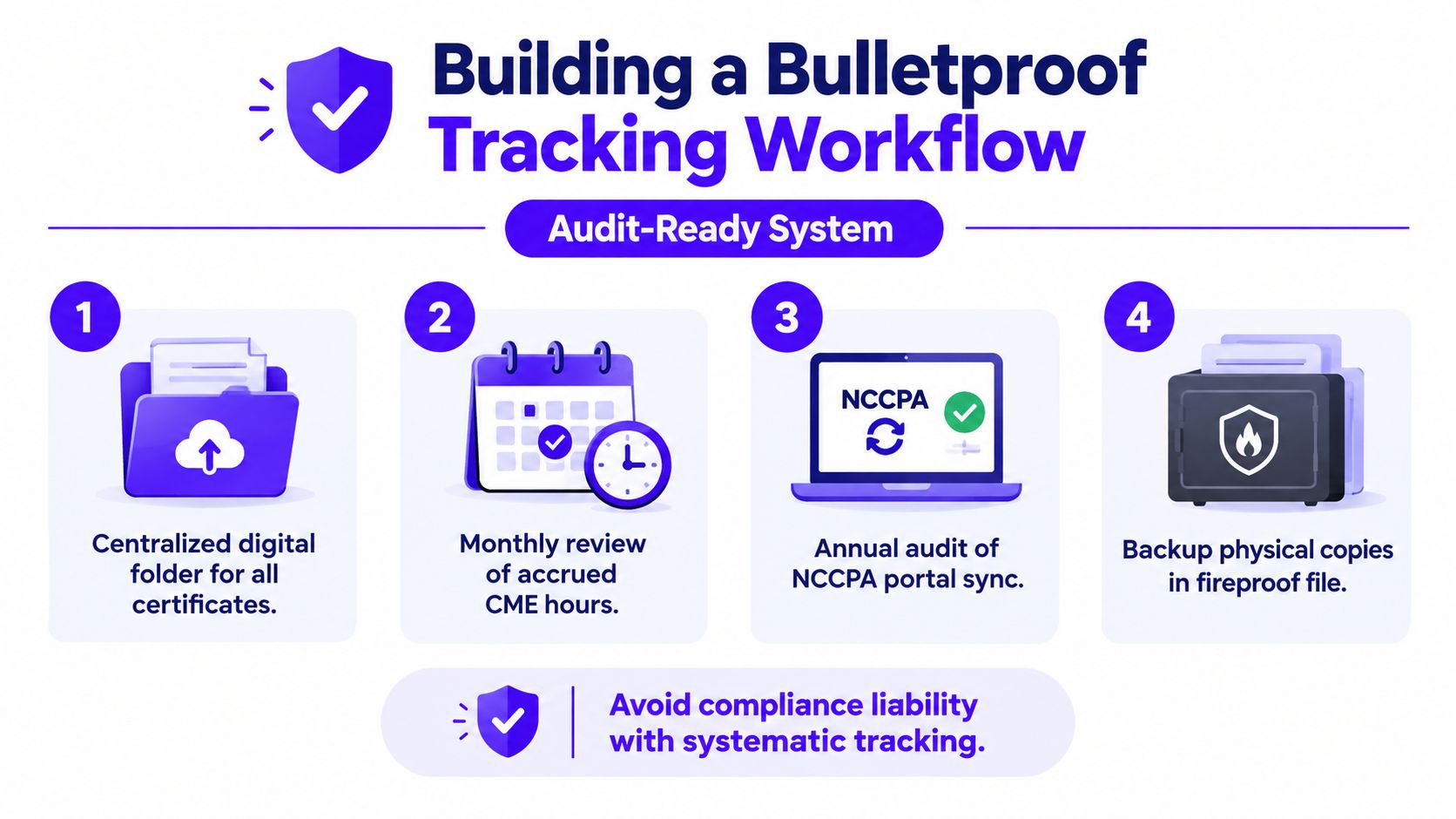
A centralized digital folder or compliance platform should contain certificates, transcripts, board correspondence, and renewal confirmations. Subfolders or tags should distinguish NCCPA cycles, states, credit categories, and mandated topics.
A tracking matrix should include:
- Cycle start and end dates: Record the NCCPA period and each state renewal period separately.
- Running totals: Track total CME and Category 1 CME in different fields.
- Activity metadata: Capture course title, provider, completion date, credit type, and certificate.
- State mapping: Identify which license period the activity falls within.
- Mandate checklist: Mark required topics as incomplete, scheduled, or documented.
Review before the deadline, not during it
Logging immediately after completion reduces uncertainty. A monthly review can identify a missing certificate or unclear category while the provider record is still easy to retrieve. A deeper mid-cycle audit should compare the running totals against the remaining requirements and test whether the state and NCCPA windows are both being satisfied.
The review should also check the NCCPA portal or other reporting destination for synchronization issues. A course can be completed without appearing in the expected record, so the PA should compare the external transcript with the personal certificate file.
Audit-ready records answer three questions quickly: What was completed, when was it completed, and why does it count?
Before the NCCPA deadline or a state renewal submission, the PA should export or preserve a final record set. Physical backups may help with resilience, but they shouldn't replace a searchable digital system. The objective is not only to own certificates. It's to produce a coherent trail that a reviewer can understand without explanation.
Leveraging Accredited CE Platforms
Manual spreadsheets can work for an individual with one license and a simple learning plan, but they become fragile when several states, learners, or mandated topics are involved. An accredited CE platform can centralize course records, completion certificates, progress monitoring, and reporting where applicable.
Features that reduce administrative exposure
A useful platform should make the credit decision visible before enrollment. State-specific course mappings, provider accreditation details, Category 1 or Category 2 labels, and completion documentation help a PA avoid spending time on an activity that doesn't fit the intended requirement.
For organizations, the control set is broader:
- Dashboards show assigned and completed education.
- Automated progress tracking reduces manual tallying.
- Centralized certificates support renewal and audit responses.
- Group portals let managers assign courses and monitor completion status.
- Agency reporting can reduce repetitive entry where reporting is supported.
Premiere Education is one example of a platform offering accredited continuing education, certifications, certificates of completion, state-specific course mappings, group assignment tools, dashboards, and reporting to CE Broker and other relevant agencies where applicable. PAs evaluating an online option can also review CME for physician assistants online while checking that each activity matches the applicable board and certification rules.
Automation doesn't replace verification
A dashboard can show progress, but it can't make an unrecognized course acceptable. The PA or compliance manager still needs to confirm the governing board's current rule, renewal period, and category threshold. Automated reporting also needs periodic review because a transmission or mapping issue can leave a completed activity absent from an official record.
The same evaluation principle applies to specialized credentials. Someone comparing emergency-care or specialty education may find it useful to compare hyperbaric certification programs before choosing a training path. The comparison should focus on recognition, scope, documentation, and relevance, not just convenience.
A platform works best when it becomes the operational home for the compliance matrix. It works poorly when staff still maintain disconnected spreadsheets, inbox folders, and unverified assumptions about what has been reported.
Quick Reference Compliance Checklist
A busy PA doesn't need a complicated annual review, but the review must cover both regulatory tracks. The checklist below is designed to expose the gaps that a single national CME total can hide.
Verify the national record
- Confirm the NCCPA cycle: Record the certification issuance and expiration dates, including the May 1 starting point and December 31 ending point specified by NCCPA.
- Reconcile total credits: Confirm that the current two-year cycle contains the required 100 CME credits.
- Audit Category 1: Confirm that at least 50 credits are Category 1, with certificates or provider records supporting the classification.
- Review directed learning: Check whether applicable self-assessment or performance-improvement requirements have been addressed.
- Check the official record: Compare the personal certificate folder with the NCCPA record or reporting history.
Verify every state license
- Map renewal windows: Record each state's license-renewal or registration period separately from the NCCPA cycle.
- Check the hour rule: Confirm the state's total requirement and whether it differs from the national baseline.
- Check category rules: Identify any state-specific Category 1 minimum or approved-provider condition.
- Review exemptions: Determine whether current NCCPA certification satisfies the state requirement, as it may in California or Mississippi.
- Preserve attestation support: If the state requires an attestation, retain the evidence supporting the statement.
Clear the subject-specific items
- List mandated topics: Check for professional boundaries, sexual misconduct prevention, impairment, infection control, ethics, and other state-designated education.
- Match course to mandate: Confirm that the course explicitly addresses the required subject and approval standard.
- Avoid double-counting: If one activity serves multiple obligations, record each applicability without inflating the credit total.
- Save the certificate: Keep completion evidence with the activity metadata and renewal-period assignment.
Perform the final risk review
The final review should happen before the nearest deadline, not after an application is submitted. A PA who finds a gap early can investigate an accepted course, correct a reporting issue, or contact the relevant board with supporting records. A PA who waits may face a renewal delay, an audit problem, or an interruption in the ability to practice.
The central control is simple: never use one number to represent two regulatory obligations. Maintain separate totals, separate dates, and one evidence file that shows how each activity qualifies.
Premiere Education provides online continuing education and certification courses, along with certificates, state-specific mappings, group assignment tools, progress tracking, and reporting where applicable. Visit Premiere Education to review options that can support a structured PA CME workflow and keep documentation connected to the education completed.
Latest Posts





25% off Sitewide→
Use Code: PCECYBERSALE2025→