
.avif)
Nursing CEUS Texas: Complete Renewal Guide for 2026

A Texas nurse can finish a demanding shift, open a folder of continuing education certificates, and still wonder whether renewal is covered. The headline requirement may appear simple, but the correct answer depends on the license type, area of practice, prescriptive authority, recurring topic mandates, and the way completion records are documented.
For nurses researching nursing CEUs Texas requirements, the safest approach is to treat renewal as a compliance checklist rather than a race to collect hours. The Texas Board of Nursing permits more than one competency pathway, and certain roles carry obligations that sit on top of the general rule.
What Every Texas Nurse Faces at Renewal Time
A med-surg RN finds certificates scattered between a computer folder and work email. Her license expires in two weeks. She believes she completed enough education, yet several questions remain: do the certificates fit the licensing period, does caring for older adults create an added topic requirement, and would APRN status change the checklist?
Start with the license category. RNs and LVNs generally begin with the same continuing competency framework, while APRNs may have additional requirements tied to prescriptive authority and controlled-substance prescribing. The patient population and daily duties can add another layer. A nurse who provides direct care to older adults may need targeted education beyond the general pathway.
Texas organizes continuing competency around a two-year licensing cycle. The central route is 20 contact hours of continuing nursing education in the nurse's area of practice, completed during the two-year period immediately preceding renewal. The Texas Board of Nursing continuing education requirements provide the governing framework.
The number of hours is only the baseline. Role determines what else belongs in the file. A staff RN, an LVN in long-term care, and an APRN with prescribing authority may all need different supporting records.
A role-first way to read the rules
Use these questions to sort the requirements:
- License type: Is the credential an RN, LVN, or APRN license?
- Practice area: Do the courses relate to the nurse's current area of practice?
- Authority and population: Does the nurse prescribe, handle controlled substances, or regularly care for older adults?
- Proof path: Will the nurse document contact hours, or maintain an approved national certification?
For role-based planning, Premiere Education's guide to Texas nursing CE requirements and course options can help organize possible courses and documentation. Keep the records together, then check each certificate against the nurse's role, practice area, and renewal pathway. Texas CE compliance is a baseline plus targeted obligations, not one universal bucket.
How the Two-Year Cycle and 20-Hour Baseline Work
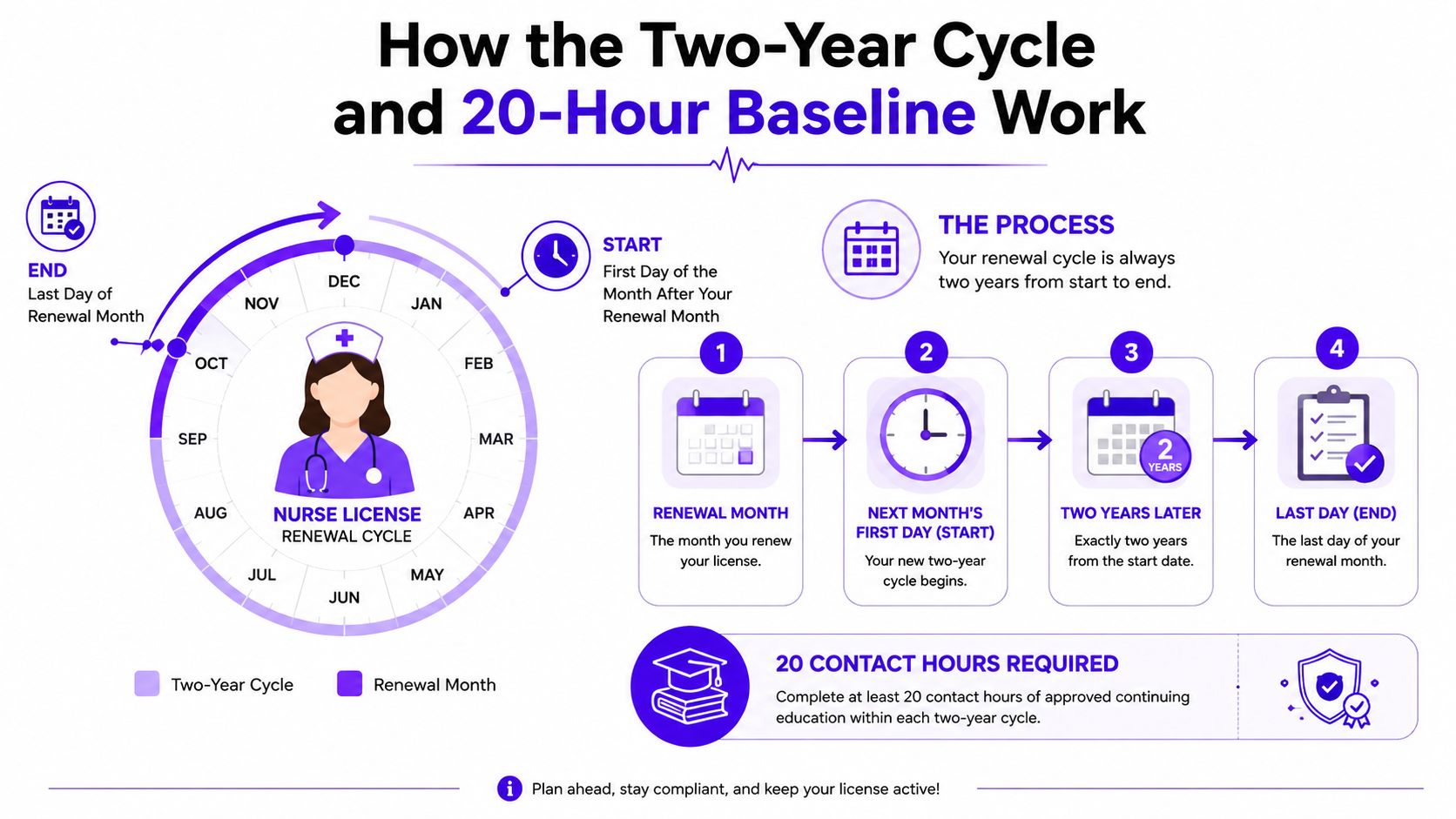
A nurse reviewing renewal paperwork may find that a recently completed course falls outside the relevant period. Texas continuing competency follows a defined two-year licensing cycle. The education window begins on the first day of the month after the renewal month and ends with the close of the subsequent renewal period, according to the Texas Board of Nursing's guidance.
The baseline route calls for 20 contact hours of CNE in the nurse's area of practice during that window. Relevance matters. A course may be useful professional development yet still fail to support renewal if its subject does not connect clearly with the nurse's practice.
Use the license record as the starting point:
- Locate the renewal month on the Texas nursing license record.
- Mark the first day of the following month as the opening of the education window.
- Check every certificate date and set aside courses completed before that date.
- Match each subject to the nurse's area of practice.
- Total the eligible contact hours and retain the certificates.
An ICU nurse might document critical-care, infection-control, assessment, and related courses. Each completion date still needs to fit the licensing window. A weekend conference held just before the renewal month may belong to the previous cycle. The renewal month controls the calculation, not the nurse's birthday.
Practical rule: Each certificate should identify the course, completion date, awarded contact hours, and connection to the nurse's practice.
A separate record may also be needed for controlled-substance prescribing. The DEA MATE Controlled Substances Training Package is described as 10 total hours of training that can be completed before the next DEA license application or renewal. Treat that training as its own documentation item. It does not automatically replace Texas requirements tied to the nurse's role, authority, or practice.
For APRNs, the baseline is only the first layer. Prescriptive authority, controlled-substance prescribing, geriatric care, and jurisprudence can add obligations that an RN or LVN may not share. The safest file therefore separates general practice-area CNE from role-specific records, then checks dates and certificates before renewal submission.
Layered APRN and Specialized Practice Requirements
The most common mistake in Texas APRN planning is stopping at the baseline. An APRN with prescriptive authority may need practice-area education plus pharmacotherapeutics and controlled-substance education, while a nurse caring for older adults may need a geriatric topic requirement.
The Texas Board of Nursing states that APRNs with prescriptive authority need the baseline education in their area of practice and 5 additional contact hours in pharmacotherapeutics. APRNs who prescribe controlled substances may need 3 additional hours on controlled-substance prescribing, and opioid prescribing carries a recurring pain-management requirement, according to the Texas Board of Nursing APRN education FAQ.
The role-based stack
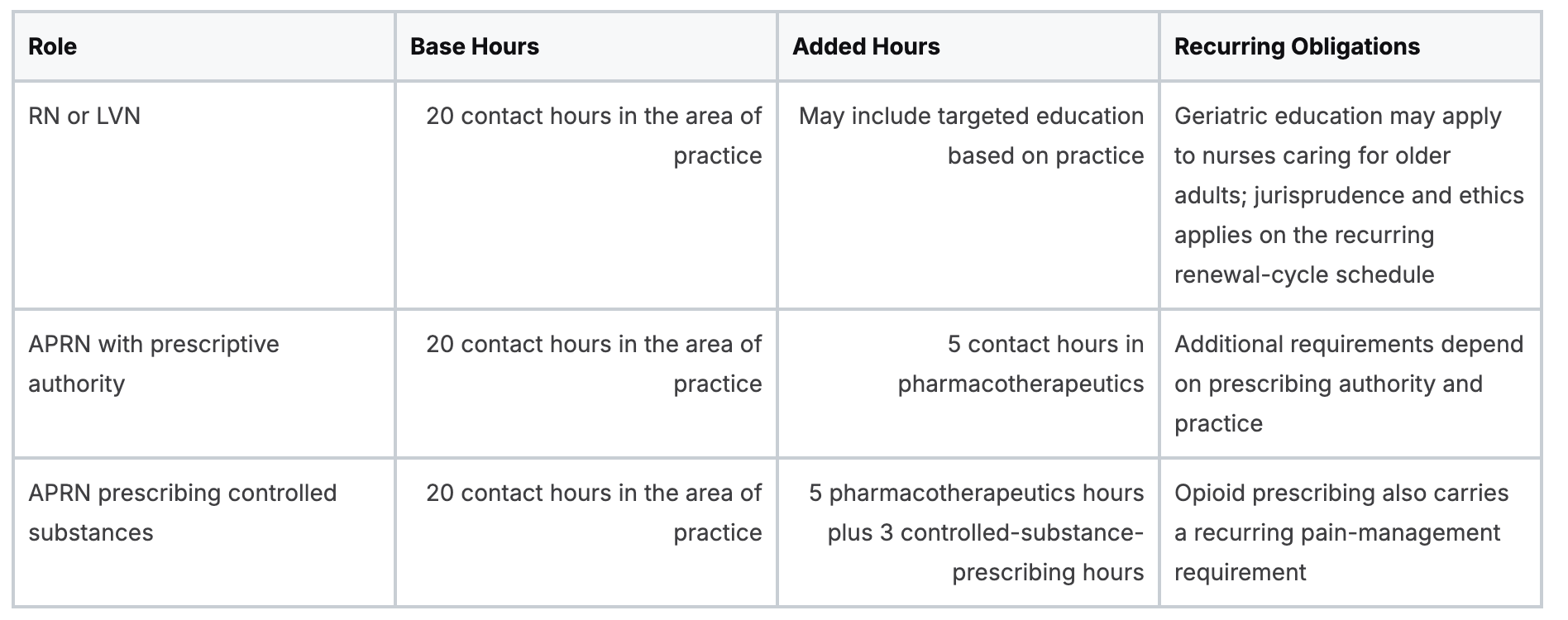
A family-practice APRN who prescribes controlled substances should map the education before enrolling. The working checklist is 20 hours in the practice area, 5 pharmacotherapeutics hours, and 3 controlled-substance-prescribing hours, with pain-management education added when opioid prescribing is authorized. The Texas APRN continuing education requirements can help separate the APRN pathway from the RN or LVN baseline.
A course such as Controlled Substance Prescribing Verification and the Shocking Reality of True Crime Stories examines controlled substances, public health, ethical issues, law-enforcement encounters, and practical care strategies. It should be matched to the applicable Texas and professional requirements rather than counted solely because its title mentions prescribing.
Practice setting adds another layer
A med-surg nurse who regularly cares for older adults needs to account for 2 contact hours of geriatric continuing education during each licensing period when the requirement applies to the nurse's practice, as described in the Texas Board of Nursing education newsletter. A practical choice could be a 2-hour module on fall prevention or dementia care.
All nurses must also complete 2 contact hours in nursing jurisprudence and ethics before the end of every third licensure renewal cycle, according to the Board's jurisprudence and ethics guidance. Direct-care nurses may also face human-trafficking education requirements, so the final checklist should reflect patient population and job duties, not only license initials.
Approved Providers and Course Types That Count
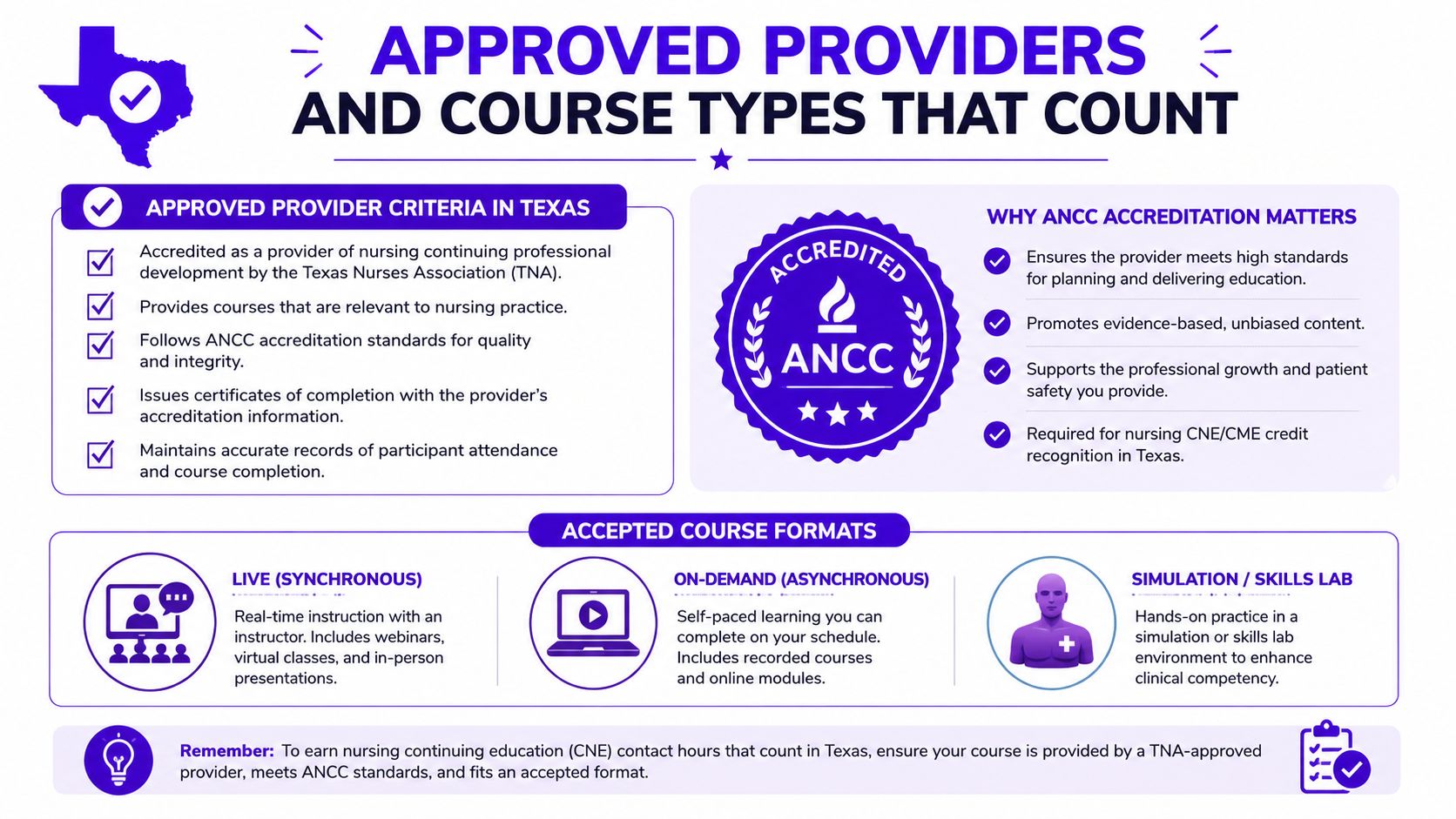
A Texas nursing course earns a place in a renewal file only when its provider, hours, subject, and completion record support the applicable requirement. Before enrolling, check whether the provider identifies nursing education approval or accreditation, states the contact hours, explains how completion is verified, and issues a certificate.
ANCC accreditation is a useful screening point, not a substitute for checking the course itself. General healthcare training may improve practice yet fail to document nursing contact hours for Texas renewal. The label on the course is the signpost. The provider details and certificate are the road map showing where the education fits.
An LVN completing jurisprudence and ethics education might compare a free webinar with an accredited course. The webinar could contain useful information, but unclear provider recognition, missing contact-hour details, or no completion certificate leaves a gap if the Board requests proof. The accredited option gives the LVN a clearer record to retain, provided its content and timing match the applicable Texas requirement.
Use this pre-enrollment check:
- Provider status: Does the provider identify recognized nursing education approval or accreditation?
- Course relevance: Does the content address the nurse's role, practice area, or a specific Texas requirement?
- Contact-hour record: Are the awarded contact hours stated clearly?
- Completion proof: Will the certificate name the learner, course, completion date, and hours?
- Renewal fit: Will completion occur within the correct licensing window?
The guide to the difference between accredited and state-approved CE helps clarify those labels before a nurse selects a course. Course format alone does not decide whether education counts. Live instruction, on-demand learning, and simulation may each fit, while provider recognition and documentation determine whether the record can support renewal.
Choose education that connects four points: recognized provider, nursing contact hours, relevant subject matter, and a certificate that can withstand review.
Reporting Credits and the 2026 Texas Nurse Portal Change
Renewal preparation changes when documentation may be requested. The Texas Board of Nursing selects a random sample of licensees 90 days before each renewal month and may require records proving continuing competency, as described in the Texas nursing rules on continuing competency documentation.
Starting September 1, 2026, the Texas Board of Nursing will require CE certificates to be uploaded in the Texas Nurse Portal before renewal is processed. Nurses renewing after that change should manage certificates throughout the cycle, rather than search email attachments at renewal time.
Consider a nurse who has completed a geriatric module, a jurisprudence and ethics course, and controlled-substance education. Each record should be easy to identify and connected to the nurse's license and renewal cycle.
- Geriatric module: Save the certificate with the course title, completion date, and contact-hour information.
- Jurisprudence certificate: Keep the document with notes showing why the course applies to the renewal cycle.
- Controlled-substance records: Store Texas nursing documentation separately from other professional or federal training records.
- Portal confirmation: After uploading, retain the portal acknowledgment or confirmation in the renewal folder.
A clear file system works like a chain of custody. The certificate shows what was completed, the cycle notes explain where it belongs, and the portal confirmation shows that the record was submitted. If the Board reviews the file, the nurse can substantiate compliance instead of relying on a verbal statement.
Audit habit: Download certificates immediately after completion, name files consistently, and store a second copy outside the course platform.
Documentation also depends on the competency path selected. A nurse using contact hours should maintain a complete, connected set of certificates. A nurse using national certification should retain evidence that the certification is Board-approved, current, and aligned with the nurse's area of practice.
Contact Hours or National Certification
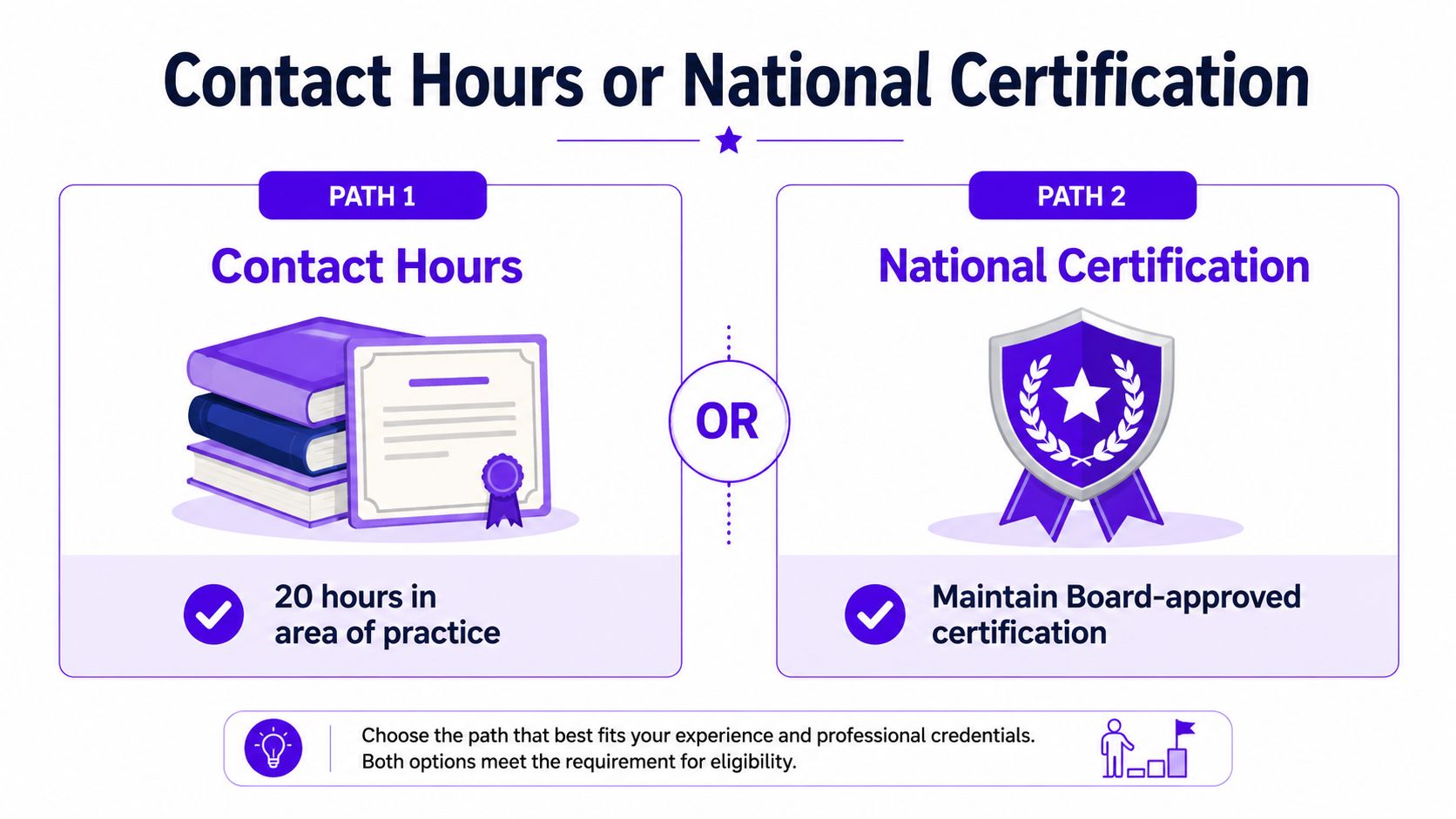
At renewal, a pediatric nurse may hold a current specialty credential while another nurse may rely on completed courses. Texas recognizes both competency paths: 20 contact hours of CNE in the area of practice during the applicable two-year period, or a Board-approved national nursing certification in the area of practice, as noted earlier.
The choice is a documentation decision. A nurse with an approved, current pediatric certification can show the credential and its status. A nurse whose certification is expiring, changing, or difficult to verify may find pediatric-focused contact hours easier to organize. In either case, the evidence should match the nurse's role and renewal cycle.
Comparing the proof paths
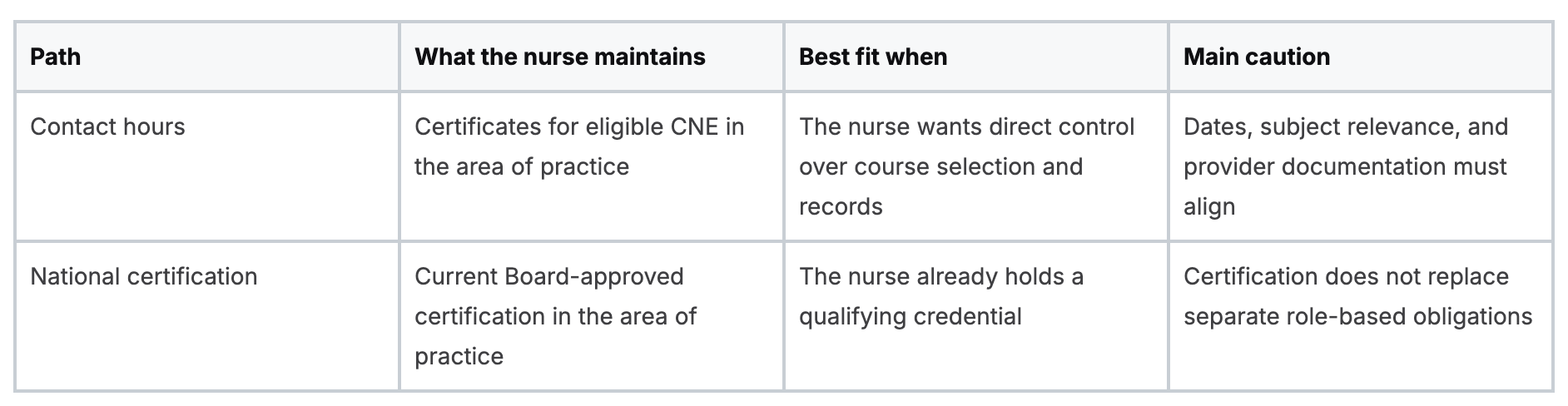
Certification is not a complete shortcut for an APRN with prescriptive authority. The APRN must still account for 5 pharmacotherapeutics contact hours, plus 3 additional hours for controlled-substance prescribing when applicable, when using national certification for renewal. Those subjects belong in a separate education record, even when certification supports the baseline competency requirement.
A practical rule helps: select the path that can be proved clearly, then check it against any role-specific requirements. Contact-hour records function like individual receipts, while certification functions like one current credential. Neither option removes the need to preserve evidence that can support a Board review.
Common Misconceptions and Audit Triggers
Renewal problems often begin with assumptions that sound reasonable but don't match the Board's requirements. The following myth-versus-fact review helps expose the weak points.
Myth and fact review
Myth: Any recent course can fill the baseline.
Fact: The course must fall within the applicable licensing window and relate to the nurse's area of practice. A course completed outside the window may not support the current renewal.
Myth: Twenty hours always completes the job.
Fact: APRN prescriptive authority, controlled-substance prescribing, geriatric practice, jurisprudence and ethics, and other targeted obligations can add requirements based on role or practice.
Myth: A healthcare webinar automatically counts as nursing CE.
Fact: The provider and certificate must support nursing continuing education. General professional learning shouldn't be placed in the renewal file without checking its approval and documentation.
Myth: Jurisprudence and ethics is required at every renewal.
Fact: Texas requires 2 contact hours before the end of every third licensure renewal cycle, according to the Board's jurisprudence guidance cited earlier.
Myth: Portal uploading can wait until after renewal.
Fact: Beginning September 1, 2026, certificates must be uploaded in the Texas Nurse Portal before renewal is processed.
An audit-survival checklist
- Match the role: Separate RN, LVN, APRN, and prescriptive-authority obligations.
- Check the dates: Keep only education that falls within the applicable cycle for the renewal being documented.
- Retain originals: Preserve certificates for at least two full licensing cycles, using a durable personal recordkeeping system.
- Confirm the upload: Keep portal receipts or confirmation records after submitting certificates.
- Review targeted topics: Check geriatrics, jurisprudence and ethics, controlled substances, pain management, and other requirements relevant to the nurse's practice.
The Board's random review process makes orderly documentation more than a convenience. It gives the nurse a defensible answer when the renewal record is questioned.
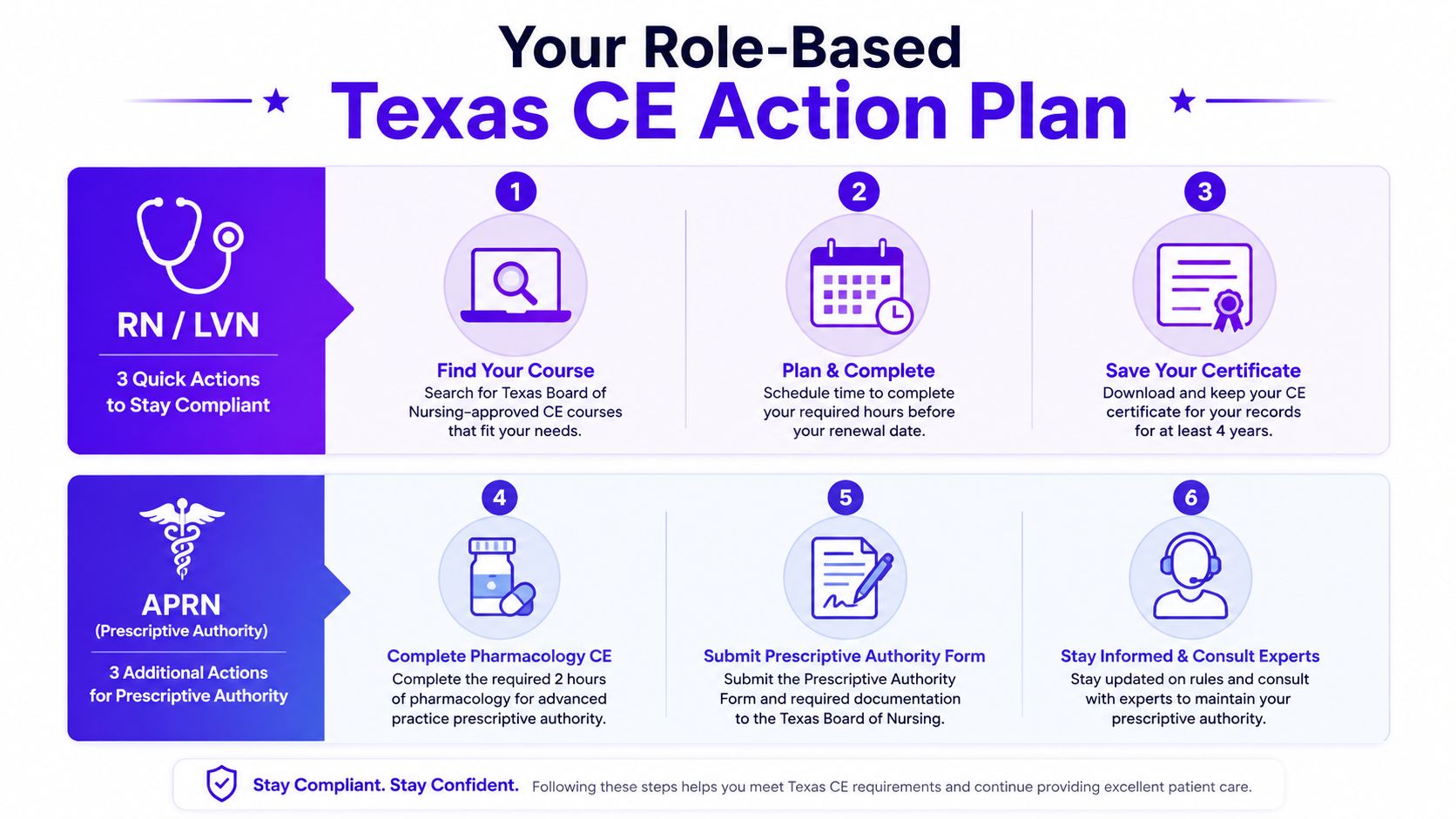
Your Role-Based Texas CE Action Plan
A Texas nurse can turn the rules into a practical task list during one short administrative session. The key is to begin with the license and practice profile, then build the education record around the obligations that apply.
RN or LVN
- Identify the renewal window. Mark the renewal month, then calculate the period beginning on the first day of the following month and ending at the close of the applicable renewal period.
- Sort the baseline education. Gather CNE certificates in the area of practice and verify that the eligible total reaches 20 contact hours.
- Screen for targeted topics. Check whether geriatric care, jurisprudence and ethics, human trafficking, or another practice-specific requirement belongs in the file.
A med-surg nurse who cares for older adults should separately locate the geriatric certificate, rather than assuming that general med-surg content proves the targeted requirement. A nurse approaching the third renewal cycle should also verify the jurisprudence and ethics record.
APRN with prescriptive authority
- Start with the practice-area education. Confirm the baseline CNE record and its dates.
- Add pharmacotherapeutics. Locate 5 contact hours in pharmacotherapeutics and keep them distinct in the file.
- Check prescribing authority. If controlled substances are prescribed, add the applicable 3 contact hours on controlled-substance prescribing and review the recurring pain-management obligation when opioid prescribing is authorized.
The APRN's file should make each layer visible. Combining everything into one vague “CE completed” note makes review harder for the nurse and for anyone evaluating the renewal record.
The shared final step
Every nurse should download certificates promptly, label them by topic and completion date, and keep them in a personal renewal folder. Nurses renewing on or after the 2026 portal change should upload the required certificates before renewal processing and retain the confirmation.
Rules can evolve, so the safest habit is to check current Texas Board guidance whenever a renewal cycle begins. Role-specific tracking prevents the last-minute scramble that happens when a nurse counts hours without checking the obligations attached to the license and practice.
Premiere Education offers accredited continuing education courses and certifications, including state-specific nursing education, controlled-substance training, certificates of completion, and tools for tracking documentation. Nurses can review relevant options and organize their renewal preparation by visiting Premiere Education.
Latest Posts





25% off Sitewide→
Use Code: PCECYBERSALE2025→