
.avif)
Nursing CEU Minnesota: Requirements, Courses, and Renewal

A Minnesota nurse can finish a demanding shift, open the Board of Nursing portal, and discover that renewal is closer than expected. The immediate question usually sounds simple: How many nursing CEUs are needed in Minnesota? The harder questions come next. Which activities count, what dates belong to the participation period, and what records must remain available if the Board selects the licensee for an audit?
Minnesota's system is more than an hour total. It combines a time-based requirement with documented proof, and it offers several ways to meet the standard. The safest approach is to verify the license details first, choose activities that enhance nursing practice, and organize evidence before renewal becomes urgent.
What Minnesota Nurses Need to Know Before Renewal Season
A bedside RN in Duluth checks the expiration date on the licensing portal and sees that renewal is approaching. Before enrolling in a course, the nurse should answer four questions: Is the license active, what is the exact renewal deadline, how long is the current registration period, and does the nurse hold only an RN license or an additional APRN registration?
Minnesota ties continuing education to the registration period, not a universal calendar cycle. A typical period lasts 24 months, but the first period after licensure or reregistration can vary. The Minnesota Board of Nursing renewal FAQ explains that the participation period generally covers the 24 months immediately before renewal, while unusual registration timing can change the calculation.
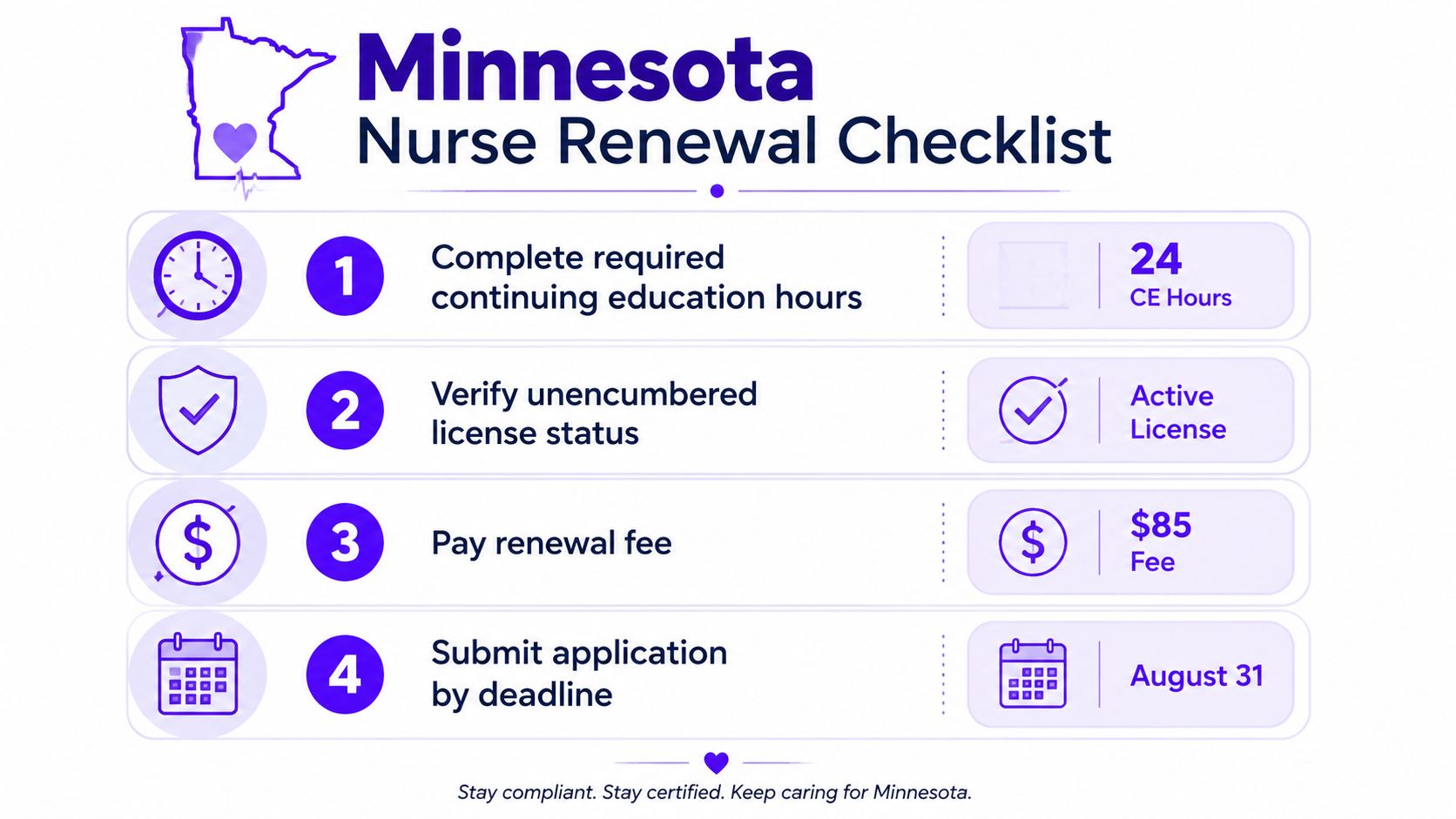
Start with the license record
A nurse should save or print the current license information before selecting education. The record should show the license type, registration status, expiration date, and any additional credential. An RN renewing an LPN license follows a different hour requirement, while an APRN must also monitor national certification status.
National certification can support a Minnesota renewal pathway, but it shouldn't be treated as an automatic substitute for checking the state record. The Board allows specialty certification, approved continuing education activities, and certain professional activities, but each activity must fit Minnesota's rules and be documented.
The Board also requires activities to enhance nursing practice, include written objectives, occur during the participation period, and be taught by someone other than the licensee. A course that sounds educational may still create a problem if its objectives, instructor information, completion date, or contact-hour calculation aren't clear.
Practical rule: Before a nurse earns the first hour, the nurse should identify the license type, the registration window, and the evidence that will prove each activity qualifies.
Some nurses also confuse continuing education with separate employer training or specialty obligations. A workplace module may be useful, but usefulness alone doesn't establish that it satisfies Minnesota nursing CE. Nurses comparing state rules can also consult this state-by-state continuing education guide for nurses, then confirm the final decision against the Minnesota Board's requirements.
How the 24-Month CE Cycle Actually Works
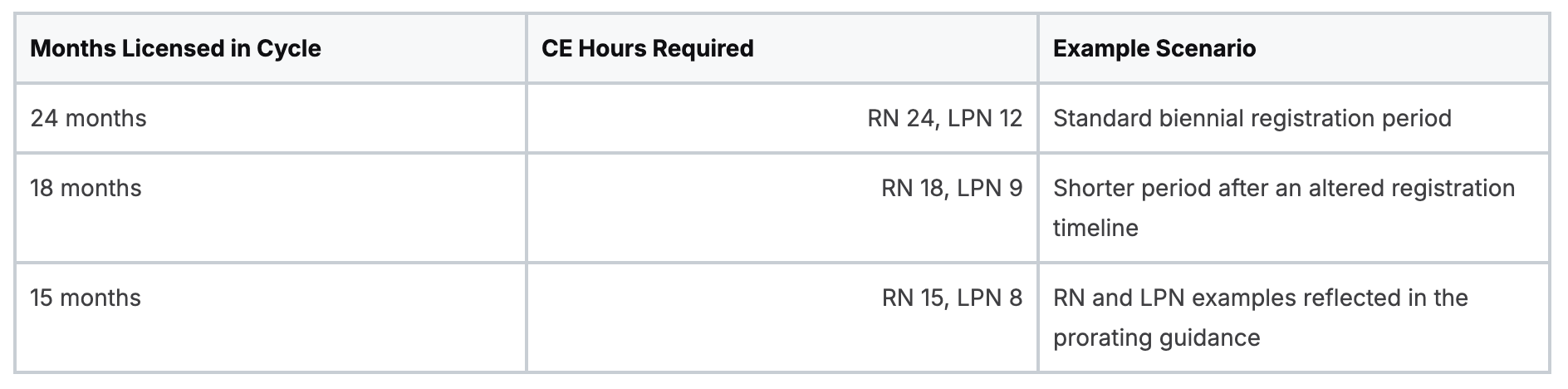
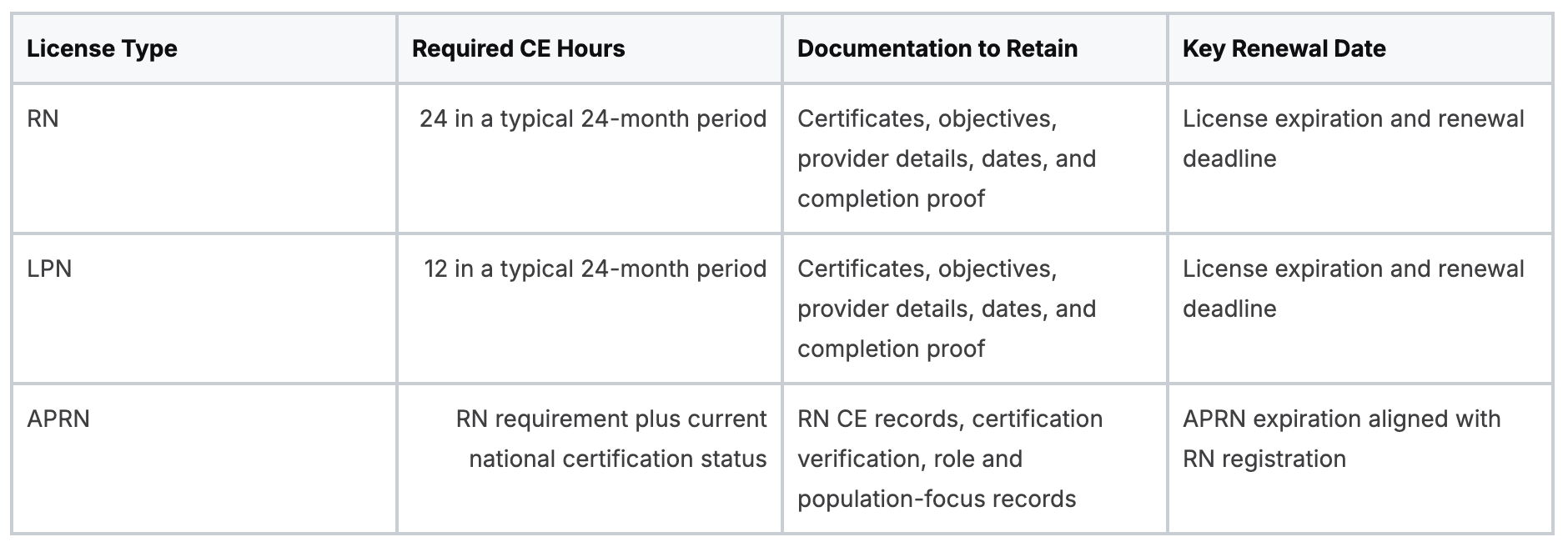
The standard Minnesota formula is straightforward. During a typical 24-month participation period, an RN needs 24 contact hours, while an LPN needs 12 contact hours. Minnesota defines one contact hour as 60 minutes, and the Board permits learning in increments as small as 0.25 hours, or 15 minutes, when the activity qualifies and smaller units are combined appropriately. These rules appear in the Minnesota Board of Nursing continuing education requirements and its renewal guidance.
A shortened registration period changes the amount owed. The verified prorating guidance states that an RN accrues 1 contact hour per month, while an LPN accrues 1 contact hour per 2 months when the registration period isn't a full 24 months. A nurse licensed for 18 months therefore calculates the requirement from the actual months in that registration period, rather than automatically claiming the full biennial amount.
A worked calculation
An RN with an 18-month registration period uses the RN rate of one contact hour per month and owes 18 contact hours. An LPN with the same 18-month period uses the LPN rate of one contact hour per two months and calculates the prorated requirement from that shorter window. The exact registration dates matter, so the nurse should use the Board record rather than estimate from the calendar year.
CE must be completed during the applicable participation period. A certificate earned after the registration period closes may not repair a shortage from the prior cycle, and nurses shouldn't assume that unused hours transfer forward. The Board's rules make the participation period and completion date central to compliance.
Record the course date, not only the date the certificate was downloaded. The completion date determines whether the activity belongs in the renewal window.
Minnesota uses contact hours rather than treating every academic credit as a direct equivalent. When a transcript uses semester-based language, the nurse should obtain documentation that clearly states the nursing contact hours awarded and retain the syllabus or provider explanation. For example, Minnesota Bloodborne Pathogens Training for Body Art Professionals is designed for Minnesota body artists and addresses bloodborne pathogen risks and essential precautions for safe, compliant practice. Its relevance to a nursing license must still be evaluated under the Board's nursing-practice criteria.

Three Pathways That Satisfy Minnesota Nursing CE
Minnesota gives nurses more than one route to renewal. The Board identifies approved continuing education activities, specialty certification, and certain professional activities as accepted pathways, but the documentation burden differs substantially between them. The licensee remains responsible for deciding whether an activity qualifies.
Approved courses
Formal courses are usually the easiest pathway to audit. A complete record should identify the course title, provider or instructor, completion date, contact hours, written objectives, and proof of participation. A certificate alone may be enough when it contains the essential details, but a nurse should also save the course description or outline when the subject matter could be questioned.
Self-study is not automatically countable. Reading a journal article, attending an informal discussion, or watching an unstructured presentation may support professional growth, but the activity needs the structure Minnesota requires before it can be used as nursing CE.
Certification
A current nursing specialty certificate can serve as a renewal pathway. The nurse should retain the certification record and identify the certifying body, credential, specialty, current status, and relevant dates. Certification evidence differs from a course certificate because it proves an ongoing credential rather than attendance at one educational event.
Professional activities
Publishing, presenting, and research may qualify when they meet the Board's standards. These activities require stronger supporting evidence, such as a publication record, presentation agenda, authorship documentation, research confirmation, or other records showing exactly what the nurse did and when it occurred. A professional activity should never be added to a renewal folder based only on memory.
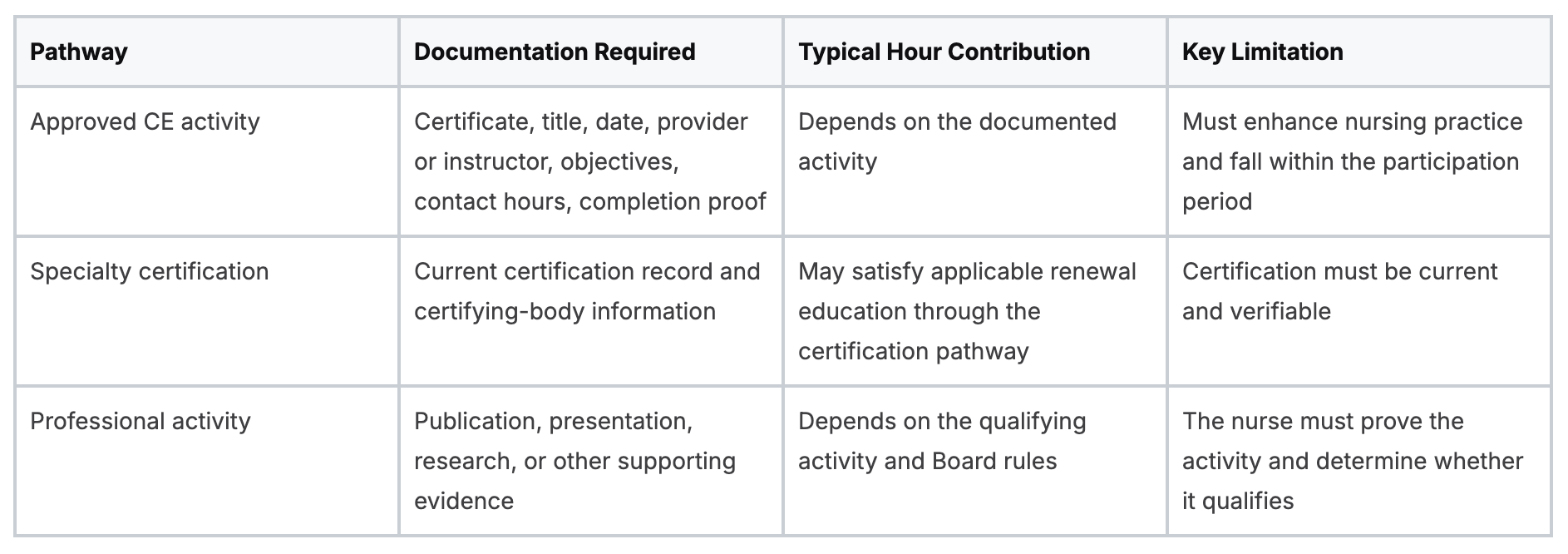
A mixed strategy can work well. An RN might use approved courses for the core requirement, then document a qualifying presentation or specialty certification pathway if appropriate. The key is to keep each pathway's evidence separate and avoid counting the same accomplishment twice.
RN, LPN, and APRN Requirements Compared
The main difference between Minnesota license categories is not only the number of contact hours. It's also the relationship between the state nursing license and any specialty credential attached to advanced practice.
An RN in a standard 24-month period needs 24 contact hours, while an LPN needs 12 contact hours, as stated by the Minnesota Board of Nursing's registered nurse information. The prorating rule applies when the registration period differs from the usual 24 months. Both license types must use activities that meet Minnesota's quality and documentation requirements.
An APRN has an additional compliance layer. The APRN registration depends on maintaining an active RN license and current national certification on file with the Board for the APRN role and population focus. The Board states that the APRN registration expiration date matches the RN registration date, with the registration date determined through the nurse's birth month and odd or even birth year. When certification is renewed, verification must come directly from the certifying body, as explained in the Minnesota APRN renewal requirements.
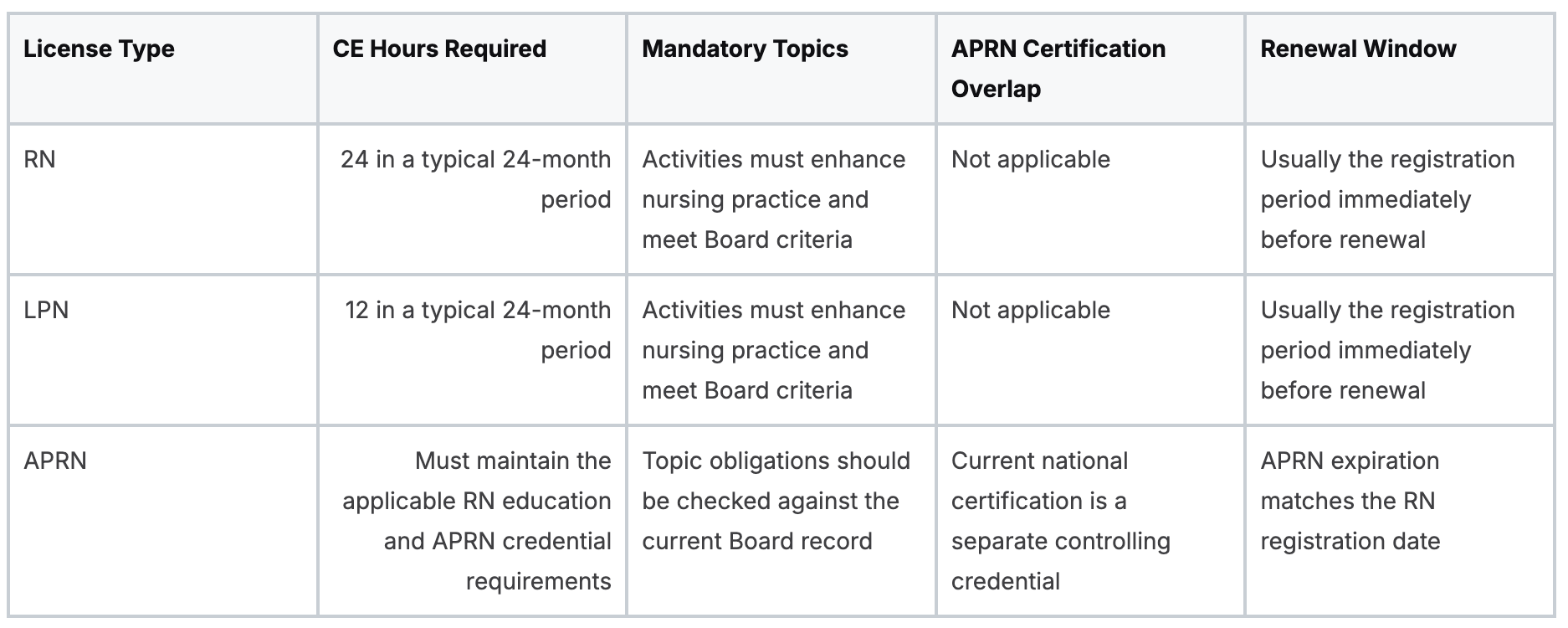
An APRN can have enough education and still face a renewal problem if the national certification record isn't current or hasn't been verified by the certifying body.
For nurse managers, the practical lesson is to track APRNs by credential status, not only by course completion. A spreadsheet that shows hours but omits certification expiration and verification status leaves the most important APRN risk invisible.
Choosing Courses and Providers That Actually Count
A course should pass a basic compliance screen before a nurse spends time completing it. Minnesota requires each activity to enhance nursing practice, include written objectives, occur during the correct participation period, and be taught by someone other than the licensee. The Minnesota continuing education provider guidance is the starting point for evaluating those elements.
Check the provider and the record
Nurses commonly begin with providers connected to recognized nursing education systems, including ANCC-accredited providers, state nursing association offerings, and accredited academic nursing programs. Provider status alone isn't the entire decision. The course record still needs enough information to show what was taught, who taught it, how long it lasted, and when the nurse completed it.
A credible course page should make the following easy to locate:
- Provider identity: The organization or instructor should be clearly named.
- Learning objectives: Objectives should explain the practice knowledge or skill the activity intends to enhance.
- Contact-hour calculation: The record should state contact hours, not merely use vague terms such as credit or participation.
- Completion evidence: The nurse should receive a certificate, transcript, or equivalent proof.
- Practice relevance: The subject should connect logically to nursing practice.
Look beyond the course title
A polished title doesn't guarantee acceptance. A course called “clinical leadership” may be relevant, while an informal webinar with no objectives or completion record may not be usable. Conversely, an activity outside a nurse's exact specialty might still qualify if it enhances nursing practice and the documentation supports that connection.
Nurses who are comparing provider credentials can use this guide to understand accredited and state-approved CE. The decision should remain tied to Minnesota's requirements, not to marketing language.
A nurse should be able to answer three questions from the file alone: what was learned, who provided it, and when was it completed?
When a provider's status or documentation is unclear, the safer choice is to contact the provider before enrollment and request written confirmation of contact hours, objectives, instructor information, and completion records. That small check can prevent a certificate from becoming unusable during an audit.
What Happens If You Are Selected for Audit
An audit notice can feel alarming, especially when certificates sit in different email accounts or a nurse used more than one renewal pathway. The practical task is to rebuild the record for the participation period and show that each claimed activity meets Minnesota's requirements. A nurse who completed appropriate education may still face delays if the evidence is scattered.
The Minnesota Board of Nursing may request CE documents from a selected nurse. The response should therefore match the renewal claim, including activities credited through professional practice or specialty certification. Treat the file like a patient chart: each entry should be identifiable, dated, and supported by the underlying record.
Build the response from the renewal record
Gather course certificates, completion dates, contact hours, provider or instructor details, written objectives, proof of participation, certification verification, and records supporting professional activities. The Board's continuing education page explains the requirement to retain documentation for two years after the education is used for renewal.
An incomplete date or unclear provider name is a clerical problem that may be corrected. Education completed outside the participation period, an activity unrelated to nursing practice, or a professional activity without evidence can affect whether the claimed CE is accepted. Organize the response around each claimed activity instead of sending an unindexed collection of files.
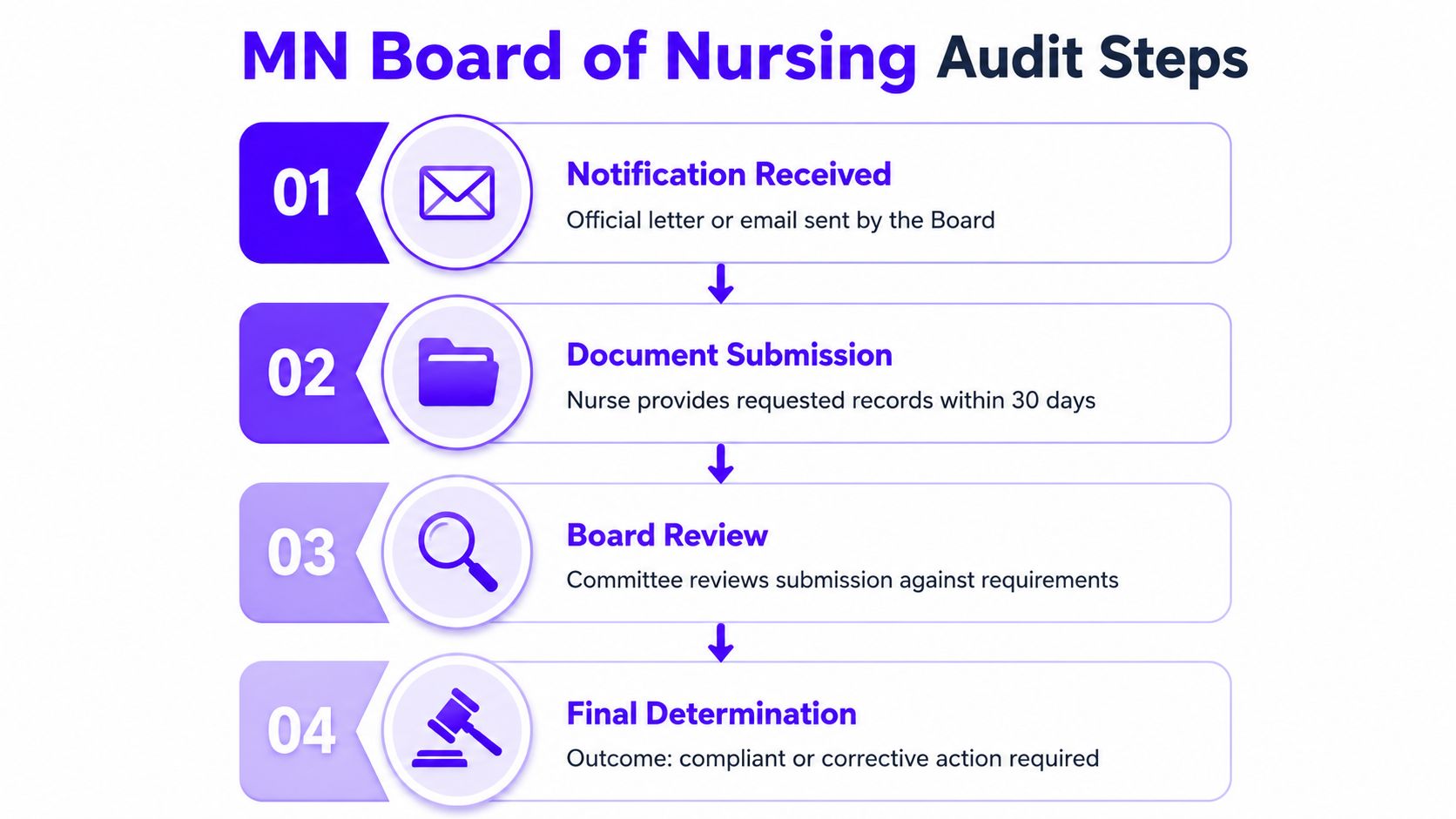
The infographic presents the usual sequence from notification and document submission to Board review and final determination. The deadline in the official notice controls. If a record is missing, contact the provider promptly, save the correspondence, and explain the gap rather than ignoring the request.
For a visual walkthrough of the audit process, watch this video from the Minnesota Board of Nursing.
Create one file for each activity. Use filenames containing the course title and completion date, then maintain an index showing the participation period, pathway used, hours claimed, and location of the supporting record. This setup makes it easier to distinguish a correctable paperwork issue from a genuine education deficiency. It also helps APRNs keep RN and APRN documentation connected without assuming that one credential's evidence automatically satisfies the other.
A Practical Renewal Checklist for Minnesota Nurses
Renewal becomes manageable when the work is distributed across the registration period instead of left for the final weeks. A nurse or compliance lead can use the following sequence to connect each action with the risk it controls.
At the beginning of the registration period
- Verify the license record: Check the Minnesota Board of Nursing portal for license type, active status, registration dates, and expiration date.
- Identify the credential mix: Mark whether the nurse holds an RN, LPN, or APRN credential. APRNs should record national certification status and the population focus maintained with the Board.
- Calculate the obligation: Use the actual months in a shortened registration period. The Board's renewal guidance supports prorating by registration length, rather than assuming every nurse owes the full standard amount.
- Create the evidence folder: Set up folders for certificates, transcripts, professional activities, specialty certification, and correspondence with providers.
During the participation period
A nurse should choose activities with written objectives, a clear contact-hour calculation, a qualified instructor or provider, and a direct connection to nursing practice. Completion records should be saved immediately, not reconstructed at renewal.
For an activity used through specialty certification or professional practice, the nurse should preserve the evidence that explains the pathway. An APRN should also keep certification verification separate from ordinary course certificates because the state renewal depends on both statuses.
Before renewal submission
- Reconcile the hours: Compare completed contact hours with the requirement for the actual registration window.
- Check the dates: Confirm every activity was completed during the applicable participation period.
- Review topic obligations: APRNs and employers should check the current Board record for any role-specific or credential-specific requirements instead of relying on a general RN checklist.
- Prepare for audit: Retain documentation for two years after using it for renewal, as stated by the Minnesota Board of Nursing.
- Submit before the deadline: Use the expiration date shown in the Board record and keep confirmation of the renewal submission.
Employers can adapt the same process into a team tracker. The purpose isn't to collect every training record ever completed. It's to show which education supports Minnesota renewal, where the proof is stored, and which credential needs attention next.
Premiere Education offers online continuing education courses, certifications, state-specific training, completion certificates, and tracking tools for individual learners and organizations. Nurses and compliance teams can visit Premiere Education to review available education and build a more organized Minnesota renewal record.
Latest Posts





25% off Sitewide→
Use Code: PCECYBERSALE2025→