
.avif)
Nursing Care of Postpartum Hemorrhage: A Clinical Guide

A nurse checks the postpartum room and sees a pad becoming saturated faster than expected. The patient is awake and speaking, but the fundus feels soft rather than firm. Waiting for a provider to arrive can turn a manageable bleed into a rapidly deteriorating emergency. Nursing care of postpartum hemorrhage depends on recognizing the pattern early, starting the response bundle immediately, and communicating changes before the patient appears critically ill.
Postpartum hemorrhage occurs in about 1% to 3% of deliveries and remains the leading cause of obstetric morbidity and mortality worldwide. The World Health Organization estimates that about 14 million women experience PPH each year, contributing to roughly 70,000 maternal deaths annually, more than 20% of maternal deaths globally. Those figures explain why bedside nurses must treat blood loss, uterine tone, vital-sign trends, and patient appearance as one developing clinical picture, not as separate observations.
Recognizing Postpartum Hemorrhage in Real Time
Twenty minutes after a vaginal birth, a nurse notices that the patient's pad is increasingly saturated. The patient says she feels “fine,” but the nurse palpates a soft, boggy fundus. Instead of waiting for the obstetric provider, the nurse checks the fundal position and tone, assesses the amount and character of bleeding, obtains vital signs, begins uterine massage, and calls for assistance.
That sequence matters. A patient may compensate for blood loss before obvious hypotension appears, and visual estimation often underestimates the volume collected in pads, linens, suction canisters, and clots. Postpartum hemorrhage is commonly operationalized as at least 1,000 mL of blood loss or blood loss accompanied by signs of hypovolemia within 24 hours of delivery, although older teaching uses 500 mL after vaginal birth and 1,000 mL after cesarean birth (American Family Physician practice guideline). A nurse shouldn't wait for the final total when the patient has dizziness, tachycardia, falling blood pressure, pallor, altered behavior, or worsening bleeding.

The bedside pattern that demands action
Normal postpartum bleeding should trend down rather than accelerate. A brief increase with movement can occur, but a rapidly filling pad, passage of large clots, or blood pooling beneath the patient requires immediate reassessment. A uterus that feels firm but bleeding continues raises concern for causes other than atony, such as laceration, retained tissue, or a coagulation problem. A boggy uterus points toward atony, but it doesn't eliminate the need to consider the other causes when bleeding persists.
The first observations should be stated clearly and documented in real time:
- Fundus: Record tone, position, and response to massage.
- Bleeding: Record measured blood loss, pad or linen changes, clots, and ongoing saturation.
- Physiologic response: Compare pulse, blood pressure, respiratory status, skin appearance, mental status, and urine output with earlier findings.
- Context: Note delivery type, placental delivery, uterotonic administration, recent procedures, and known risk factors.
A nurse caring for a patient during the first 24 hours after birth must keep reassessing even when the uterus firms temporarily. A transient improvement doesn't prove that the bleeding source has been controlled. Families also need calm, direct explanations, while the clinical team needs concise information that supports immediate decisions.
Assessment and Early Warning Signs
Assessment becomes safer when every nurse follows the same order rather than relying on visual impressions or memory. The first task is to identify whether the uterus is firm, whether the bleeding is continuing, and whether the patient's physiology is changing. The second is to create a reliable measurement record that the next clinician can use without repeating the entire assessment.
A measurable assessment sequence
Begin with the fundus. Support the lower uterine segment while assessing tone and position, then massage a boggy uterus and reassess the response. A uterus that remains soft, rises, shifts laterally, or becomes difficult to palpate needs prompt escalation because poor contraction can sustain bleeding.
Quantitative blood loss should be used whenever possible. Weighing blood-soaked materials, measuring suction contents appropriately, and recording cumulative loss provide a more useful basis for staging than describing a pad as “heavy.” Current guidance recommends basing staging and management on quantitative blood loss when available, with escalation at cumulative loss of 500 mL, or at 300 mL when abnormal vital signs or concern for instability are present (2025 SOGC guideline). The nurse should record the time, method, amount, fundal findings, vital signs, and actions taken.
A patient with cumulative measured loss above 500 mL may still look comfortable. That finding is not reassurance. It is a trigger to increase surveillance, notify the team, and prepare the response pathway. If blood pressure begins to fall while the heart rate reaches 110 beats per minute, the trend should be reported as a developing concern even if the patient is still talking normally.
Findings that change urgency
Dizziness, tachycardia, hypotension, pallor, confusion, agitation, reduced urine output, and increasing weakness can indicate hypovolemia. A nurse should compare trends rather than record isolated values. A rising pulse with ongoing pad saturation is more concerning than either finding alone.
A structured documentation entry might state: “Fundus soft and displaced to the right, ongoing saturated pad, cumulative quantified loss increasing, pulse rising from earlier assessment, patient reports lightheadedness, provider and hemorrhage team notified.” This language gives the receiving clinician a sequence, not a vague impression. Foundations such as inclusive and evidence-based reproductive healthcare education can reinforce thorough assessment habits, but unit protocols and escalation pathways must guide the emergency response.
Immediate Nursing Interventions
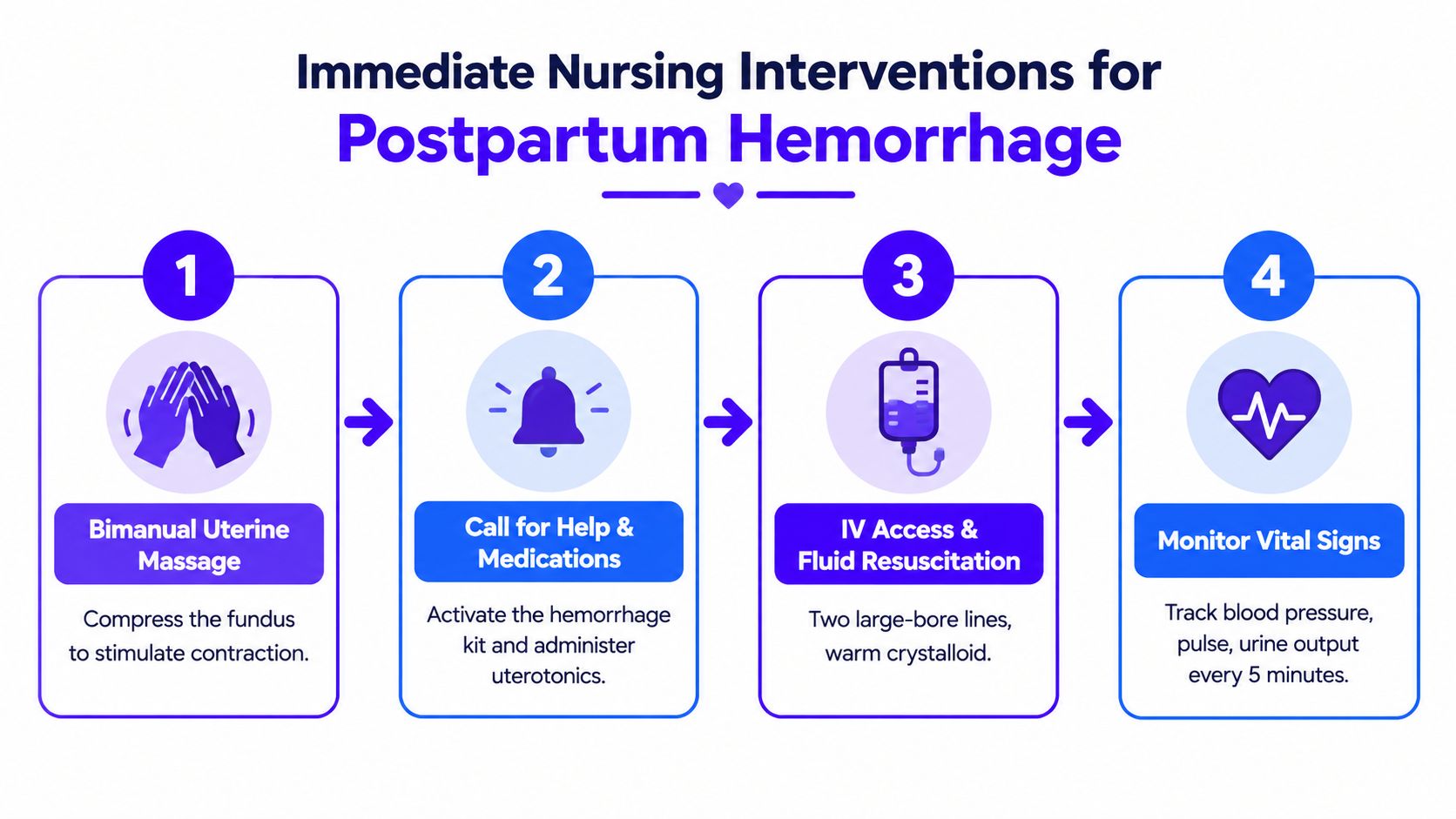
Once the assessment indicates concerning bleeding, the nurse should activate help and begin treatment at the same time. The response is not a relay race in which one person finishes an assessment before another person starts an intervention. One nurse can massage the uterus while another establishes access, another brings the hemorrhage cart, and another communicates with the obstetric and anesthesia teams.
Start the response bundle
For a boggy fundus, begin firm uterine massage while supporting the lower uterine segment. The purpose is to stimulate contraction and reduce ongoing atony-related bleeding. Continue reassessing tone and blood loss rather than assuming that a temporary firming has ended the event.
Establish two large-bore IV lines when possible. Begin isotonic crystalloid resuscitation according to the local hemorrhage protocol, keep the patient warm, and prepare for blood products if hypovolemia or ongoing bleeding develops. Continuous vital-sign monitoring, frequent reassessment, and urine-output surveillance help show whether resuscitation is matching the loss.
Oxytocin is the preferred first-line uterotonic. FIGO-cited regimens include 10 IU IV or IM, or an infusion of 10 to 40 IU in 500 to 1,000 mL of lactated Ringer's solution (NCBI Bookshelf uterine atony guidance). Medication administration should not be delayed while the team waits for a perfect blood-loss estimate. The nurse verifies the order, route, concentration, infusion rate, allergies, and response, then reports inadequate improvement promptly.
Practical rule: A boggy uterus, active bleeding, and a changing pulse should trigger simultaneous action, not sequential task completion.
A practical night-shift example is a patient whose fundus becomes soft after delivery while the pad continues to fill. The primary nurse massages the uterus and calls for help. A second nurse starts access and fluids, a third obtains oxytocin and the hemorrhage supplies, and the team prepares second-line medications if the fundus doesn't remain firm. This division of work reduces the common failure of one nurse attempting every task alone.
Avoid delays that create false reassurance
Oxytocin alone may not control bleeding when the response is inadequate. The team should move quickly to the next treatment step, including additional uterotonics, tranexamic acid, blood products, or procedural intervention according to the clinical picture and local protocol. WHO guidance recommends TXA early, within 3 hours of birth, as an adjunct when PPH is diagnosed (WHO PPH guidance). Delaying TXA beyond that window or continuing ineffective first-line treatment without escalation are preventable operational errors.
The Red Alert postpartum hemorrhage management course uses skills-focused learning around risk recognition, uterotonic measures, and practical response drills. Education is most useful when it helps nurses rehearse who calls for help, who brings equipment, who documents, and who communicates the response.
Escalation and Second-Line Treatments
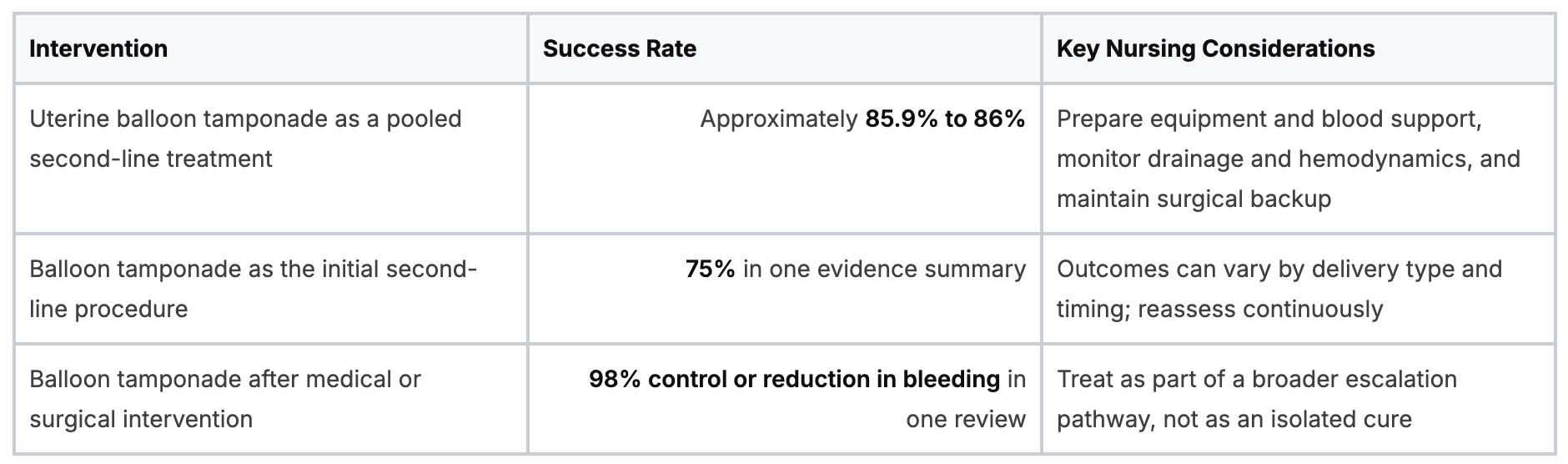
When massage, oxytocin, TXA, and supportive resuscitation don't control bleeding, the nurse must help the team escalate without treating the next intervention as a final solution. Uterine balloon tamponade can provide direct pressure inside the uterus while the team continues resuscitation, investigates the cause, and prepares backup treatment.
Pooled evidence reports an overall balloon tamponade success rate of approximately 85.9% to 86% in controlling PPH (systematic review and meta-analysis). Outcomes vary by timing and clinical context. One evidence summary found 75% success when balloon tamponade was the initial second-line procedure, with better outcomes after vaginal birth than cesarean birth. Another review found 98% control or reduction in bleeding when it was used after prior medical or surgical interventions. These figures describe evidence across different settings, not a guarantee for an individual patient.
Prepare before insertion
The nurse should bring the balloon device, confirm the insertion supplies, assist with positioning and analgesia or anesthesia needs, and ensure that blood products and emergency equipment remain available. The team should establish who will document insertion, who will monitor drainage and vital signs, and who will communicate the response to the obstetric lead.
During placement, the nurse watches for ongoing blood loss, changes in mental status, worsening tachycardia, hypotension, pain, and signs that bleeding is not responding. After placement, close hemodynamic monitoring continues. The nurse tracks drainage, uterine tone, cumulative loss, fluids, transfusions, temperature, urine output, and laboratory results.
Keep the rescue pathway active
Balloon tamponade doesn't correct every cause of hemorrhage. A firm uterus with continued bleeding may indicate trauma, retained tissue, or coagulopathy, and persistent instability requires rapid investigation and escalation. Nurses support correction of hypothermia, ongoing blood product administration, laboratory surveillance, and preparation for surgery or other interventions when ordered.
Evidence quality also matters. Much of the balloon evidence comes from nonrandomized studies and case series, so teams shouldn't assume that placement alone will resolve refractory bleeding. A safer protocol pairs balloon readiness with access to surgery, blood products, experienced procedural support, and clear criteria for declaring the intervention inadequate.
Monitoring and Team Communication
A patient can appear stable while the clinical situation worsens. The nurse at the bedside often sees the sequence first: another saturated pad, a pulse that keeps rising, a new look of pallor, a shorter answer to a question, or less urine in the collection system. Effective communication turns those observations into action before the patient reaches overt instability.
Blood loss should be tallied and reported at frequent 5- to 15-minute intervals during active hemorrhage, with the exact interval determined by the patient's condition and local protocol (ANMC postpartum hemorrhage guideline). Each update should include cumulative loss, current bleeding, fundal tone, vital-sign trend, urine output, mental status, fluids, medications, transfusions, and response to treatment.
Use closed-loop communication
During a crowded emergency, vague statements create delay. A nurse can use SBAR or a similar structure:
- Situation: “Postpartum patient with ongoing heavy bleeding and a soft fundus.”
- Background: “Vaginal birth, oxytocin already started, quantified loss continuing.”
- Assessment: “Pulse is rising, blood pressure is trending down, and massage has produced only temporary improvement.”
- Recommendation: “Hemorrhage response and anesthesia are needed now. Please assess for second-line treatment and blood product support.”
The receiving clinician should repeat or acknowledge the request. The nurse then confirms when the action occurs. This closed loop prevents a call for help from disappearing into a noisy room.
A practical example is a nurse who sees continued pad saturation and a rising pulse during reassessment. The patient is still alert, but the nurse stops routine charting, repeats the assessment, announces the trend, and notifies the obstetric team. That decision creates time for access, medication preparation, laboratory testing, and procedural support before the patient's condition declines further.
Resources on interprofessional collaboration in healthcare can help teams strengthen communication habits outside an emergency. During PPH, however, the standard is simple: state the change, name the risk, identify the required action, and confirm completion.
Documentation and Follow-Up Care
The emergency record should reconstruct what happened without forcing the next clinician to infer the sequence. Document the time bleeding was first recognized, fundal findings, quantified loss, vital-sign trends, notifications, orders, medication administration, IV fluids, laboratory collection, blood products, procedures, patient response, and the names or roles of responders.
A vague entry such as “heavy bleeding, doctor notified” doesn't show whether the uterus was assessed, whether loss increased, or how quickly treatment began. A stronger timeline records the observed change, the action taken, the person notified, the response, and the next escalation decision. Accurate timing supports continuity, quality review, and a defensible clinical record.
After bleeding is controlled, surveillance continues. The nurse reassesses uterine tone and bleeding, follows vital signs and urine output, administers continued uterotonics as ordered, observes for recurrent symptoms, and reviews laboratory results with the team. Patient education should cover warning signs that require urgent attention after discharge, including renewed heavy bleeding, dizziness, faintness, worsening weakness, or concerning changes in general condition.
Follow-up also includes emotional support. A frightening hemorrhage can affect the patient's confidence, sleep, feeding plans, mobility, and willingness to seek care. The nurse should explain what occurred in plain language, clarify the medications and follow-up plan, and make sure the patient knows whom to contact if symptoms recur.
Key Takeaways for Clinical Practice
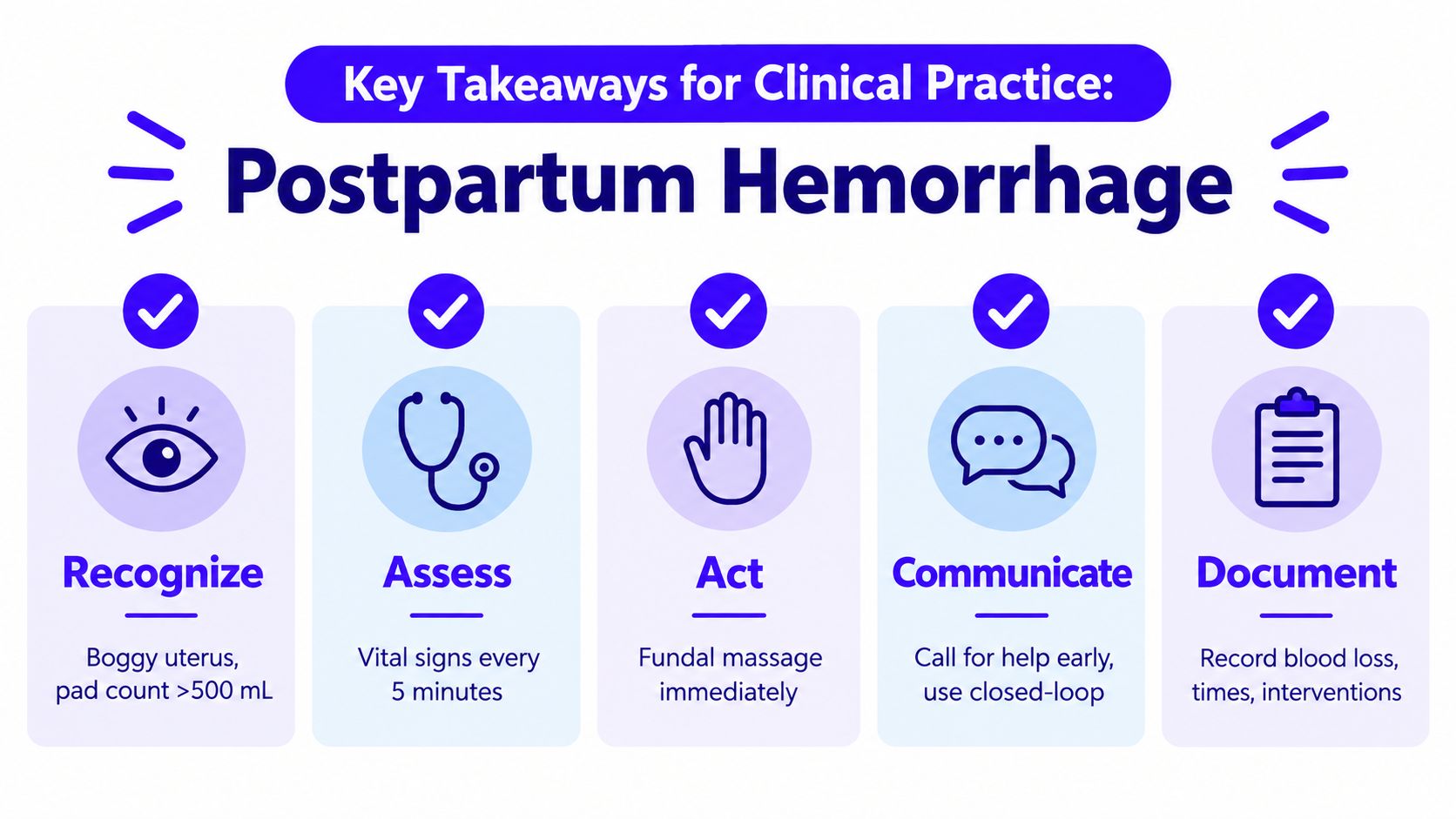
The most reliable bedside response is a mental model that compresses recognition and action into a few repeatable verbs: recognize, assess, act, communicate, and document. A nurse shouldn't wait for a final blood-loss total when the patient has a boggy uterus, ongoing saturation, dizziness, a rising pulse, or a falling blood pressure. Clinical signs and trends can justify urgent intervention while measurement continues.
A shift-ready checklist should include the following:
- Recognize the change. Check the fundus, bleeding pattern, patient appearance, and vital-sign trend. A soft uterus with increasing blood loss is an active warning, not a routine postpartum finding.
- Assess objectively. Use quantitative blood-loss methods whenever possible. Record the amount, time, pad or linen measurement, clots, fundal response, urine output, and mental status.
- Act together. Call for help, begin uterine massage, establish large-bore access, start isotonic crystalloid as directed, administer oxytocin without delay, and prepare TXA or further treatment according to protocol.
- Escalate deliberately. If bleeding continues despite initial therapy, prepare second-line treatment and maintain access to blood products, laboratory surveillance, procedural support, and surgery.
- Communicate clearly. Give the team cumulative loss, current physiology, interventions already completed, response, and the action needed next. Use closed-loop confirmation.
- Document the timeline. Record recognition, assessment, calls, medication times, fluids, transfusions, procedures, reassessments, and patient response.
Institutional readiness strengthens individual performance. Hemorrhage carts, standardized protocols, transfusion readiness, simulation training, and clear escalation pathways help nurses execute under pressure rather than improvise. The global incidence rate declined from 998.26 per 100,000 women in 1990 to 722.16 per 100,000 in 2021, yet PPH remains frequent enough to require dependable hospital systems (global epidemiologic analysis). A global survey also found that 53.7% of respondents saw at least 10 PPH cases per month, supporting the need for routine preparedness rather than occasional exposure.
Clinical priority: The nurse who measures, reassesses, calls early, and keeps the team oriented to the trend can prevent a delayed response from becoming a crisis.
Premiere Education offers online continuing education, clinical certifications, skills-focused courses, and tools for assigning and documenting learning across healthcare teams. Nurses can visit Premiere Education to review postpartum hemorrhage education alongside broader professional development and renewal resources.
Latest Posts





25% off Sitewide→
Use Code: PCECYBERSALE2025→