
.avif)
Nurse Practitioner CME Online Courses: A Practical Guide
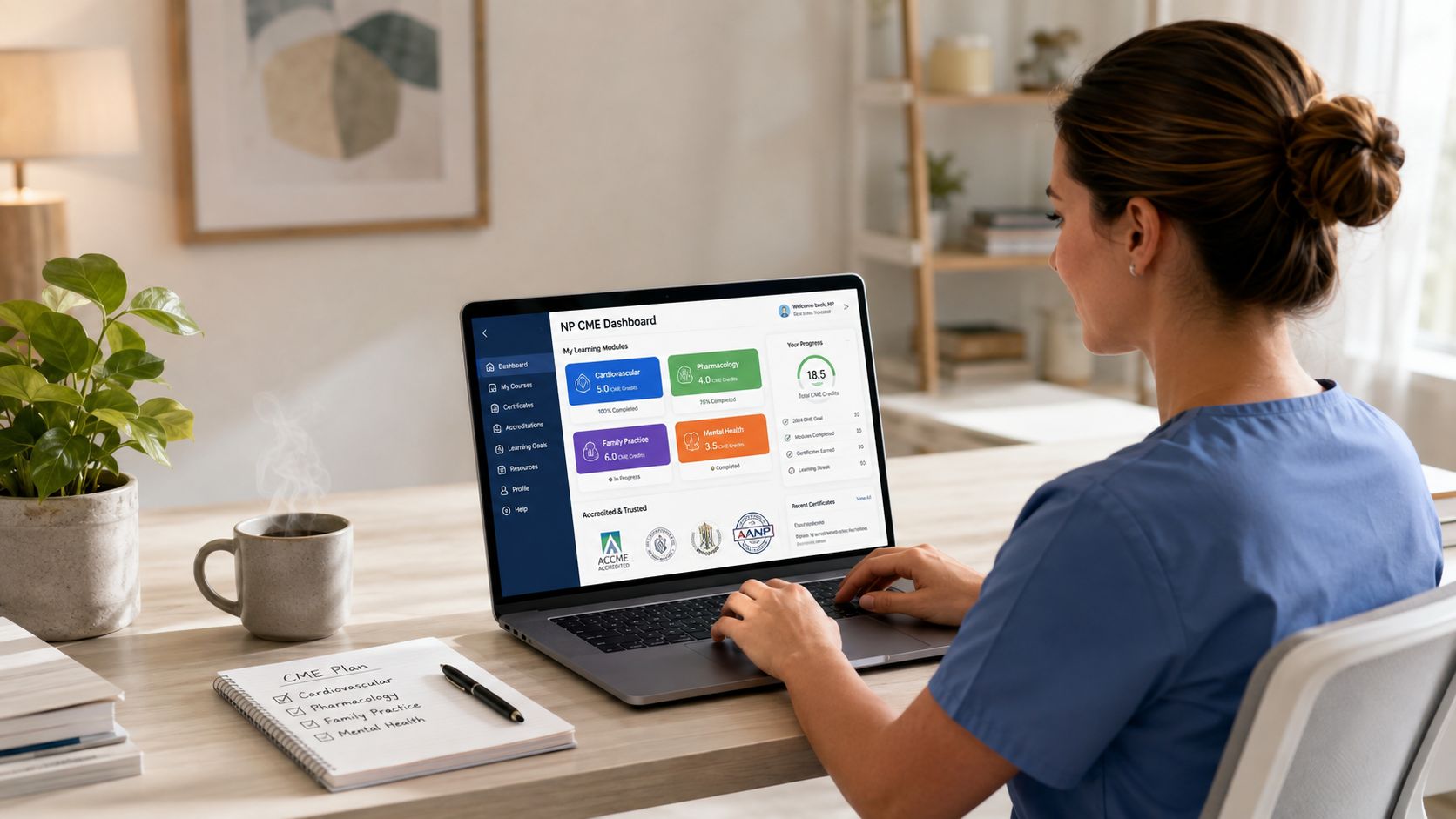
An NP can finish a late shift, open a laptop between patient calls, and discover that a renewal deadline is approaching with several credit hours still missing. The catalog offers plenty of options, but the certificate may not satisfy the state board, the certification organization, or a prescriptive authority requirement. That's the central problem with nurse practitioner CME online courses: earning hours is only part of the job. The hours must also be approved, relevant, correctly documented, and accepted by the jurisdiction that governs the NP's license.
Online education has become the practical backbone of NP professional development. It accommodates rotating schedules, rural practice, family responsibilities, and specialty changes better than a fixed conference calendar. Yet convenience can create false confidence. A course can be clinically useful and still fail to meet a specific pharmacology rule, reporting standard, or certification pathway.
What Online CME Looks Like for Nurse Practitioners Today
A family nurse practitioner may complete a short pharmacology module during a lunch break, attend a live webinar after clinic, and reserve a weekend for a virtual specialty conference. A psychiatric-mental health NP may choose behavioral health updates, suicide risk assessment, and telehealth documentation content, while an acute care NP may prioritize critical care pharmacology and advanced diagnostic decision-making. The common thread is operational pressure. Clinical work rarely leaves a clean block of time for education.
Online-delivered continuing education has supported NP practice for decades. A 1998 PubMed-indexed study identified five sites already providing CE programs online and another using email delivery, with certificates and approval through a state board of nursing or the ANCC Commission on Accreditation. That history matters because digital CE wasn't a sudden response to recent technology. It was already being used as a recognized way to document professional education in the late 1990s.
A later scoping review in the Journal of Advanced Nursing found that research on continuing education for advanced practice nursing roles, including nurse practitioners, has focused primarily on online interventions for clinical care competency. Most interventions in that literature used online delivery, which supports the view that digital education is a central format rather than a peripheral convenience.
The catalog is broader than the renewal rule
Modern providers commonly combine self-paced modules, recorded lectures, specialty libraries, live sessions, and virtual events. That mix lets an NP match the format to the task. A dense legal update may work better as an on-demand lesson that can be paused. A clinical controversy may benefit from live questions and discussion.
The hidden difficulty appears during renewal review. A national catalog may label a course as nursing CE, but the NP's state may require a specific pharmacology topic, controlled-substance content, or approval from a named organization. The certificate can show a completed activity while the renewal file remains incomplete.
Practical rule: Choose courses by the requirement they satisfy, not just by the number of hours displayed in the catalog.
Accreditation Marks That Matter for NP Credit
An NP can finish a course, download a certificate, and still discover that the hours do not satisfy a renewal rule. The accreditation statement determines who approved the activity, which credit category applies, and whether the education may support a particular certification or state requirement. Check those details before enrollment, not at the renewal deadline.
Three approval pathways appear most often:
- ANCC-accredited nursing contact hours support nursing education and may apply to ANCC certification renewal and state nursing requirements. The certificate should name the accredited provider, activity, credit amount, and completion details.
- ACCME-accredited activities generally award AMA PRA Category 1 Credit for physician education. ANCC renewal rules accept AMA PRA Category 1 CME when it meets the stated criteria. An NP should verify the documentation and approval language rather than assume that every physician CME activity transfers automatically. The Premiere Education accreditation information shows the provider-level details learners should review.
- State board approval or a state provider number can determine whether a course satisfies a jurisdiction-specific requirement. Controlled-substance prescribing, jurisprudence, and other legislatively mandated topics may require a named approval pathway in addition to national accreditation.
The gap between hours earned and hours that count becomes clear with a course such as Beyond the Birth Enhancing Healthcare Provider Expertise in Postpartum Depression. The subject addresses postpartum depression, including risk-factor recognition, symptom identification, and collaborative care strategies. Those clinical aims do not by themselves establish eligibility for a specific renewal obligation. Review the certificate, credit designation, and approval language before recording the course.
What an accreditation statement should show
A reliable certificate generally identifies the provider, activity title, completion date, credit type, credit amount, and any activity or provider identifier used for reporting. The course page should also state the accrediting body and approved credit category clearly. If those details are absent, pause before enrolling and contact the provider.
Telehealth competency creates another verification gap. A course may carry valid accreditation while offering little preparation for virtual assessment, remote prescribing workflow, or technology-related documentation. Accreditation confirms the credit pathway, not that the activity closes every practice gap.
An attractive interface cannot replace usable documentation. Save the certificate, approval details, and course description together, then compare them with the board and certifying-body requirements before renewal submission.
Comparing Course Formats and Delivery Styles
An NP working across urgent care sites has different scheduling needs from an NP with a predictable outpatient clinic. Course format affects not only convenience but also how well the activity supports the intended learning objective.
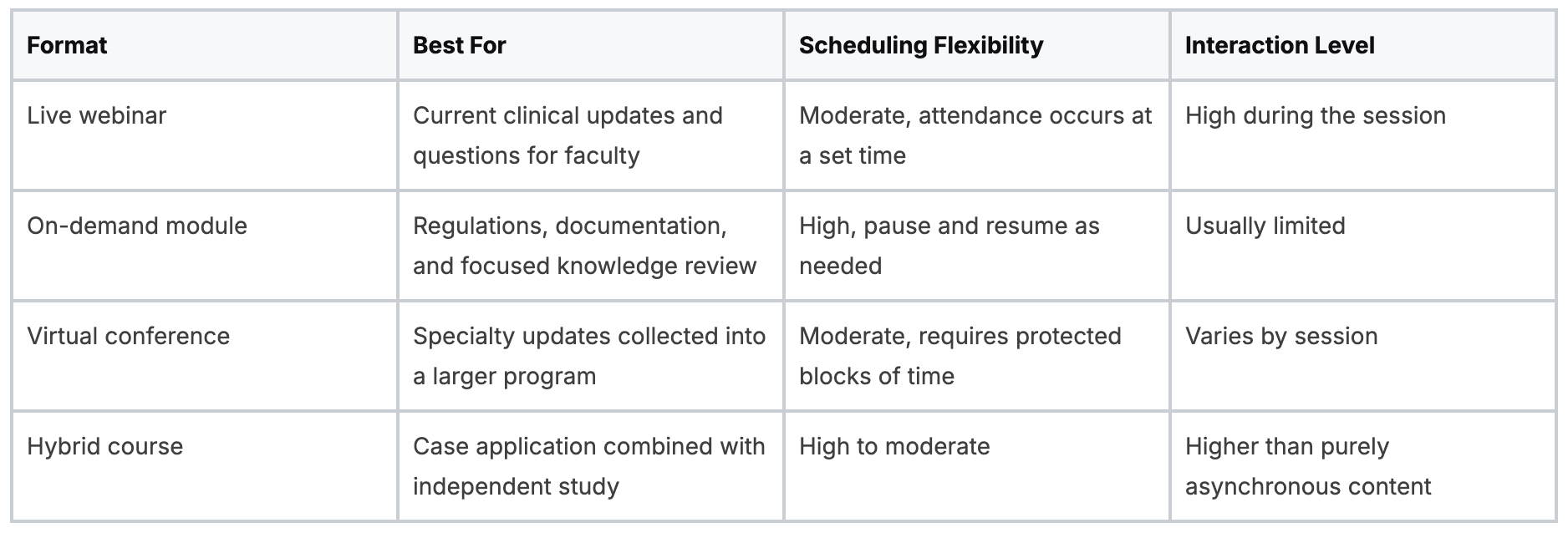
Live webinars work well when questions improve the learning experience. A pharmacology update, for example, may raise practical concerns about titration, adverse effects, or prescribing workflow that a static module can't address fully. The trade-off is that a missed start time may mean missed credit unless the provider offers a recording with a separate completion pathway.
On-demand lessons suit clinicians who study between obligations. Regulatory content, opioid prescribing rules, and documentation standards often benefit from pause-and-resume access. The weakness is predictable: passive viewing can encourage rushing, especially when the learner treats the post-test as the only meaningful checkpoint.
Virtual conferences compress a broad specialty agenda into a concentrated schedule. They can help an NP organize a large portion of a renewal plan, but the format demands advance calendar protection. Hybrid programs offer a useful middle ground by pairing asynchronous preparation with a live case discussion.
Most renewal plans work better with a deliberate mix. The NP can use self-paced content for mandatory rules, live sessions for difficult clinical updates, and interactive case work for decisions that require judgment rather than recall.
How Contact Hours and CME Credits Convert
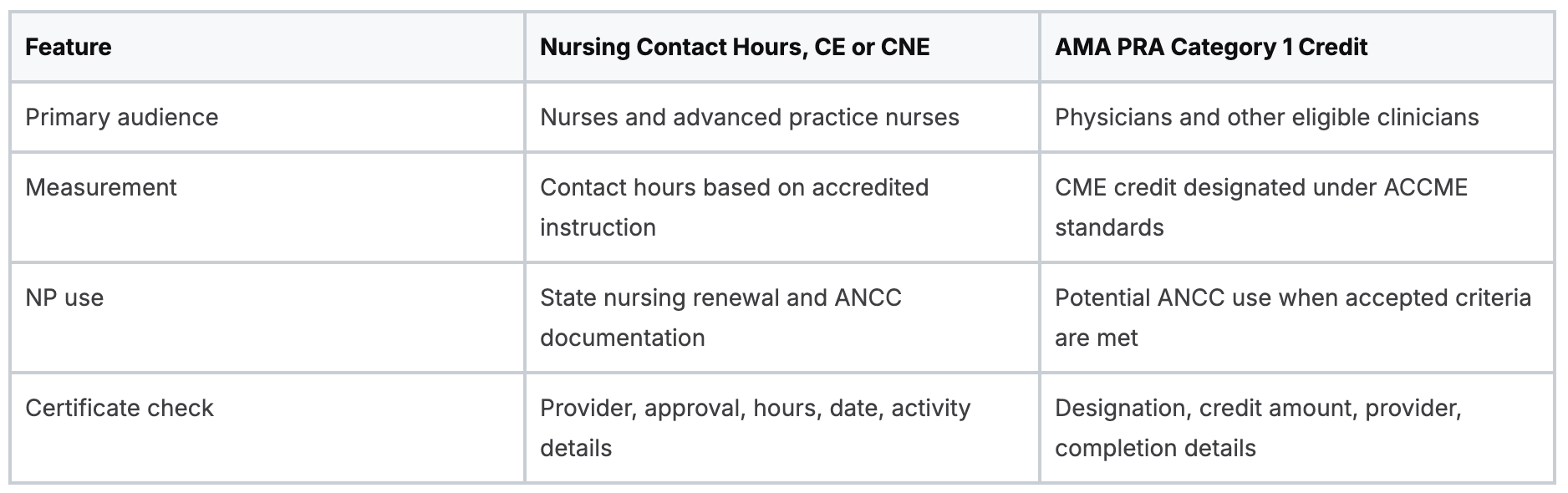
NPs often encounter two labels on certificates, nursing contact hours and AMA PRA Category 1 Credit. The labels identify different credit systems, but ANCC documentation provides a clear measurement standard: one contact hour equals 60 minutes of accredited instruction, as specified in the ANCC certification renewal requirements.
ANCC requires NP certificants to complete 75 continuing education contact hours over a five-year renewal cycle, including 25 pharmacology hours. At least 60 hours must be formally approved continuing education, and accepted formats include nursing contact hours from an accredited nursing provider or AMA PRA Category 1 CME when the activity satisfies ANCC requirements.
A practical conversion example helps. If an accredited cardiology update documents 10 contact hours, the certificate represents 600 minutes of accredited instruction. If the same activity also awards AMA PRA Category 1 Credit, the provider should state the physician credit amount separately. The NP shouldn't assume that a course's advertised duration equals approved credit. Breaks, noninstructional time, evaluations, and incomplete activities may affect the final amount.
Partial completion creates another edge case. Some providers issue credit only after the learner completes all required elements, while others document partial credit under defined rules. Rounding practices also differ. The certificate, not the course title or video length, should control the amount entered into a transcript.
A dual certificate can be useful when an NP needs nursing documentation and an employer or collaborating medical staff office requests physician-equivalent CME records. That convenience doesn't remove the need to verify whether the activity fits the specific renewal pathway.
Evaluating Online CME Providers Before You Enroll
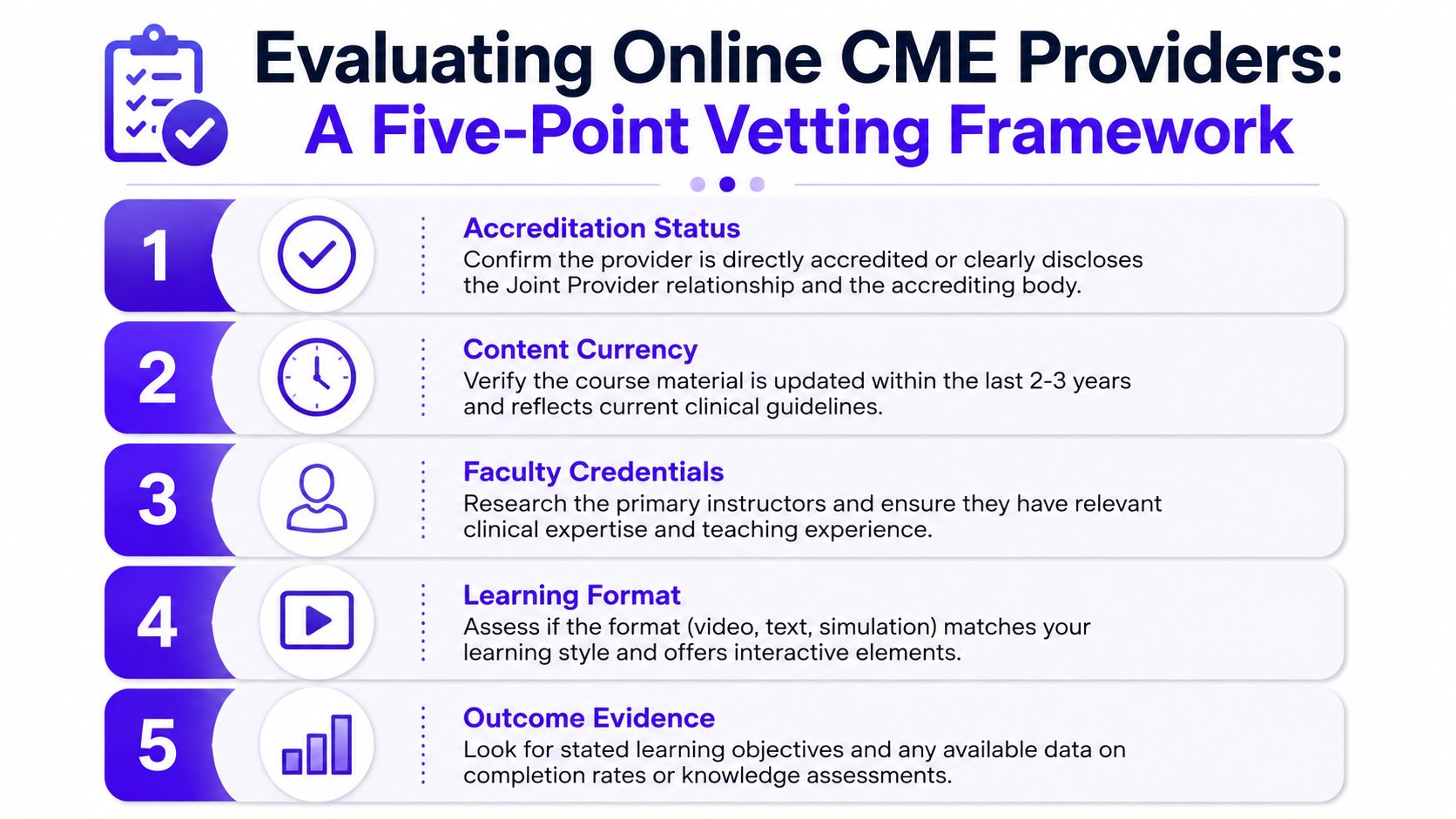
A provider can be evaluated before payment with a short, repeatable review. The most important information usually appears in the accreditation disclosure, course details, and certificate sample rather than in the marketing headline.
A five-point enrollment check
- Accreditation status: Confirm whether the provider is directly accredited or clearly identifies a Joint Provider relationship and the accrediting organization. A vague statement about “approved CE” isn't enough.
- Content currency: Check the update date and determine whether the material reflects current guidelines, regulations, and clinical practice. A course can be well written and still be outdated.
- Faculty credentials: Review the instructors' clinical background and teaching experience. The author should understand the decisions the NP makes in practice, not only the terminology used in a textbook.
- Learning design: Decide whether video, text, audio, simulation, or a hybrid format fits the objective. A regulatory module may work asynchronously, while a communication skill needs opportunities for application.
- Outcome evidence: Look for specific objectives, meaningful assessments, and explanations for incorrect answers. A post-test that permits rapid clicking without rationales provides weak evidence of learning.
The guide to choosing an online APRN continuing education provider offers a useful framework for comparing accreditation, content, and platform features.
Operational details decide whether a course is usable
Certificate turnaround matters when renewal is close. The provider should explain when the certificate becomes available, what information it includes, and whether the activity can be reported to the relevant system. A refund or cancellation policy also deserves review before enrollment, particularly for subscription programs or bundled events.
Red flags include a missing accreditation statement, a certificate sample without the activity identity, and unclear reporting instructions. A low price alone doesn't prove poor quality, but a bargain course that omits approval information can cost more time when the board rejects it.
State-Specific Requirements Most National Catalogs Miss
National catalogs simplify discovery, but they can't replace a state board review. Requirements differ by jurisdiction, especially when an NP holds prescriptive authority. The learner must check the current board rule before selecting a package.
North Carolina illustrates the scale of a recurring state requirement. The state requires 50 contact hours every two years, with at least 20 hours in the NP's national certification area, and those 20 hours must be approved by a national credentialing body or ACCME, according to the North Carolina practitioner licensing information. An NP who buys a general package without specialty mapping may have enough total hours but not enough qualifying specialty content.
Texas creates a separate pharmacotherapeutic checkpoint. Any APRN with prescriptive authority must complete 20 contact hours plus at least 5 additional contact hours in pharmacotherapeutics, creating a 25-hour floor for prescribing APRNs under the Texas Board of Nursing continuing education rules. A 20-hour general package doesn't finish the requirement. The NP needs a separate qualifying pharmacotherapeutics activity or a package that clearly includes the required content.
Alabama provides another warning about prescriptive practice. A CRNP with prescriptive authority must earn 6 contact hours of pharmacology content specific to prescriptive practice in the approved collaborative area, as reflected in the verified Alabama requirement. A broad pharmacology course may not satisfy that topic-specific rule.
New Hampshire combines education with practice documentation. The state requires 60 contact hours every two years, including 20 specialty hours and 5 pharmacology hours, plus 400 hours of active NP practice in the specialty area over the past 4 years. For NPs registered to prescribe controlled substances, 3 of the 5 pharmacology hours must address pain management, opioid prescribing, or substance use disorder, according to the New Hampshire continuing education overview.
These examples show why an ANCC mark doesn't automatically satisfy every state detail. The safest workflow is to download the board rule, highlight topic and approval language, and match each course to one line of that requirement before enrollment.
Closing Practice Gaps That Credit Hours Cannot Fix
A completed certificate proves participation. It doesn't prove that an NP can handle a difficult virtual encounter under pressure.
A 2026 national simulation study identified five deficits among practicing NPs: distinguishing originating and distant sites, adapting the virtual physical examination, documenting telehealth encounters, prescribing controlled substances, and understanding audio-only limits. Those are operational tasks, not merely facts to memorize. A course that asks the learner to recall a definition may satisfy an assessment requirement while leaving the actual performance gap untouched.
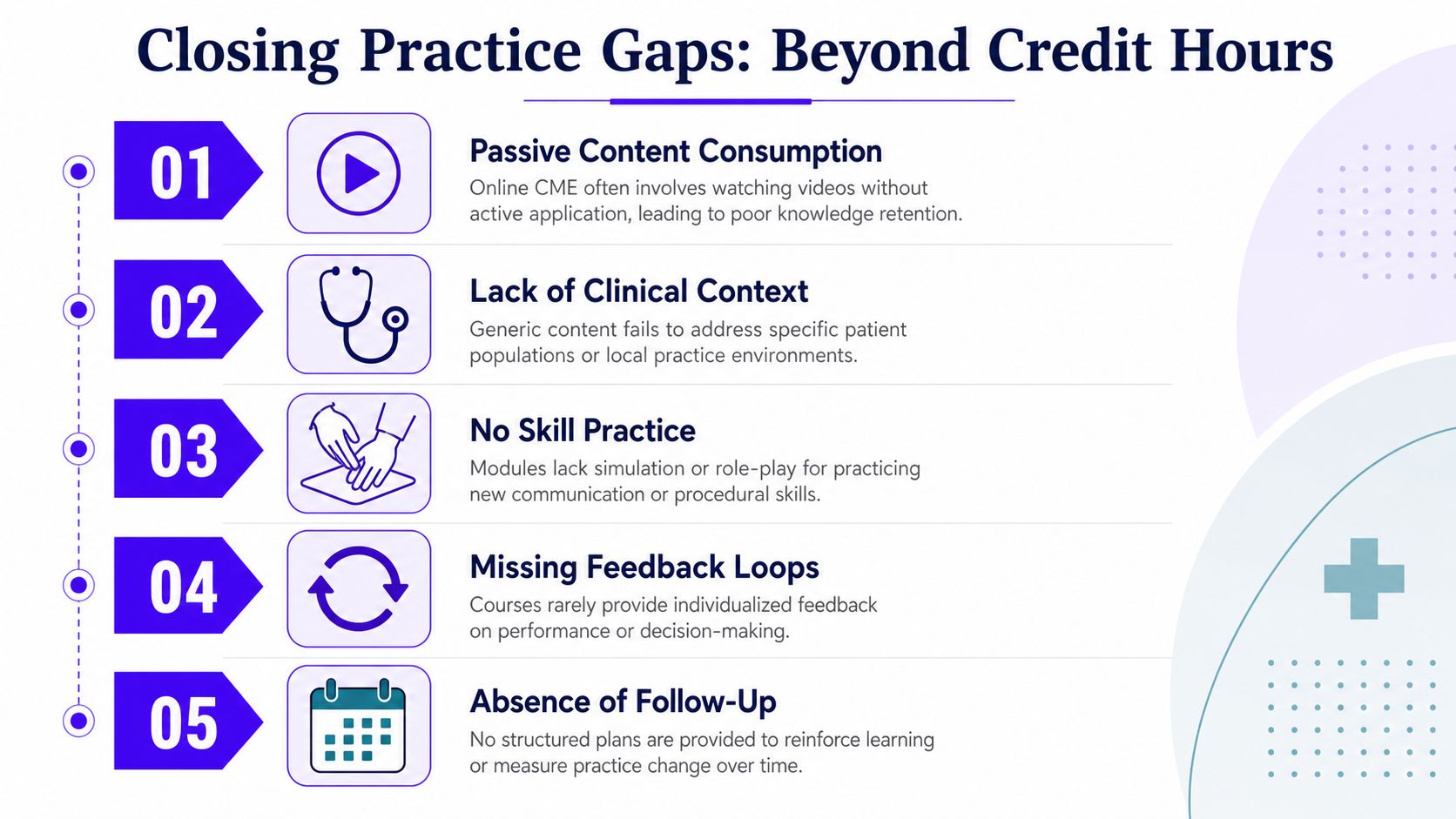
What stronger course design looks like
The most useful online activities present a clinical situation, force a decision, and explain why the selected path succeeds or fails. For example, a telehealth module might ask the NP to identify the patient's location, determine whether the encounter can proceed, document the virtual exam, and decide whether an audio-only visit is sufficient. That sequence mirrors the work rather than describing it.
A certificate closes a documentation requirement. Scenario practice closes a clinical decision gap.
After completing a course, the NP should convert the lesson into a workplace action:
- Add one question: Include a location, consent, or medication-safety question in the next telehealth workflow.
- Revise one process: Update the documentation template or escalation pathway.
- Track one outcome: Review whether the change improves completeness, handoff clarity, or follow-up reliability.
The study's five deficits make telehealth a particularly strong filter for course quality. Rural and underserved settings may expose these weaknesses more often because the NP cannot rely on an on-site colleague or immediate in-person examination. Online CME works best when it pairs credit with deliberate application, feedback, and a reason to revisit the new behavior.
Assigning, Tracking, and Reporting Completions
An individual NP can maintain a spreadsheet, but manual tracking becomes fragile when several clinicians have different licenses, specialties, and renewal dates. A group learning portal gives an administrator a way to assign education by role, expiration date, or prescriptive authority requirement, then monitor completion without relying on email reminders.
The reporting record should be more detailed than a completion total. Each certificate should identify the course, completion date, accreditation source, credit type, and contact-hour amount. The administrator should be able to export certificates and a transcript for credentialing, audits, hospital privileging, and payer requests.
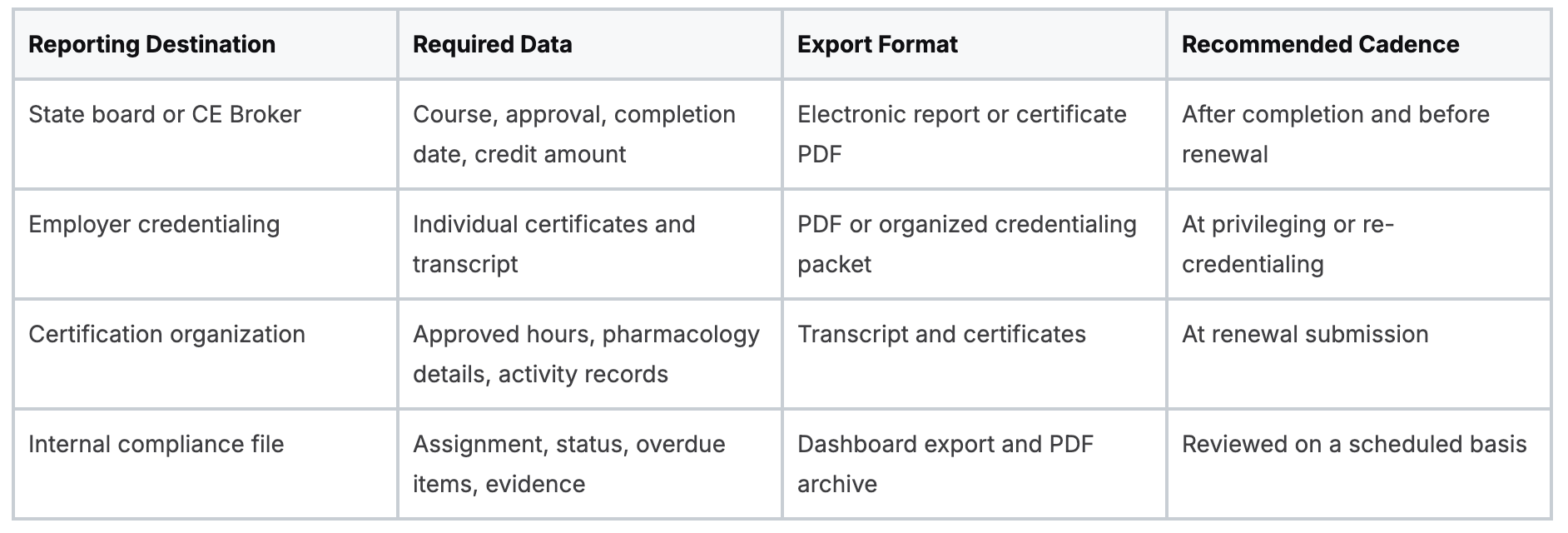
Florida NPs should confirm whether the provider is approved for CE Broker reporting. When automatic reporting is available, it can reduce manual uploads, but the learner remains responsible for checking that the completion appears correctly.
A defensible recordkeeping process has three parts:
- Reconcile portal data against the state record on a regular schedule.
- Archive original certificates outside the learning platform.
- Keep records for the applicable renewal and audit period, rather than assuming a provider will preserve access indefinitely.
Premiere Education offers online CE, certificates of completion, group enrollment tools, assignment workflows, completion monitoring, and reporting to CE Broker and other agencies where applicable. Those features address administration, but the organization still needs to map each assigned course to the individual NP's board and certification requirements.
Sample Course Entries for Common NP Scenarios
A catalog becomes useful when every entry answers a compliance question. The title, credit category, approval statement, and transcript placement should make clear why the NP is taking the activity.
Consider a Florida NP reviewing a renewal checklist. The NP needs a two-hour Impairment in the Workplace course and a two-hour Florida Laws and Rules course, both through ANCC-accredited providers and approved by the Florida Board of Nursing. These aren't optional enrichment activities. Omitting either can leave the renewal file incomplete even when the total transcript looks substantial.
An ANCC-certified family nurse practitioner in the third year of a five-year cycle may need to organize remaining education around pharmacology and specialty relevance. An on-demand antimicrobial stewardship bundle can be evaluated for its stewardship, opioid-prescribing, and TB-screening content, but the NP should count only the hours and categories explicitly documented by the provider.
A psychiatric-mental health NP may select a telehealth-specific suicide risk assessment activity because it addresses a practical remote-care competency. The course should be reviewed for its actual accreditation and whether it satisfies any separate state or prescribing requirement. Subject relevance helps, but it doesn't substitute for approval verification.
The decision rule is simple: each course entry should connect to a documented deadline, topic mandate, certification category, or identifiable practice gap. “Interesting” is a valid reason to learn, but it isn't enough to approve a renewal transcript.
Quick-Reference Matrix for NP Renewal Planning
A renewal plan should begin with the trigger, not the catalog search. The NP identifies the governing organization, required categories, and documentation standard, then chooses a format that fits the remaining calendar.
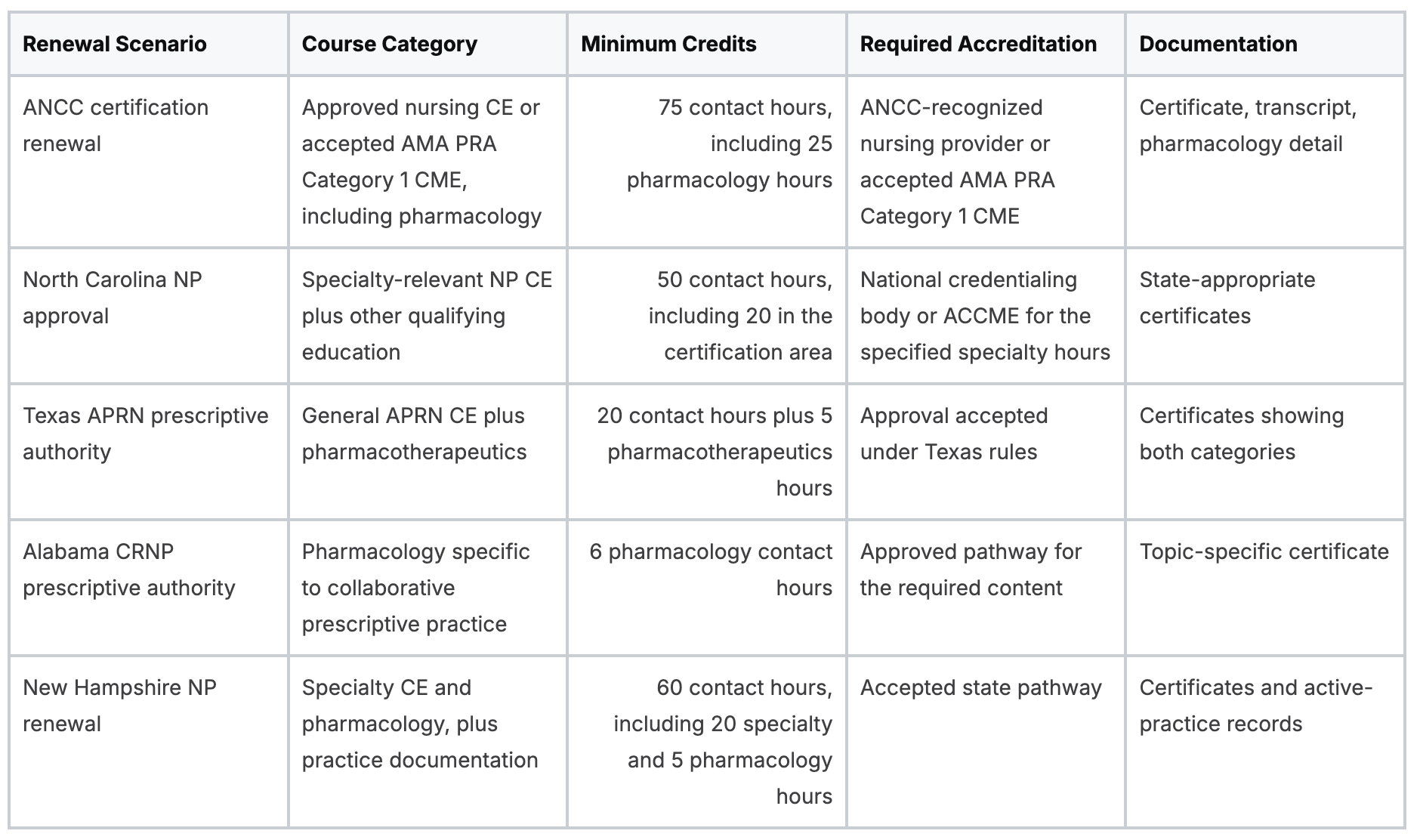
On-demand modules suit knowledge and regulatory requirements when the provider permits the required completion documentation. Live webinars or simulations are more appropriate when interaction, case discussion, or observable practice is part of the activity. The NP should not select a live format solely because it appears more rigorous, nor an asynchronous format solely because it is convenient.
The guide to renewing a nursing license with online continuing education can support the planning process, but the state board and certification organization remain the controlling authorities.
Frequently Asked Questions About NP CME Online
Does CE Broker always pull completions automatically?
No single assumption is safe. Approved providers may report electronically, but the NP should verify that the activity appears in the personal record and retain the certificate in case manual correction is needed.
How long should certificates be retained?
The NP should keep original certificates for the applicable renewal and audit period. Maintaining an independent archive protects the record if a provider changes platforms, removes a course, or loses access to older accounts.
What happens if a provider pulls a course after completion?
Save the certificate, transcript, course identifier, completion date, and approval information immediately. Contact the provider and the relevant board or certification organization if the activity is later questioned.
Do AMA PRA Category 1 Credits count one-to-one toward ANCC contact hours?
ANCC accepts AMA PRA Category 1 CME when the activity meets its renewal criteria, but the NP should rely on the certificate and ANCC's current rules rather than assume every CME unit transfers automatically.
How do boards verify completion?
Audits can compare certificates, reporting records, activity dates, provider information, and credit categories. A screenshot of a course dashboard is weaker than a complete certificate with the required identifiers.
Does an employer group enrollment satisfy individual renewal?
It can, provided the individual NP completes the activity and receives documentation tied to that learner. A group administrator's roster alone shouldn't replace the NP's personal certificate and transcript.
Premiere Education provides accredited online CE, state-specific course coverage, certificates, individual learning access, and group tools for assigning and tracking professional education. NPs and practice administrators can review the Premiere Education catalog to match course documentation with renewal requirements before the deadline.
Latest Posts





25% off Sitewide→
Use Code: PCECYBERSALE2025→