

Motivational Interviewing Stages in Clinical Practice

A patient nods through a discharge conversation, agrees to take the medication, and then misses the next appointment. In a school office, a student required to attend counseling sits with crossed arms and answers every question with “I don't know.” In both situations, more advice may produce more resistance, not more readiness.
Motivational interviewing (MI) gives clinicians and educators a different way to work. Rather than trying to win an argument, the practitioner builds collaboration, identifies a meaningful direction, draws out the person's own reasons for change, and supports a realistic next step. The approach is especially useful when motivation is mixed, externally pressured, or still developing.
Understanding the Core Purpose of Motivational Interviewing
A nurse meets with a patient who has been told to improve their diet after repeated health concerns. The patient understands the recommendation, but follow-up appointments keep getting canceled. When the nurse lists the risks again, the patient becomes quiet. When the nurse asks what makes appointments difficult, the patient describes shift work, embarrassment about not following the plan, and doubt that anything will make a difference.
That conversation contains ambivalence, not simple defiance. The patient wants better health and also wants relief from shame, inconvenience, and repeated reminders. MI treats both sides as clinically relevant. The practitioner doesn't need to overpower the reluctance. The practitioner needs to understand it well enough to help the patient examine what matters.
A similar pattern appears in education. A student referred to behavioral counseling after a disciplinary incident may not believe counseling is necessary. A directive opening, such as “You need to change your attitude,” gives the student little reason to participate. An autonomy-supportive question, such as “What would make this meeting useful, even if attendance isn't your choice?” creates room for an honest answer.
From observation to an operational method
MI has a clear historical origin. William R. Miller published the first description in 1983, emerging from work with alcohol problems, and the method later expanded into a broader approach to ambivalence, readiness, and commitment across professions, nations, and languages. The historical evolution of motivational interviewing shows how the method developed from a relatively loose counseling style into a more teachable framework.
A fuller exposition published in 1991 placed ambivalence at the center of MI, building on the original description and preparing the ground for later process-based teaching (National Library of Medicine overview). The major structural milestone came with the third edition of the core MI text, which reframed the method around four tasks: engaging, focusing, evoking, and planning.
That shift matters in supervision. A general instruction such as “be empathetic” is difficult to observe and evaluate. Four processes give practitioners a shared language for asking better questions, noticing premature planning, and identifying when advice has replaced collaboration.
Clinical rule: Resistance often signals a mismatch between the practitioner's approach and the client's readiness, not a character flaw in the client.
MI also gives healthcare professionals a useful bridge between clinical knowledge and patient autonomy. For readers working with substance use concerns, Premiere Education's course on understanding addiction provides related professional education on misconceptions and recovery support.
The four processes aren't a rigid staircase. They describe a progression that can be revisited throughout a conversation. A practitioner may engage, focus briefly, return to engagement after hearing resistance, and only then evoke a reason for change. The method becomes consistent not because every conversation follows an identical script, but because the practitioner knows which task the relationship needs next.
Navigating the Four Processes of Motivational Interviewing
A patient with a chronic condition says medication is important but admits missing doses during busy workdays. The nurse could immediately explain pharmacology, provide a pill organizer, and warn about complications. Those interventions may be appropriate later. At the beginning, however, the conversation needs a process that protects trust and makes the patient's priorities visible.
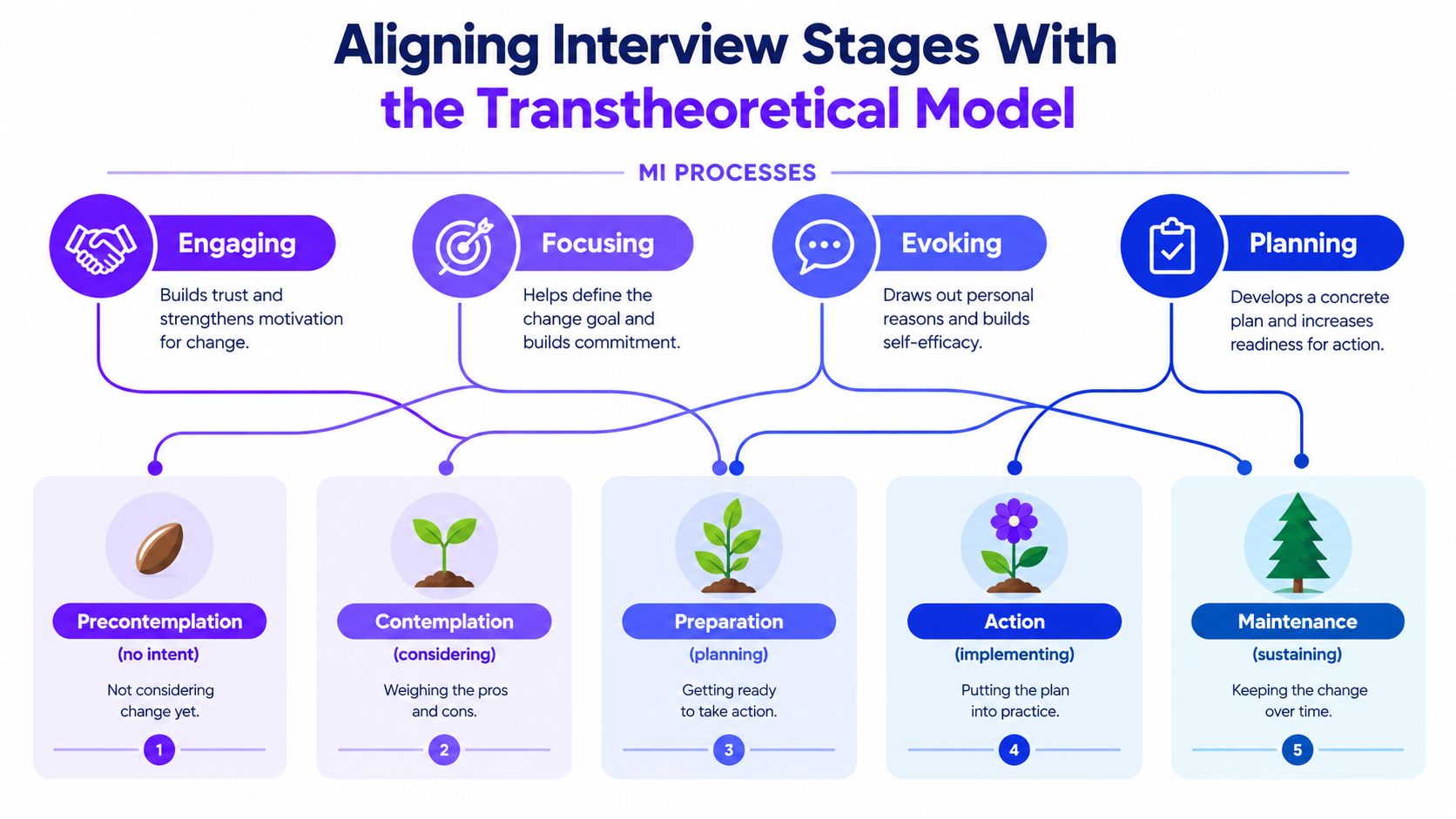
Engaging creates a working relationship
Engaging means more than being polite. The nurse listens for the patient's experience, reflects it accurately, and avoids treating the appointment as a compliance inspection.
The nurse might say, “Taking the medication matters to you, but the schedule falls apart when work becomes unpredictable.” That reflection communicates understanding without approving missed doses. It also gives the patient an opportunity to correct the nurse, which keeps the conversation collaborative.
If the patient is distracted, ashamed, or wary, planning is premature. Engagement may require a brief discussion of privacy, a choice of topics, or permission to talk about barriers before discussing solutions.
Focusing identifies a shared direction
Once the patient feels heard, the nurse asks what deserves attention. “Would it be useful to look at the workday routine, the medication itself, or the concern about side effects?” This question offers structure without claiming ownership of the agenda.
Focusing turns a broad concern into a mutually understood target. The target might be taking medication more consistently, learning about side effects, speaking with the prescriber, or deciding whether the current treatment still fits the patient's priorities. The practitioner shouldn't assume that the most obvious clinical problem is the only topic the patient considers important.
A similar approach helps educators and behavioral health professionals working with attention, organization, or emotional regulation. When a person needs more individualized support, a resource describing individual sessions for ADHD can help clarify what a customized conversation may address, without turning the MI discussion into a generic referral.
Evoking draws out the person's own reasons
Evoking is the point at which the nurse invites the patient to articulate motivation rather than supplying it. Useful questions include:
- Values: “What would taking the medication more consistently make easier in daily life?”
- Experience: “When the routine works, what do you notice?”
- Confidence: “What has helped on the days when the dose wasn't missed?”
- Discrepancy: “How does the current pattern fit with what the patient wants for long-term health?”
Suppose the patient says, “The medication helps me stay well enough to keep working, but I hate feeling controlled by it.” The nurse can reflect both sides: “Being well enough to work matters, and relying on a daily medication feels restrictive.” That response sustains exploration instead of arguing for one side.
Planning translates motivation into a chosen action
Planning belongs after the patient expresses sufficient desire, ability, reason, or need for change. The nurse might ask, “What small adjustment would fit the workday best?” The patient chooses to connect the medication with the first meal, set a discreet reminder, and contact the prescriber about side effects.
A useful plan states what will happen, when it will happen, and what the patient will do if a barrier appears. It should still belong to the patient. If the nurse creates the plan and the patient merely agrees, apparent commitment may conceal low ownership.
The sequence can move backward. If the patient rejects every option, the nurse returns to evoking or engaging rather than pushing harder. For professionals who want to connect MI with screening and brief intervention, Premiere Education's SBIRT guide for nurses offers a related clinical learning resource.
Aligning Interview Stages With the Transtheoretical Model
MI processes describe how the practitioner conducts the conversation. The Transtheoretical Model describes where the person is in readiness for change. Confusing those two frameworks leads to a common error: treating every client as if planning should begin immediately.
The readiness stages are precontemplation, contemplation, preparation, action, and maintenance. Relapse or recycling is treated as a common non-linear return point rather than proof that the person has failed.
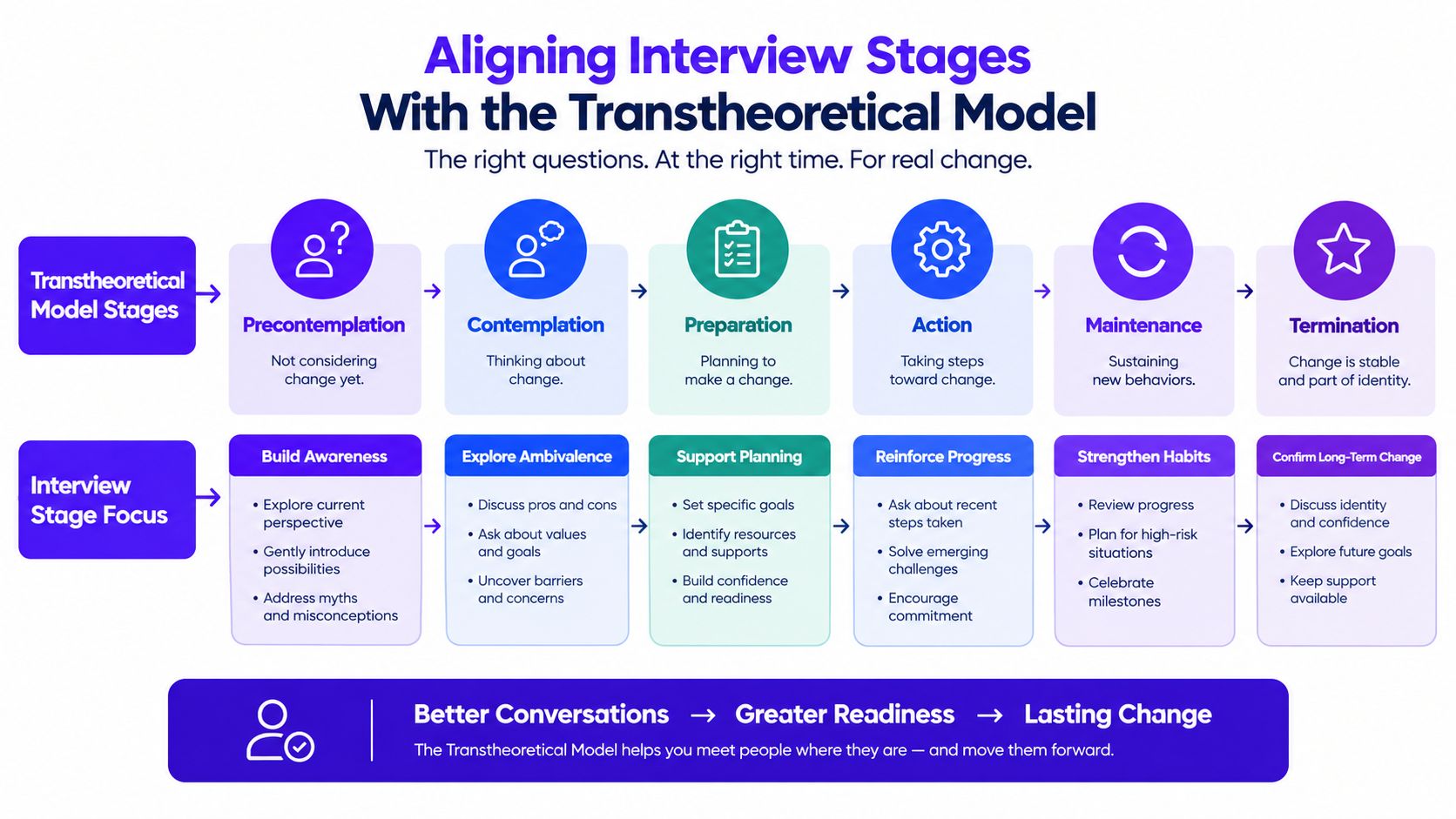
Readiness determines the immediate task
A person in precontemplation isn't considering change or doesn't see the behavior as a concern. The practitioner's priority is awareness and respectful exploration, not a detailed action plan. For example, a patient who says, “Smoking hasn't caused me any problems,” may respond better to “What have you noticed about smoking and breathing during work?” than to a lecture about quitting.
In contemplation, the person recognizes possible benefits but remains ambivalent. The practitioner helps the person examine both sides. “What are the advantages of continuing as things are, and what concerns you about it?” allows the patient to describe the function of the behavior and the costs attached to it.
Preparation calls for practical collaboration. A patient who has begun planning how to handle urges and triggers may be ready to choose an initial action. The clinician can explore options, barriers, support, and confidence without taking control of the plan. This is the stage at which planning becomes more prominent, but engagement remains necessary.
During action, the person is implementing change. The practitioner reinforces effort, reviews what is working, and helps adjust strategies when daily conditions interfere. A patient who has started walking but misses sessions during bad weather may need problem-solving, not renewed persuasion.
In maintenance, the focus shifts toward sustaining the behavior and recognizing warning signs. A setback can become information about triggers and support needs. The person may recycle into contemplation or preparation, and the practitioner can respond without shame.
Practical rule: Match the intervention to the person's readiness, not to the practitioner's urgency.
The four MI processes and five readiness stages therefore overlap rather than align in a one-to-one sequence. Engaging is relevant at every readiness level. Focusing may be needed before a precontemplative client can identify a meaningful concern. Evoking can help a contemplative client develop personal reasons for change, while planning supports a prepared client. Action and maintenance still require evocation because commitment can weaken when stress, symptoms, or environmental barriers return.
The federal SAMHSA guide to motivational interviewing illustrates this progression through a person weighing the benefits and drawbacks of quitting a substance, then planning how to manage urges and triggers before taking action. The clinical lesson is simple: a client who isn't ready for a plan may still be ready for curiosity, reflection, or a small increase in awareness.
Eliciting Change Talk Through Practical Micro-Skills
Change talk consists of the client's own language favoring change. Sustain talk supports the current pattern. The practitioner's task isn't to eliminate sustain talk by force. It is to create a conversation in which change talk can be heard, strengthened, and connected to personally meaningful goals.
A meta-analysis found that therapist MI-consistent skills had a significant correlation with client change talk, r = .26, p < .0001, while the relationship with sustain talk was weaker and not statistically significant, r = .10, p = .09 (HRSA motivational interviewing training resource). These findings support a practical supervision focus: assess what the clinician evokes, not only what information the clinician delivers.
OARS in a real conversation
A patient says, “The diet matters, but cooking after work is impossible.” The practitioner can use OARS without turning the exchange into an interview checklist.
- Open questions: “What makes cooking feel impossible on those evenings?”
- Affirmations: “The patient has already found ways to keep the health goal in mind despite a demanding schedule.”
- Reflective listening: “Convenience is doing important work for the patient right now.”
- Summaries: “The patient wants improved health, relies on quick meals after work, and is willing to consider a change that doesn't require elaborate cooking.”
The summary gathers motivation and barriers in the client's language. It can also reveal whether the practitioner has misunderstood the problem.
A 0–10 readiness ruler makes vague intention more specific. The APA obesity guide recommends asking about importance or confidence and using prompts such as, “What small change might you be willing to make?” and “If you made this change, how might your daily life change?” (APA motivational interviewing guide).
If a patient chooses a low confidence score, the next question shouldn't be “Why isn't it higher?” That wording can sound evaluative. A better question is, “What would move confidence one step higher?” The answer may identify a manageable experiment, a support person, or a clinical issue requiring referral.
A supervision table for conversation quality

A nurse reviewing a difficult encounter can mark which column dominated. The communication skills resource for nursing careers can complement that reflection, especially when teams are building consistent listening and patient education practices.
Adapting Strategies for Mandated and Low-Readiness Clients
MI doesn't require a client to arrive enthusiastic. Healthcare and education professionals often meet people because an institution, clinician, parent, court, school, or employer has required contact. The external pressure may be real, while internal motivation remains uncertain.
A student referred after a conflict might say, “I'm only here because the principal made me come.” The practitioner shouldn't pretend the referral was voluntary. A transparent response preserves autonomy: “Attendance is required, but the student can decide what to discuss and what would make the meeting useful.” That distinction reduces the false choice between coercion and collaboration.
The same principle applies to a patient mandated to attend substance use counseling. The practitioner can explain the limits of confidentiality and reporting, clarify what the patient controls, and ask which part of the situation the patient is willing to examine. The initial goal may be engagement and honest participation, not immediate agreement that a diagnosis or behavior is a problem.

Autonomy can exist inside a system constraint
A mandated client still has choices. The practitioner can offer choices about topic, pace, examples, support people, and next steps. Even a small choice can shift the conversation from passive resistance to active participation.
Useful adaptations include:
- Name the pressure: “The referral came from the school, and that may make this feel imposed.”
- Separate attendance from agreement: “Being here doesn't require agreeing with every concern in the referral.”
- Find a workable focus: “Which part of the situation creates the most difficulty right now?”
- Look for small movement: “What would make the next week slightly easier?”
- Avoid labels as explanations: Ambivalence may reflect fear, competing responsibilities, culture, prior experiences, or limited control, not a lack of character.
The CDC's motivational interviewing material for HIV care highlights practical tools such as change talk, confidence rulers, and collaborative agenda setting. Those tools are particularly useful when readiness is mixed, because they allow the practitioner to work with a small amount of willingness rather than demanding complete commitment.
Supervision question: What choice did the client retain, and what evidence showed that the practitioner listened to the client's priorities?
Low readiness also requires careful documentation. A note can record the client's stated concern, readiness language, agreed focus, offered information, and chosen follow-up without describing hesitation as noncompliance. That record supports continuity and reduces the risk that future clinicians will approach the person with a fixed, deficit-based story.
Avoiding Common Misconceptions in Clinical Practice
MI is often mistaken for gentle advice-giving. A practitioner may use a warm tone, ask one open question, and then spend the rest of the visit explaining what the client must do. The conversation sounds supportive, but the client still has little space to develop personal reasons for change.
Another misconception treats MI as a technique for manipulating compliance. MI respects autonomy precisely because behavior change is more durable when the person can examine choices openly. The practitioner can communicate clinical concerns clearly without pretending that the client has no right to disagree.
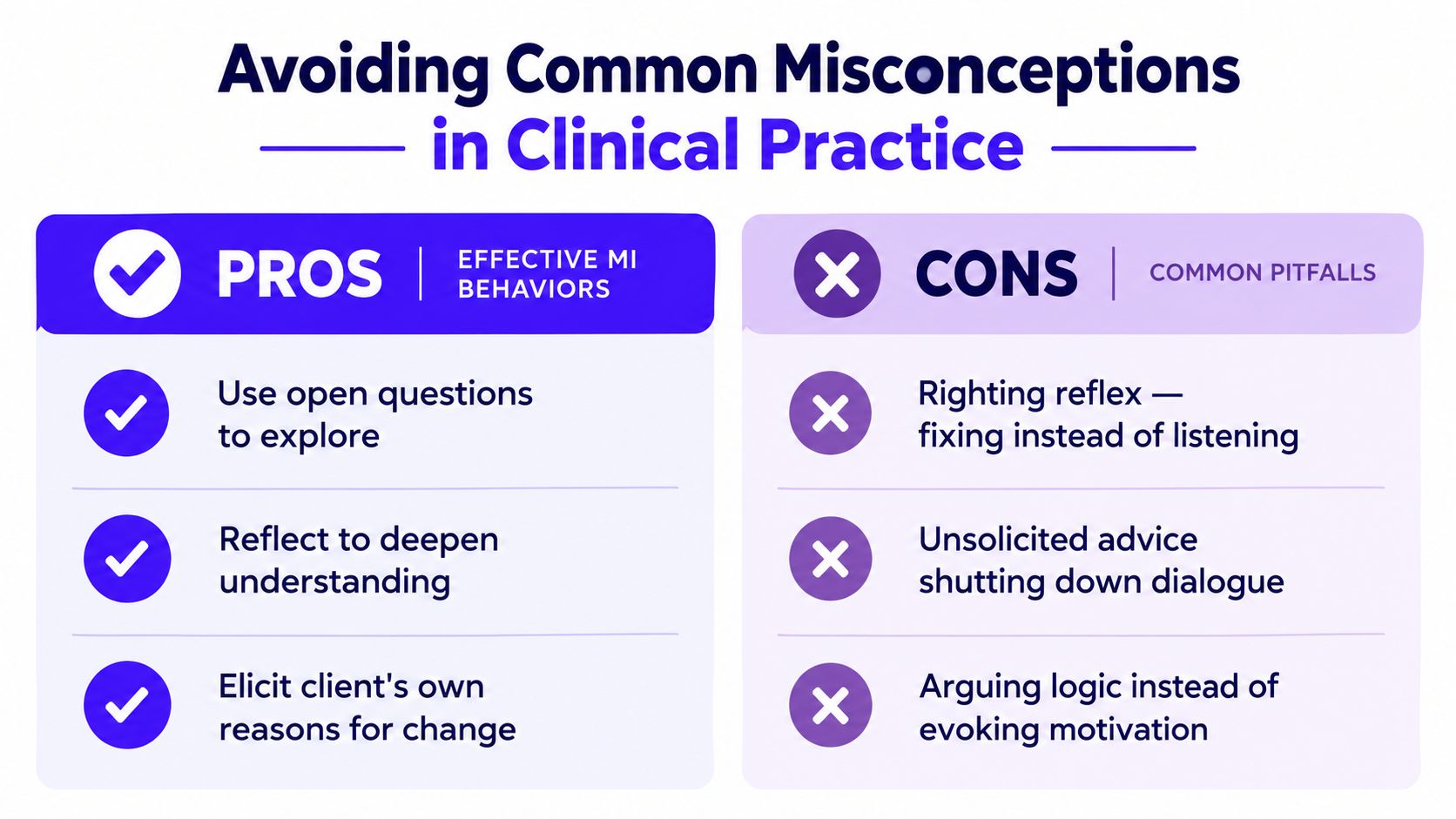
The righting reflex in everyday encounters
The righting reflex appears when a nurse hears a patient describe a risky behavior and feels compelled to correct it immediately. A patient says, “I can't stop using the inhaler incorrectly because the instructions are confusing.” The reflex produces a correction. MI first explores the confusion, asks permission to offer information, and checks how the patient understands it.

MI also isn't passive listening. The practitioner still focuses the agenda, provides expertise when appropriate, identifies safety concerns, and supports planning when the client is ready. The difference lies in how authority is used. Information becomes collaborative when the practitioner asks permission, gives it neutrally, and invites the client's reaction.
A brief encounter might include one question about what matters, one reflection of the client's position, and one invitation to choose a next step. That isn't a full intervention, but it can prevent the conversation from becoming a contest between professional urgency and client resistance.
Integrating Motivational Interviewing Into Daily Practice
Skill with the motivational interviewing stages develops through deliberate practice, observation, and feedback. A single course or workshop can't replace repeated attention to how clinicians open conversations, respond to sustain talk, and decide whether planning is appropriate.
A practical daily checklist can remain brief:
- Engagement: Did the client feel understood before advice was offered?
- Focus: Did the client and practitioner agree on the topic?
- Evocation: Did the client voice a reason, ability, need, or desire for change?
- Planning: Did the client choose a realistic next step?
- Readiness: Did the intervention match the client's current position?
Premiere Education provides online continuing education for healthcare and education professionals, including case-driven learning and tools for tracking and documenting course completion. Its Nurse Licensure Compact Essential InformationAn Ohio Category A Nursing CE Offering addresses the rules, regulations, and continuing education standards that guide nursing practice across state lines under Ohio's participation in the NLC.
Professionals supporting clients with depression may also need referral pathways beyond MI. A clinician seeking a geographically relevant resource can review depression help in Penticton when local counseling support is appropriate.
Behavior change remains non-linear. A missed appointment, return to an old behavior, or refusal to plan can provide information about readiness and barriers. Effective practitioners meet the person at that point, preserve dignity, and choose the next conversational task carefully.
Premiere Education offers online continuing education for healthcare and education professionals, with courses that use practical scenarios to strengthen communication and clinical decision-making. Visit Premiere Education to explore training that can help teams apply motivational interviewing principles with greater consistency in real-world conversations.
Latest Posts





25% off Sitewide→
Use Code: PCECYBERSALE2025→