
.avif)
5 IV Therapy Nurse Training Resources

A nurse finishes an online IV module, downloads the certificate, and still faces the part that determines whether the training is clinically useful. The nurse must demonstrate catheter selection, aseptic technique, vein assessment, infusion monitoring, complication recognition, and documentation under supervision. That gap separates knowledge-based continuing education from real procedural readiness.
The five resources below are complementary, not interchangeable IV therapy qualifications. Some address emergency response, controlled substances, mandated reporting, or disaster preparedness rather than IV insertion itself. Before enrolling, nurses should verify accreditation, state-board acceptance, employer policy, required clinical hours, competency checklists, and CE reporting. The comparison should focus on whether a resource supports workplace readiness, not merely whether it produces a certificate.
1. DEA MATE Controlled Substances Training Package
The DEA MATE Controlled Substances Training Package belongs in an IV therapy learning plan only when the nurse or advanced practice clinician's role includes the relevant prescribing responsibilities. It isn't a peripheral IV insertion course, an infusion pump practicum, or a substitute for observed vascular-access validation. Its value lies in addressing the controlled-substance education requirement described in the catalog, with 10 total hours of self-paced training before the next DEA license application or renewal.
That distinction matters in a clinic where IV therapy includes medications that require careful prescribing, storage, administration, and documentation. A prescriber may understand the mechanics of starting a peripheral line yet still need stronger decision-making around medication selection, patient screening, controlled-substance records, and diversion prevention. A course focused on those responsibilities can complement IV preparation, but it can't establish that a nurse can safely cannulate a patient.
The course is a first-party catalog resource, which makes the publisher's description and completion documentation the starting point for evaluation. Nurses should still confirm whether the learner's license type and role make the training applicable, and whether the certificate contains the information an employer, licensing body, or DEA-related review requires.
What this resource can and cannot verify
A useful implementation example is an outpatient infusion practice where one clinician assesses the patient, another nurse establishes access, and the prescriber authorizes a medication. The controlled-substance course may support the prescriber's education record, while the nurse's file still needs an IV-specific course record, supervised clinical evaluation, and unit-level sign-off.
Nurses comparing this resource with IV therapy nurse training should inspect the documentation fields rather than treating every certificate as equivalent:
- Course identity: Confirm that the certificate names the controlled-substance program and learner.
- Completion record: Retain the completion date and training details for renewal or audit files.
- Role alignment: Verify that the education applies to the clinician's prescribing responsibilities.
- Clinical separation: Keep it separate from the checklist used to validate catheter insertion, infusion setup, site assessment, and complication response.
The publisher also maintains an article on whether DEA MATE Act CME can be completed online, which can help a learner frame questions about online completion and documentation. The practical limitation remains clear: no amount of controlled-substance education demonstrates aseptic insertion or supervised infusion management.
Practical rule: Treat controlled-substance education as a compliance layer around IV practice, never as proof of IV procedural competence.
2. Basic Life Support Certification Training
A patient receiving an infusion can deteriorate quickly, whether the cause is an adverse reaction, a medication problem, a vasovagal episode, or an unrelated emergency. Basic Life Support Certification Training addresses the emergency foundation nurses need through CPR, AED use, and rescue techniques. The catalog also describes updates incorporating COVID-19 guidance, so learners should review the current course details and certificate language before enrolling.
BLS supports IV readiness indirectly. During a practical scenario, a nurse might notice that a patient becomes unresponsive shortly after an infusion begins. The nurse must recognize the emergency, activate the response system, begin appropriate resuscitation actions, use available equipment, and communicate the infusion details to the responding team. BLS can strengthen that response framework, but it doesn't validate catheter choice, vein assessment, medication compatibility, pump programming, or infiltration management.
Separate emergency credentials from infusion sign-off
BLS is strongest when the employer treats it as one component of a broader competency pathway. A new outpatient infusion nurse might complete BLS education, review emergency protocols, participate in a facility simulation, and then undergo direct observation for peripheral access and infusion monitoring. That sequence connects emergency readiness to the actual workflow without confusing one credential with another.
The distinction becomes especially important for online education. A digital module can explain recognition and response concepts, but the employer should confirm whether the certification includes the required skills demonstration and whether that demonstration meets workplace policy. Nurses should ask who evaluates performance, what equipment is used, how the result is recorded, and when the credential must be renewed.
The publisher's resource on Basic Life Support guidelines and best practices for nurses provides related educational context. For IV therapy nurse training, the practical test is whether the nurse can connect a deteriorating-patient response to the infusion record: solution or medication, start time, rate, access site, symptoms, actions taken, and escalation.
- Strong fit: Emergency-response preparation for nurses who administer infusions.
- Weak fit: Independent proof of peripheral IV insertion competence.
- Required companion evidence: Employer-approved observation, skills validation, and documentation review.
3. Bioterrorism Training A Deep-Dive into Healthcare Response
Some training needs sit outside routine cannulation but still affect how healthcare teams protect patients and staff. Bioterrorism Training A Deep-Dive into Healthcare Response is described as a 4-hour course for meeting Nevada's bioterrorism training requirement. Its subject matter includes identifying weapons of mass destruction, recognizing signs of exposure, and applying protective measures in healthcare settings.
That content has a different purpose from IV therapy nurse training. A nurse working in an emergency department, urgent-care clinic, or community setting may need to recognize an unusual exposure pattern, use protective measures, preserve safety, and notify the appropriate response chain. During a high-consequence event, infusion decisions still matter, but the first priority may be isolation, personal protective equipment, communication, and coordinated emergency operations.
A practical example is a patient who arrives with unexplained symptoms and a history that raises concern about exposure. The nurse shouldn't treat the case as an ordinary infusion appointment because vascular access may be needed. The response requires following facility protocols, limiting exposure, documenting observations, and coordinating with trained responders. A bioterrorism course can support that situational awareness, while an IV competency evaluation addresses the separate technical procedure.
Evaluate relevance without overstating the credential
The course's stated duration makes it easy for an organization to assign and track, especially when a Nevada requirement applies. Managers should preserve the completion record alongside other mandatory education, but they shouldn't place it in the same competency category as an observed peripheral IV assessment.
A sound training matrix would list separate domains:
- Emergency preparedness: Exposure recognition, protective measures, and escalation.
- Infusion procedure: Patient identification, vein assessment, catheter selection, aseptic technique, and securement.
- Infusion monitoring: Site checks, pump observation, reaction recognition, and timely intervention.
- Documentation: Procedure details, patient response, complications, notifications, and follow-up.
The resource is therefore a complement, not a substitute. It may help a nurse operate safely during unusual events, but it won't establish that the nurse can perform IV access independently. Organizations should also confirm that the course's Nevada-specific purpose matches the learner's location and role before assigning it as a compliance requirement.
4. Pediatric Advanced Life Support Certification Training
Pediatric infusion work raises the consequence of every assessment and response decision. Pediatric Advanced Life Support Certification Training is intended for healthcare professionals who need pediatric emergency skills and high standards of patient care. It belongs in the learning plan for nurses who care for children, particularly when IV therapy occurs in settings where rapid deterioration requires coordinated pediatric response.
PALS should be judged by what the certification requires beyond reading content. A nurse comparing programs should verify whether the course includes a practical skills component, what type of evaluation is performed, and how the resulting credential is documented. Those questions matter because pediatric emergency preparation and IV procedural readiness overlap in practice but remain distinct competencies.
Consider a child who develops respiratory distress during an infusion. The nurse must assess the patient, identify deterioration, call for help, support the emergency response, and provide accurate information about the infusion and observed changes. PALS can support that broader response. It doesn't, by itself, demonstrate that the nurse selected an appropriate pediatric catheter, maintained asepsis, secured the access safely, or documented the infusion correctly.
Match pediatric education to the actual assignment
A pediatric clinic might combine PALS certification with a supervised IV skills pathway. The nurse could first complete knowledge-based education, then practice equipment handling in a simulation lab, and finally demonstrate access and monitoring under an evaluator approved by the employer. The evaluator's record should identify the exact skills observed rather than stating that the nurse completed PALS.
Simulation has a defensible role. A systematic review and meta-analysis found a modest but significant improvement in overall vascular-access success compared with traditional training, with a risk ratio of 1.08 and a 95% confidence interval from 1.03 to 1.13 across 6 randomized trials involving 840 participants (systematic review and meta-analysis). That evidence supports simulation as a practical training method, but it doesn't erase the need for local policy, supervision, and competency documentation.
The publisher's guide on what to expect from pediatric advanced life support certification can help learners prepare for the certification process. For IV practice, the final sign-off should still cover pediatric assessment, access technique, infusion monitoring, complication recognition, and documentation expectations.
Pediatric emergency certification prepares the nurse to respond to deterioration. It doesn't authorize a procedure that the nurse's license, state law, or employer policy does not permit.
5. New York Child Abuse Identification & Reporting Training
The New York Child Abuse Identification & Reporting Training serves a mandatory-reporting purpose, not an infusion purpose. The course description addresses recognition and reporting duties while adding education on trauma, bias, adverse childhood experiences, and disabilities. The catalog states that professionals should complete the latest mandated reporter requirement by November 17, 2026, so New York learners should verify the current rule and their own reporting status before relying on the course for compliance.
Its relevance to IV therapy nurse training appears in the patient-care environment. A nurse may notice unexplained injuries, fearful behavior, inconsistent caregiver explanations, or other concerns during an infusion visit. The nurse must follow New York reporting requirements and employer procedures while continuing to provide safe clinical care. The ability to identify and report suspected abuse has no connection to whether the nurse can insert a peripheral catheter, monitor an infusion, or manage an infiltration.
Keep mandated training visible in the competency record
A school-based health program or pediatric outpatient clinic may assign this course to every eligible professional, then track completion through an organizational dashboard. The manager should store the certificate with other mandated education and maintain a separate IV competency file for nurses who perform vascular access. Combining the records into one undifferentiated “clinical training” category creates audit confusion.
A useful file structure separates:
- State-mandated education: Course title, learner identity, completion record, and applicable deadline.
- Professional CE: Accreditation details, contact information, and agency reporting where applicable.
- IV procedure validation: Observed catheter insertion, aseptic technique, monitoring, complication response, and evaluator sign-off.
- Employer authorization: Unit policy, role assignment, supervision requirements, and reassessment schedule.
New York provides a strong example of why jurisdiction matters. State guidance says LPNs who provide IV therapy in hospitals, nursing homes, diagnostic and treatment centers, ambulatory surgery centers, dialysis facilities, home care agencies, and hospice programs must complete IV training with supervised clinical experiences and competency assessments, followed by additional IV training at least annually. The same guidance recommends IV therapy training for all LPNs before they provide IV therapy, regardless of practice setting (New York State guidance on LPN IV therapy).
That model treats competence as recurring and documented. The child-abuse course may satisfy a separate state obligation, but it can't replace the annual IV refresher, supervised experience, or competency assessment required for the applicable LPN role.
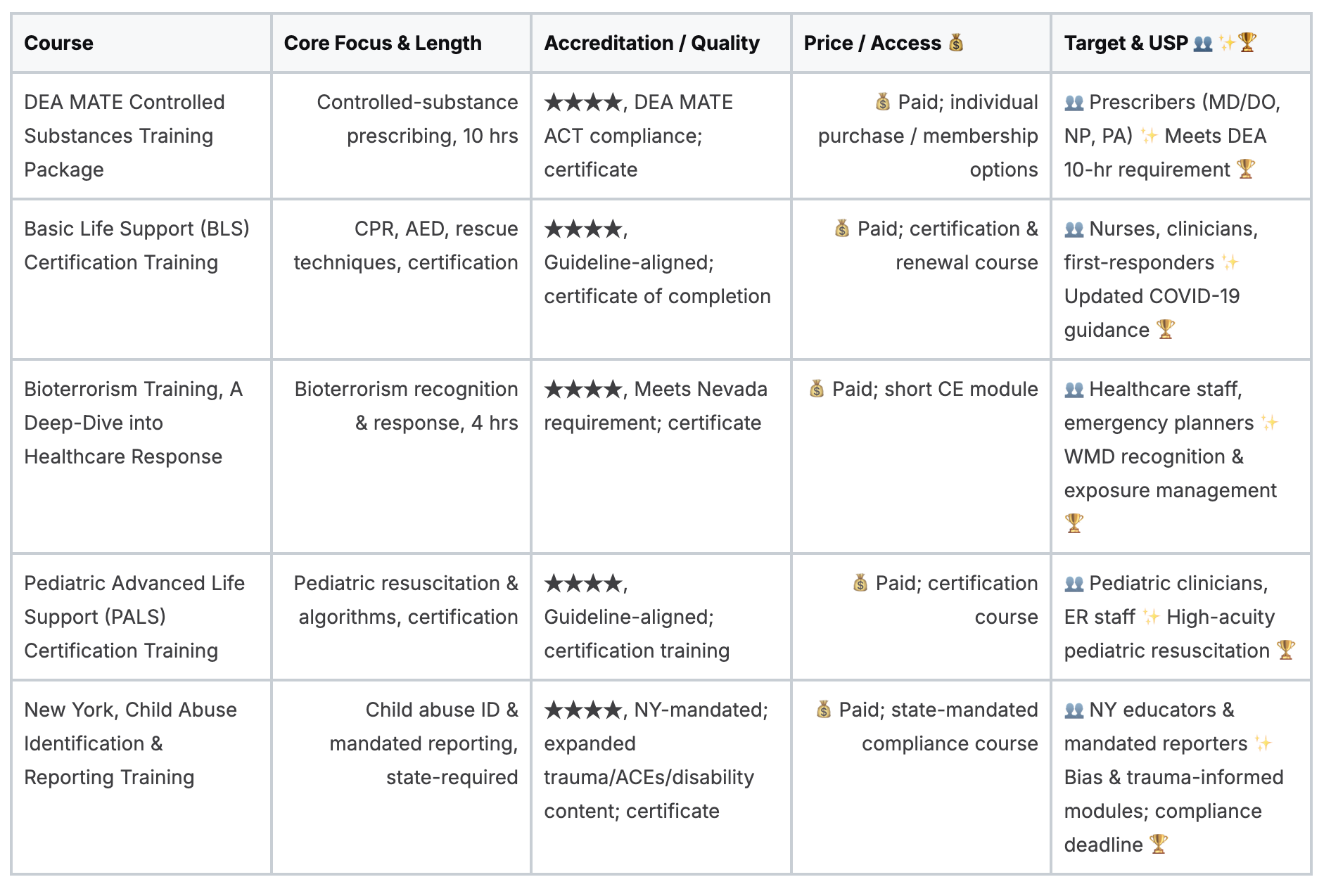
5-Course Comparison for IV Therapy Nurse Training
Build a Verifiable IV Therapy Learning Path
A course list becomes useful only after it is converted into an implementation plan. The first step is to identify the nurse's state, license type, practice setting, and employer policy. Requirements can differ sharply by role and jurisdiction. Florida requires an LPN or graduate practical nurse to complete a post-graduation IV therapy course of at least 30 hours before administering IV therapy, with supervised clinical practice (Florida IV therapy rule). Kansas requires an LPN IV fluid therapy course to include at least 30 hours of instruction and at least 8 hours of supervised clinical practice, including successful peripheral venous access and initiation of an IV infusion treatment modality on an individual (Kansas Board of Nursing rule).
Those rules show why an online certificate can't automatically authorize independent practice. A nurse may complete the theory remotely, then need a supervised skills lab, direct patient practice, or employer evaluation before performing the procedure. New Zealand guidance likewise states that the nurse must hold registered-nurse status with a current practising certificate and complete appropriate education before attempting IV access.
Build documentation around observed performance
A defensible pathway should include:
- Knowledge education: Choose accredited CE that addresses the identified gap, such as fluid therapy, pharmacology, infection prevention, assessment, or documentation.
- Supervised practice: Schedule observed insertion and infusion procedures with an evaluator authorized by the employer or applicable policy.
- Competency checklist: Record catheter selection, vein assessment, aseptic technique, securement, monitoring, complication recognition, and escalation.
- Retention plan: Set recurring refreshers and reassessment instead of treating the initial course as permanent proof.
- Audit file: Retain certificates, evaluation records, CE reporting confirmations, and employer authorization.
Published nursing standards describe IV competence as something that must be validated rather than assumed, and a competency-based evaluation tool was developed to support orientation and evaluation against IV nursing standards (competency-based IV evaluation research). Evidence also points to the maintenance problem. A 2024 study associated IV fluid therapy knowledge with in-service training, educational level, and training institution, while a 2024 review identified an urgent need for continuous refresher programs. A 2025 study linked the absence of IV specialist certification and non-participation in accredited IV training with lower IV core competency (review and related evidence).
BLS, PALS, mandated-reporting, bioterrorism, and controlled-substance education can strengthen the surrounding practice environment. None should be presented as substitutes for IV-specific hands-on validation.
Premiere Education offers accredited nursing CE, self-paced access, certificates, agency reporting where applicable, and organizational tracking tools. Those capabilities fit learners and managers who need documented education alongside a separately supervised IV skills process, especially when assignment, completion monitoring, and audit-ready records matter.
Premiere Education provides accredited healthcare CE and certification courses that can complement an IV therapy nurse training pathway, including emergency, state-mandated, and specialty education. Visit Premiere Education to review self-paced courses, certificates, reporting options, and organizational tracking tools that match the learner's documentation needs.
Latest Posts





25% off Sitewide→
Use Code: PCECYBERSALE2025→