
.avif)
What Getting CE Certification Really Means for Your License

A renewal deadline is approaching, but the certificate folder is a mess. One course was completed on a mobile phone, another came from a live webinar, and a third certificate shows a completion date without the approval details the licensing board may request. The courses may have been useful, yet usefulness alone doesn't prove that the hours count.
Learning how to get CE certification means treating continuing education as a compliance record, not a casual course purchase. The right activity must match the profession, jurisdiction, renewal cycle, approved subject categories, and documentation rules. Completion, assessment, and retrievable evidence all matter.
What Getting CE Certification Really Means for Your License
A nurse practitioner approaching renewal can discover that “finish some education” is not a sufficient plan. ANCC renewal rules require a Nurse Practitioner or Clinical Nurse Specialist certificant to complete 75 continuing education contact hours, including 25 pharmacology hours, with at least 60 hours formally approved through recognized pathways. The ANCC renewal information summarized for nurses shows why an approved credit hour differs from informal reading, an employer meeting, or a conference session that lacks recognized credit.
Continuing education has long been connected with professional authorization. The National Center for Biotechnology Information notes that, since the early 1970s, health professionals' continuing education has been tied to licensure, certification, and credentialing. Licensing boards require approved learning and verifiable records so they can confirm relevant competence during the renewal period.
Teachers can face a different mandate. A school employee may need a state-required topic course, while a nurse may need pharmacology, specialty-relevant education, or board-approved contact hours. Completing a course and earning credit recognized by the governing authority are separate steps.
Practical rule: A course counts only when its provider, content, timing, credit type, and completion evidence fit the governing requirement.
What an auditor actually checks
An auditor needs a traceable record connecting the learner with the activity. The file may need the learner's name, course title, approval information, completion date, hours, assessment evidence, and certificate or transcript. Missing approval details or an unclear completion date can weaken an otherwise legitimate record.
Repeated coursework can also create a compliance problem. Under the ANCC framework, repeated courses do not count twice, and the education must match the full scope of the credential and specialty. Keep the original certificate, course description, approval details, and assessment record together rather than relying on a provider portal that may later change.
Course attendance is an event. CE certification is a documented, approved result that supports renewal or credentialing.
How to Identify Your Exact CE Requirements Before You Enroll
A nurse can finish a polished pharmacology course and still discover during renewal that it missed the board's approved provider route. A teacher may complete general professional development while the state requires a named safety topic. These failures usually come from enrolling before checking the exact license, jurisdiction, and renewal cycle.
Start with the governing authority
Open the current renewal page, regulation, or credential handbook for the specific credential. Record these details before paying for coursework:
- Renewal cycle: Write down the opening and closing dates. An otherwise suitable activity may fall outside the accepted period.
- Total credit requirement: Confirm whether the authority uses contact hours, continuing education units, clock hours, or another term.
- Required categories: Check for pharmacology, ethics, infection control, child safety, controlled substances, or other mandated topics.
- Approval route: Verify whether the board accepts national accreditation, state approval, individual activity approval, or a particular provider type.
- Evidence rules: Find out whether you must retain certificates, transcripts, evaluations, assessments, direct-reporting records, or original documents.
Read the wording closely. “Relevant to practice” does not automatically include every professional development course. A nursing board may require specialty alignment, while a counseling board may separate general education from ethics or clinical supervision. A teacher's state mandate may specify both a topic and a delivery standard.
Decode the category before buying
Counting total hours first is a common renewal mistake. A professional can have enough education overall and still lack one required category. Under the ANCC example, category rules sit inside the broader renewal requirement, with pharmacology treated as a distinct part of the record, as discussed in licensure-linked continuing education guidance.
Requirements can also differ within one credentialing system. CompTIA requires CEUs within a three-year cycle and states that at least 50% of course content must relate to the certification's objectives. The same document states that CDCES renewal requires two ADA Standards of Care CE activities during the cycle. These examples show why a total-credit check cannot replace a category-by-category review.
A prescriber reviewing a controlled-substances mandate should confirm the exact topic, provider route, credit amount, and timing. The DEA MATE Controlled Substances Training Package is described as 10 total hours of training for the DEA's controlled substance prescribing continuing education requirement before a DEA license application or renewal. Compare that description with the prescriber's own obligations before enrollment.
Keep a short eligibility note with the credential, jurisdiction, cycle dates, required categories, accepted provider type, and evidence needed. That record gives you a written basis for the purchase and helps prevent education that cannot be applied at renewal.
How to Find Accredited Providers and Choose Courses That Count
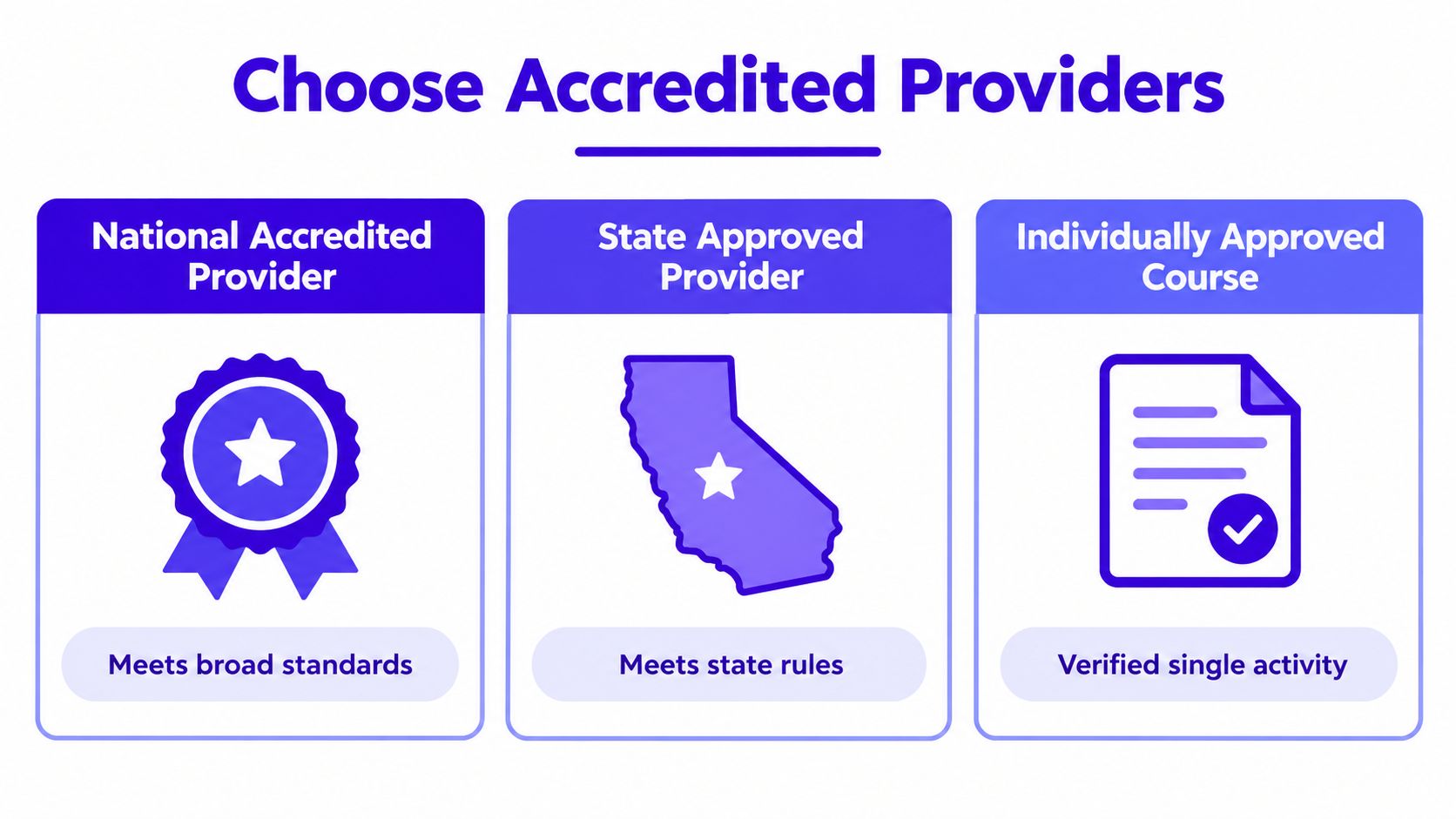
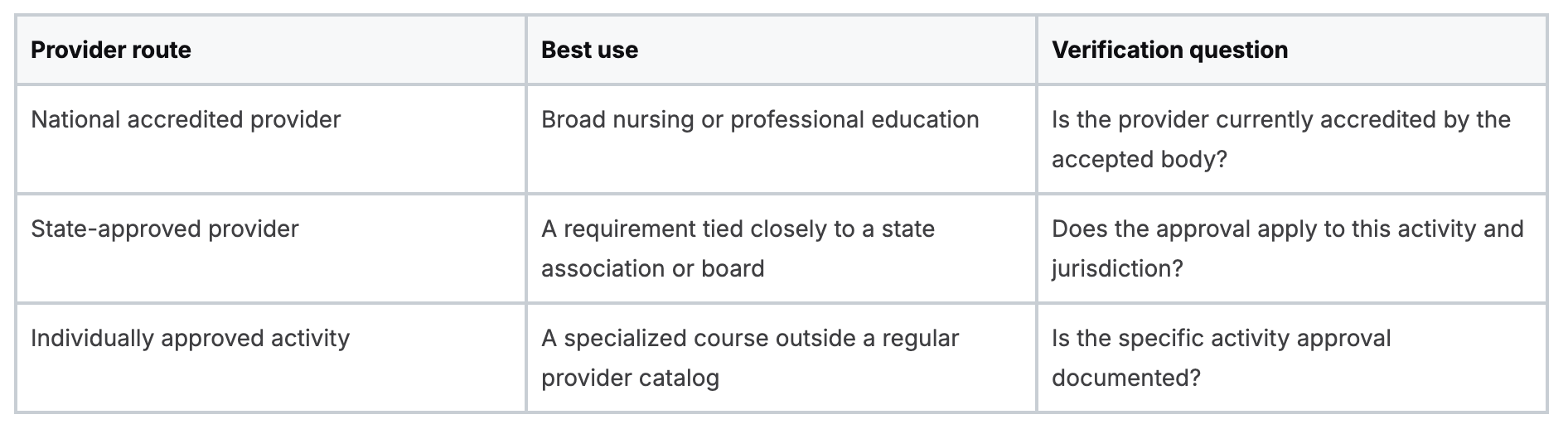
A nurse may finish a polished online course and still discover during renewal that the credit does not qualify. The problem is often the provider route, approval scope, or missing evidence, not the learner's effort. Accreditation reflects how an organization plans education, manages independence, evaluates learning, and maintains records. State-approved activities and individually approved courses may follow different acceptance rules than nationally accredited activities.
For nursing education, ANCC describes three routes: an organization can become an Accredited Provider, become an Approved Provider through a constituent or state nursing association, or submit an individual activity through an Accredited Approver (ANCC accreditation FAQs). Use the route that matches the governing board or credentialing body.
Compare the course with the mandate
A New York school employee completing Dignity for All Students Act training needs that required subject, not an unrelated clinical certification. A nurse renewing ACLS should confirm whether the employer, certifying organization, or licensing board requires the credential and whether the course produces the evidence that body accepts.
Review the course page for its target audience, learning objectives, credit type, approval information, assessment method, and certificate process. A title such as “Ethics” does not prove that the activity satisfies an ethics category. It may cover general workplace conduct without recognized approval.
Provider catalog mappings can narrow the search, but the learner remains responsible for checking the governing rule. The Premiere Education accreditations page offers a reference point for comparing accreditation information. The relevant board or certifying organization has final authority.
Trust a course only when its approval and completion evidence can be traced.
ANCC's provider pathway also illustrates the documentation behind approval. An organization applying for accreditation must implement the criteria for 6 months and plan, implement, and evaluate at least 3 professional development or education activities under the required standards. Look for comparable signs of control, including clear objectives, qualified faculty, independent planning, evaluation, and reliable recordkeeping. These details reduce the risk of paying for education that cannot withstand a renewal review.
How to Complete Coursework and Earn Your CE Credits
A nurse finishes an infection-control module after a shift, pauses it, and returns later. The course is not complete until every required lesson, assessment, and evaluation is finished. Enrollment alone does not create a usable credit record. Completion must follow the provider's rules, and the resulting evidence must be accurate.
A standards-based CE activity should state its learning objective, intended audience, workload, trainer qualifications, delivery method, and recordkeeping process. One North American CE accreditation framework assigns one CE credit for one hour of training and often recognizes an accredited unit of 0.5 credits, or 30 minutes. The rule that applies to a particular renewal still depends on the profession, jurisdiction, and provider.

Three completion situations
Self-paced module: Confirm that the platform records progress through each required lesson. A partial viewing session does not establish completion. Finish the evaluation, quiz, or other required activity before relying on the course for renewal.
Live webinar: Providers may verify attendance through registration, login, participation, and departure records. Complete any required post-session evaluation or quiz before expecting a certificate. A login record alone may not satisfy the provider's completion conditions.
Exam-based certificate: Certificate programs can require a final assessment in addition to attendance and evaluation steps. One professional CE certificate program requires a 75% or higher final assessment score and 75% attendance with evaluation completion where applicable.
Keep the objective, activity, and evidence aligned. If a course says learners will identify a reporting obligation, its materials and assessment should test that ability. Thin content, unrelated questions, or an inaccurate completion record can lead to denial or rework during a renewal review.
Coursework choices should receive the same scrutiny, whether the learner is completing a nursing activity, a teacher renewal course. Confirm the credential's purpose and recognition, complete every stated requirement, and retain the evidence produced by the system. That discipline helps distinguish a credit that merely appears on a dashboard from one that can withstand a state-specific review.
How to Document Submit and Store CE Records for Audits
An audit file must show more than a certificate. It should connect the learner, activity, approval route, completion date, credit amount, required category, and any required assessment or evaluation evidence.
Build the file as completion happens
Create one digital folder for each renewal cycle, then use subfolders for nursing, teaching, counseling, or other credentials. Name files with the learner's name, course title, completion date, and credit type. Keep the original certificate beside a transcript export, and use a tracking sheet to identify whether each activity meets a mandatory category.
Save these records immediately:
- Certificate: Check the name, activity title, completion date, hours, and approval information.
- Transcript: Retain a provider transcript or reporting confirmation when available.
- Assessment evidence: Keep proof of any required quiz or final assessment.
- Evaluation record: Save evidence of a required course evaluation.
- Approval details: Preserve the provider's accreditation or activity approval information.
- Requirement mapping: Record the board category or mandate the activity fulfills.
The certificate support guidance can help locate missing completion documentation. It does not replace the original record. Correct an incorrect name or date before submitting renewal materials.
Treat retention as a jurisdictional rule
Storage periods and audit response deadlines depend on the governing authority. Oregon rules allow 30 days to submit evidence after an audit notice (Oregon continuing education audit rule). California dental hygiene rules require certificates to be retained for 6 years, while Texas pharmacists may be asked for certificates covering all reported CE hours during a specified period. Use the strictest applicable requirement when setting the retention plan.
ANCC activity records must remain retrievable and accessible to authorized personnel for 6 years, as noted in its accreditation guidance. For an individual, an encrypted cloud copy plus a local backup reduces the risk of losing proof. A clinic or school should assign an administrator to control access, preserve exports, and test retrieval before an audit request arrives.
Audit habit: Open a stored record before the renewal deadline. Confirm that it can be found, read, and matched to the correct license. A file that fails any of those checks is weak evidence.
Staying Certified With Smart Renewal Habits and Next Steps
Renewal is easier to manage as a scheduled maintenance process. At the start of each cycle, record the license dates, confirm current board rules, and divide required categories into realistic learning targets before buying courses. State requirements can change, so a course accepted previously may fail a new topic mandate, relevance threshold, or reporting rule.
Use a tracker that lists the credential, jurisdiction, cycle dates, required categories, completed hours, pending assessments, certificate location, and submission status. Shift workers may need mobile access and pause-and-resume coursework. Managers can assign learning, monitor completion, and export records to find missing documentation before an audit.
Review requirements after a credential change and before final submission. Check that each certificate shows the correct name, date, provider, course details, and applicable category. Correct errors while the provider can still update the record.
The strongest routine is simple: check first, complete deliberately, and store immediately. Keep an encrypted cloud copy and a local backup, then test retrieval before renewal. A file that cannot be found, read, or matched to the correct license is weak evidence.
Premiere Education offers accredited continuing education, state-specific course mappings, certificates of completion, reporting where applicable, and group tools for assigning and tracking staff learning. Review options through Premiere Education, select courses that match the license, and build the records before an audit notice arrives.
Latest Posts





25% off Sitewide→
Use Code: PCECYBERSALE2025→