Courses for Nurses: 5 Accredited Options

A Florida nurse opens her renewal records three weeks before the deadline. Her certificates show completed learning, but the topics don't match the requirements she still needs. An interesting clinical course hasn't filled a state-specific category, and another certificate needs closer review before she can count it.
That's the renewal problem worth solving first. The right courses for nurses must match the license, required topic, credit type, and renewal cycle, not just the nurse's interests. Premiere Education's nursing continuing education is ANCC-accredited, but accreditation and state-topic acceptance still need to be matched separately.
Professional development also differs across professions.
The following options address distinct situations: Texas sexual assault response, Florida legal education, workplace impairment, adult ADHD care, and adolescent substance use. Each belongs in a different place on a renewal or workplace training plan.
1. Sexual Assault Forensic Evidence Collection: Victim Centered Techniques for Clinicians
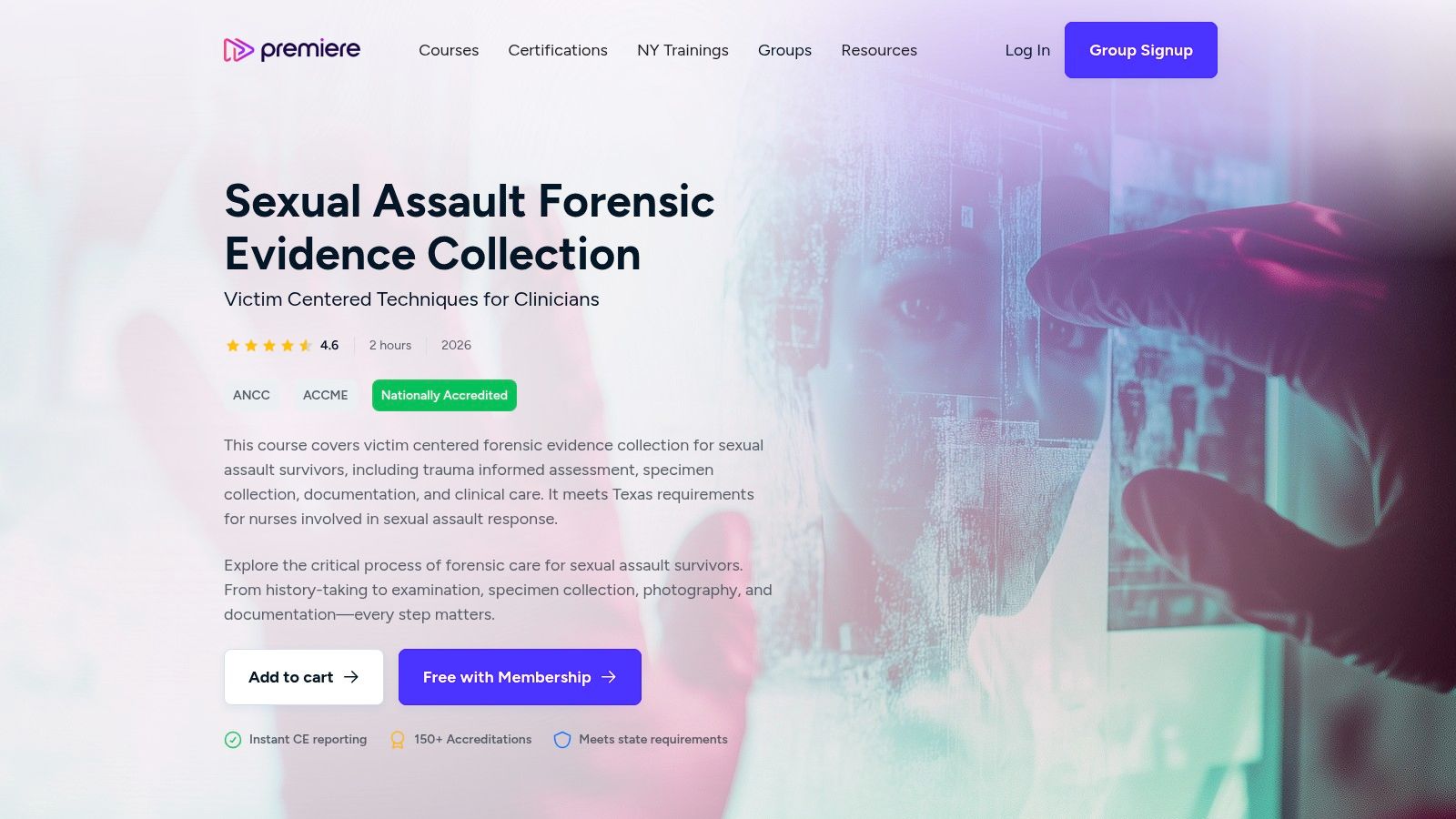
Best for a Texas nurse whose responsibilities include sexual assault response. This course covers victim-centered forensic evidence collection, including trauma-informed assessment, specimen collection, documentation, and clinical care. It meets Texas requirements for nurses involved in sexual assault response.
The practical value is the connection between patient care and evidence handling. A nurse may need to explain an examination, respond to a survivor's hesitation, document findings objectively, and follow specimen-handling procedures during the same encounter. Treating those tasks as separate subjects can leave gaps at the bedside.
Where this training fits in practice
Say an emergency department nurse receives a patient reporting sexual assault. The immediate task isn't collecting a kit. The nurse must establish clinical priorities, explain the process without pressure, and follow the facility's consent and escalation procedures.
A useful application exercise would follow the encounter from arrival through handoff:
- Assessment: Identify immediate care needs while avoiding unnecessary repetition of the patient's account.
- Collection: Follow the applicable evidence-kit instructions and facility procedures rather than improvising.
- Documentation: Separate the patient's statements, observed findings, and actions taken.
- Handoff: Confirm who receives specimens and how the transfer is recorded.
The companion article on a victim-centered approach to the sexual assault investigation process offers related reading. It belongs alongside clinical procedures, not in place of them.
The trade-off is knowledge versus demonstrated competence
A topic-specific CE course isn't the same as an employer's clinical authorization or a specialist credential. A nurse newly assigned to forensic responsibilities should pair coursework with supervised skills validation and the organization's response pathway.
Practice boundary: A completion certificate documents education. It doesn't independently establish readiness to perform every procedure discussed.
Communication deserves equal attention. For families seeking broader background, a trauma informed recovery guide for families can support understanding, but it isn't a forensic nursing protocol.
This option is a strong match when the nurse needs the stated Texas sexual assault response education. It's a less direct choice for someone trying to resolve Florida legal-topic requirements or build general behavioral-health knowledge.
2. Florida Rule and Law for Nurses
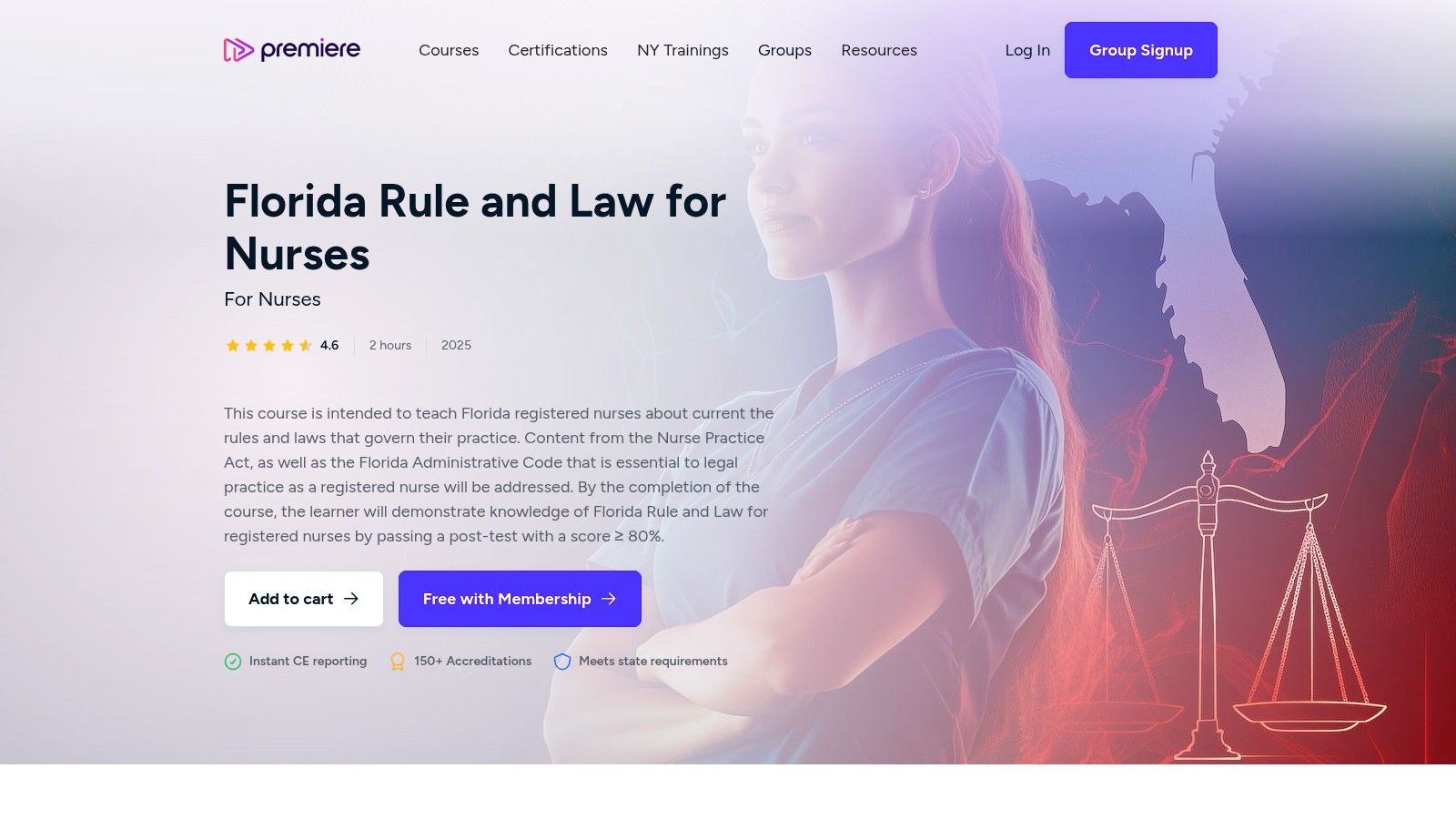
A Florida nurse with a rules-and-law gap needs a state-focused option, not another general clinical elective. This is the relevant course to review when the renewal record identifies that topic. Before enrollment, the nurse should match its current course details to the applicable Florida license and renewal category.
The distinction matters because accredited credit and required-topic credit aren't interchangeable concepts. An adult assessment course may be useful clinical education without addressing a Florida legal requirement. Likewise, workplace orientation shouldn't automatically be treated as board-accepted continuing education.
The NCSBN Model Rules describe continuing education as a possible method of demonstrating continued competence while leaving applicable requirements to individual jurisdictions. Model rules are a policy reference, not a replacement for the governing state board's rules.
Match the requirement before starting the course
For the nurse approaching renewal, the practical tool is a simple worksheet with separate fields for the required topic, selected course, credit designation, completion status, and certificate location. A course belongs in a required category only after that match is clear.
Premiere Education provides nursing continuing education requirements by state.
- License match: Confirm whether the requirement applies to the nurse's particular license.
- Topic match: Use the course's stated category rather than assuming the title settles acceptance.
- Record match: Keep the certificate under the same identifying information used for renewal.
Keep legal education connected to everyday decisions
A practical study example is a nurse asked to accept an unfamiliar assignment. The useful learning outcome isn't memorizing a legal phrase. It's recognizing when to pause, identify the applicable rule or policy, and escalate through the proper channel.
This option is more directly relevant to a Florida legal-topic gap than the ADHD or adolescent substance-use courses. Its limitation is equally important: legal education doesn't replace clinical competency training, and it shouldn't be assumed to satisfy a separate impairment requirement.
A nurse handling licenses in different jurisdictions should maintain separate requirement lists. Combining every certificate into a single total makes it harder to see whether the necessary state-specific categories are complete.
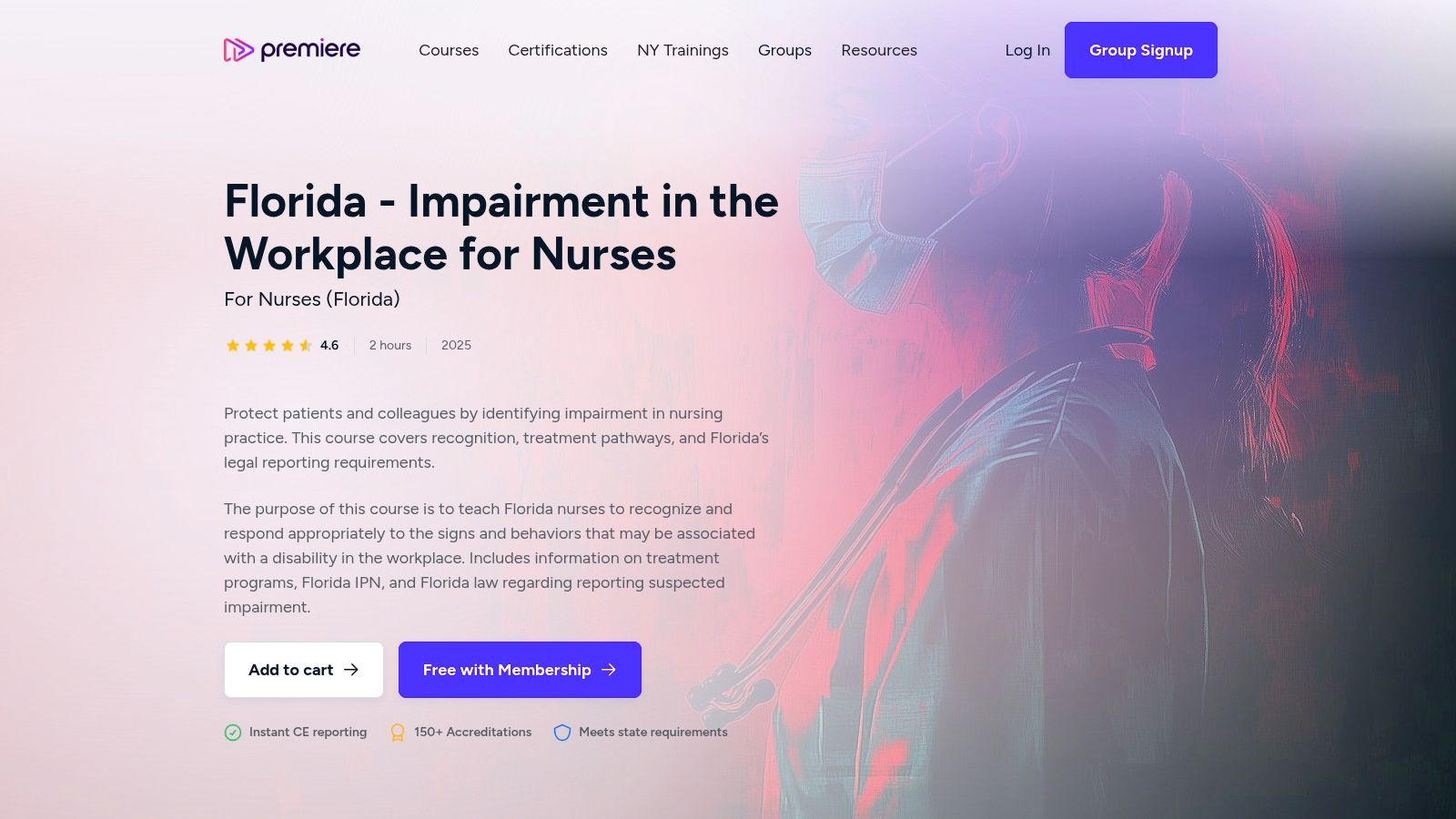
3. Florida - Impairment in the Workplace for Nurses
A charge nurse notices behavior that raises concern about a colleague's ability to practice safely. The immediate problem is patient protection and appropriate escalation, not diagnosing the colleague or settling the matter through informal conversation.
This course addresses recognition of impairment in nursing practice, treatment pathways, and Florida's legal reporting requirements. Its practical focus distinguishes it from a general rules-and-law course. It connects a workplace safety concern with the reporting and support decisions that follow.
Use observations rather than labels
Consider a handoff during which a nurse repeatedly loses track of essential information and appears unable to complete assigned tasks safely. The appropriate learning exercise is to identify objective observations, activate the organization's safety process, and determine who must take responsibility for the next action.
Documentation should describe behavior and circumstances, not unsupported conclusions. A record of specific observed actions is more useful than a label such as impaired without supporting detail.
Patient protection and a colleague's access to help shouldn't be treated as opposing goals. The response needs a clear safety pathway and an appropriate reporting pathway.
The course's treatment-pathway component is important here. Education that stops at recognition leaves nurses without a clear understanding of what happens after a concern is raised.
Evaluate whether learning changes the response
For managers, completion alone is a weak test of readiness. A short scenario discussion can reveal whether staff know whom to notify, what to document, and how to avoid discussing a colleague's situation with uninvolved coworkers.
A 2024 systematic review of continuing professional development evaluated 155 studies involving more than 17,000 participants, most of whom were nurses. That review supports looking beyond attendance toward knowledge, skills, and practice-related outcomes.
A manager can apply that principle without building a complicated testing system:
- Before learning: Ask staff to describe the escalation route for an immediate safety concern.
- After learning: Use a case discussion to test the difference between observation and accusation.
- During follow-up: Confirm that staff can locate the relevant policy and reporting contacts.
This is the more targeted option for workplace impairment education. It doesn't replace a facility's emergency response process, occupational-health procedures, or current legal guidance. For renewal purposes, its exact category and credit designation still need to match the nurse's applicable Florida requirement.
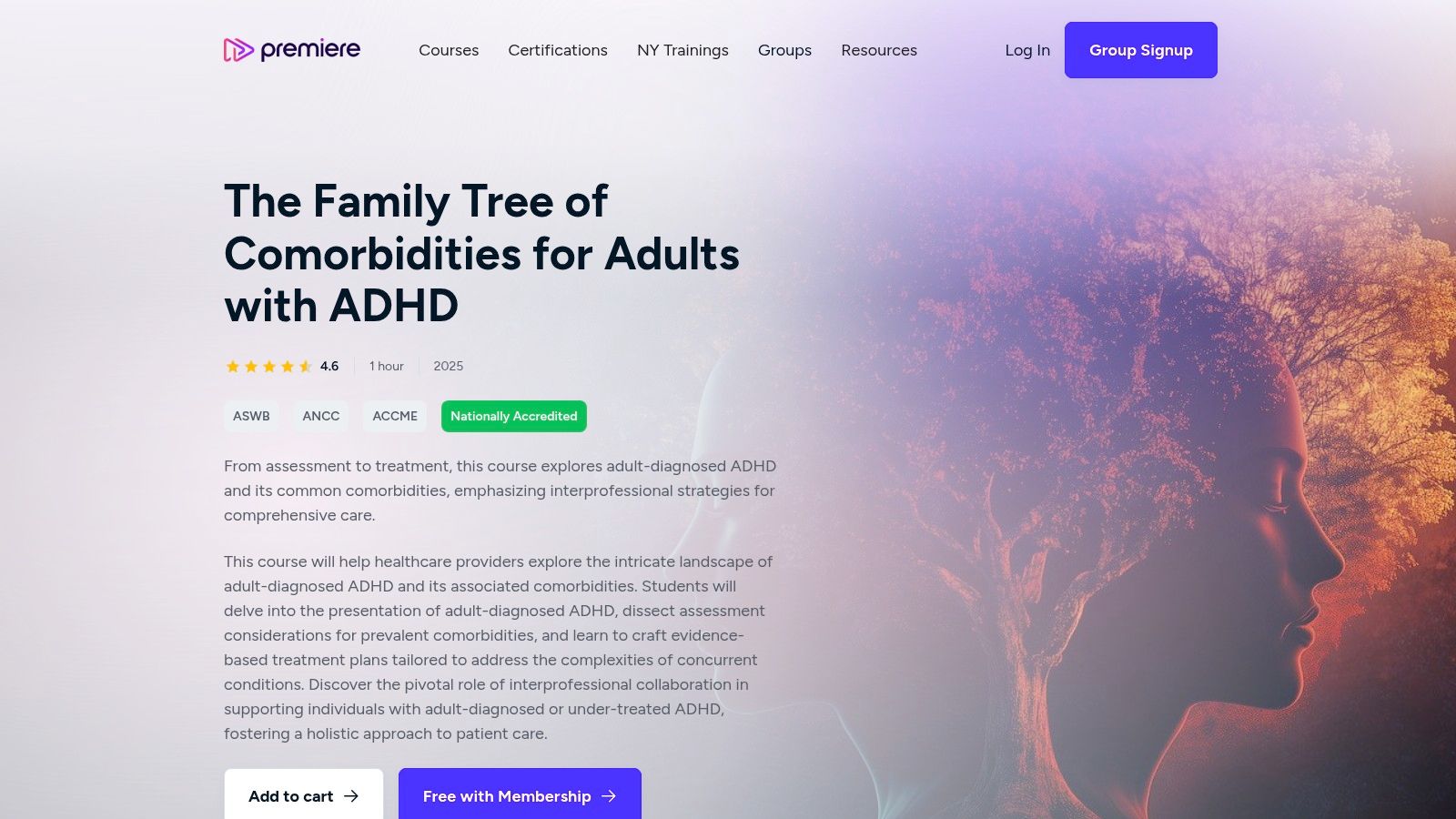
4. The Family Tree of Comorbidities for Adults with ADHD
An adult patient arrives with a recent ADHD diagnosis and several unresolved care concerns. For a primary-care nurse, behavioral-health nurse, or nurse practitioner, the useful question is how to organize assessment and coordinate care without attributing every difficulty to the same diagnosis.
This course explores adult-diagnosed ADHD and common comorbidities, from assessment through treatment. It emphasizes interprofessional strategies for thorough care, making it a clinical-development choice rather than a stated substitute for a specific Florida or Texas mandate.
A practical scenario might involve a patient reporting poor sleep, trouble following a treatment plan, and difficulty managing appointments. The nurse's task is to gather a clear history, identify concerns requiring further assessment, and communicate findings to the appropriate clinician. The course topic supports a broader view of the patient rather than a diagnosis-only encounter.
Choose it for the patient population
This option makes the most sense when adult ADHD appears regularly in the nurse's work. It is less directly relevant to a nurse whose immediate priority is a missing state-mandated legal topic.
The Refresh Psychiatry & Therapy ADHD guide provides related reading on finding specialized care. Such material can help frame referral conversations, but it shouldn't replace the organization's assessment tools or clinical guidance.
The practical comparison is breadth versus obligation. A state-specific course closes a defined compliance gap. This course develops a clinical topic that may support accepted nursing CE, subject to the listed credit and the learner's board requirements.
Turn online learning into a usable care tool
A nurse can prepare an assessment note template while studying. Useful fields include presenting concerns, functional difficulties, current treatments, other reported symptoms, and follow-up responsibilities. The template should support assessment, not imply that the nurse has made a diagnosis outside the nurse's scope.
An e-learning systematic review and meta-analysis found no statistically significant difference in knowledge, skills, or satisfaction across 11 randomized controlled trials involving 2,491 nurses and student nurses. Online delivery is therefore a reasonable format, but it isn't proof that passive reading will produce good clinical decisions.
A stronger application is a case-based handoff. The learner summarizes what is known, what remains uncertain, and which professional should address each concern. That exercise fits this course's interprofessional emphasis and keeps the learning connected to actual patient care.
5. Teenage Turbulence: Screening and Treatment for Substance Use Disorder in Adolescents
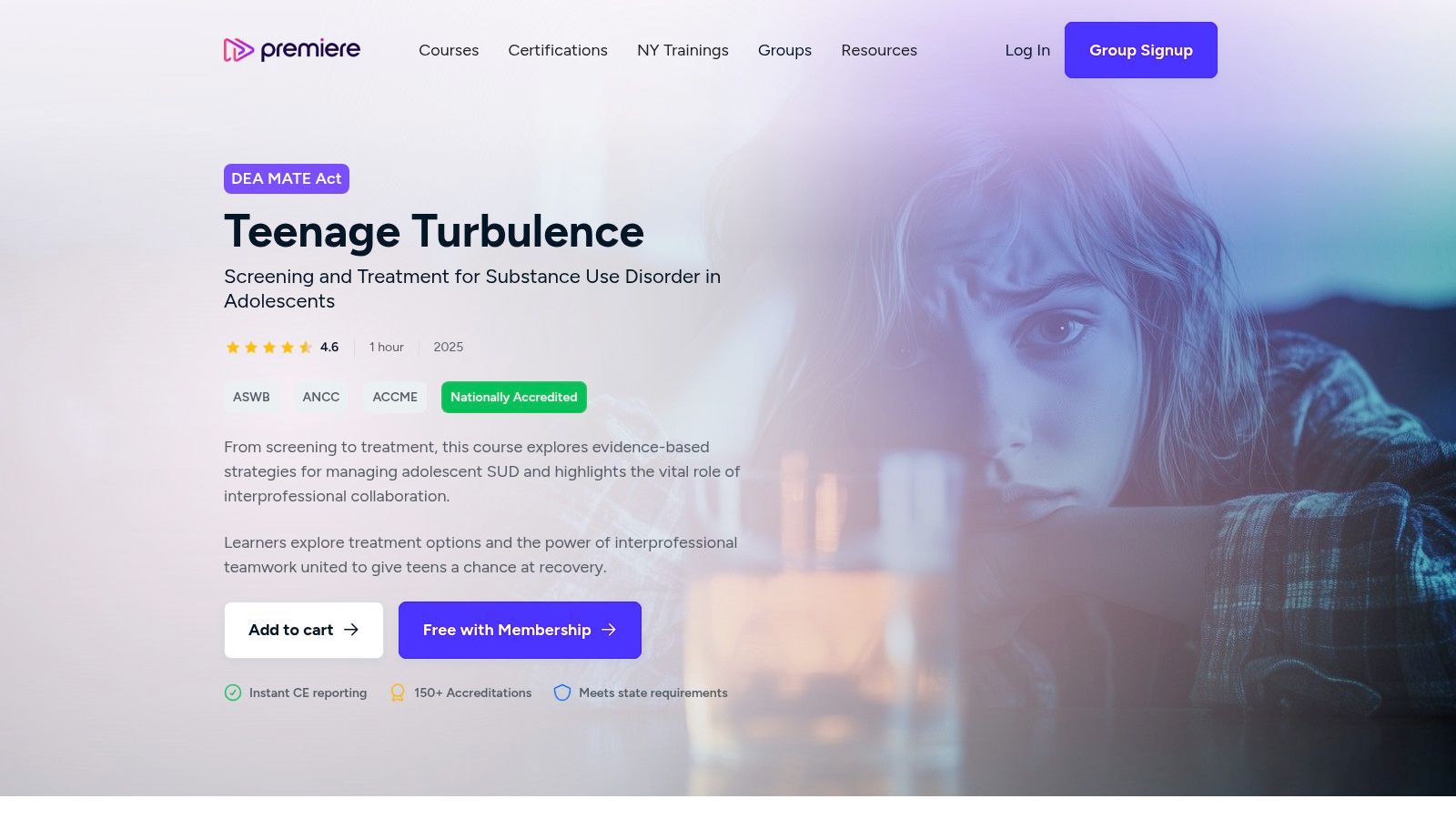
A clinic lead needs staff prepared for adolescent substance-use concerns, not another adult-only overview. This course explores evidence-based screening and treatment strategies for adolescent substance use disorder and emphasizes interprofessional collaboration.
That makes it a practical option for nurses working with adolescents in primary care, behavioral health, or school-linked services. For renewal, it belongs under the accepted clinical or elective credit category shown in the current course details. No specific state-mandate equivalence should be assumed from the topic alone.
Build a response beyond the screening result
Say a teenager attends a clinic appointment after a school-related concern. A positive screen isn't the end of the encounter. Staff need a defined route for clinical assessment, immediate safety concerns, referral, and follow-up.
The team should connect coursework with its own operating procedures:
- Screening workflow: Identify who administers the approved tool and who reviews the result.
- Clinical escalation: Name the clinician responsible for further assessment.
- Communication: Apply the relevant consent, confidentiality, and family-involvement rules.
- Follow-up: Assign responsibility for referrals and unresolved appointments.
For clinicians whose responsibilities include medication-related care, Unlocking Effective Treatments Pharmacology for Substance Use Disorder is a related topic to review separately. Its relevance doesn't establish adolescent-specific coverage or a particular credit designation.
Coordinate school and clinical learning without mixing credentials
School-linked care requires shared understanding, but not identical courses for every employee. A nurse, teacher, counselor, and administrator may participate in the same response while holding different responsibilities and professional-development requirements.
Related education resources include Arizona educator course topics and Mississippi school staff and administration course topics. These are separate profession-and-state pathways, not nursing-credit equivalents.
A shared student-support plan doesn't mean every team member needs the same credential or should perform the same clinical task.
Arizona's professional-learning guidance emphasizes sustained, classroom-focused learning rather than isolated workshops. A school-linked team can apply that approach by pairing individual coursework with a joint referral exercise and a review of staff responsibilities.
Compared with the adult ADHD option, this course is the more direct fit for adolescent substance-use work. Its limit is scope: coursework supports preparation, while assessment authority, treatment decisions, and information-sharing must remain within each professional's role.
How the five featured nursing courses compare by topic, state focus, and audience

Turn Your Renewal List Into a Plan You Can Finish Early
A workable renewal plan starts with required topics, not a shopping cart. The nurse should list each applicable state category, identify the required credit type, and match a course before enrolling. Clinical interests can then fill accepted elective space without displacing mandatory subjects.
The distinctions among these options are practical. Texas sexual assault response education addresses a defined practice requirement. Florida legal education and impairment education address different subjects, while adult ADHD and adolescent substance-use training should be selected for clinical relevance and accepted credit.
Make the schedule and records part of the decision
A nurse working irregular shifts needs more than an online label. The plan must account for uninterrupted study time, assessment requirements, employer reimbursement procedures, and certificate storage. Premiere Education's courses are online, can be taken on the learner's schedule, and provide instant certificates.
In a study of 122 nurses in Kuala Lumpur, 82.0% reported domestic responsibilities as a barrier to continuing education. The practical response is to reserve realistic study periods rather than assume coursework will fit into whatever time remains after work and caregiving.
A useful renewal record includes:
- Requirement: The state topic and applicable renewal cycle.
- Course match: The selected course and listed credit designation.
- Completion evidence: The certificate and any necessary reporting confirmation.
- Workplace application: A procedure, referral pathway, or skill requiring follow-up.
The next cycle should begin with an organized record rather than a search through email attachments. Early enrollment, accurate topic matching, and retrievable certificates reduce avoidable deadline pressure, while practice-focused course selection gives the learning a purpose beyond renewal.
Premiere Education offers accredited nursing CE, state-specific education, and documentation tools for individuals and organizations. Nurses and training managers can visit Premiere Education to match these course topics to their renewal needs, review the listed credits, and build a training plan around actual workplace responsibilities.
Latest Posts