
.avif)
COPD Nurse Care Plan: Step-by-Step Guide
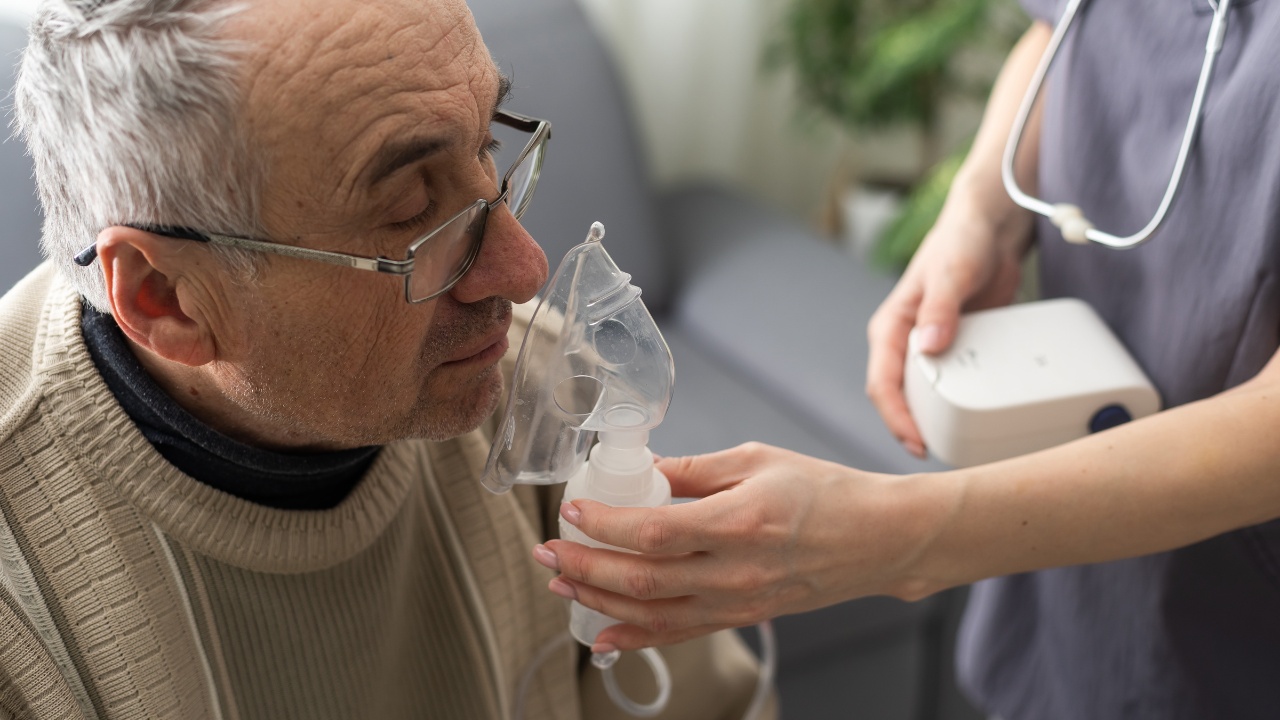
COPD caused 3.4 million deaths globally in 2023, representing 6% of all deaths worldwide. A strong COPD nurse care plan turns that global threat into specific bedside actions, from controlled oxygen and airway assessment to self-management teaching and timely escalation.
COPD is also described by the World Health Organization as the third leading cause of death. That scale matters at the bedside because nurses often see deterioration before anyone else does. A patient who pauses between words, abandons meals because breathing takes too much effort, or becomes unusually sleepy may be moving from a manageable problem toward respiratory failure.
A care plan can't remain a list of diagnoses copied from a template. It needs measurable findings, matched interventions, clear escalation criteria, and education the patient can use when no clinician is present.
Why COPD Nursing Care Plans Matter More Than Ever
A 2025 systematic review and meta-analysis found a pooled global prevalence of post-bronchodilator COPD of 12.16%, including 15.70% in men and 9.93% in women. The Americas had the highest regional prevalence at 14.53%. COPD therefore affects nursing care across medical wards, emergency departments, rehabilitation, and community services, not only specialist respiratory units.
Those figures represent patients who need a plan that remains useful after the immediate dyspnea settles. Without one, care becomes reactive. Staff treat wheezing, increase oxygen, administer a nebulizer, and document improvement, while missing the trigger for deterioration, incorrect inhaler technique, or the patient's plan for managing symptoms after discharge.
A practical COPD nurse care plan links each finding to a bedside decision:
- Breathing changes set monitoring frequency and escalation thresholds.
- Sputum changes direct airway-clearance teaching and infection assessment.
- Functional decline shapes pacing, mobility goals, and rehabilitation referrals.
- Anxiety or low confidence shows whether education is likely to be followed.
- Cognitive or social barriers test whether the home plan can work in daily life.
Practical rule: The next nurse should see what changed, what action is due, and which finding requires urgent escalation.
A strong plan also prevents duplicated documentation. One respiratory assessment can support the nursing diagnosis, establish the patient's baseline, guide oxygen decisions, and provide the reference point for evaluation. That saves time while keeping the record clinically useful.
WHO notes that nearly 90% of COPD deaths in people under 70 occur in low- and middle-income countries (WHO). Early assessment, smoking-cessation support, inhaler teaching, and exacerbation-prevention coaching matter especially where specialist access is limited. The psychosocial details determine whether those interventions continue after the patient leaves the ward.
Assessment Foundations for Your COPD Care Plan
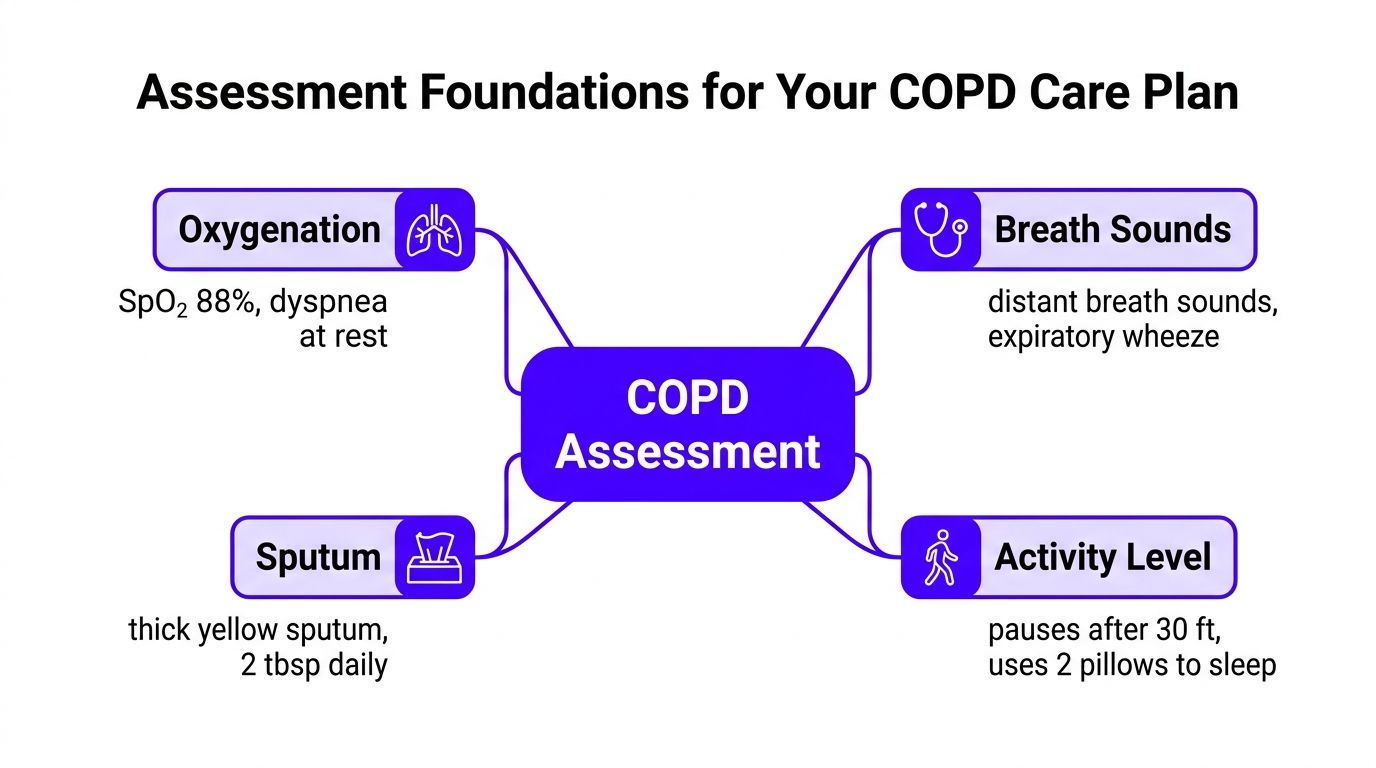
A COPD nurse care plan succeeds or fails on the assessment beneath it. Respiratory rate and lung sounds provide useful data, but they are incomplete without the patient's usual function and a comparison of findings at rest, during movement, and after treatment. Document changes in a way that lets the next nurse make a decision, not repeat an observation.
Start with breathing and oxygenation
Record respiratory rate, depth, rhythm, speech tolerance, nasal flaring, and accessory-muscle use. Note whether the patient sits upright, leans forward, or uses a tripod posture. Measure oxygen saturation at rest and during a defined activity, rather than relying on one isolated value.
A useful entry might read: “Patient becomes breathless while walking to the bathroom, pauses after a short distance, uses accessory muscles, and requires recovery time after sitting.” This supports activity planning and reassessment after exertion. “Short of breath” alone gives the next nurse little direction.
Mental status requires the same attention. New confusion, agitation, or somnolence may indicate worsening gas exchange or carbon dioxide retention. Promptly reassess respiratory status and follow the prescribed investigation or escalation pathway.
Assess the airway, circulation, and nutrition
Auscultate all lung fields and describe wheeze, diminished air entry, crackles, or asymmetry. Ask about cough strength, sputum volume and color, difficulty expectorating, and differences from baseline. Thick sputum with a weak cough supports airway-clearance interventions, while a sudden increase in dyspnea requires broader assessment.
Check for peripheral edema, neck-vein distension, cyanosis, and reduced exercise tolerance when right-sided cardiac strain or cor pulmonale is a concern. Nutritional assessment should cover appetite, fatigue while eating, swallowing difficulty, recent intake, and visible muscle wasting. A patient who stops meals to catch their breath may need smaller portions, rest before eating, and dietetic input.
Document whether the patient understands the spirometry procedure, since anxiety or confusion can alter cooperation and results. Cognitive screening also matters because hypoxemia, fatigue, anxiety, or baseline impairment can affect inhaler teaching and action-plan use.
Record baseline cognition separately from an acute mental-status change.
Common COPD Nursing Diagnoses and What They Mean for Your Plan
A nursing diagnosis should explain the patient's current problem, not repeat the medical diagnosis. The assessment findings must support the label, and the interventions must address the cause or consequence identified.
Impaired gas exchange
Use this diagnosis when oxygenation or ventilation findings indicate a problem, such as worsening saturation, cyanosis, altered mental status, or increased respiratory effort. The plan should specify prescribed oxygen delivery, target saturation, reassessment timing, and the findings that require blood-gas review or escalation.
For example: “Impaired gas exchange related to ventilation-perfusion imbalance, evidenced by dyspnea at rest, increased work of breathing, and oxygen saturation below the prescribed target.” The common error is writing “monitor oxygen” without stating what the nurse will do if the saturation falls or the patient's mental status changes.
Ineffective airway clearance
This diagnosis fits thick secretions, a weak or ineffective cough, diminished air entry, or difficulty expectorating. The plan may include upright positioning, prescribed bronchodilator coordination, hydration when appropriate, huff coughing, and reassessment of sputum and breath sounds.
A patient with thick sputum who tires after repeated coughing needs pacing, not relentless coughing exercises. The error to avoid is treating all cough as a problem without assessing whether the cough is clearing secretions.
Activity intolerance
Activity intolerance reflects a mismatch between the patient's available oxygen supply and the demands of movement. Evidence might include dyspnea during washing, frequent rest pauses, fatigue, or a marked difference between resting and exertional saturation.
A workable entry could state: “Patient will complete personal hygiene with planned pauses and use pursed-lip breathing, with symptoms reassessed after the activity.” The plan should coordinate activity with medication timing and consider pulmonary rehabilitation referral. It shouldn't promise a distance or endurance level unrelated to the patient's baseline.
Anxiety and ineffective coping
Dyspnea can create fear, rapid breathing, avoidance of activity, and reluctance to use inhalers. A patient who says, “Breathing gets worse, so I stop moving and wait,” needs both symptom management and a clear response plan.
Assess what the patient understands, what triggers panic, who helps at home, and whether depression, isolation, fatigue, or low health literacy affects follow-through. The documentation error is to record “anxious” without identifying the behavior that places care at risk. A specific plan might include calm coaching, positions of ease, teach-back, family involvement with consent, and referral for further psychosocial support.
Interventions That Move the Needle in COPD Care
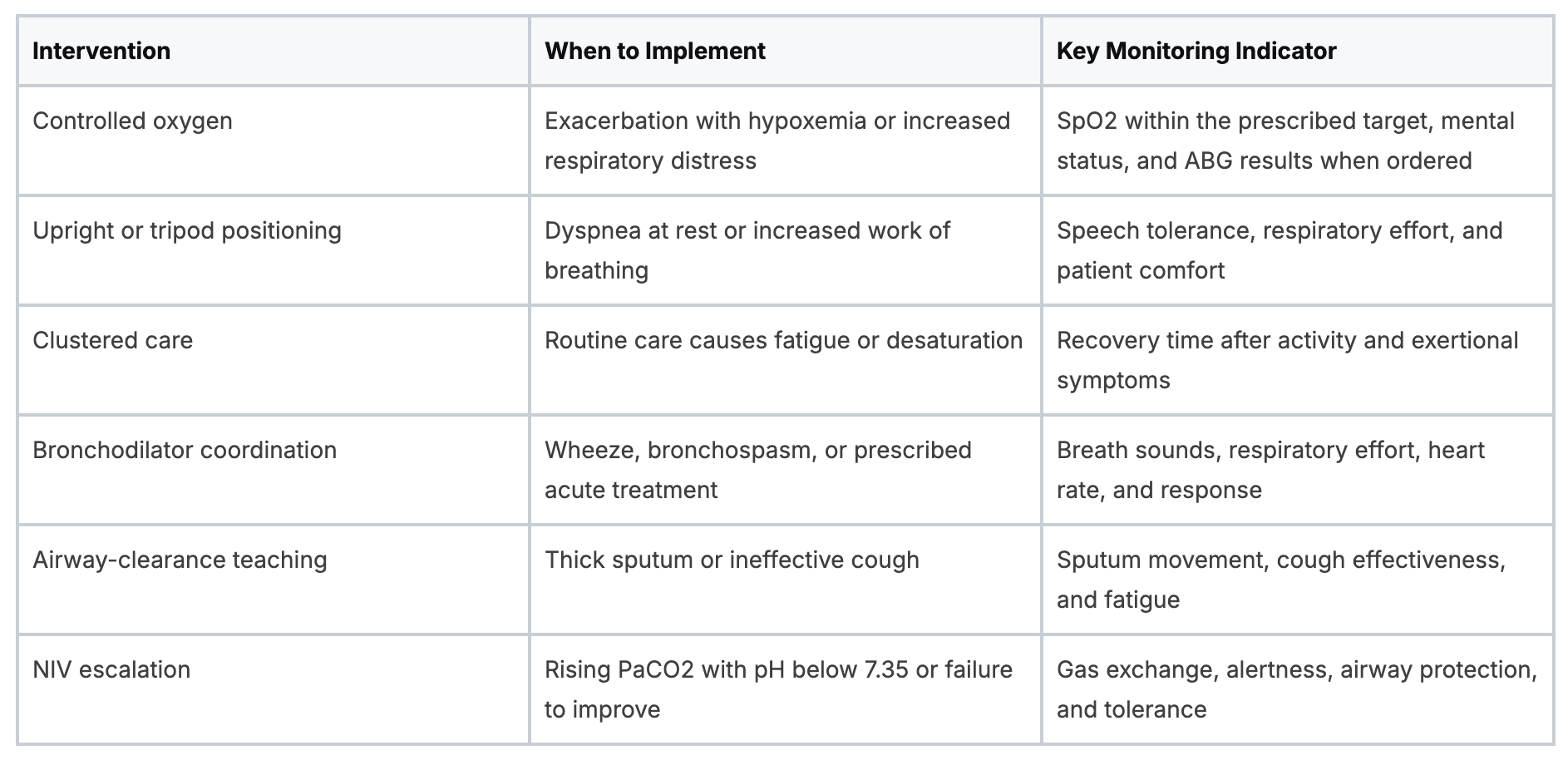
The safest COPD intervention is the one matched to the assessment. Oxygen, positioning, medication coordination, airway clearance, and non-invasive ventilation all have a place, but they don't solve the same problem.
Control oxygen instead of chasing a normal number
During an exacerbation, the commonly targeted saturation range is 88% to 92% (clinical guidance). Uncontrolled high-flow oxygen can worsen hypercapnia, so the nurse should use controlled delivery, continuous saturation monitoring, and reassessment rather than automatically pushing saturation into the normal range.
For a patient arriving dyspneic with COPD and an SpO2 of 84%, a practical response is to start low-concentration oxygen, such as a 24% Venturi mask at 2–4 L/min or a 28% mask at 4 L/min while awaiting blood-gas results, then reassess saturation, respiratory effort, mental status, and ABGs as prescribed. The correct action isn't to leave the patient hypoxic. It is to correct hypoxia carefully and avoid excessive oxygen exposure.
Match the intervention to the immediate problem
Positioning often comes first. High Fowler's or a supported tripod posture can reduce the effort required to breathe. Clustering care prevents repeated exertion, while planned rest periods allow recovery between bathing, assessment, meals, and ambulation.
Coordinate prescribed short-acting bronchodilators with assessment of breath sounds, respiratory effort, heart rate, and response. Check inhaler or nebulizer technique directly. A patient may nod confidently while holding the device incorrectly, so demonstration and return demonstration are more reliable than verbal agreement.
Non-invasive ventilation requires rapid coordination when the patient is failing to improve. The verified care-plan bundle supports coordinating bronchodilators and NIV when pH is below 7.35 with rising PaCO2 (meta-analysis and nursing intervention evidence). Escalation is also required when the patient becomes increasingly somnolent, cannot protect the airway, or shows persistent respiratory distress.
A 36-study meta-analysis found that nursing interventions significantly improved six-minute walk distance, with SMD 0.628 and p=0.001, and self-efficacy, with SMD 0.800 and p<0.001, while reducing anxiety and depression, both with SMD -0.952 (meta-analysis). These findings support interventions that address function and confidence, not only breath sounds.
Patients and families may ask about non-prescribed products marketed for oxygen support. Such products shouldn't replace prescribed oxygen, controlled delivery, or urgent assessment. General respiratory-care principles can also be reviewed in nursing interventions for influenza patients, while keeping the patient's COPD-specific oxygen target and escalation plan central.
The Psychosocial Gap Most COPD Care Plans Miss
A care plan can cover smoking cessation, medication use, and exercise yet still fail at home. A recent review found that COPD education remains uneven in both content and delivery. Stress, fatigue, depression, social participation, and end-of-life planning receive less attention than routine inhaler and medication teaching (review of COPD education).

Low health literacy can undermine adherence. Test understanding instead of assuming that information was understood. A patient may recognize the word “exacerbation” but miss that increased sputum, worsening cough, or reduced activity requires action. Use plain language, ask for teach-back, and write instructions around the patient's actual routines.
Build self-management around real routines
A written plan should state what the patient does when symptoms are stable, when they worsen, and when urgent help is needed. Include positions of ease, pursed-lip breathing, huffing, activity pacing, and prescribed reliever-inhaler instructions. A published action plan also sets a maximum daily puff limit, giving the patient a clear boundary instead of an open-ended instruction to take more medication (COPD self-management action plan).
A patient who becomes breathless while showering may sit for part of the task, pause before washing their hair, use pursed-lip breathing, and follow the prescribed reliever plan if symptoms increase. The American Lung Association advises avoiding tobacco products and inhaled irritants and using oxygen as prescribed. The home plan should also identify smoke exposure, oxygen flow, tubing hazards, medication access, and who to call.
A patient can't follow a plan that ignores fatigue, loneliness, low mood, transport problems, or fear of becoming a burden.
Screen mood and anxiety during routine care, then document the response and referral pathway. Supportive communication is part of the nursing intervention, not a conversation reserved for the end of the visit.
The gap is especially visible in residential care. A 2026 scoping review found only one eligible study on educational interventions in care homes and concluded that empirically evaluated staff education for COPD is almost absent in that setting (care-home COPD education review). Care-home plans should specify how staff identify baseline changes, supervise inhaler technique, pace personal care, document sputum or appetite changes, and escalate concerns for frail residents with multimorbidity.
Evaluating Your COPD Care Plan and Adjusting for Outcomes
A care plan that isn't evaluated is only a record of intentions. Evaluation should compare the patient's current status with the baseline documented at assessment and should measure whether the intervention changed function, confidence, symptoms, or safety.
Track outcomes that reflect daily life
Useful indicators include:
- Gas exchange: Review oxygen saturation trends against the prescribed target and note whether the patient needs more support at rest or during activity.
- Breathing effort: Record respiratory pattern, accessory-muscle use, speech tolerance, and recovery after exertion.
- Airway clearance: Assess cough effectiveness, sputum movement, and whether the patient can demonstrate huffing or another taught technique.
- Functional capacity: Compare walking tolerance, personal-care completion, rest requirements, and six-minute walk distance when that test is part of the care pathway.
- Self-efficacy: Ask the patient to explain the action plan, demonstrate inhaler use, and describe what they will do when symptoms worsen.
- Psychosocial response: Reassess anxiety, mood, sleep disruption, fatigue, social participation, and confidence managing breathlessness.
A written action plan combined with regular nurse contact has shown reductions in unscheduled primary-care use. In the intermediate-care study, the intervention group had 171 unscheduled GP contacts versus 280 in controls, and the authors reported 1.79 fewer unscheduled GP contacts per COPD patient receiving the intervention (trial report). The same study found that hospital readmission rates didn't improve, so a successful plan shouldn't be judged by one utilization outcome alone.
Change the plan when the evidence says it isn't working
Consider a patient whose two-week review shows better inhaler technique and improved confidence but persistent breathlessness during bathing. The nurse should identify whether the barrier is exertion, anxiety, poor pacing, inadequate equipment, or a change in respiratory status. The revised plan might move bathing to a time when the patient has more energy, add seated care and planned pauses, involve occupational therapy, and arrange clinical review if symptoms have changed from baseline.
Documentation should make the adjustment visible: record the original goal, the observed result, the patient's explanation, the revised intervention, and the date for reassessment. “Continue current plan” isn't enough when the patient still can't complete essential activities.
Evaluation question: Can the patient demonstrate the skill and explain the escalation step without prompting?
Escalation must remain explicit. Worsening somnolence, rising carbon dioxide, inability to protect the airway, persistent distress, or failure to improve after prescribed treatment requires urgent clinical review and possible NIV or intensive-care escalation. Education alone isn't a substitute for reassessment, and a good action plan always tells the patient and staff when self-management has reached its limit.
Premiere Education offers accredited continuing education courses and certifications for healthcare professionals, along with tools for assignment, tracking, and completion documentation. Nurses and organizations can visit Premiere Education to review respiratory-care learning options and broader clinical education that supports safer, more consistent care planning.
Latest Posts





25% off Sitewide→
Use Code: PCECYBERSALE2025→