
.avif)
Continuing Education for Pediatric Nurses: A 2026 Guide

A pediatric nurse can complete 100 CERPs and 432 practice hours during a three-year renewal period for AACN's Pediatric CCRN credential, while an ANCC Pediatric Nurse Board-Certified nurse needs 30 pediatric nursing continuing education hours within three years. Those figures, detailed by AACN and ANCC, show why continuing education for pediatric nurses isn't a random collection of certificates. It's a renewal strategy tied to clinical practice, specialty categories, documentation, and the actual children a nurse cares for.
A defensible plan starts with the credential, state license, employer requirements, and practice setting. A pediatric emergency nurse needs a different mix from a home care nurse supporting a child with a tracheostomy, gastrostomy tube, or chronic infusion. The useful question isn't, “How many hours are required?” It's, “Which education keeps the nurse compliant and clinically ready?”
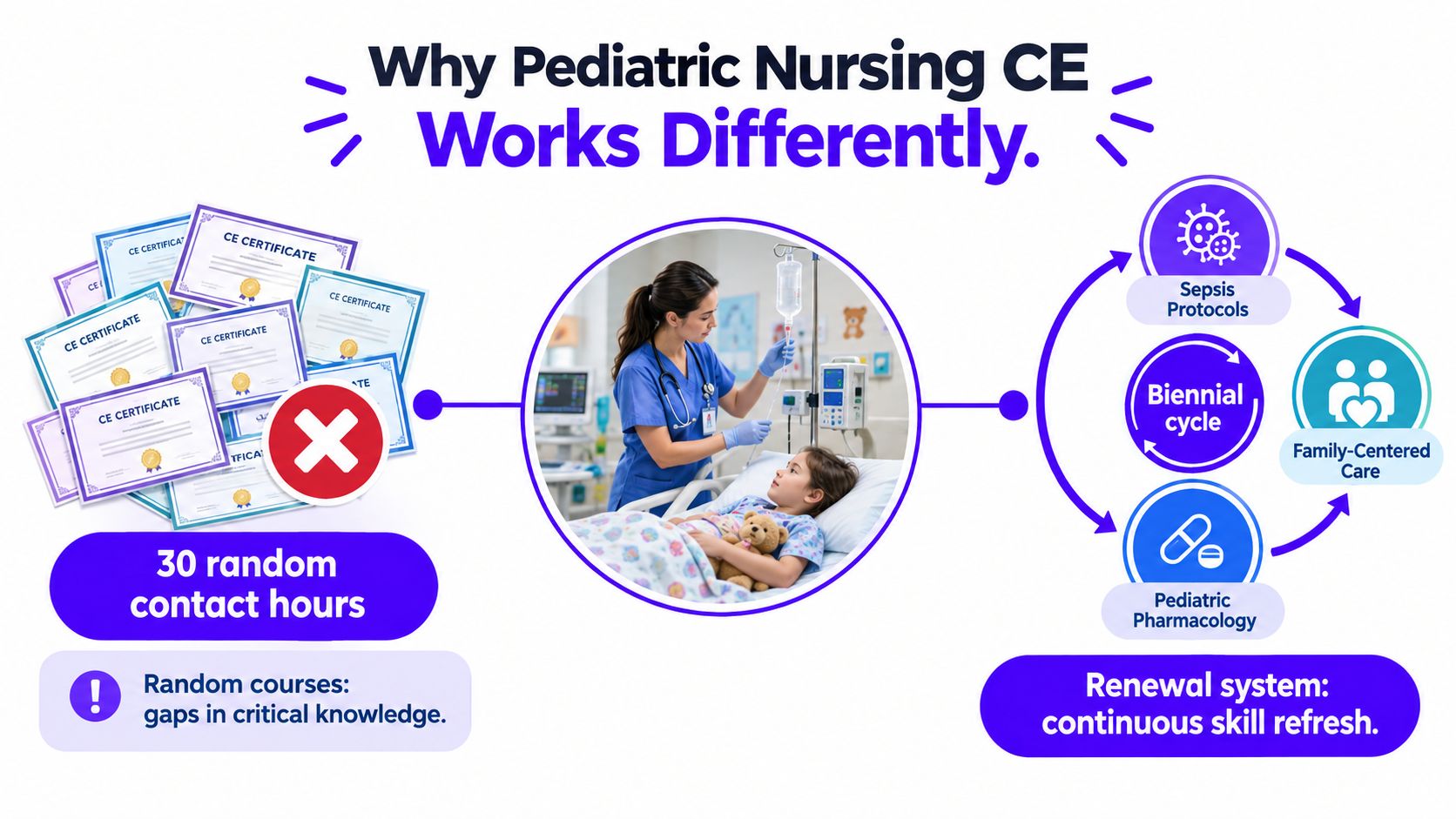
Why Pediatric Nursing CE Works Differently
A pediatric floor nurse completes 30 one-off contact hours during a renewal cycle and feels finished. Later, the nurse discovers that the courses don't satisfy a required resuscitation renewal or a state-mandated topic. The certificates are real, but the plan fails because the hours weren't matched to the rules or to bedside risk.
Pediatric continuing education functions as a renewal system, not a pile of unrelated courses. Children's physiology, medication dosing, communication needs, and emergency presentations create a narrower margin for error than a generic nursing review can address.
The clinical reasons the plan must be specific
First, low-frequency pediatric procedures decay without practice. A nurse may understand chest tube management or pediatric code dosing but rarely perform those tasks. A one-time lecture can confirm knowledge, yet it won't necessarily preserve speed, sequencing, or confidence during an emergency.
Second, weight-based pharmacology requires active retraining. Pediatric dosing depends on the child's weight, concentration, route, allergies, renal function, and the potential consequences of a decimal error. A useful course should require calculation, order verification, and escalation decisions rather than relying only on passive reading.
Third, family-centered communication must be rehearsed. Explaining a procedure to a frightened child, responding to a caregiver's concern, and de-escalating distress are performance skills. Case discussion, role-play, simulation, and feedback make those skills more usable at the bedside.
What the hour actually represents
Nurses should separate contact hours, continuing education units, and CERPs before buying a course. Credentialing bodies can use different terms and category systems, so a certificate's number alone doesn't prove that the education will count. The provider's accreditation, topic, completion date, and category designation all matter.
The historical development of the specialty helps explain this structure. Pediatric nursing entered nursing curricula in 1917, and the first pediatric nursing textbook appeared in 1923, according to a review of pediatric nursing history. Formal education grew alongside children's hospitals, including the first U.S. children's hospital in Philadelphia in 1855 and later hospital expansion in several major cities during the nineteenth century.
Practical rule: A pediatric CE course should answer three questions before enrollment: which credential accepts it, which category it fills, and which bedside behavior it strengthens.
Matching Your Credential to Its Renewal Rules
Renewal requirements vary by credential, and the differences affect both course selection and scheduling. A nurse who treats every pediatric certification as a basic contact-hour target may purchase education that does not fit a category, overlook required practice hours, or find a gap just before submitting documentation.
Use the table as a planning reference, not as a permanent rulebook. Credentialing organizations can revise requirements, so confirm the current details with the issuing body before completing renewal.
Pediatric credentials at a glance
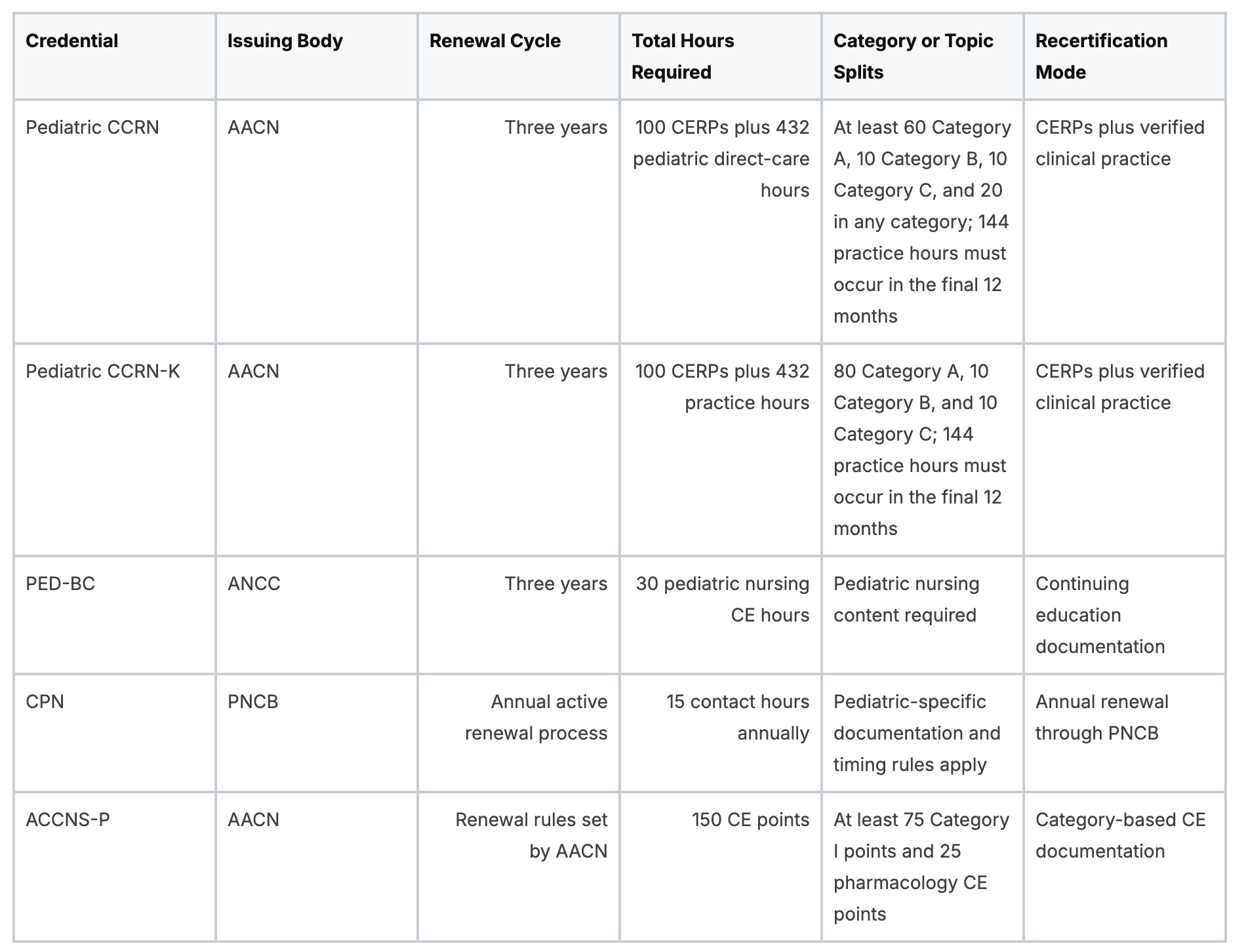
For Pediatric CCRN renewal, AACN's renewal requirements list 100 CERPs: at least 60 Category A, 10 Category B, 10 Category C, and 20 in any category. The credential also requires 432 hours of direct pediatric care during the three-year period. Pediatric CCRN-K follows a different distribution, with 80 Category A, 10 Category B, and 10 Category C, plus its practice-hour requirements, as described by AACN.
ANCC's PED-BC requires 30 hours of pediatric nursing continuing education within three years. PNCB's CPN recertification FAQ describes 15 earned contact hours and rollover rules within a 24-month window. The 2026 recertification guide states that PNCB-certified nursing professionals complete 15 contact hours annually, with renewal running from November 1 through January 31.
ACCNS-P uses points rather than a simple hour total. AACN's ACCNS-P renewal page requires 150 CE points, including 75 Category I points and 25 pharmacology CE points. A pediatric clinical nurse specialist may need to pair pharmacology education with advanced pediatric care content because a general nursing course will not automatically satisfy the required mix.
A practical check prevents two common costs. Before paying for a course, match its provider approval, subject, completion date, and category to the credential. Repeated BLS content may not fill a specialty category, and reaching the total CCRN education hours does not replace the required CERP distribution. The Access Courses Online CPD guide offers broader professional-development planning context.
For education on team coordination and life-saving techniques, Pediatric Advanced Life Support (PALS) Recertification Training is one course to compare with the applicable resuscitation and renewal rules.

Core Clinical Topics Worth Your CE Hours
Course selection should follow clinical exposure and credential categories, not whichever title appears first in a catalog. High-value continuing education for pediatric nurses connects a recognizable patient problem with a decision the nurse must make under pressure.
Seven practical topic priorities
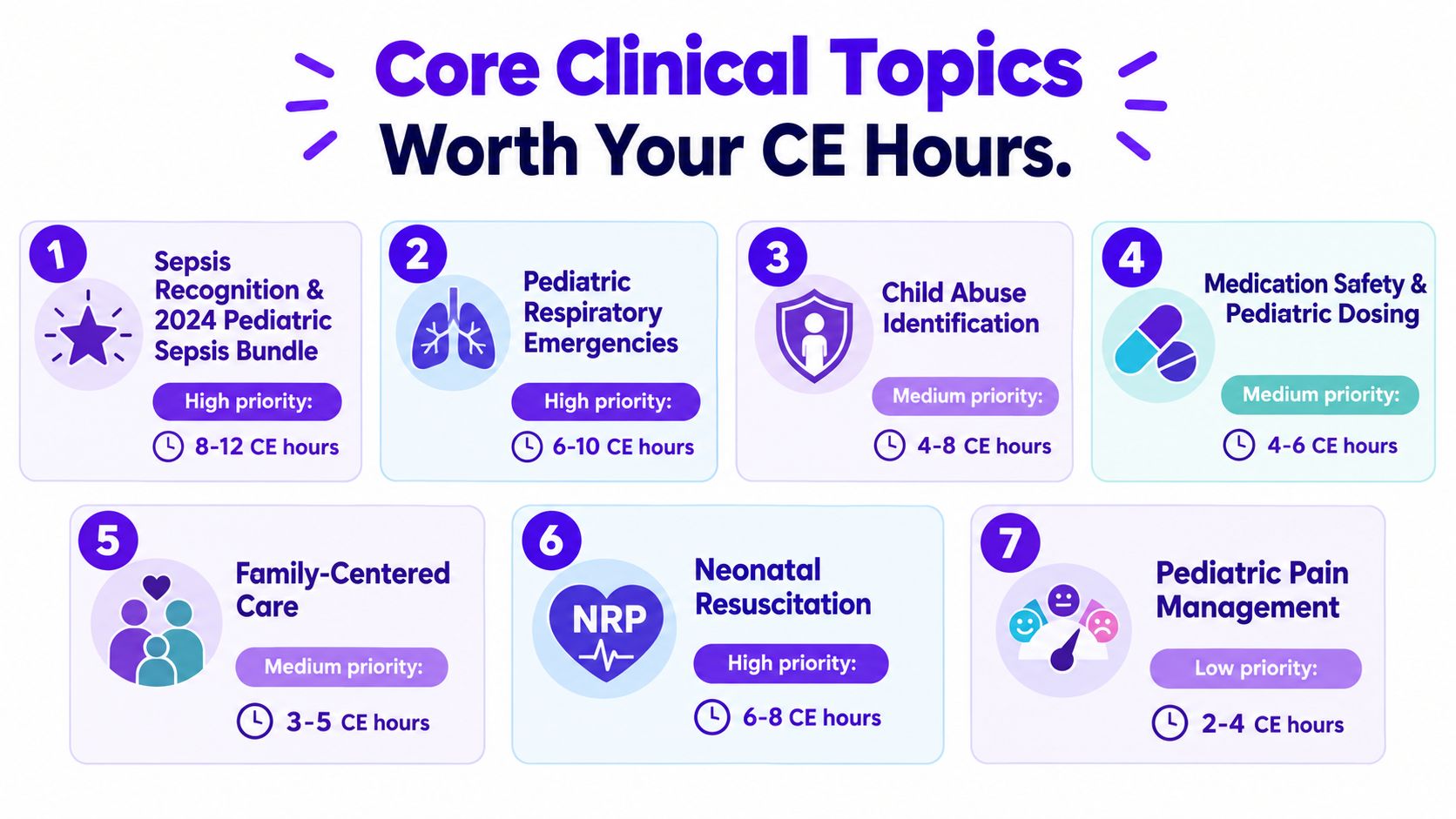
Sepsis recognition and pediatric bundle updates deserve early attention because recognition depends on trend interpretation, escalation, reassessment, and team communication. A strong module should use changing vital signs and caregiver observations, not just definitions.
Pediatric respiratory emergencies should include respiratory failure, oxygen delivery, and high-flow nasal cannula escalation. The practical test is whether the nurse can identify worsening work of breathing and communicate the change before decompensation.
Medication safety and pediatric dosing belongs in every plan, especially where weight-based calculations, concentration changes, pump programming, and independent verification are involved. A calculation exercise is more useful than a general medication-safety overview.
Family-centered care covers shared understanding, plain-language teaching, and respect for caregiver expertise. It can complement an acute-care topic and help satisfy a broader professional-development plan.
Other useful categories include child abuse identification, neonatal resuscitation, and pediatric pain management. Each should be matched to the nurse's population and employer expectations rather than treated as universally urgent.
Match acuity with communication
A practical pairing is one high-acuity clinical subject with one communication, safety, or equity subject during the same planning period. For example, respiratory failure education can be paired with trauma-informed communication, while pediatric dosing can be paired with family teaching.
Low-frequency skills need spaced reinforcement. A rolling pediatric code-cart refresher reduced first-attempt failure odds by 43% between training cycles, with p=0.01, in the program reported by PubMed. That finding supports short recurring simulations and structured debriefing for resuscitation workflows, medication-cart navigation, external pacing, arterial line procedures, and code-team roles.
A nurse looking for a PALS-focused option can compare the content and approval details of Pediatric Advanced Life Support certification training with the credential's current renewal requirements.
Pediatric CE in Real Practice Settings
A children's hospital emergency department nurse and a home care nurse may both hold pediatric credentials, yet their highest-value education looks very different.
The ED nurse encounters resuscitations, trauma, medication emergencies, and behavioral health holds. A practical annual mix would place a PALS refresher near the renewal deadline, then add toxicology, pediatric respiratory emergencies, and de-escalation practice. Simulation should reproduce the interruptions and competing priorities of the department, such as a deteriorating child arriving while another family needs immediate communication.
That nurse also benefits from reviewing role clarity. During a pediatric emergency, a course should help the nurse identify who prepares medications, who documents, who communicates with the caregiver, and who escalates when the first intervention fails. The value comes from rehearsing decisions that mirror the department's workflow.
A home care nurse supporting medically complex children faces a different set of risks. The patient may depend on a ventilator, gastrostomy tube, tracheostomy, or chronic infusion, and the nurse may spend more time teaching caregivers than responding to a high-volume emergency environment.
The home care plan needs a different center
For this nurse, ventilator management, tracheostomy care, G-tube care, seizure management, caregiver teaching, and palliative communication may provide more direct benefit than a PALS-heavy schedule. A 2026 industry announcement reported that many nursing programs don't prepare nurses for advanced home and community care for medically complex children, while skills such as tracheostomy care, G-tube care, seizure management, and pediatric hospice are often learned on the job or through specialty certification. The announcement also described the launch of 50+ ANCC-accredited skills modules, as reported by Business Wire.
Setting test: If a nurse can't name the patient intervention that a course will improve, the course probably shouldn't lead the annual plan.
The home care nurse should still maintain emergency readiness, but the balance should reflect daily practice. Pediatric education can also include hearing, communication access, and caregiver interaction.
Navigating State Mandates and Specialty Overlap
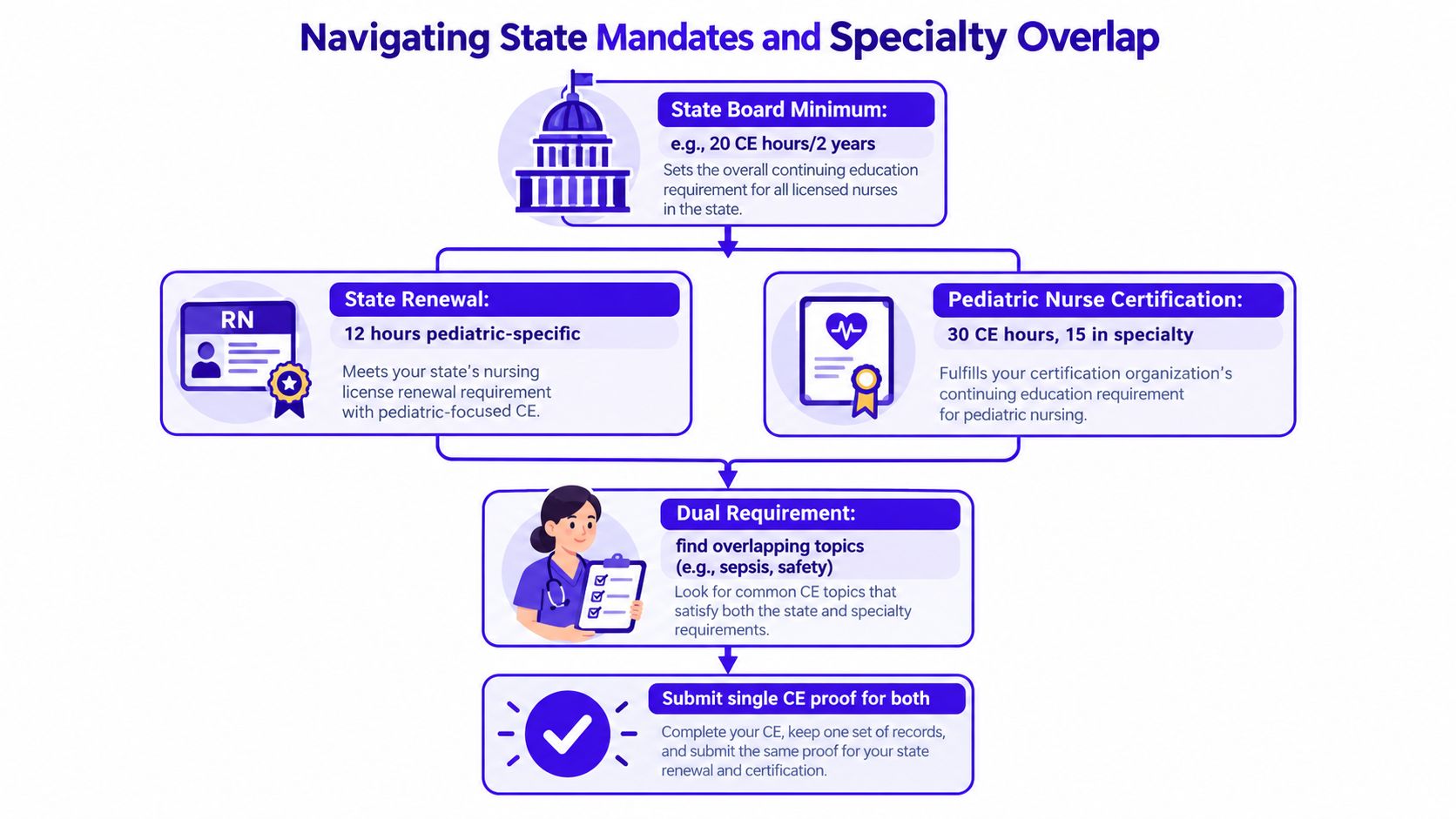
State boards establish the licensing floor. Specialty credentials add their own rules, and employers may impose a third layer. A single course can sometimes support more than one requirement, but acceptance isn't automatic.
The first task is to separate the requirements into a written inventory:
- State license: Record the renewal date, required subjects, accepted provider types, and reporting method.
- Specialty credential: List the cycle, total hours, category splits, practice requirements, and documentation standards.
- Employer training: Add mandatory modules such as restraints, bloodborne pathogens, emergency procedures, or local competency checks.
- Career development: Use remaining capacity for skills connected to the nurse's next role or current patient population.
State requirements vary. PNCB notes examples of pediatric-specific mandates that can include pediatric trauma or emergency care in California and pediatric medical-error prevention in Florida. A nurse practicing under compact licensure or across state lines should check each applicable board rather than assume the home-state rule travels automatically.
A simple audit method
Create a spreadsheet with one row per course and separate columns for provider, approval, completion date, contact hours, specialty category, state topic, employer requirement, and certificate location. Then mark each course only where the receiving organization explicitly accepts it.
The difficult overlap often appears between CCRN-Pediatric CERPs and PED-BC contact hours. A pediatric emergency course may be clinically valuable but still fail to fill a specific CERP category or pediatric nursing requirement. The required continuing education for nurses guide can serve as a general planning reference, while the credentialing body remains the final authority.
Audit question: Does the certificate show the exact provider, approval, topic, hours, and completion date needed by every organization that may review it?
A national hospital study found that emergency departments with a nursing continuing education policy had a median weighted pediatric readiness score of 71.3, while specialty certification policies were associated with 83.5 and hospital-specific competency evaluation policies with 72.3. The findings, including the reported significance values, appear in PubMed. For leaders, the lesson is operational: pediatric education, certification, and competency review belong in the system, not only in an individual nurse's private study plan.
Choosing the Right CE Delivery Model
The delivery model affects flexibility, approval access, catalog depth, documentation, and total spending. Individual courses work well when a nurse needs one precise topic. Memberships can make sense for recurring education. Employer portals are useful when a hospital needs assignment, completion, and reporting controls.
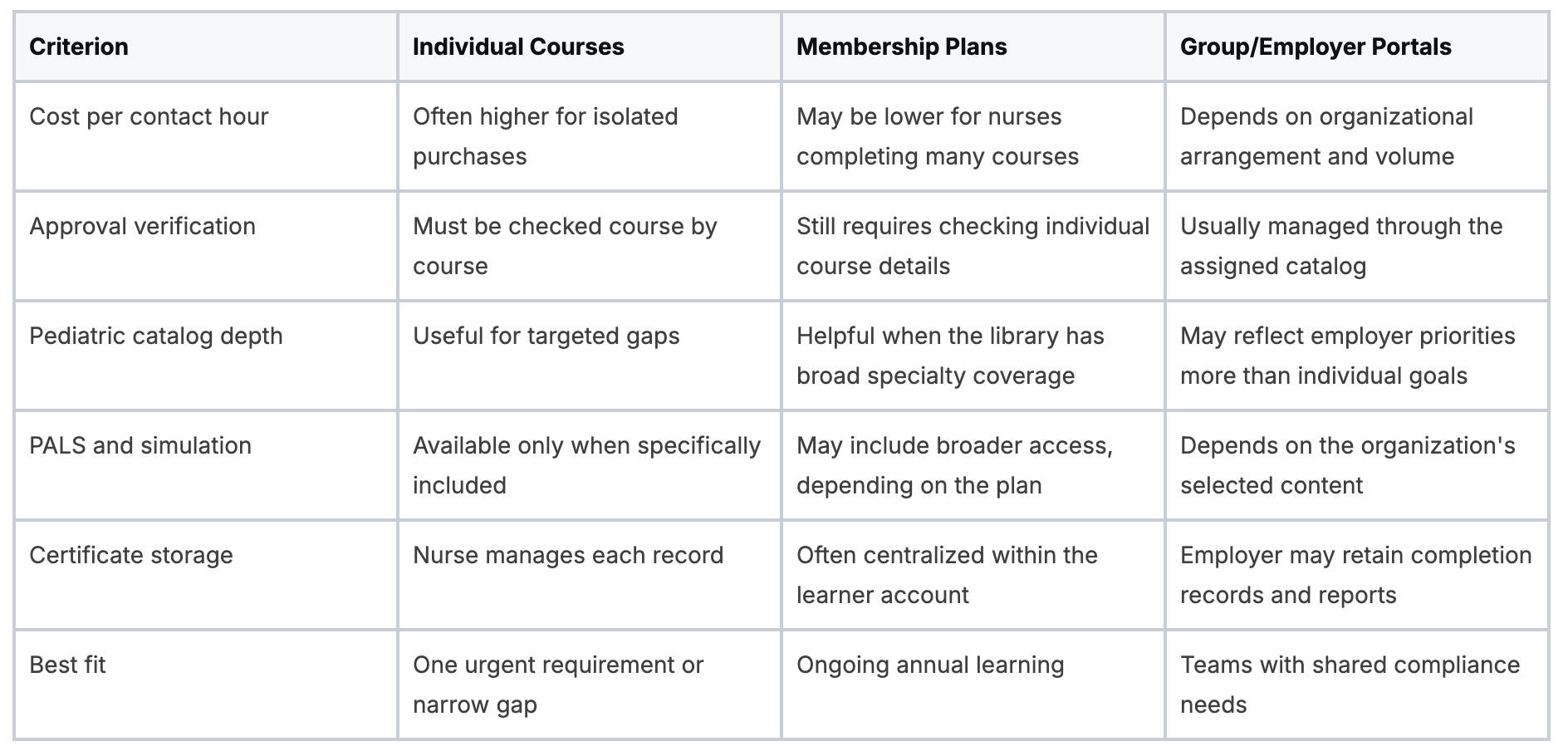
Three buying decisions
An individual purchase is the clearest choice when a nurse needs a particular pediatric topic before a deadline. The trade-off is that several separate purchases can become expensive and difficult to track, especially when categories differ.
A membership plan suits a nurse who expects steady learning across the year. Nursing organizations may bundle journals, webinars, and CE, but the nurse still needs to confirm that each activity satisfies the relevant state or specialty rule.
A group or hospital portal works best when leaders need to assign courses, monitor completion, and retain audit records. The limitation is selection. The content may be chosen for institutional priorities, leaving a nurse responsible for finding additional education for a credential-specific category.
Free or low-cost CE can be useful for general learning, but price doesn't establish acceptance. A course may lack ANCC recognition, state-board approval, pediatric specificity, or the category documentation required for renewal.
Nurses who want a more detailed comparison of online access can review nursing online learning and unlimited CE. A course outside bedside nursing can still support broader professional work. For example, Understanding and Implementing Section 504 Plans Ensuring Equity and Access for All Students addresses legal foundations, eligibility, accommodations, MTSS, and RTI for students with disabilities, though it shouldn't be counted toward pediatric nursing renewal unless the receiving credential explicitly accepts it.
Building Your Annual Pediatric CE Plan
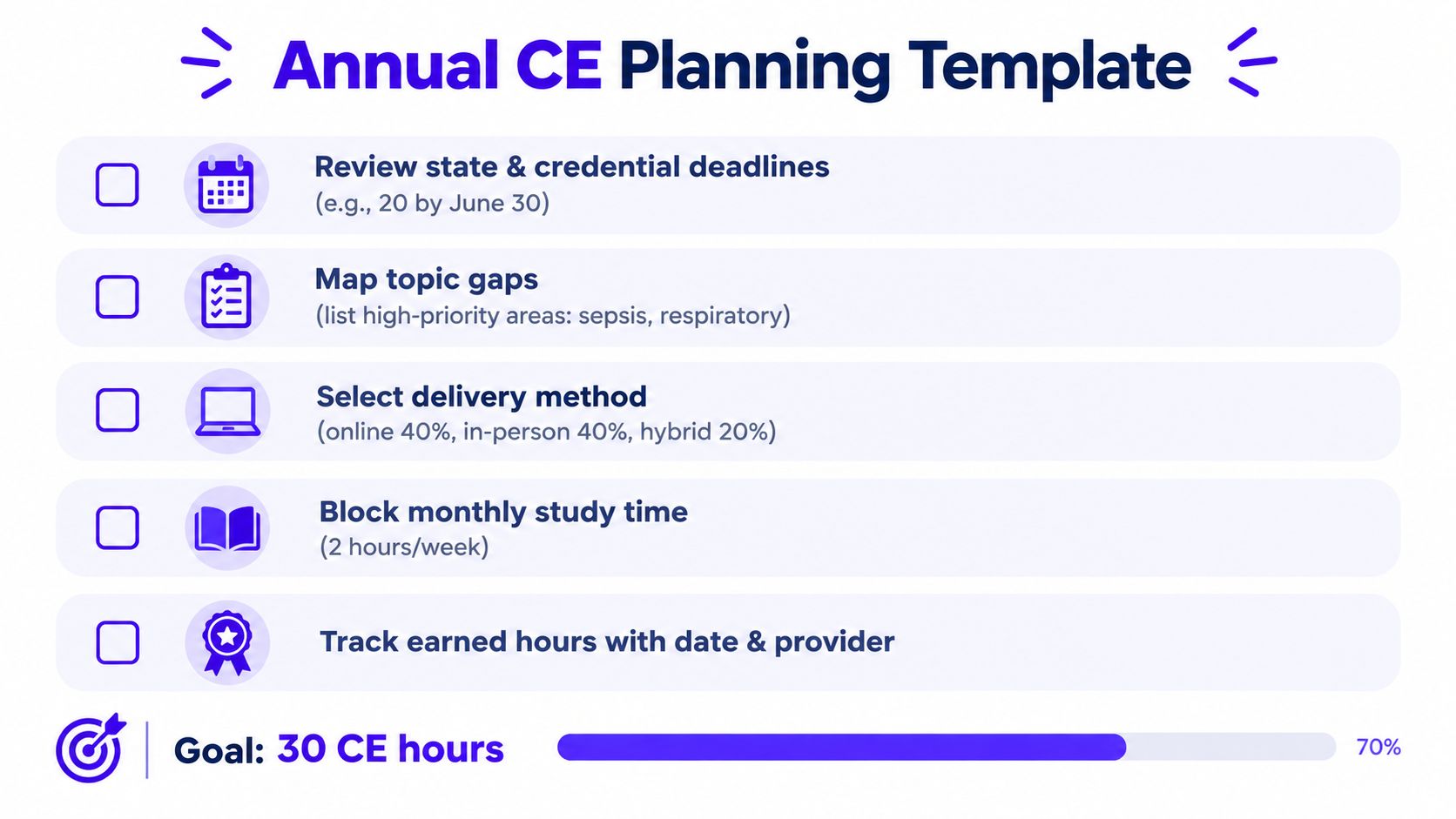
A workable plan uses one 12-month calendar. Put the state license deadline, specialty renewal dates, PALS deadline, employer assignments, and practice-hour checkpoints in the same view. Separate reminders make it easy to finish a course while missing the credential category or reporting step that makes it count.
Renewal cycles rarely align. PALS follows a two-year pattern, CCRN-Pediatric and CCRN-K use three-year structures, CPN requires annual active renewal steps, and ANCC PED-BC uses its defined three-year pediatric CE window. Review every credential at the beginning of the year, then plan around the earliest obligation.
A four-block working schedule
First quarter, clinical priorities. Start with the most serious practice gap, such as pediatric sepsis, respiratory failure, dosing safety, or seizure emergencies. Add simulation when the skill is uncommon or time-sensitive. This places high-risk learning before the year becomes crowded.
Second quarter, resuscitation readiness. Schedule a PALS refresher or related emergency competency work as the card or employer validation approaches. Match the course to the required pathway. A PALS activity should not automatically be counted as every other resuscitation credential.
Third quarter, specialty categories. Check the required mix before selecting more hours. A CCRN-Pediatric nurse should review Category A, B, and C allocation. An ACCNS-P nurse should verify Category I and pharmacology points. A CPN nurse should track the annual contact-hour requirement described in the PNCB 2026 Recertification Guide, cited earlier, instead of waiting for the renewal window.
Fourth quarter, documentation and buffer. Review certificates, confirm approvals, and complete remaining state or employer topics. Keep time for corrections. A clinically useful course may still be unusable if its provider, approval, or category does not satisfy the receiving organization.
Documentation that survives an audit
Store each certificate in one digital folder, using the completion date in the file name. Keep a tracker with the course title, provider, approval, hours, credential category, state requirement, and upload or reporting status.
Verify acceptance through the relevant ANCC, AACN, PNCB, state board, or employer portal before paying. If one course may satisfy two requirements, record it in both columns only after both organizations confirm that overlapping credit is allowed. This is the difference between hours completed and hours that can be defended during renewal.
Use this short weekly check:
- License: Confirm the state renewal date and required subjects.
- Specialty: Check total hours, category splits, and practice requirements.
- PALS: Verify the current card and renewal pathway.
- Certificates: Archive each completion record in one location.
- Tracker: Update earned hours and remaining gaps.
Premiere Education offers online continuing education, PALS, BLS, and ACLS courses, along with membership access, certificates, tracking tools, and organizational assignment and completion reporting. Nurses and healthcare organizations can review the pediatric and compliance options at Premiere Education, then compare each course with the applicable credential and state rules.
Latest Posts





25% off Sitewide→
Use Code: PCECYBERSALE2025→