
.avif)
Asthma Nursing Interventions That Improve Patient Outcomes

You can have a patient on the monitor who looks “just okay,” but the room tells a different story. They're upright, tight in the chest, speaking in short bursts, and the inhaler they used at home didn't buy much relief. In that moment, asthma nursing interventions are about more than giving a treatment. They're about reading the bedside cues fast, choosing the right sequence, and not missing the second turn when a patient starts to tire.
When Asthma Walks Into Your Shift
Asthma rarely arrives politely. It shows up in the ED at 2 a.m., on med-surg after a viral illness, or in clinic when a patient says the rescue inhaler is “working less and less.” The nurse's first job is to sort out whether this is a tight airway that needs immediate relief, a patient who's drifting toward failure, or a chronic control problem that keeps circling back because the plan at home isn't realistic.
The work matters because nursing-led care can change outcomes in ways that are very concrete. A 2023 systematic review and meta-analysis of 14 studies found nursing interventions for children with bronchial asthma were linked with a 51% lower risk of emergency visits and a 54% lower risk of hospitalization, along with fewer symptom days, fewer nights with symptoms, fewer asthma attacks, better quality of life, and a positive trend in asthma control. That's not abstract education, that's less acute care use.
Practical rule: If the patient is still working hard after the first treatment cycle, don't treat the chart. Treat the trend.
A 2024 CDC report adds the larger picture. In 2021, 24.9 million people in the United States had asthma, including 4.7 million children and 20.3 million adults, and in 2020 approximately 1 million people had an emergency department visit for asthma (CDC report). That's why nursing judgment has to work across settings. The same patient who needs high-Fowler's and a bronchodilator in the ED may need inhaler coaching, trigger review, and a written plan in clinic, then a different handoff in school or home care.
This guide follows that path from bedside rescue to long-term control, with an equity lens built in. Teaching matters, but so do housing, access, bias, and the fact that some patients can't control the air they breathe. The useful question is never just “Did the nurse teach it?” It's “What changed at the bedside, and what changed in the patient's daily life?”
The First Ten Minutes of an Acute Exacerbation
The first ten minutes are choreography, not a checklist. A patient in distress needs a sequence that lowers work of breathing, opens airflow, and gives the nurse a clear read on whether the plan is helping. The bedside rhythm is straightforward, but it has to stay disciplined.
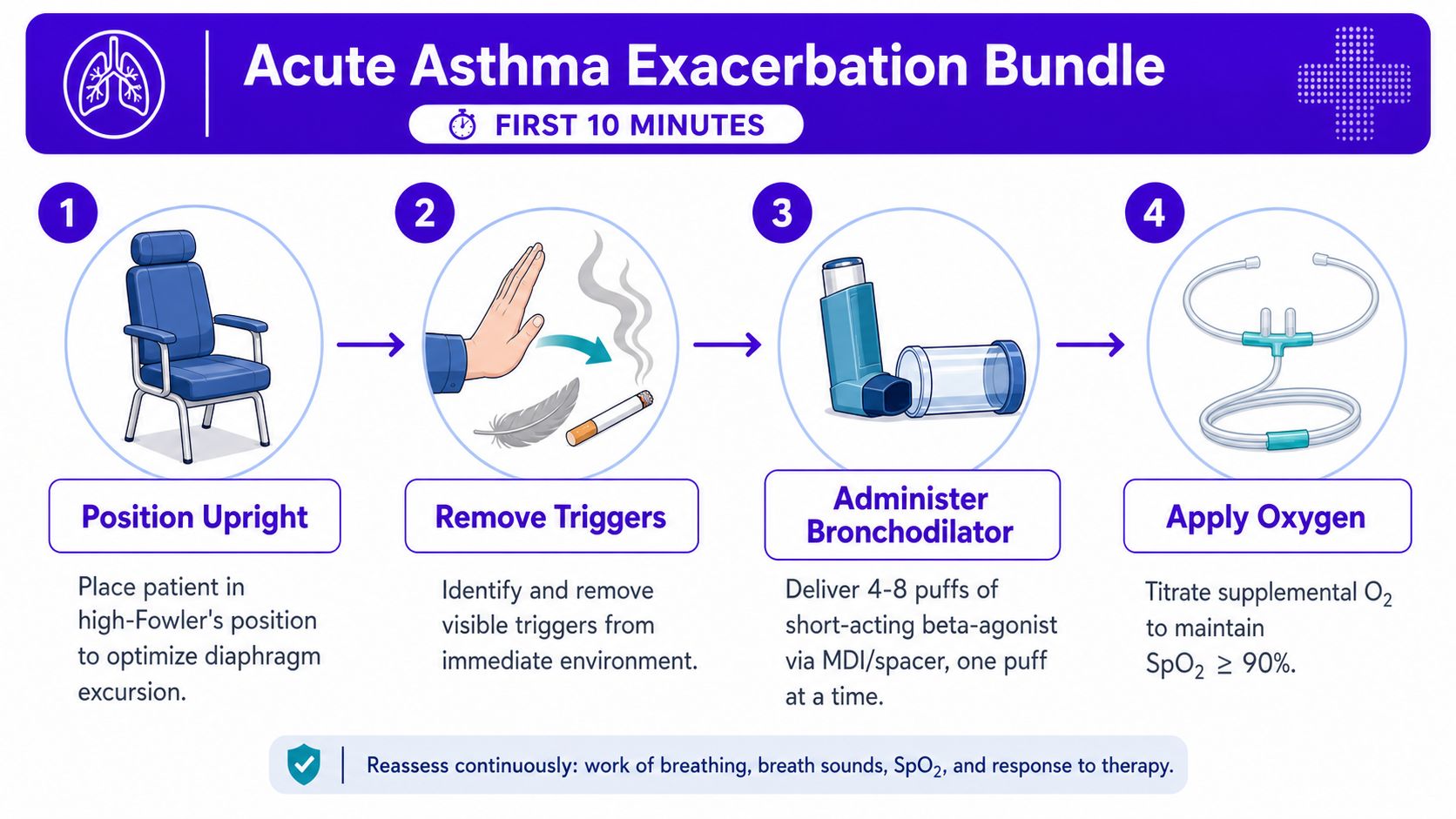
Start with position, access, and the first treatment
Begin with upright or high-Fowler's positioning. That gives the diaphragm more room to move and usually eases the struggle to inhale. If obvious triggers are in the room, smoke residue, strong scents, visible dust exposure, remove what can be removed quickly. After that, deliver the rapid-acting bronchodilator as ordered, and add oxygen if it is ordered or clinically needed while keeping the patient under close watch.
A practical pediatric emergency reference gives a concrete albuterol approach, nebulized albuterol 2.5–5 mg initially, repeated every 20 minutes. For a child 5 years or older, 5 mg is recommended, and more frequent redosing or even continuous nebulization may be needed when distress worsens between doses (StatPearls pediatric guidance). Oxygen targets in that same guidance are above 90–92% saturation. In real bedside terms, treatment is not one-and-done, and the nurse has to watch the response, not just the order.
Teams that keep current BLS certification training and PALS certification training are often better prepared to carry out this bundle under pressure, because they have already rehearsed airway support, escalation, and team roles when the patient starts tiring.
Reassess with the bedside picture, not just the monitor
Use respiratory rate, pulse oximetry, mental status, work of breathing, and peak flow or FEV1 when available to decide what happens next. A patient who is still speaking only in short phrases after treatment, or who looks more fatigued even if the wheeze is quieter, needs a different level of attention than a patient who is clearly easing.
The acute bundle for adult asthma care also includes evaluating triggers, prior exacerbation history, vital signs, and PEF or FEV1, then coordinating therapy and education. The NHLBI quick reference also supports starting a written asthma action plan, demonstrating inhaler use, and scheduling follow-up at the initial visit, because poor technique and incomplete action-plan use commonly drive persistent poor control (NHLBI quick reference summary).
One practical limit shows up fast in the ED and on the floor. A patient may leave the bedside breathing better, yet still go home to a crowded apartment, secondhand smoke, a broken nebulizer, or no money for the controller inhaler. Teaching still matters, but the plan has to fit the patient's access, not just the chart.
Teaching Inhaler Technique the Right Way
A patient can have the right medication and still get under-dosed because the device use is off. That's why inhalation-technique teaching isn't a nice extra, it's a core intervention, and it works best when the nurse keeps it short, specific, and observable. The goal is not to lecture, the goal is to make the patient do it correctly before leaving the room.
Use teach-back in a fixed sequence
The clearest bedside protocol is explain, demonstrate, check, then praise or correct. The patient should hear the steps once in plain language, watch the nurse do them, then show the technique back without coaching if possible. That sequence is fast enough for bedside care and structured enough to catch errors that patients don't know they're making.
For an MDI with spacer, the practical steps are straightforward. Shake the inhaler. Exhale fully. Seal the lips around the spacer. Inhale slowly while actuating. Hold the breath for about 10 seconds. Wait about 30 to 60 seconds between puffs. The value here is precision, because incorrect technique can mean less medication reaching the lungs even when the prescription is right (asthma nursing consensus document).
Slow inhalation beats rushed confidence. Most missed doses at the bedside are really missed technique.
Catch the errors that look harmless
Common mistakes are easy to spot once you know what to watch for. Patients actuate before sealing the lips, inhale too fast, forget to exhale first, or take the second puff immediately without waiting. With nebulizers, another common problem is passive use, where the patient sits through the treatment but never gets the breathing pattern coached to match the device.
A useful clinic scenario is the patient who says the controller is “fine” but still wakes at night. That often isn't a medication failure, it's a delivery failure. When the nurse slows the patient down, rechecks the device use, and corrects the sequence, the same prescription can behave very differently in real life.
The technical details matter because inhalation-technique training is considered indispensable for effective inhaled therapy (asthma nursing consensus document). When the nurse pairs teaching with objective reassessment, symptom relief, work of breathing, and pulse-oximetry response after instruction, the feedback loop becomes visible instead of theoretical.
Assessment Findings That Should Change Your Plan
Some patients look stable until they don't. A wheezy patient who can still speak in complete sentences is not the same as a wheezy patient who's getting quiet, tiring out, or drifting mentally. Good asthma nursing means knowing which findings justify staying put, which ones need the provider, and which ones demand rapid response.
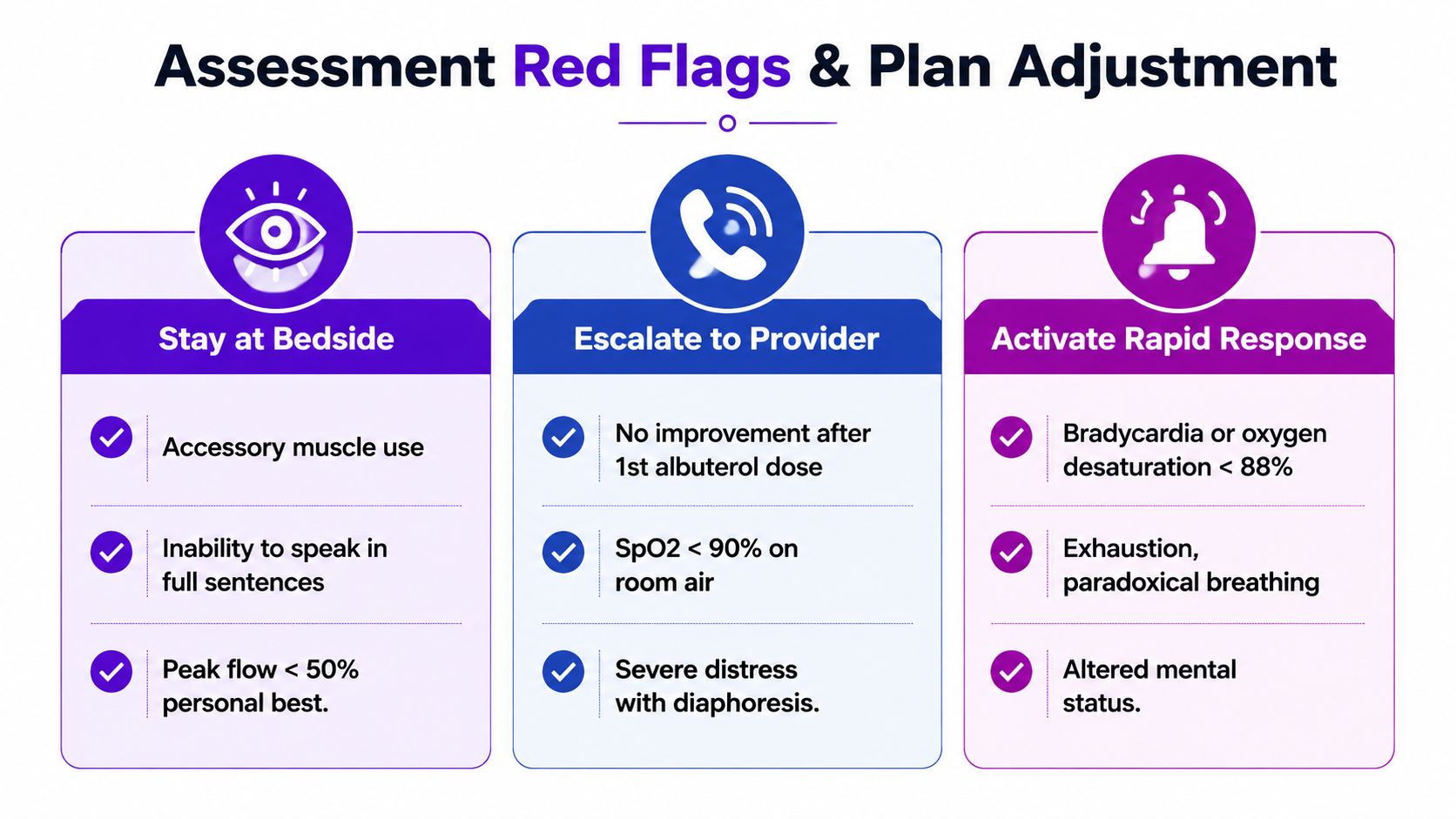
Stay at the bedside when the patient is straining
Accessory muscle use, inability to speak in full sentences, and a peak flow below 50% of personal best are not “watch and wait” findings. They say the patient still needs a nurse close by, because the work of breathing is already significant and the margin for error is thin.
Mental status matters just as much as the lungs. A patient who is still answering questions but seems slower, less engaged, or unusually quiet may be tiring. In asthma, silence can be a warning sign, not a reassuring one.
Escalate when treatment isn't changing the trend
If there's no improvement after the first albuterol dose, if SpO2 is below 90% on room air, or if the patient shows severe distress with diaphoresis, the nurse should call the provider and push for a higher level of review. That's the point where the bedside story is no longer “tight but stable,” it's “not responding as expected.”
Escalation rule: If the patient is working harder but oxygenation and speech are not improving, don't keep repeating the same assumption.
Activate rapid response for collapse patterns
Bradycardia or oxygen desaturation below 88%, exhaustion or paradoxical breathing, and altered mental status are emergency signals. By then, the patient may be moving from severe bronchospasm into respiratory failure territory, and the nurse's job is speed, not optimism.
A patient can look briefly calm after exhausting themselves. That's why a trend-based assessment matters more than a single bedside glance. If the chest is getting quieter, the effort is going up, and the patient is less responsive, the plan has already changed.
For nurses who want a systems-level medication lens on why this deterioration matters, a course such as Systems-Based Pharmacology, Corticosteroids, and the Hormonal Footprint fits the way escalation and medication response intersect in real care.
Building the Chronic Care Routine
Acute rescue gets attention, but chronic control decides who comes back next month. A patient who keeps missing controller doses, cannot name triggers, and has no written action plan usually does not need more blame. They need a routine that fits a real day, not an ideal one.
A useful outpatient scene is the working parent who says mornings are chaos. The inhaler sits on the counter, the child's trigger list is vague, and follow-up got lost between shifts. In that case, education only sticks when it is tied to habits, reminders, and a plan the family can actually use. If the family is juggling late buses, unstable housing, or a phone that only works on Wi-Fi, the routine has to be built around those limits, not around a clinic fantasy.
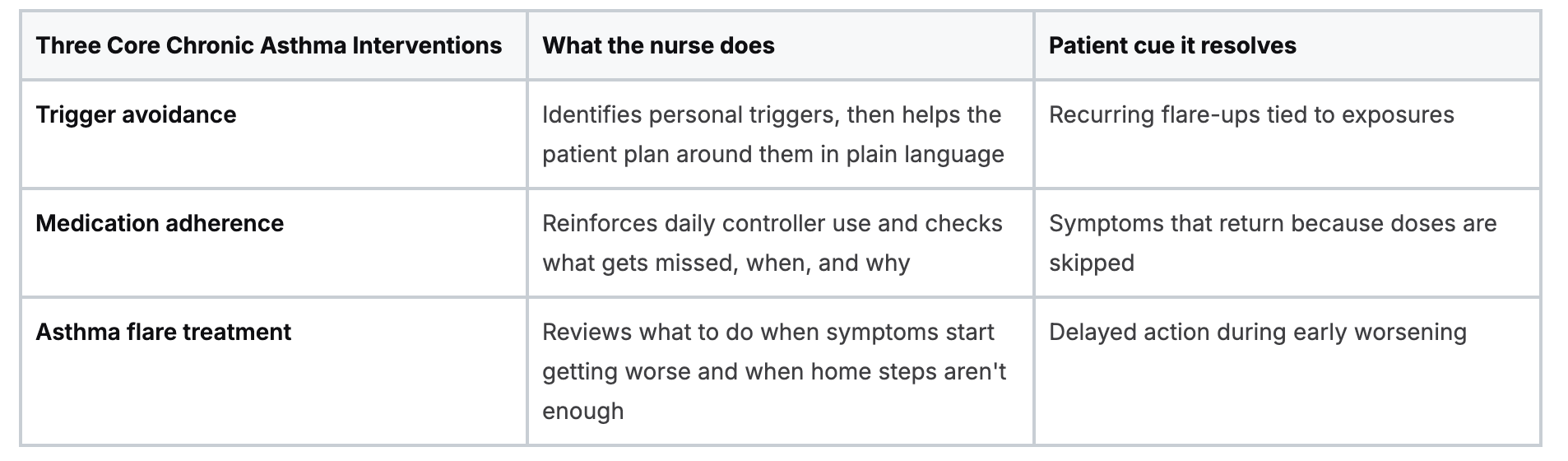
A 2022 nursing review says asthma management improves with those same three interventions, trigger avoidance, medication adherence, and asthma flare treatment, and it highlights spirometry as a definitive diagnostic tool in the workup. In practice, that means nurses should not treat symptoms alone as the whole story. The diagnosis belongs to the clinical picture, and the home plan belongs to the patient's routine.
Written action plans need to be updated, not filed away. Pediatric guidance from StatPearls says all children should have an asthma action plan updated at every office visit and revisited at every emergent or unscheduled visit (StatPearls pediatric guidance). That same logic works in adult care too. If the plan does not survive a busy week, it is not really a plan. It also has to survive real barriers, including refill gaps, transport problems, and the kind of housing or work situation that makes regular follow-up hard to keep.
Equity-Oriented Asthma Nursing Care
Standard teaching is necessary, but it's not sufficient when the barriers are structural. A patient can know how to use an inhaler and still flare repeatedly because the apartment has mold, the neighborhood has poor air quality, the family can't get refills on time, or mistrust makes follow-up unlikely. The nurse who only repeats trigger avoidance is missing the bigger machine.
A recent review of childhood asthma care identified major gaps around environmental racism, mistrust, bias, discrimination, and uneven access to resources, along with underrepresentation of health professionals from diverse backgrounds and systemic marginalization of communities (PubMed review). That matters because asthma control isn't only a knowledge problem. It's often a context problem.
Use multifaceted support, not clinic-only advice
The strongest approaches combine home, school, and clinician-based interventions, plus social-service support and school partnerships to improve adherence and access. A child with correct inhaler teaching but repeated ED use may need school medication access, family support around transportation, and someone to help connect the dots between symptoms and living conditions.
The contrarian truth is that “teach inhaler use and avoid triggers” can be necessary and still fail. If the trigger is a leaking radiator, a crowded apartment, or a caregiver who can't get time off work, education alone won't move the outcome.
Make the plan fit the patient's world
That means asking different questions. Who can give the controller during school hours? Can the family store medication safely? Is the discharge plan realistic if the patient depends on public transit or shares housing with smokers? These aren't extras, they're the plan.
For nurses working on broader systems and discharge barriers, a course such as Closing the Gaps, Advancing Equity in Social Determinants of Health fits naturally with asthma care that reaches beyond the bedside. The point is simple, if the environment keeps winning, the teaching won't hold.
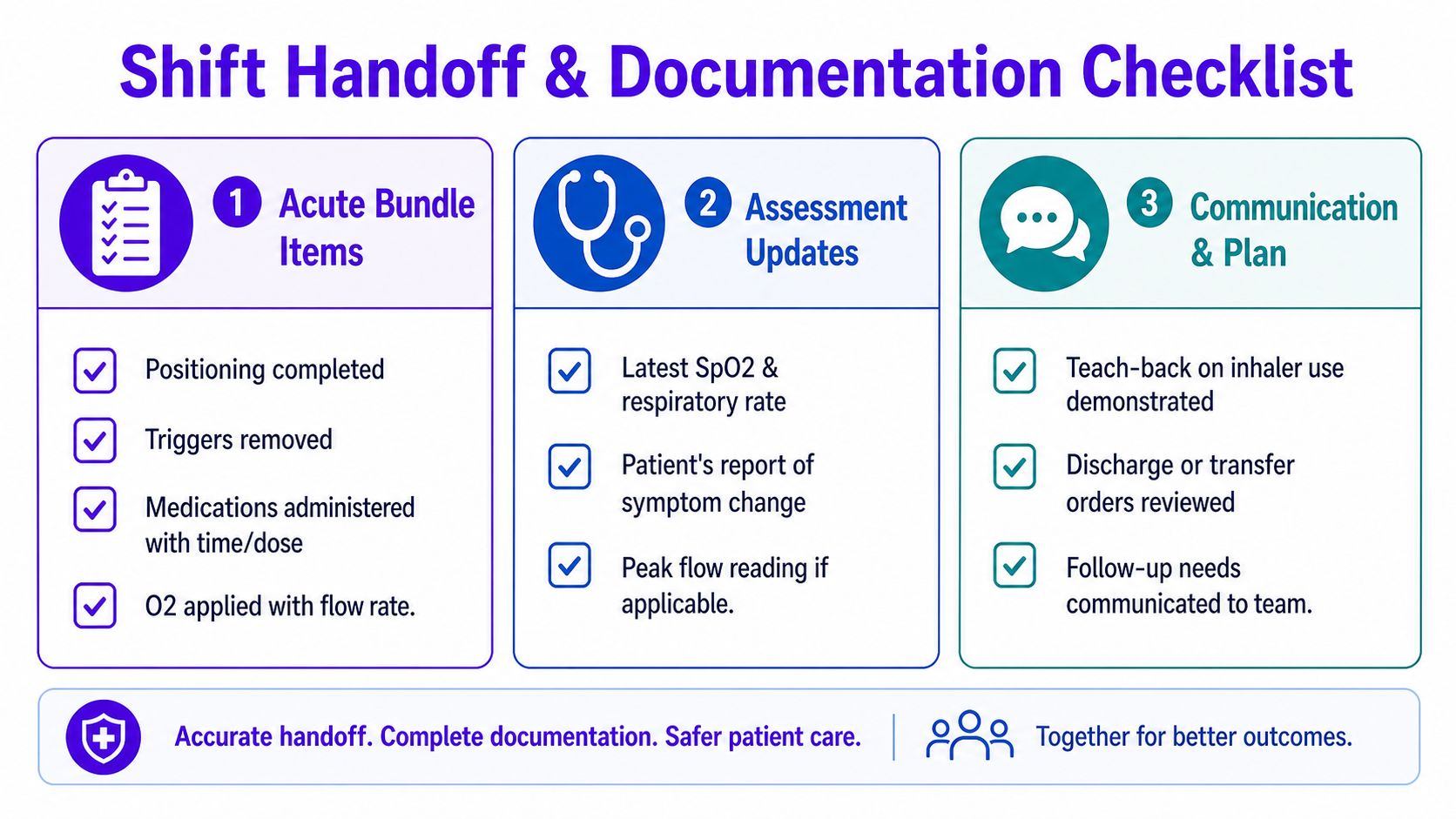
A Practical Handoff and Documentation Checklist
A strong handoff tells the next nurse what was done, what changed, and what still needs attention. In asthma, that means documenting the acute bundle, the response to inhaler teaching, and any warning signs that made the plan more urgent. A good note is short enough to scan and specific enough to act on.
In a school-nurse setting, the same logic still works. If a student used a rescue inhaler, the next nurse needs the time, the dose, the breathing response, and whether the child could repeat the action plan back in simple terms. That keeps the intervention portable across settings instead of locked to one unit.
Use a handoff note that includes these points:
- Acute care completed: Positioning, trigger removal, medication time and dose, oxygen flow rate if used.
- Current assessment: Latest SpO2, respiratory rate, work of breathing, and symptom change.
- Teaching status: Whether inhaler technique was demonstrated by teach-back, and what still needs correction.
- Escalation signs: Any poor response, altered mental status, fatigue, or desaturation.
- Plan status: Action plan present or absent, follow-up confirmed or still pending.
- Equity concerns: Access barriers, housing issues, school coordination, or family support needs that the next nurse should know.
If it wasn't documented clearly, the next shift has to rediscover it.
That checklist is what keeps asthma care from fragmenting between ED, inpatient, clinic, and school. It's also how the nurse turns a busy shift into a usable clinical story.
If this approach fits the way you teach and practice, visit Premiere Education to explore continuing education, certifications, and team-ready tracking tools that support real bedside care. Their courses and documentation tools help nurses keep asthma training, emergency response skills, and compliance work organized across shifts and settings.
Latest Posts




25% off Sitewide→
Use Code: PCECYBERSALE2025→