
.avif)
The Anxiety Nursing Care Plan That Actually Works

At 4 a.m., the call light blares from the post-op room that never stays quiet for long. The patient is gripping the siderail, asking the same question again, breathing fast, and refusing the incentive spirometer because every breath feels too big. That's the moment a real anxiety nursing care plan starts, not at the charting desk later, and not with a generic template that ignores the difference between situational panic and something more dangerous.

A nurse at the bedside has to decide fast whether this is anxiety, pain, hypoxia, medication effect, or the start of a bigger problem. That judgment gets easier when the care plan is tied to what's happening in front of the nurse, not to a vague label copied from a template. For a patient like this, practical resources such as evidence-based anxiety therapy for children can be useful for families who need a clearer picture of anxiety management, even when the bedside issue is adult acute care.
When Anxiety Shows Up at the Bedside
The post-op patient is wide awake, eyes fixed on the monitor, and every noise in the hallway seems to make the breathing worse. He asks, “Am I okay?” every ninety seconds. He also keeps saying he can't catch his breath, which is exactly why the nurse has to stop thinking in textbook language and start sorting cues.
The chart might eventually read anxiety, but the bedside assessment comes first. Restlessness, tachycardia, tension in the jaw, gripping the siderail, refusing the incentive spirometer, and repeated reassurance-seeking all matter because they tell the nurse this is not just ordinary nervousness. The scene also raises the usual questions that textbooks skip over, whether the patient is in pain, whether oxygenation is drifting, and whether a new medication is making the picture noisier than it looks.
Practical rule: if the patient is too distressed to follow simple coaching, the nurse needs a targeted plan right away, not another round of “try to relax.”
That's why a usable anxiety nursing care plan starts with what's visible at 4 a.m. and captures those cues before they vanish after a dose of medication or a quieter hallway. The nurse who documents the exact behaviors, the trigger, and the response has something defensible to work from when the provider reviews the chart later.
Reading the Patient and Naming the Diagnosis
A patient who says, “I just can't settle,” while pacing, gripping the sheet, and asking the same question again and again is giving you more than a feeling. In the NANDA-I system, Excessive Anxiety is a recognized nursing diagnosis, and current nursing references assign it code 00400. That standardized label matters because it keeps assessment, documentation, and teaching tied to the same language at the bedside.
The diagnosis also shows up often enough that nurses need to treat it like a routine part of shift thinking, not an afterthought. Reference materials note that anxiety disorders affect a large share of adults and adolescents, and that symptom severity ranges from mild to severe. Another nursing source reports that many adults describe anxiety symptoms in some form, which is why a nurse has to sort the presentation quickly instead of waiting for it to sort itself out.
What nurses actually chart
The strongest charting ties what the patient says to what the nurse sees. “I feel trapped” carries more weight when it matches pacing, facial tension, voice changes, insomnia, sweating, or urinary frequency. In the same post-op patient, the nurse also has to keep an eye on pain control, sedation, and oxygenation, because those problems can feed anxiety or look like it.
The label has to fit the pattern. Generalized anxiety is broader and ongoing. Situational anxiety has a clear trigger, like surgery, transfer to a new unit, or a frightening procedure. Panic-level anxiety is sharper and more disruptive, with a patient who cannot settle enough to absorb reassurance or teaching. If the patient is post-op, taking opioids, and getting winded with movement, the diagnosis should reflect the whole picture, not just the easiest word to chart.
One source that helps with this kind of sorting is the PTSD assessment and care planning criteria, which keeps the nurse alert to overlap between anxiety, fear, and trauma responses. When the bedside picture is still muddy, the pattern has to be compared against other diagnoses, not forced into the first label that fits. For a closer look at differential work, Cracking the Code Mastering the Differential Diagnosis of PTSD walks through separating PTSD from depression, anxiety, and related disorders with case-based tools and interprofessional collaboration.
Setting Goals You Can Actually Measure
Vague goals fail because nobody can evaluate them cleanly. “Patient will feel less anxious” sounds nice, but it doesn't tell the next nurse what improved, when it improved, or whether the plan worked. A strong anxiety nursing care plan uses measurable behavior, a timeframe, and a realistic target based on the patient's condition.
Short-term goal
For the post-op patient, a short-term goal can read: within two hours, the patient will demonstrate paced breathing with verbal coaching and maintain a calmer interaction pattern, while vital signs trend closer to baseline. If the nurse wants a more specific chartable outcome, the goal can include improved participation in incentive spirometry once pain is addressed and the room is quieter. The point is to make the outcome observable during the shift, not just hoped for by discharge.
Discharge goal
A discharge goal should reflect independence. The patient can verbalize three coping strategies, describe when to use them, and use at least one before ambulation or before calling for help unless symptoms suggest urgent deterioration. That matters for an older post-op patient on opioids because drowsiness, pain, and fear of movement can all make anxiety come back the second the nurse leaves the room.
Useful charting standard: if the goal cannot be checked against a behavior, it probably needs to be rewritten.
A good goal pair also separates immediate symptom control from longer-term coping. Short-term breathing control may be appropriate for the current shift, while discharge teaching focuses on what the patient can do later without nurse coaching. The nurse should avoid goals that only describe emotion, because chart review needs evidence, not guesses.
Interventions That Move the Needle
The post-op patient from 4 a.m. does not need a lecture. He needs calm, targeted nursing action that fits the trigger, the setting, and the severity of his response. The most useful interventions fall into four nurse-controlled groups, and each one works better when it's tied to the actual situation instead of pulled from a template.
Therapeutic communication
Start with active listening and short validation. “You're safe, and I'm staying with you while we get this under control” is more useful than a stream of empty reassurance. If the patient can follow coaching, use a controlled breathing script that he can repeat, and keep the language simple enough to work during distress.
Environmental control
A chaotic room makes anxiety worse. Cluster care, dim the lights around 0200 or 0400 when possible, close the door before a breathing exercise, and cut unnecessary alarm noise when policy allows. If a nebulizer is likely to raise the heart rate, coordinate with respiratory therapy first so the patient isn't getting another stimulus while already frightened.
Patient teaching
Teaching should be concrete. Before a procedure, explain what happens, what it feels like, and what the patient is likely to hear or see. Teach the purpose and common side effects of ordered medications, name personal triggers when the patient can identify them, and reinforce practical self-management strategies such as deep breathing, grounding, journaling, or mindfulness education from the NCBI nursing interventions table for anxiety.
Pharmacologic collaboration
Medication is part of the plan when it's ordered, but it should not become the whole plan. If the patient has breakthrough symptoms, the nurse should time PRN anxiolytics around predictable peaks when possible, and alert the provider when the distress doesn't match the order set. Pain has to be treated on its own terms, because anxious breathing after surgery often looks worse when pain is ignored.
The bedside chart should reflect both action and response. A note that says the patient accepted guided breathing after the room was cleared tells the next nurse something useful. A note that says the patient “remained anxious” without describing what was tried tells almost nothing.
When Anxiety Signals Something Bigger
Anxiety does not always travel alone. In high-acuity patients, it often overlaps with poor sleep, cognitive changes, and delirium risk, which is why nursing care has to widen when the patient stops responding to simple reassurance. The ICU study on structured anxiety-focused nursing intervention found lower anxiety in the intervention group, better cognitive function, and lower delirium incidence, with significant findings across all three outcomes. That is the kind of signal nurses should pay attention to when the bedside picture gets messy.
The escalation pattern is usually obvious if the nurse keeps watching. If the patient's oxygen saturation drifts, if pain spikes, if orientation changes, or if a previously calm patient becomes visibly disorganized at night, anxiety should stop being treated as a standalone issue. The plan may need another nursing diagnosis layered in, such as impaired gas exchange, acute confusion, or sleep disturbance, depending on the assessment.
A worried patient who becomes confused is not just “more anxious.” That is a change in clinical status until proven otherwise.
The nurse integrates physical and psychological data. A patient can appear panicked due to hypoxia, withdrawal, medication effects, or delirium, and the chart must reflect that possibility rather than using a generic label. In higher-risk situations, the nurse should contact the provider, review labs if indicated by the clinical picture, and tighten safety measures if self-harm risk or unsafe behavior is present. For practical crossover thinking, the nursing diagnosis for suicide prevention practical guidance for clinical care article is relevant when anxiety becomes a safety concern rather than routine distress.
Evaluating the Plan Like a Charge Nurse Would
Evaluation is where weak plans get exposed. The charge nurse looks for proof that the goal was met, partially met, or not met, then checks whether the chart explains why. A good evaluation note does not just repeat the intervention, it compares outcomes against the actual goal.
What a defensible note looks like
If the short-term goal was controlled breathing and calmer interaction, the note should say whether the patient used the breathing script, whether the room adjustments helped, and whether the patient's behavior changed during the shift. If the discharge goal was coping strategy use, the note should show whether the patient could name the strategies without prompting and whether the patient participated in self-care tasks. If the patient still cannot ambulate without escalating distress, the plan needs revision.
A practical evaluation format looks like this:
- Goal status: met, partially met, or not met.
- Supporting evidence: exact behavior, vital sign trend, sleep pattern, participation in care.
- Plan revision: continue, modify, or escalate.
Documentation should include timestamps and clear escalation language. SBAR works because the next nurse can follow it without guessing. “At 0415, patient had worsening restlessness, repeated reassurance-seeking, and refused spirometry after pain medication. At 0430, oxygenation was reassessed and provider notified because anxiety remained severe despite nonpharmacologic interventions” is much stronger than “patient still anxious.”
The diagnosis itself may need to change if the response worsens. Panic-level anxiety, impaired gas exchange, or acute confusion may fit better than a routine anxiety label when the clinical picture shifts. That is not over-documenting, it's honest nursing judgment.
Quick Reference and Common Questions
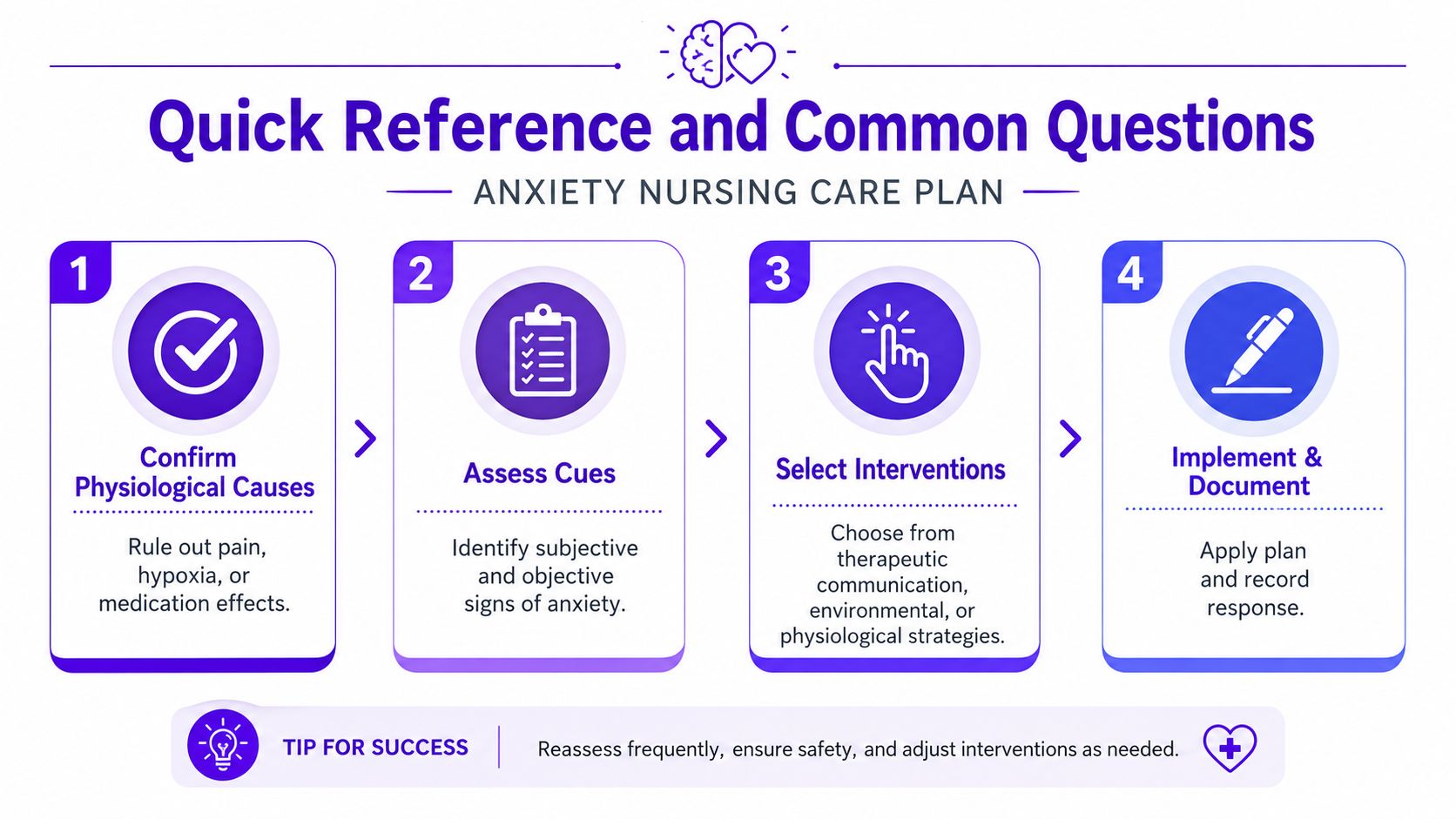
A shift-ready anxiety plan starts with the patient in front of you, not the template. Check whether pain, hypoxia, medication effects, withdrawal, or delirium are driving the behavior, then judge the anxiety cues you can see and hear. From there, choose the diagnosis that fits the pattern, match the intervention to the trigger, and document the response. If safety is slipping or the patient is getting worse, escalate without waiting for the chart to catch up.
Quick checklist
- Confirm physiologic causes: check pain, oxygenation, medication timing, and recent changes.
- Assess cues: note what the patient says, what the body shows, and what changed from baseline.
- Choose the diagnosis: use the label that fits the pattern, not the easiest one to copy.
- Write measurable goals: include behavior, timeframe, and a result you can verify.
- Match the intervention: use communication, environment, teaching, or collaboration based on the trigger.
- Reassess and document: record response, not just effort.
- Escalate if needed: call the provider or get mental health support when the pattern worsens.
Common questions nurses ask
Is anxiety an approved nursing diagnosis? Yes. It is recognized in the NANDA-I taxonomy, including the 2024 to 2026 edition used in current nursing references. If you want continuing education that supports this kind of bedside reasoning, Premiere Education's mental health course options are a practical place to look.
How is anxiety different from fear? Fear usually points to a more immediate, identifiable threat. Anxiety is broader, more diffuse, and often harder for the patient to name.
Can a generic plan be individualized? Yes, but only if the nurse ties it to the trigger, the patient's baseline, and the response to intervention. A copy-paste care plan falls apart at the bedside.
When does medication move up the list? When ordered medication is needed because nonpharmacologic steps are not enough, or when symptoms are severe enough that the patient cannot engage in coaching.
Can anxiety be the priority diagnosis if something else is going on? Sometimes, but not when pain, hypoxia, substance withdrawal, or delirium is the clearer immediate threat. The priority has to follow the actual risk.
The fastest way to make an anxiety nursing care plan work is simple, even if the patient is not. Rule out the physical cause, write a goal that can be checked, pick interventions that fit the trigger, and document what changed. That is how the plan stays useful at 4 a.m., and that is what the next nurse needs to trust it.
Latest Posts





25% off Sitewide→
Use Code: PCECYBERSALE2025→