
.avif)
Continuing Education Requirements for Nurse Practitioners
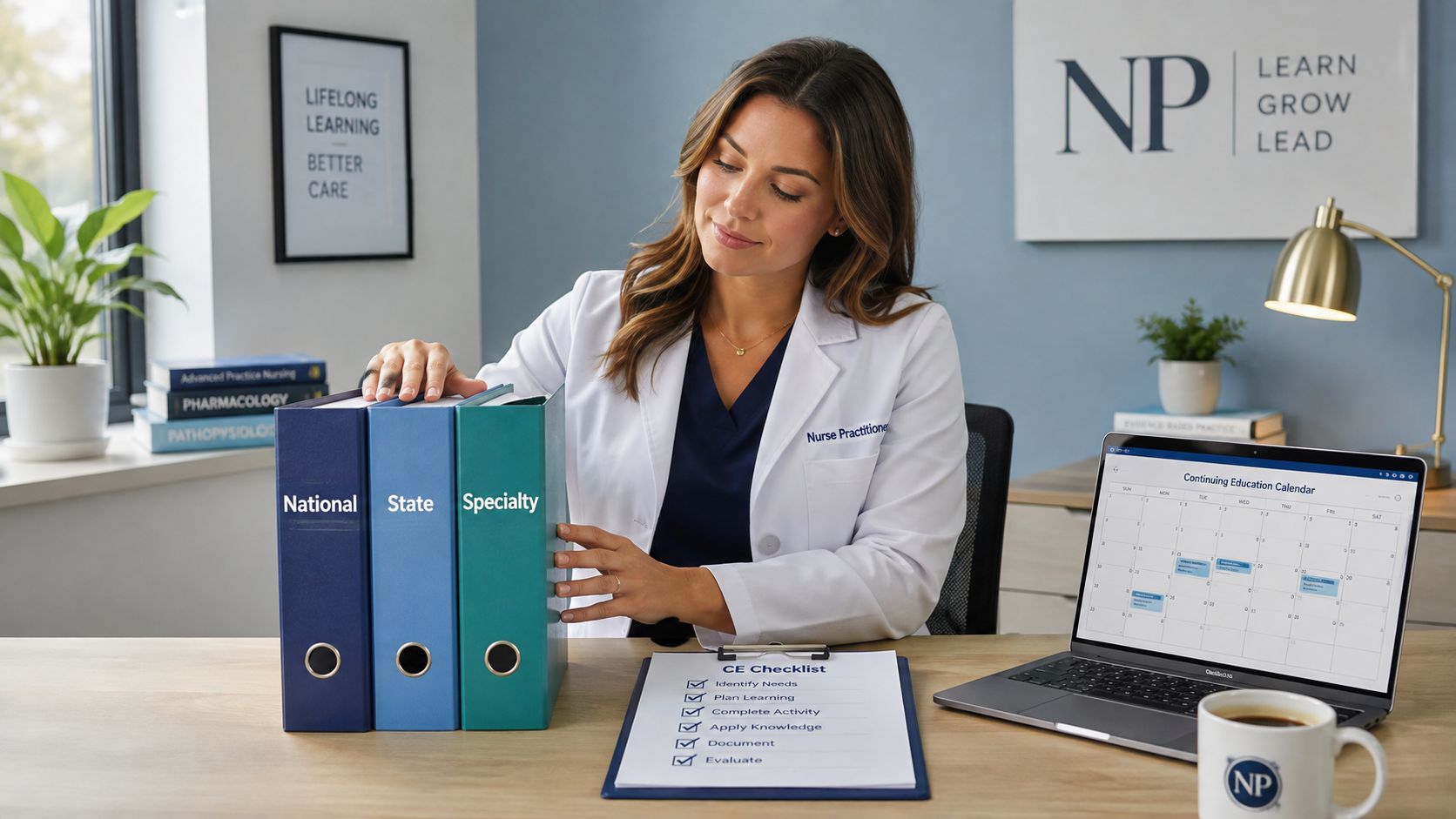
Renewal season often arrives as a pair of conflicting reminders. An FNP may receive one message from a national certifying body, another from a state board, and a third notice connected to prescribing privileges or a collaborative practice agreement. Each message may list different topics, deadlines, and credit totals, leaving one practical question: which nurse practitioner continuing education requirements control the right to practice?
The answer becomes clearer when CE compliance is treated as a layered stack rather than one master checklist. National certification, state licensure, and prescriptive authority can overlap, but they don't serve the same purpose. The safest planning rule is simple: identify every applicable layer, then follow the strictest requirement that applies to the credential or authority being renewed.
The Three-Layer Stack of NP Continuing Education Requirements
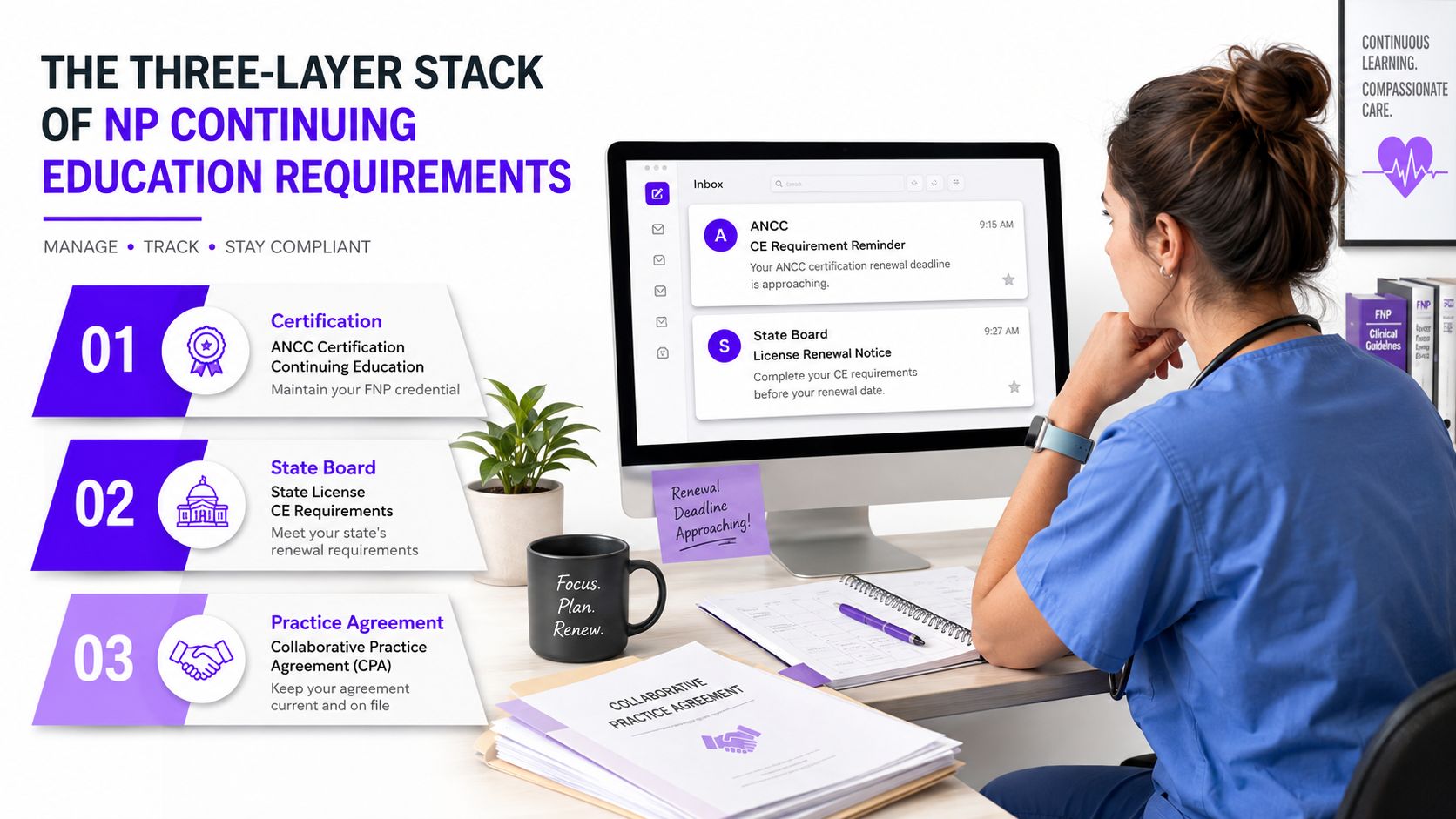
An FNP sits at her desk in scrubs, scanning two renewal emails before the first patient arrives. The ANCC message points to certification renewal. The state board message lists licensure obligations. A collaborative practice agreement in the same stack of papers calls for opioid-related education. None of the reminders is necessarily wrong, but each one governs a different part of her professional status.
Layer one national certification
The national certifying body determines whether the NP can maintain a specialty credential such as an FNP certification. ANCC and AANPCB set their own renewal cycles, total contact-hour expectations, pharmacology rules, and accepted educational activities. A national certificate supports professional recognition, but it doesn't replace a state license.
Layer two state licensure
The state board controls the legal license to practice within that jurisdiction. State rules may require general contact hours, specialty education, pharmacology, active practice, or subject-specific training. Those rules can be more frequent or more specialized than the national certification standard, as the state comparisons later in this article demonstrate.
Layer three prescriptive authority
Prescriptive authority adds another compliance track. A state may require extra pharmacotherapeutics or controlled-substance education for an NP who prescribes, while an employer or collaborative agreement may impose additional learning expectations. A course that satisfies general licensure might not satisfy a prescribing-specific rule.
A useful planning resource is Premiere Education's accreditation information, but the final authority remains the applicable certifying organization, state board, and prescribing regulator.
Practical rule: A national certificate can confirm specialty competence, but the state license and prescribing authority determine whether the NP may practice and prescribe under local rules.
When requirements conflict, the strictest applicable layer wins in almost every state. An NP who tracks only the national certificate may remain certified yet fall short of state licensure or prescribing obligations. An NP who tracks only the state license may renew legally but discover a certification gap later.
How Contact Hours and CEUs Actually Work
A contact hour represents 60 minutes of learning, not the time a learner remains logged into a webinar. The AANP approved provider policy defines 1.0 contact hour as 60 minutes of learning and states that AANP CE activities don't provide less than 0.25 contact hours.

The distinction resembles billing. A clinician can't automatically bill a 15-minute visit as a quarter-unit service unless the billing rule and documentation support it. Likewise, a 50-minute webinar isn't automatically one full contact hour. The provider must identify the instructional time, learning activity, and completion method, then award the credit shown on the certificate.
Contact hours, CEUs, and CME
NPs also encounter AMA PRA Category 1 CME credits, nursing CEUs, and nursing contact hours. These terms don't always convert one-to-one. ANCC and state nursing boards commonly ask for nursing contact hours, while physician-oriented activities often issue CME, so the certificate type matters before an activity gets added to a renewal log.
A certificate that says “CME” may be clinically useful but not automatically acceptable for a particular nursing requirement. The NP should verify the accrediting provider, credit type, specialty designation, and whether the state board accepts that activity.
The guide to accredited versus state-approved nursing CE can help clarify that distinction. For prescribing-focused education, the DEA MATE Controlled Substances Training Package describes 10 total hours of training that can be completed on the learner's own time before the next DEA license application or renewal. The NP still needs to confirm how that training fits the specific state and credential rules.
National Certification Standards for NPs
National certification requirements create a baseline for specialty recertification, but they don't necessarily determine the full CE burden. The two major pathways commonly used by NPs illustrate why the certificate holder must read the exact handbook rather than rely on a general rule of thumb.
ANCC requires 75 continuing education contact hours every five years for NP or CNS certification renewal, including 25 pharmacology hours and completion of at least one professional-development category listed by the organization. That total averages 15 hours per year before state, employer, or specialty requirements are added. The ANCC renewal requirements provide the governing details.
AANPCB commonly requires 100 contact hours over five years, also including 25 pharmacology hours, according to the available certification guidance. That averages 20 hours per year. The AANP certification and pharmacology explanation describes the 100-hour advanced continuing education benchmark and its 25-hour pharmacology component.
Side-by-side comparison
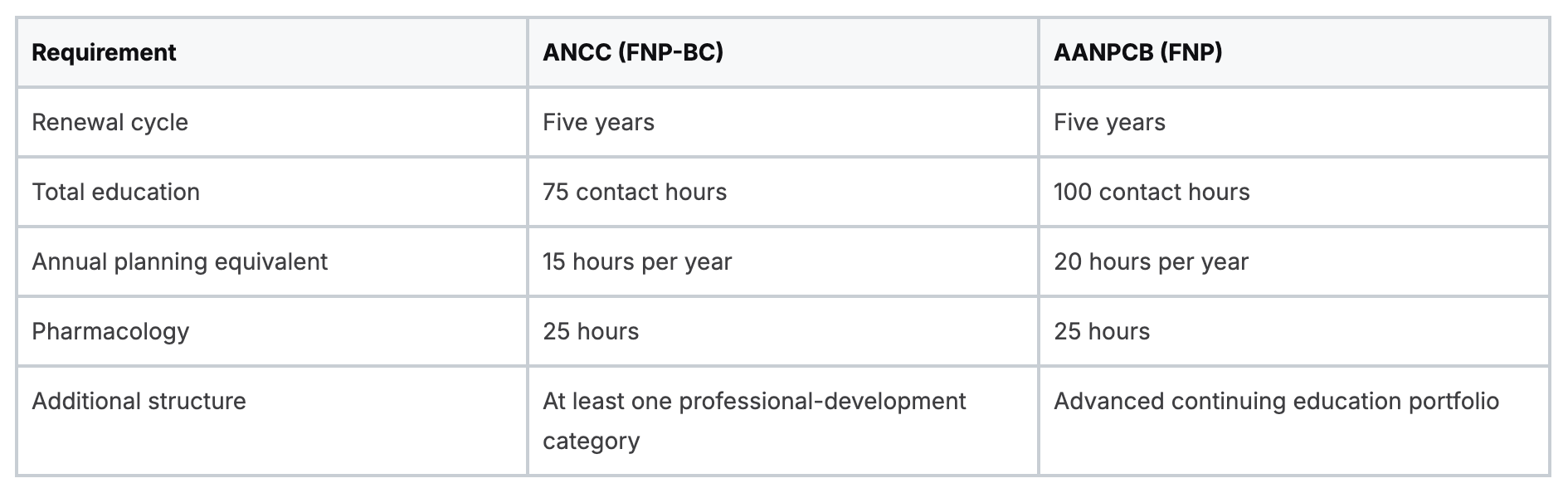
The pharmacology concentration deserves attention. For ANCC, 25 of 75 hours is roughly one-third of the total. For AANPCB, 25 of 100 hours is one-quarter. Those proportions aren't merely mathematical details. They affect course selection, because a portfolio full of broad clinical topics can leave an NP short of the required pharmacology density even when the total appears complete.
A current RN license is also part of ANCC FNP-BC renewal planning, and accepted provider accreditation matters. A course should be checked for the accrediting statement and certificate language before completion, not after the renewal deadline.
The practical conclusion is that national certification sets the floor, not the ceiling. State licensure may require a larger or more specialized portfolio, and prescriptive authority may create another content-specific obligation.
State Licensure Rules That Override National Minimums
State licensure can change the renewal calculation completely. An NP may satisfy a national certification cycle and still lack enough state-approved education to renew an active practice license. The state-by-state nursing CE requirements guide is a useful starting point, but the state board remains the controlling source.
The verified examples show a substantial spread. Texas APRNs must complete 20 contact hours every two years. North Carolina requires 50 contact hours every two years for nurse practitioners, with at least 20 hours connected to the NP's national certification and approved by an appropriate national credentialing body or ACCME-recognized source. New Hampshire requires 60 contact hours every two years, with specialty and pharmacology conditions layered into the total. These requirements are summarized in the relevant NP continuing education overview.
State comparison
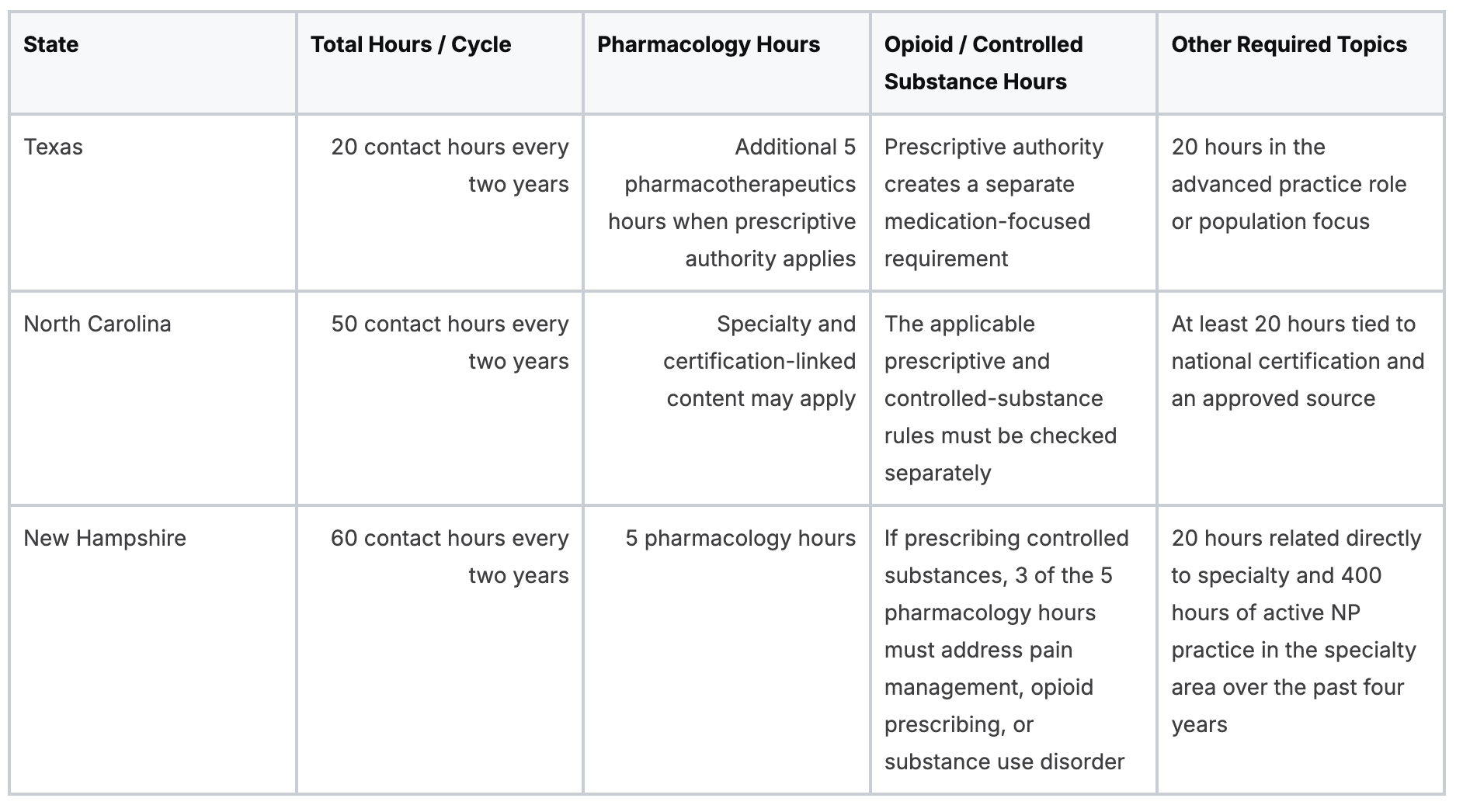
Texas demonstrates why a generic total can mislead. The state requires 20 contact hours in the advanced practice role or population focus, and prescriptive authority adds 5 pharmacotherapeutics hours. The Texas Board of Nursing classifies this as a continuing competency requirement, so organizations should map assignments by scope of practice, not job title alone. Its APRNs continuing education guidance is the appropriate reference.
North Carolina and New Hampshire illustrate a different problem. Their requirements connect CE to certification, specialty, pharmacology, practice activity, or controlled-substance prescribing. If a state rule is silent on a particular pharmacology category, the national certification requirement may fill that gap, but silence doesn't erase the certification obligation.
A Practical CE Plan for a Working Nurse Practitioner
Consider a fictional primary care FNP in Texas who has prescriptive authority and maintains ANCC certification. She doesn't begin by searching for random courses that add up to a convenient number. She first creates three columns in a planning sheet: Texas licensure, ANCC certification, and prescribing-related education.
Her first filter is content. Texas requires 20 contact hours every two years in the advanced practice role or population focus, while prescriptive authority adds the pharmacotherapeutics requirement. ANCC adds its five-year portfolio and pharmacology expectations. She therefore labels each selected activity by total contact hours, pharmacology hours, specialty relevance, and evidence of a practice gap.
A calendar built around clinical work
In the first quarter, she completes a primary care activity addressing diabetes management because her panel's quality review shows missed A1C targets. She records the activity's title, provider, accreditation, contact hours, and the clinical problem that prompted the selection.
During the second quarter, she chooses pharmacotherapeutics content that fits her prescribing scope. Instead of assuming that any medication update counts, she verifies that the certificate identifies the credit as pharmacology or pharmacotherapeutics and that the activity is acceptable for the relevant credential.
The third quarter is reserved for a broader population-focus topic. She selects content applicable to the patients she treats, then checks whether the hours can be used for both Texas renewal and ANCC documentation. Dual use is helpful, but she still logs the activity separately under each rule rather than assuming one record proves everything.
In the fourth quarter, she reviews her totals and gaps. Her spreadsheet includes separate running totals for general contact hours, pharmacology, specialty content, and practice-gap activities.
The certificate proves completion. The planning log proves why the activity belonged in the portfolio.
This method prevents a common late-renewal error. An NP can collect enough total hours while missing a required category, such as pharmacology or specialty-focused education. The fictional FNP avoids that problem by assigning each course to a compliance purpose before enrolling.
She also checks whether her employer or collaborative agreement imposes additional expectations. Those requirements may not appear in the Texas license renewal total or the ANCC certification handbook, but they can still affect the conditions under which she practices.
Practice Gaps and the 2026 Accreditation Expectation
A topic list isn't the same as a learning plan. A practice gap is the distance between current performance and a defined clinical or professional standard. For example, an NP who identifies missed A1C targets in a patient panel has a concrete reason to choose diabetes-focused education. The topic isn't arbitrary, and the learning objective can be connected to a documented need.
ANCC-related 2026 guidance emphasizes a traceable line from an identified practice gap to the learning outcome, content design, and evaluation. The 2026 ANCC NCPD criteria guide describes the expectation that activity files retain planning and needs-assessment evidence.
What the shift changes
The practical question is no longer only, “How many hours did the NP complete?” It also becomes, “Why was this activity selected, what did it aim to change, and how was learning evaluated?”
An NP doesn't need a lengthy academic paper for every course. A brief record can identify the practice concern, the relevant standard or clinical priority, the selected activity, and the action that will follow. A follow-up might involve reviewing prescribing patterns, revising patient education, or discussing a protocol with the clinical team.
This documentation discipline benefits both learners and providers. Providers can show that an activity was designed around a real need. NPs can explain their choices if a certifying organization, employer, or reviewer asks for more than a completion certificate.
Audit-ready CE connects attendance to intent.
Online and on-demand formats make this especially relevant because flexible learning is increasingly important to working clinicians. The cited guidance reports that 83% of NP respondents practicing less than five years had at least some online education, with 23% fully online. Those figures appear in the source's discussion of changing education preferences, and they reinforce the need for convenient courses that also preserve a defensible record.
Documentation and Audit Readiness for NPs
An audit is easier to manage when the folder already answers the reviewer's questions. A dated folder for each renewal cycle should contain every certificate, the provider's name, accreditation statement, contact hours awarded, and completion date. The folder should also preserve the rationale or needs assessment connected to each activity, especially as accreditation expectations move upstream from attendance to educational intent.

A workable file structure
A folder named with the renewal cycle date can contain one subfolder per activity. The filename should make the record searchable, such as “Pharmacology, provider, completion date.” A separate spreadsheet can track total hours, pharmacology, opioid or pain-management education, specialty content, and practice-gap activities.
For states that use CE Broker, the NP should reconcile uploaded entries against the personal log quarterly. A mismatch is easier to correct while the certificate and provider record are readily available than after a renewal deficiency appears.
A documentation checklist should include:
- Certificate details: Provider name, accreditation statement, credit type, hours awarded, and completion date.
- Content categories: Pharmacology, specialty, opioid or pain management, and any state-specific topic should be recorded separately.
- Needs assessment: Retain the brief reason the activity was selected and the intended practice change.
- Reporting record: Compare CE Broker or other agency entries with the personal log where applicable.
- Retention plan: Keep records for at least two full renewal cycles.
The working NP educator's test is practical: if a board reviewer can't confirm an activity within ten minutes from the folder, the record isn't audit-ready. Clear naming, consistent categories, and retained rationale turn an audit from a scramble into a verification task.
A Reusable Renewal Cycle Checklist
The three-layer stack can fit on one planning page. At month zero, the NP pulls the current state board rule, national certifying body rule, and prescriptive authority add-on, then writes the requirements side by side.
The strictest applicable layer sets the working target. The NP partitions that target before selecting courses:
- Confirm the state layer: Record total hours, renewal period, specialty rules, and state-specific subjects.
- Confirm the national layer: Record certification hours, pharmacology requirements, accepted providers, and professional-development categories.
- Confirm prescribing conditions: Add pharmacotherapeutics, controlled-substance, pain-management, or collaborative-agreement requirements.
- Map the portfolio: Assign each course to a total-hour, pharmacology, specialty, or practice-gap category.
- Review quarterly: Reconcile certificates, personal logs, and CE Broker entries where applicable.
- Protect the final buffer: Reserve a 60-day pre-renewal period to locate missing credits or retrieve delayed transcripts.
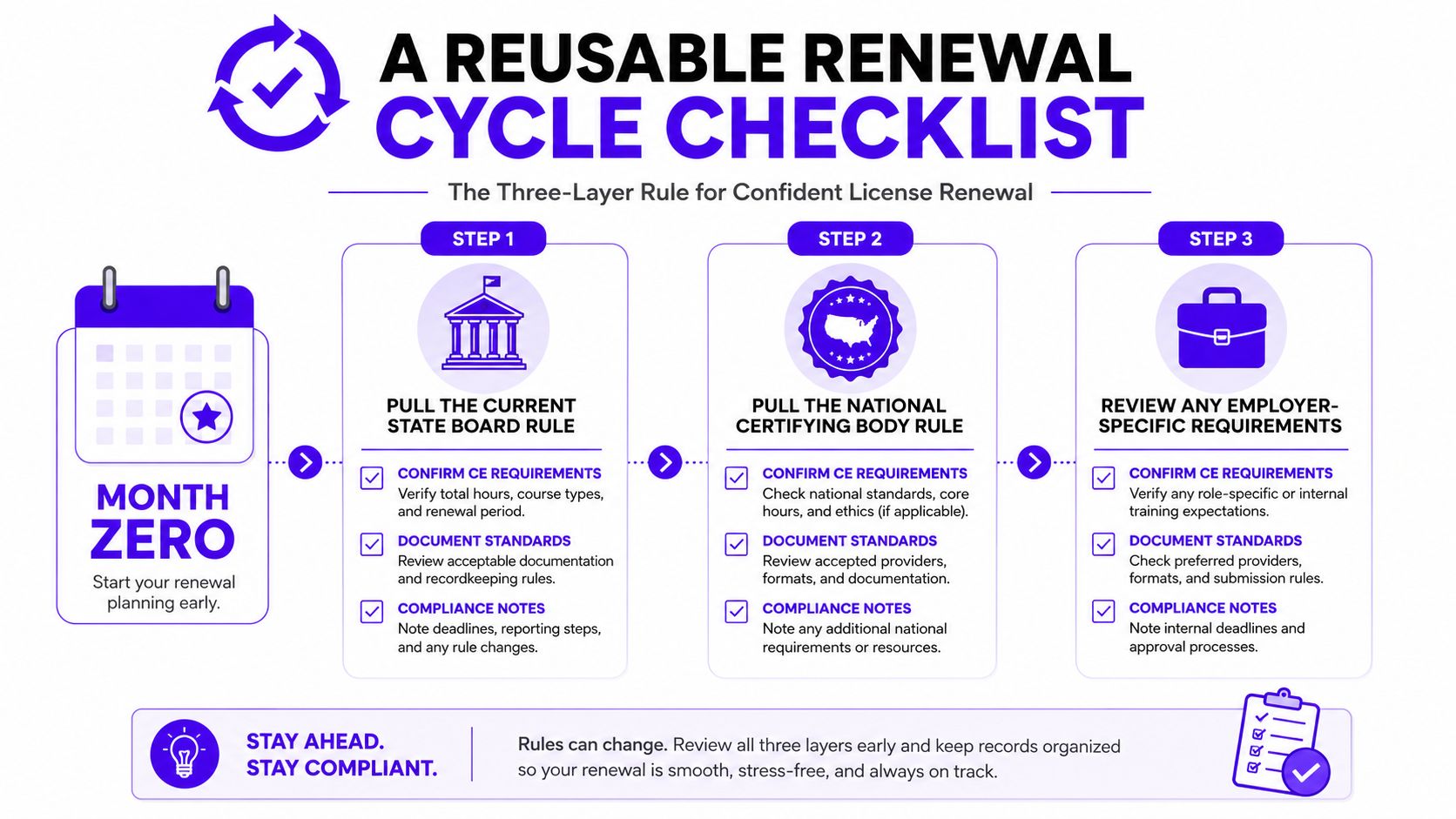
The template should be reused each cycle, with dates and practice-gap priorities updated from the most recent quality data. That habit keeps the NP from treating renewal as a last-minute hunt for hours and makes each course serve a documented compliance or clinical purpose.
Premiere Education provides accredited CE courses, certifications, completion certificates, tracking tools, and reporting support for healthcare professionals managing renewal obligations. NPs can review the available options through Premiere Education and compare courses with the requirements in their state, certification pathway, and prescribing scope.
Latest Posts




25% off Sitewide→
Use Code: PCECYBERSALE2025→