
.avif)
Accredited Nursing Courses: A Practical Guide

Renewal season often looks simple until one email changes the entire month. A nurse finishes a stack of online modules, downloads certificates, enters the hours, and assumes the file is complete. Then the board, an employer, or a credentialing office asks a harder question: who approved this course, under what pathway, and can that approval be verified for this specific requirement?
That's where many smart nurses get trapped. The course may be legitimate. The content may be useful. The certificate may even carry a familiar logo. But accredited nursing courses only help with renewal when the approval chain, contact-hour calculation, and documentation all line up with the rule that governs the nurse's license or certification.
In 2026, that gap matters more. Nurses still need strong content, but they also need clean records, provider details, and state-specific checks that hold up if someone audits the file later.
When a Renewal Audit Changes Everything
Maria, a charge nurse in Ohio, thought the hard part was done. She had completed her continuing education, saved her certificates, and submitted her renewal paperwork on time. Then a notice arrived saying that part of her file couldn't be verified.
The problem wasn't that she had skipped learning. The problem was traceability. Several of her certificates showed recognizable continuing-education branding, but when reviewers checked the provider pathway against the rule that applied to her renewal, some of the hours didn't line up cleanly enough to accept without more proof.
For the next two weeks, Maria did what many nurses end up doing under pressure. She searched old emails, logged back into course portals, requested duplicate certificates, and tried to figure out whether the issue was the course itself, the provider, or the wording on the certificate. That scramble felt worse because the courses had seemed safe at the time.
Why the panic starts so fast
A flagged renewal creates more than paperwork stress. It can spill into hospital credentialing, job applications, and internal compliance reviews. If a manager asks for proof and the nurse only has a completion screenshot or a vague certificate, the burden shifts back to the learner.
Practical rule: A certificate isn't the same thing as acceptance. A renewal file has to show a chain that another reviewer can follow without guessing.
That's the value of accredited nursing courses. Accreditation isn't a decorative label. It's a documented quality and approval structure that other parties can verify.
Why accreditation matters in the real world
Formal nursing education accreditation in the United States goes back to 1893, and the modern nursing continuing-education accreditation system was formally launched after a 1974 American Nurses Association House of Delegates resolution. The first formal accreditation for nursing continuing education was granted in 1976, and the system grew from state-level approval toward a national model in the late 1970s, as outlined in the CCNE history of nursing accreditation.
That history matters because it shows that accredited nursing courses aren't a new marketing phrase. They sit inside a structured quality-assurance system that has been evolving for more than a century.
Maria's problem is common because nurses are often told to “look for the ANCC logo” and stop there. That's incomplete advice. The logo may be part of the story, but renewal success usually depends on whether the provider, the activity, the certificate wording, and the state rule all fit together.
What Makes a Nursing Course Accredited
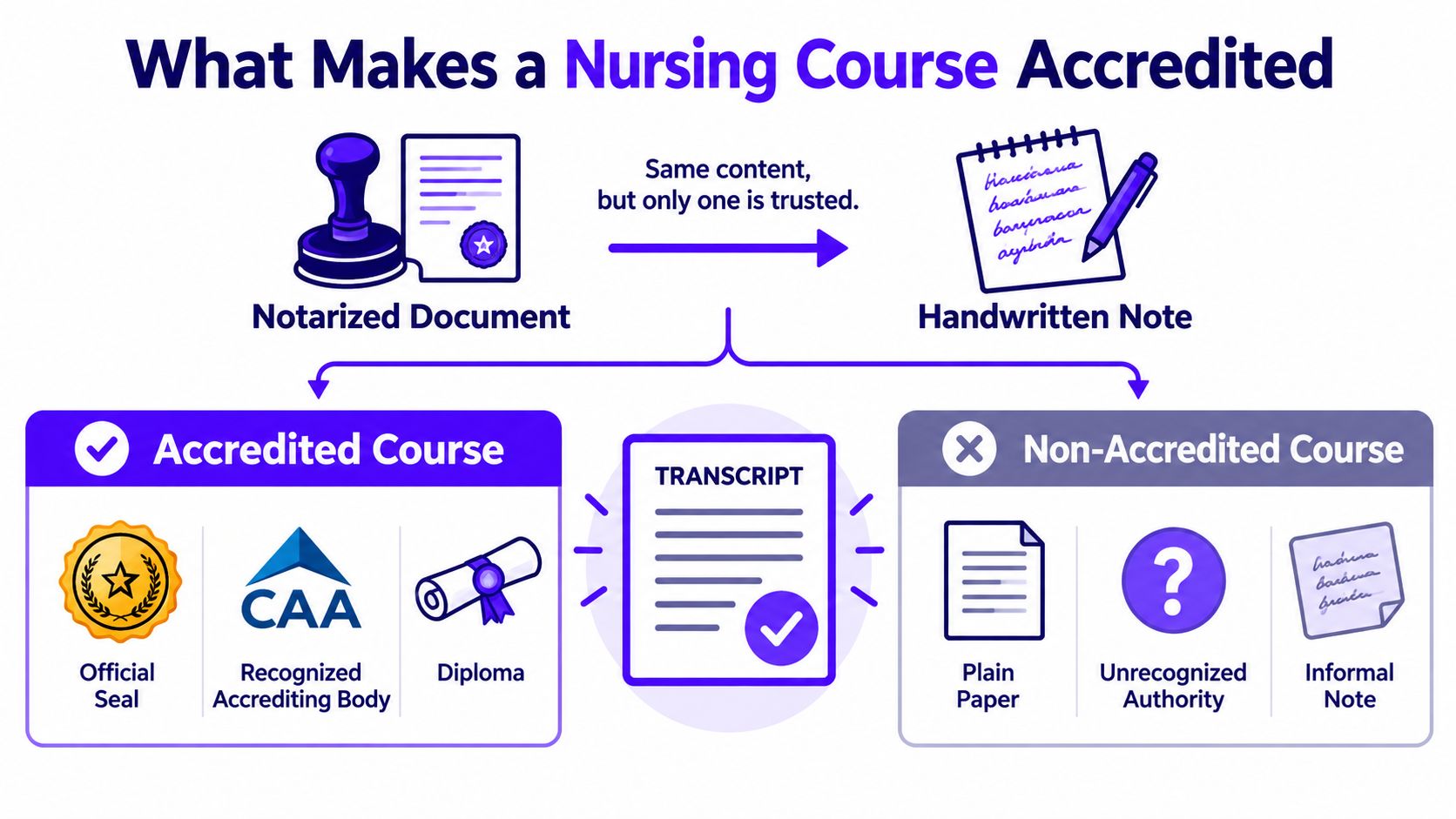
A simple way to explain accreditation is to compare it to paperwork. A handwritten note and a notarized document can say the same thing. Only one carries built-in trust when someone else reviews it later.
That's how accredited nursing courses work. The content may cover the same topic as a non-accredited class, but accreditation adds a review and approval pathway that makes the learning count in regulated settings.
The two levels nurses often confuse
The first level is the organization behind the course. The second is the activity itself.
An organization may be allowed to award nursing continuing professional development contact hours through one of three valid routes recognized by ANCC: becoming an ANCC Accredited Provider, becoming an Approved Provider through a constituent or state nursing association, or obtaining Individual Activity Approval from an ANCC Accredited Approver. ANCC also states that ineligible companies can't award these hours, according to its NCPD accreditation FAQs.
That distinction matters because many nurses look only at course branding. The better question is whether the organization had a valid pathway to award the contact hours shown on the certificate.
What the accrediting structure actually checks
ANCC describes its Nursing Continuing Professional Development accreditation as a formal peer-review system for organizations worldwide. Applicants must pass a systematic review and meet criteria in the policy and operations manual, as explained in the ANCC NCPD accreditation overview.
For nurses choosing coursework, that translates into practical questions:
- Who can award the hours: The provider needs a valid approval route.
- How the activity was built: The planning process has to meet educational standards.
- What appears on the certificate: The approval language needs to support verification later.
A real-world example helps. A course on postpartum depression may be clinically useful on its own. Beyond the Birth Enhancing Healthcare Provider Expertise in Postpartum Depression addresses risk factors, symptom recognition, and collaborative care strategies for postpartum depression. For renewal purposes, though, the nurse still has to confirm that the activity is offered through a recognized approval pathway and matches the relevant requirement.
Nurses who want to review how providers present these pathways can compare accreditation information on a page like Premiere Education accreditations.
A useful course answers a clinical need. An accredited course also answers the compliance question that comes after completion.
Why the logo alone can mislead
A course can appear professionally built and still fail a state-specific check. That's the surprise point for many nurses. ANCC-related approval tells a reviewer something important about the provider or activity, but it doesn't erase state board rules.
That's why “accredited” and “accepted for this nurse's renewal” are related, but not identical, ideas.
ANCC and State Board Approval Compared
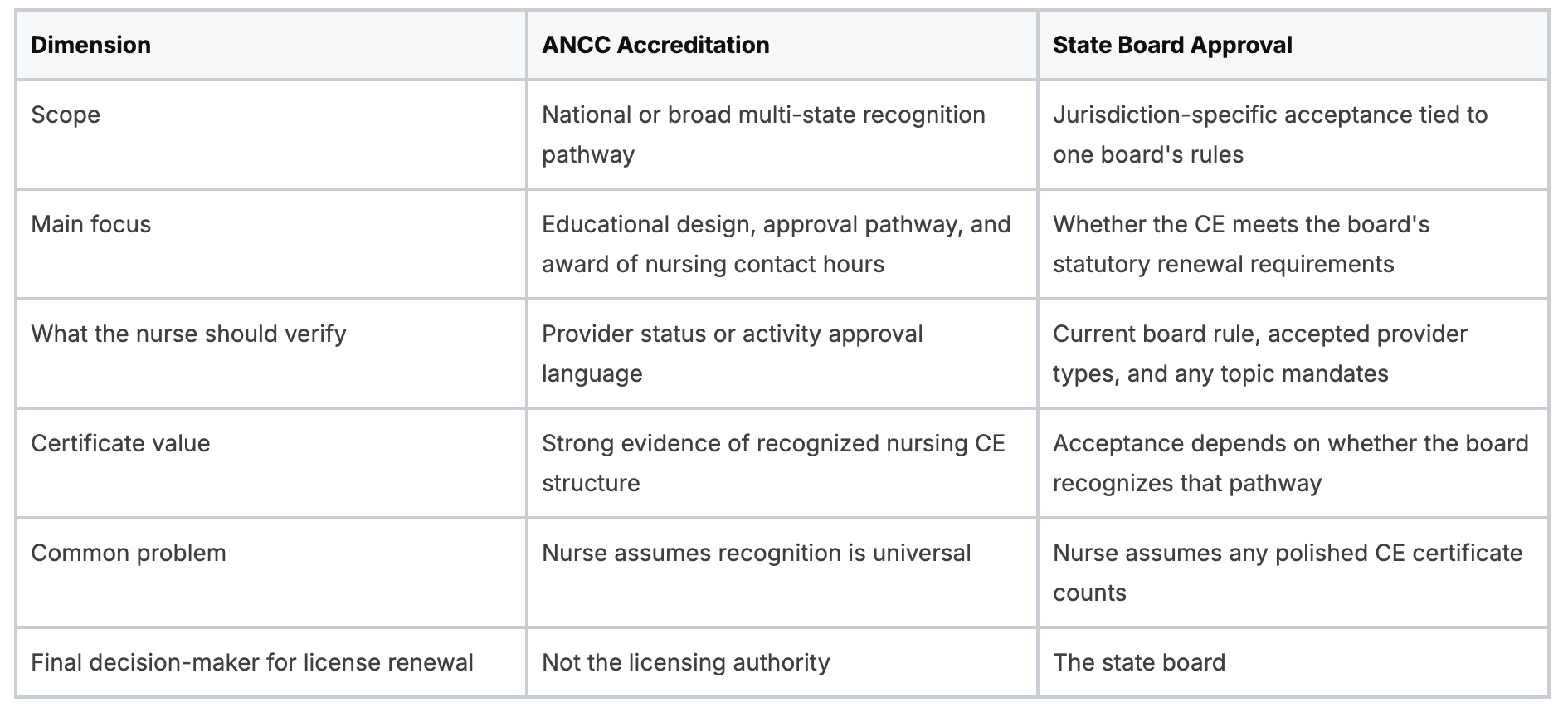
Nurses often treat ANCC accreditation and state board approval as if they're interchangeable. They aren't. They overlap, but they solve different problems.
ANCC focuses on the quality and approval structure of nursing continuing education. State boards focus on what counts under that jurisdiction's renewal rules. When a nurse renews a license, the board remains the final authority.
A side-by-side view
What ANCC validates
The current ANCC network is large. ANCC lists 502 NCPD-accredited organizations, 201 jointly accredited organizations, and 339 Practice Transition Accreditation Programs operating across 1,265 healthcare sites, according to the ANCC Provider Manual 2025. The same manual also emphasizes that contact hours are awarded only for the learning portion of an activity plus evaluation time.
That tells nurses two things. First, accredited nursing courses are delivered through a broad institutional network, not a tiny niche market. Second, the hour calculation has to be defensible.
What state boards care about
State boards tend to care less about branding and more about proof. A major source of confusion is that many nurses ask whether a course is “accredited,” when the more useful check is whether the board accepts that provider or approval pathway for the nurse's renewal category.
Recent guidance points nurses to the accreditation statement, provider number, and the actual board rule. It also warns that CE Broker is a tracking system, not an accreditor, and Nursys does not verify continuing education, as explained in this guide on how to verify a CE provider.
The question that prevents trouble isn't “Does this look official?” It's “What exact rule makes this acceptable for this license?”
For readers comparing these issues in more depth, this article on accredited vs state-approved CE for nursing license renewal maps the distinction directly to renewal decisions.
How Courses Translate Into License and CE Credit
A nurse can finish a course, save the certificate, and still have a problem two years later when renewal or an audit asks a narrower question: what exactly did these hours count toward?
That is the part many course pages gloss over. A contact hour is only the starting unit. The work is matching that unit to the right rule, the right renewal file, and the right documentation trail.
ANCC uses a clear conversion standard. 1 contact hour equals 60 minutes of learning, 1 academic semester credit equals 15 contact hours, and 1 quarter credit equals 12.5 contact hours, according to the ANCC certification renewal requirements.
The math is simple. The classification is not.
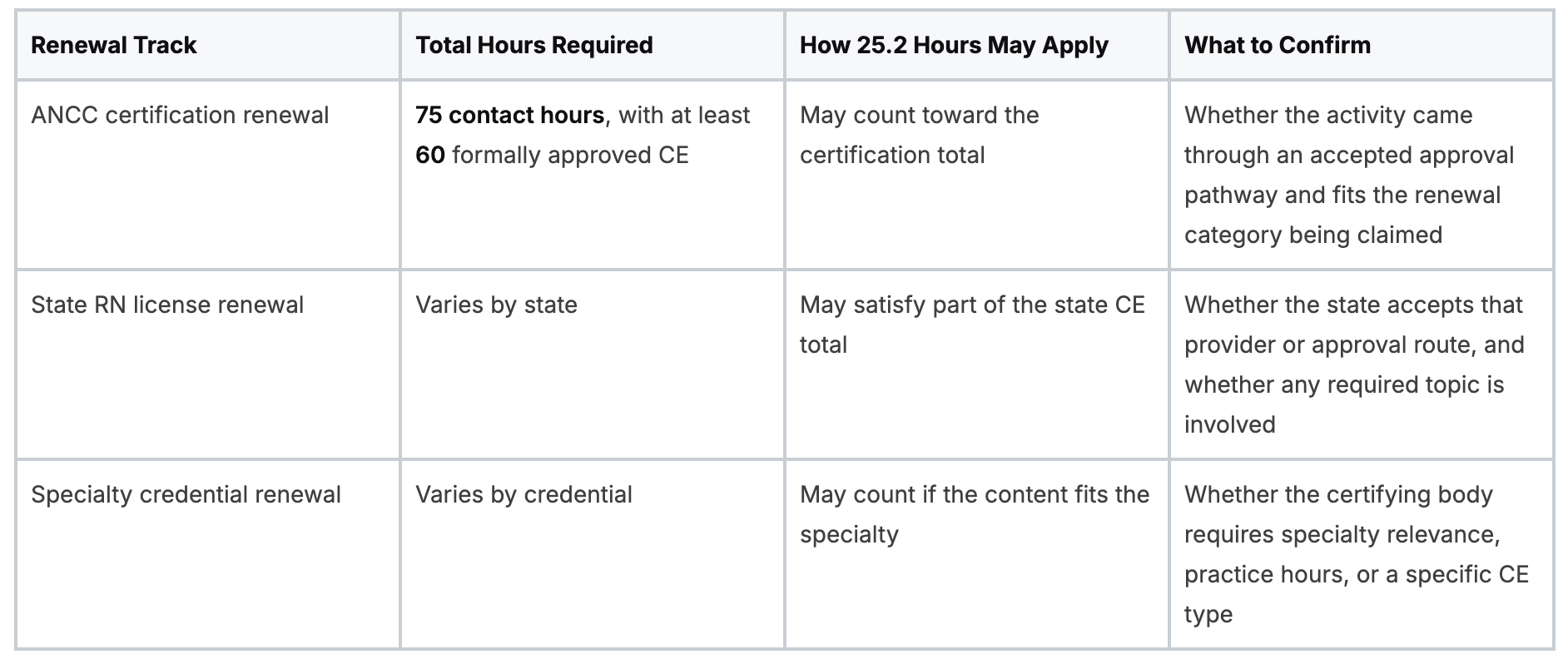
For ANCC certification renewal, nurses need 75 continuing education contact hours, and at least 60 of those hours must be formally approved continuing education. The arithmetic is usually easy enough. Six modules worth 4.2 contact hours each add up to 25.2 contact hours.
Where nurses get tripped up is the filing question. Those 25.2 hours do not automatically land in every bucket that matters. A course can be valid for certification renewal and still miss a state license rule. It can also be accepted as general CE but fail a topic-specific mandate such as pharmacology, ethics, or state-required jurisprudence.
A good way to picture it is this: contact hours work like currency, but each board and certifier decides which bills it accepts and how they must be labeled. The number matters. The acceptance rule matters more.
Why accredited does not always mean accepted
This is the gap that causes the most confusion in 2026. Nurses hear that a course is accredited and assume the problem is solved. Managers do the same when buying seats for a team.
Accreditation answers one question. It shows the activity came through a recognized educational approval process. State acceptance answers a different question. It asks whether your board will accept that approval pathway for your specific license and renewal requirement.
Those are not the same decision.
A Texas RN, for example, may complete a course with valid nursing contact hours. The certificate looks complete. The remaining question is whether Texas accepts that provider pathway for the requirement being claimed, and whether the course meets any subject rule attached to that renewal cycle.
A CCRN-certified nurse faces a different filter. A strong emergency or critical care course may be professionally relevant, but certification renewal may sort those hours differently than a state board does.
A Washington State ARNP might take a pharmacology course that fits daily practice perfectly. The course still has to be checked against the actual license requirement, the certification requirement, or both. Relevance alone does not settle that.
The certificate is only half the record
For renewal and audit protection, nurses and managers should read the certificate the way an auditor would read it. The useful fields are concrete:
- Accreditation or approval statement
- Provider name
- Provider number, if the board expects one
- Course title
- Date completed
- Number of contact hours awarded
- Any subject designation tied to a mandate, such as pharmacology
If one of those fields is missing, the problem usually shows up later, not at checkout.
This matters even more for group purchases. A hospital educator or clinic manager may buy one course for twenty nurses, then learn that the completion record lacks the subject label a board wants to see. The training happened. The proof does not line up cleanly with the rule. That creates manual follow-up, individual explanation emails, and avoidable audit risk.
The safest question is not “How many hours is this?” It is “Which requirement does this satisfy, and what document proves it?”
Choosing the Right Course for Your State and Goals
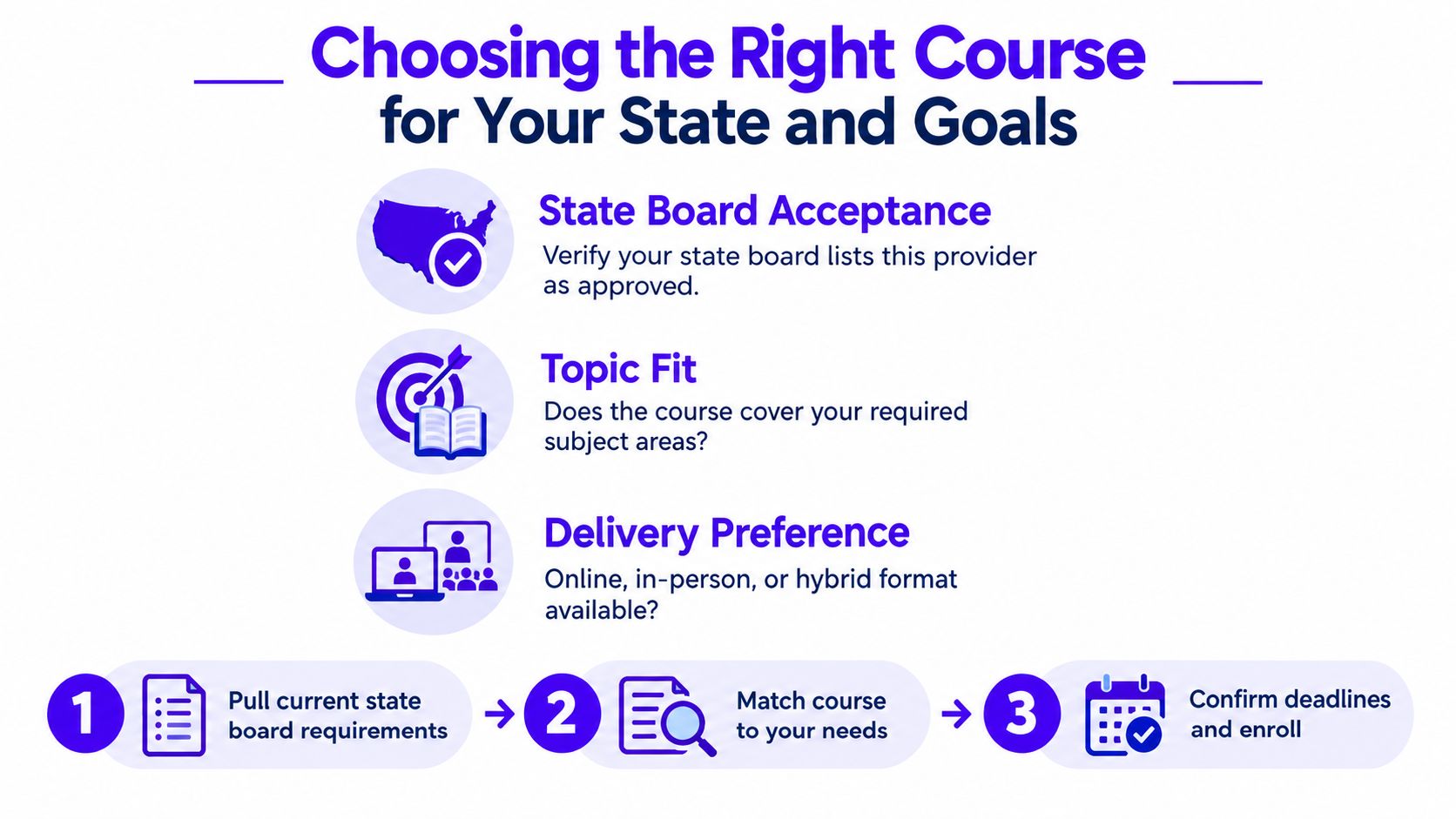
The safest way to pick accredited nursing courses is to run every option through three filters: state board acceptance, topic fit, and delivery preference. That sounds basic, but it prevents most last-minute surprises.
Filter one checks acceptance
Start with the state board's current renewal page, not an old checklist saved from the last cycle. The nurse or manager should look for the board's description of acceptable providers, approved pathways, and topic-specific mandates.
Then match that board rule to the course certificate details:
- Accreditation statement: It should clearly say who approved the activity or provider.
- Provider number: If the board expects one, it needs to be visible and traceable.
- Course category: A course may be valid CE generally but still miss a required subject area.
Filter two matches the topic to the actual gap
A nurse practitioner with prescribing authority should think differently than a staff RN completing a broad renewal cycle. Topic fit is not just about interest. It's about the rule and the role.
Examples make this concrete:
- Florida RN: A nurse who needs a specific subject update should verify that the course addresses that mandated area and comes from an accepted provider pathway.
- California RN: A nurse choosing implicit-bias training should check whether the board or employer expects a particular format or approval route, rather than assuming all diversity-related education is interchangeable.
- Ohio NP: A nurse balancing pediatric pharmacology with pain-management content should decide which requirement each course is meant to satisfy before enrolling.
Documentation check: The best time to verify a course is before enrollment, not after completion.
Filter three considers format and recordkeeping
Format affects more than convenience.
A self-paced module often makes it easier to pause and return around shift work. A live webinar may work well for a team event but can create attendance-tracking issues if staff arrive late or leave early. An in-person conference may offer dense learning, but the nurse still needs a clean certificate and clear provider details afterward.
A few practical selection habits help:
- Pull the rule first: The board's current wording should drive the choice.
- Match one course to one need: Don't rely on vague hopes that a course might count in several categories.
- Save the certificate immediately: Store it in a folder named by renewal cycle and state.
By 2026, the operational side matters more because documentation demands are getting tighter. Recent guidance notes that ANCC-style activity files now require needs assessments, gap analyses, disclosures, and evaluation records, while Texas is moving toward pre-renewal CE upload requirements through a digital tracking workflow starting September 1, 2026, according to HealthStream's practical guide to 2026 ANCC NCPD criteria.
How Group Solutions Simplify Nursing Compliance
Dana inherited a spreadsheet nobody trusted. It had nurse names, renewal dates, half-finished notes in the margin, and scattered reminders about missing certificates. Some staff stored completion records in email folders. Others uploaded PDFs to different shared drives. A few only kept paper copies in desk drawers.
That setup didn't fail because the team was careless. It failed because manual tracking breaks down once compliance depends on multiple roles, multiple renewal dates, and different course requirements.

What a centralized workflow changes
Dana moved the hospital's process into a group portal. Nurse educators could assign courses by role. Managers could see completion status by unit. Staff could retrieve certificates from one dashboard instead of searching old inboxes.
That changes the daily work in practical ways:
- Role-based assignment: ICU nurses can receive one set of required modules while outpatient staff receive another.
- Reminder timing: The system can prompt staff before deadlines instead of after they miss them.
- Certificate retrieval: A compliance manager can pull records during an audit without emailing every nurse individually.
One example of this kind of setup is a group training portal for organizations that allows organizations to create teams, enroll learners, assign courses, and monitor completion status.
What managers should demand from the system
Not every portal solves the compliance problem. Managers need tools that support verification, not just enrollment.
A stronger checklist includes:
- Single sign-on support: This reduces account confusion and duplicate logins.
- State-specific tagging: Courses should be identifiable by the rule they are meant to support.
- Audit-ready certificate storage: Records should stay organized and retrievable across renewal cycles.
- Exportable reports: Surveyors, credentialing teams, and internal auditors often want unit-level completion rosters.
Later in the rollout, Dana also used short training videos to standardize staff expectations around CE documentation and completion behavior.
Why this matters more in 2026
The operational burden is growing. ANCC's application process already requires organizations to demonstrate compliance with Structural Capacity, Educational Design, and Quality Outcomes criteria for 6 months before applying, to plan, implement, and evaluate at least 3 professional development activities, and to pay the application invoice within 30 calendar days after submission, according to the ANCC application process page.
That level of documentation discipline affects frontline employers too. If accreditors and boards expect strong records from providers, employers need equally strong records from staff.
A Practical 2026 Action Plan for Nurses and Managers
The safest 2026 strategy is simple: treat continuing education as a compliance workflow, not a year-end errand. Nurses need approved learning. Managers need verifiable records. Both need a system that survives a review.
For individual nurses
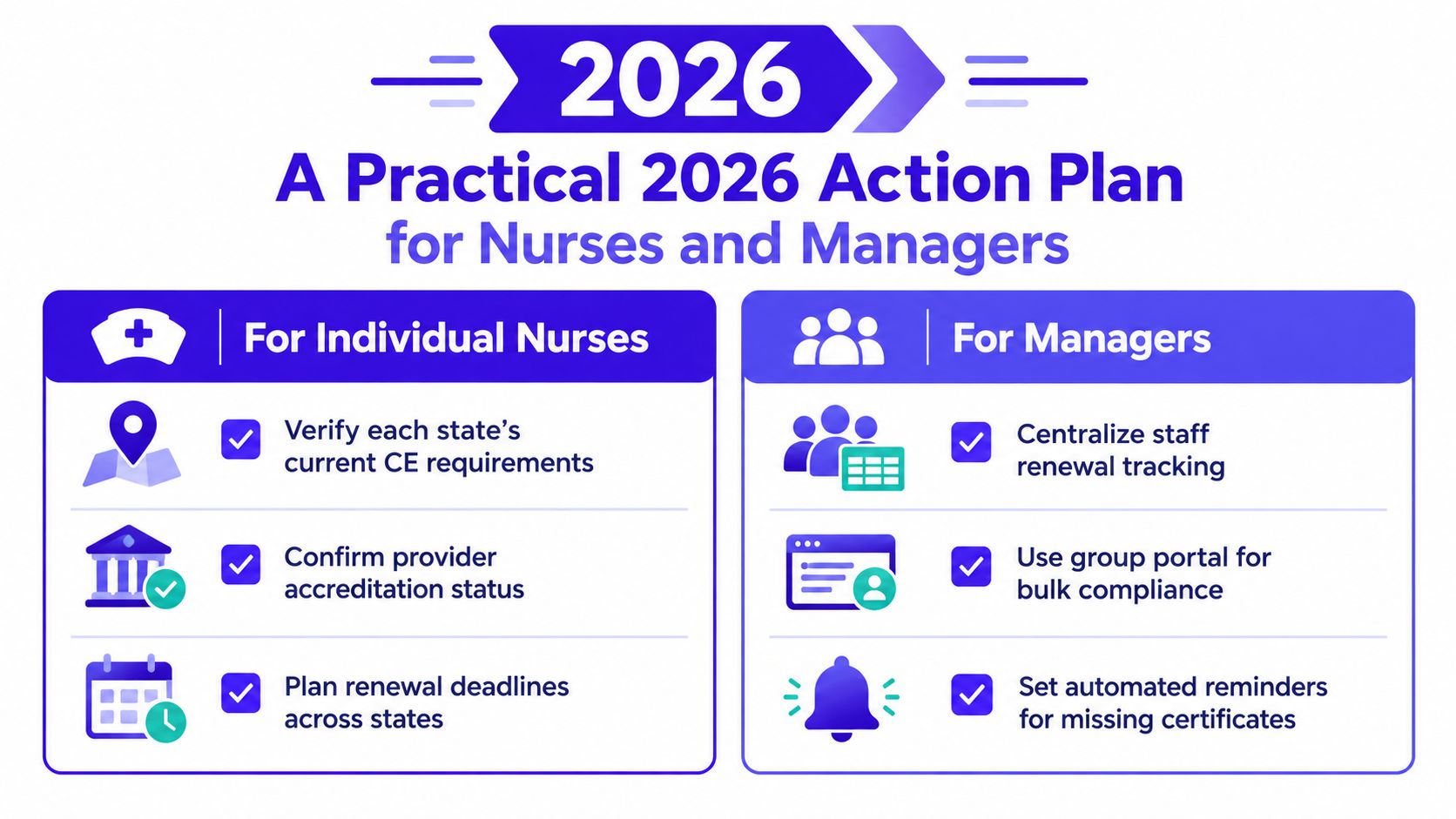
A nurse's action list should stay concrete:
- Check the board rule early: Verify the current state requirement before the renewal year gets crowded.
- Confirm provider status before enrollment: If the certificate needs an approval statement or provider number, that should be visible up front.
- Separate license needs from certification needs: The same course may help both, but it shouldn't be assumed.
- Save digital proof right away: Certificates, transcripts, and completion emails should go into one renewal folder.
A practical example is OSHA bloodborne pathogens training. Employers must train each employee with occupational exposure at initial assignment and at least annually thereafter, with retraining within one year of the previous training, at no cost, during working hours, and with additional training when tasks or procedures change exposure risk, under 29 CFR 1910.1030. For a clinic nurse, that means the course timing and proof of completion matter just as much as the content.
For managers and educators
Managers need a repeatable quarterly rhythm instead of a renewal-season scramble.
- Audit assigned courses: Check whether the current catalog aligns with ANCC pathways and the state rules the staff work under.
- Review documentation habits: Staff should know where certificates live and how to retrieve them.
- Prepare for digital reporting: Systems should be ready for tighter upload and tracking expectations.
- Train coordinators on role-specific obligations: In education settings, compliance can extend beyond nursing CE. For example, New York's Dignity for All Students Act requires every school district, charter school, and BOCES to designate at least one DASA coordinator, and those coordinators must receive training related to harassment, bullying, and discrimination, as noted in this New York DASA-related training reference.
Good renewal prep looks quiet. The nurse knows which hours count, the manager knows where the records are, and no one is rebuilding the file under deadline.
Accredited nursing courses matter, but in 2026 the winning habit is verification. The course, the provider, the certificate, and the state rule all need to connect cleanly.
Premiere Education offers accredited CE courses, state-mapped training options, and group tools for assigning, tracking, and documenting completion across teams. For nurses and managers trying to reduce renewal confusion and keep cleaner records, it's one practical place to compare course options and compliance workflows. Visit Premiere Education to review available courses, accreditations, and group training tools.
Latest Posts





25% off Sitewide→
Use Code: PCECYBERSALE2025→